
Research article · 2018 · Full text
International Journal of Statistics and Applied MathematicsProposed models for empty container management
Volume 3(2) · Pages 635–640
Research areasMaritime Ports and LogisticsAdvanced Manufacturing and Logistics OptimizationOptimization and Mathematical Programming
Abstract
Author-writtenA large number of mathematical models have been proposed in management of containers with emphasis on empty containers and their repositioning. The paper discusses the existing methods and their limitations and proposes two methods viz. Transshipment method and Dynamic Programming (DP) method. The former assumes that costs of movement of containers from any node to other nodes are known or estimated and tries to minimize total transportation cost. The latter one consists of a collection of equations that describe a sequential decision process. An optimal solution of DP has the property that whatever initial state and decisions are, the remaining decisions must constitute an optimal policy with regard to the state resulting from the first decision. Both the proposed methods appear to be simple and are likely to improve decision-makings at the level of local operators.
Summary
Source-checkedPlain-language reading of the full paper, prepared with AI and checked against the text. Each point links to the authors' own words.
Why it matters
- Container imbalance occurs when some ports have a surplus of empty containers while others face a deficit. View evidence ↗
- Significant trade imbalances exist globally; for instance, in 2007, Asia sent 15.4 million TEUs to the USA, but received only 4.9 million TEUs in return. View evidence ↗
- Managing these deficits is critical because shipping companies must pay to lease containers, and these costs increase as delays in repositioning grow. View evidence ↗
The question
- The paper aims to review existing mathematical models for minimizing the cost and time of repositioning empty containers and to propose simpler methods for local operators. View evidence ↗
What they did
- The author evaluates existing container management methods and proposes two alternatives: a Transshipment method and a Dynamic Programming (DP) method. View evidence ↗
- The proposed Transshipment model treats container management as a multi-commodity problem where costs for moving containers between any two nodes are known or estimated. View evidence ↗
- The proposed Dynamic Programming approach treats repositioning as a multistate optimization problem under uncertainty, using a sequential decision process. View evidence ↗
What they found
- Literature indicates that the annual cost of repositioning empty containers is estimated between $15 billion and $20 billion, accounting for 5% to 8% of a typical carrier's operating costs. View evidence ↗
- Existing Container in Port (CTP) models can be unmanageable; one example showed that a weekly throughput of 300 containers could result in 82 million variables and 172 million constraints. View evidence ↗
- The Container Positioning Problem (CPP) model reduces complexity compared to CTP, but still requires 432 thousand variables and 1.65 million constraints for a small sample of 100 containers in one block. View evidence ↗
- The CPPT model reduces variables to approximately 350 thousand for 300 containers but increases constraints to around 1.5 billion, remaining difficult to solve. View evidence ↗
- Research using Linear Programming (LPP) found that total repositioning costs were minimized when total supply was less than total demand, though this required leasing the difference. View evidence ↗
What it means
- The author concludes that the proposed multi-commodity Transshipment model is a simple approach likely to improve decision-making. View evidence ↗
- The author recommends the Dynamic Programming approach specifically for managing the inland movement of empty containers. View evidence ↗
- The author states that further research is required to apply these models to systems involving multiple ports and multiple voyages. View evidence ↗
Visual summary
1 visualsIllustrations explain the paper; they do not show study data.
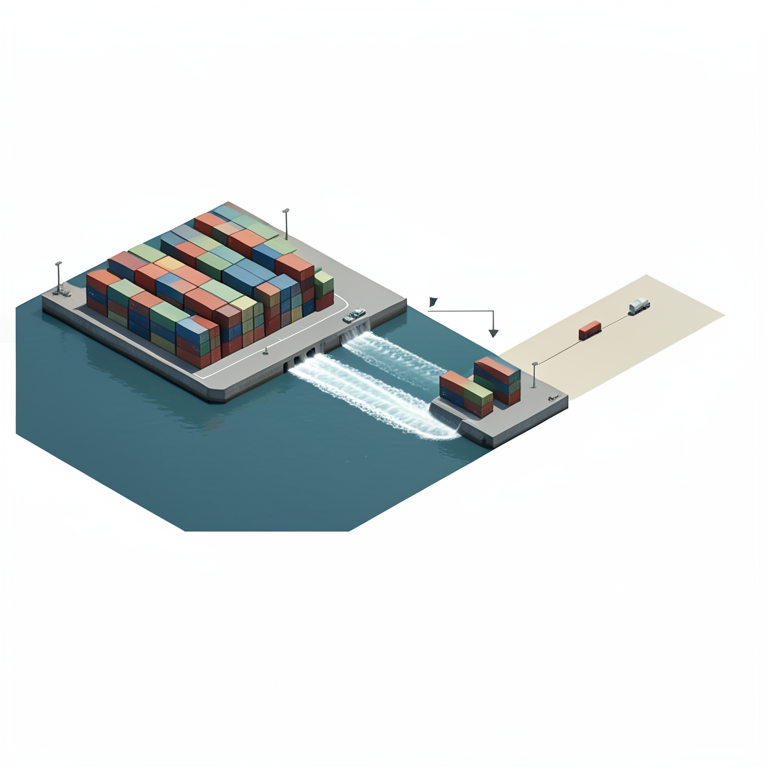
Conceptual Flow of Container Imbalance
AI-generated conceptual illustration (Intermodal shipping containers and cargo ports). It explains the idea and does not show study data.
View source evidence ↗Introduction
Consider a region A with high export traffic requiring a large number of containers (say M) to load cargo and another region B which receives those M containers as imports and may offers much less traffic for export (say m number of containers for export cargo). Thus, the region B needs to send back at least (M-m) number of empty containers to the region A to meet the demand at region A. Delay in receipt of empty containers at region A aggravates the problem of imbalance of containers and also lose of opportunities for export markets. The major feature of imbalance of containers is that there are some ports with surplus of empty containers and other ports with deficit. For example, in 2007, annual flow of container from Asia to USA was 15.4 million TEUs and the same from USA to Asia was 4.9 million TEUs. (Source: http:/ /people.hofstra.edu/geotrans/eng/ch3en/conc3en/worldcontainerflows.html). Similar situation prevails between Asia and Europe and in fact for the entire global container trade. The magnitude of imbalance is increasing with time and increase in global container traffic. Container imbalances take place between countries and also between ports. In addition to trade imbalance, there are other factors which cause repositioning of empty containers like repositioning costs, intermodal integration, manufacturing and leasing costs, usage preferences slow steaming, etc. Shipping companies need to purchase or hire empty containers from leasing companies for the ports with deficits, involving cost. The cost is positively related with delay in sending of the empty containers. The delay also reflects lose of opportunities for export markets. Recovery of the cost may be associated with surcharges, which in turn results into higher shipping cost and higher cost of cargo and thus affect the end consumers. Decisions to number of containers to be repositioned or stored or kept on vessels are associated with several uncertain factors and thus depends significantly on forecasts of inflow and out flow of containers, requirement of containers to be assigned or unassigned to scheduled vessels. Objective is to satisfy demand of Customers for empty containers which is again associated with a degree of uncertainty. Thus, the problem of managing the container imbalance of flow of empty containers involving multiple ports to satisfy the demand with minimum time and cost is important. Hence, managing empty containers effectively and efficiently is a global problem and has emerged as a major issue in supply chain management.
As per estimates of World Shipping Council, global container fleet and global container trade in 2014 was respectively 37.635 million TEUs and 127.60 million TEUs. Boile, et al. (2005) [3] found that movement of empty container constituted around 20% of the ocean container movements in 2003, at a cost exceeding $11 billion. Sanders, et al. (2015) estimates annual cost of repositioning empty containers in the level of $15 billion to $20 billion and the same for a typical carrier, represents 5% to 8% of total operating costs.
Objectives
The objectives of this paper are to review of mathematical models aiming at minimization of total cost or total time of empty containers repositioning under different scenarios and to suggest rather simpler methods, likely to improve decision-makings at the level of local operators
Mathematical formulations
Major aim of Container Management is to minimize total transportation time/cost and to facilitate trade. This involves large number of parameters and variables pertaining to supply and demand of empty containers, movement of number of empty containers and types from an importer/exporter to another importer/exporter/port, time and cost of such movements, nodes in the network, positions in the yard and vehicles, storage blocks and capacities, specification of objective function and large number of constraints like arrival and departure constraints, flow constraints, System discipline like LIFO constraints, capacity restrictions, etc. at a particular time point or a small interval of time under each scenario along with residual capacity for empty containers carried by vessels traveling among ports and related scenario. Thus, there exist a number of sources of uncertainty. These imply significant challenges and make the Container Positioning Problem (CPP) a highly complex problem. A number of approaches were used for management of containers with emphasis on empty containers and their repositioning, based on the Operations Research technique, Graph theory and Network analysis, etc. to facilitate flexible and reliable decision making to achieve the objective of meeting the demand at minimum time and cost. Implications from theory and empirical findings show that a crucial point in optimizing empty container logistics is the different and partially conflicting perspectives of relevant stakeholders. This can be a barrier for implementing measures aiming at improvement in empty container logistics. A literature review provides further insights on the main actors of empty container management. Several deterministic models were proposed (e.g. Choong, Cole and Kutanoglu, [2002]) [5] . Stochastic optimization models avoiding low quality solutions were presented as well (e.g. Cheung and Chen, [1998]) [4] . Survey conducted by Funke and Kopfer (2006) [8] through a questionnaire to record the experiences and knowledge of the main players regarding measures to mitigate negative impacts of empty flows concluded that instead of a single measure, a set of measures is effective to study management of empty containers. It is suggested that similar approach may be adopted separately for specific player since perspectives varies among the players. The set of measures, both for terminal operators and transport operators may be classified under Managerial, Pricing, Information and communication technology and other technological measures. The measures can be ranked according to their implied success based on the evaluations of the survey respondents. White and Bomberawlt (1969) [21] considered distribution to the empty vehicles through transportation planning. Using stochastic, dynamic, and systemic research on empty containers of land-carriage, Crainic and Pierre (1992) [6] ; Kikuchi (1985) [10] ; Beaujon and Turnguist (1991) [2] solved a number of depot problems successfully by linear programming, but failed to solve problems related to time management. Li and Han (2009) [13] used stochastic programming model with simulation and found that change in routes and change in expectations of decisionmakers gives different results. Shi (2003) [16] combined reposition with the strategy of renting for empty container reposition systems and developed an optimization model for repositioning by simulation. Zhang, Xie and Huang (2003) [24] studied the empty train car reposition and built the fuzzy transportation planning model with time windows based on customers' prejudice. Based on integer programming approach, Wang and Wang (2007) [20] approached the problem using integer programming technique. Al-Rikabi, Adetunji and Yadavalli (2014) [1] used LPP to minimize total container repositioning cost which is sum of transportation cost, inventory-holding cost, container leasing/procurement cost, considering only one type of empty containers and one type of transportation modes and assuming that seaports can be both shippers and customers. Results show that total cost of repositioning was minimum when total supply < total demand. However, in this situation one must lease X number of TEUs where X=total demand-total supply requiring additional leasing and coupling conditions in the leasing company Song and Carter (2009) described LPP methods for four strategies and found that for reducing cost of empty container repositioning, route coordination works better than container-sharing. However, route co-ordination with container sharing and ignoring individual company's identity does not work in reality. Similarly, route-coordination without container-sharing may not be implementable primarily because of complexity of shipping network for large shipping lines and shipping network. The problem of management of containers can be viewed from several angles. Illustrative views along with relevant mathematical details are:
Container in port (CTP) model
Suppose that there are S number of Ship nodes S= 1. 2. 3. ……S ; Position nodes P = 1,2,3, ……P and Vehicle nodes V = 1, 2, 3, ……V.. The set I = S ∪ P ∪ V represents all nodes in the network, as ships, positions in the yard and vehicles Thus, the problem could be approached through Graph Theory and Combinatorial mathematics. The objective function could be to minimize total transportation time along with cost of container positioning and reshuffling i.e. to minimize Z = ∑ 𝑇 𝑖𝑗 𝑋 𝑐𝑖𝑗 𝑐∈𝐶,𝑖∈𝑆∪𝑃,𝑗∈𝑃∪𝑉
where 𝑇 𝑖𝑗 for i ∈ 𝑆 ∪ 𝑃 𝑎𝑛𝑑 𝑗 ∈ 𝑃 ∪ 𝑉 denotes transportation time between the 𝑖 -𝑡ℎ node and 𝑗 -𝑡ℎ node ∀ 𝑖 ≠ 𝑗 and 𝑋 𝑐𝑖𝑗 = 1 if container c is moved directly from node i to j = 0 otherwise Subject to i) Arrival and departure constraints ii) Flow constraints and iii) LIFO constraints However, the model involves extremely large number of constraints and variables which increase with increase in throughput and planning horizon. For example, Sibbesen (2008) [17] found that with a weekly throughput of 300 containers arriving from 5 ships, 10 storage blocks with 20 positions each, and 250 vehicles resulted in approximately 82 million variables, (99.8% of them binary and 66% of them concerning the LIFO restrictions) and about 172 million constraints (of which 144 million correspond to the LIFO restrictions). Clearly, this is not manageable.
Container positioning problem (CPP) model
CPP model determines optimal positions of containers in one block and the total transportation time between positions. The mode considers movements of containers from arrival at the block till they depart from the block omitting the quayside transportation. It assumes that the port has a pre-determined strategy for positioning containers in certain blocks and containers are not moved between blocks. The model seeks to optimize the objective function with three constraints viz. (i) Arrival/departure (ii) Flow and (iii) LIFO Magnitude of variables and constraints of CPP is more or less similar to that of CTP. But the scope of the CPP problem is much smaller since each storage block is treated separately. A weekly throughput of 300 containers, 100 of them being assigned to a storage block with 20 positions, and 1-4 reshuffles per container, makes 432 thousand variables and approximately 1.65 million constraints. Thus, each CTP and CPP models is large and may not offer manageable solutions for real life problems. Moreover, CPP model does not consider capacity restrictions and thus allows several containers to be moved simultaneously and contradicts the reality as block cranes can carry one or at most two containers at a time.
CPPT model
To reduce number of variables and constraints, time dimension is discretized into time slots, enabling formulation of most of the restrictions in a very condensed way in CPPT model. Eliminating the big M method, the model, minimizes the total number of positioning plus the total transportation time in one storage block subject to four constraints viz. Arrival and departure constraints, Flow constraints, LIFO constraints and Capacity constraints. Number of variables gets reduced In CPPT model in comparison to CTP and the CPP model but number of constraints tends to get increased. For example, CPPT model involving 300 containers, 100 of them assigned to one of the 10 storage blocks with 20 positions and a planning horizon of one week, discretized into 336 time slots (corresponding to a discretization level of 10 minutes through the 7 days of 8 working hours) the number of variables worked out to be approximately 350 thousand, all binary with around 1.5 billion constraints. The LIFO principle accounted for about 96 % of the constraints. Such huge number of variables and constraints make the solution still unmanageable. However, the CPPT model is closer to reality by including capacity restrictions.
Optimization of Empty containers at local level (Integer Programming approach)
Suppose there are m-importers and the i-th importer can supply 𝐼 𝑖 number of empty TEUs to an exporter. Thus, I 1 , I 2 , I 3 … I m are supplies of empty TEUs from the importers. Similarly, assume there are n-exporter and 𝐷 𝑖 is the demand of empty TEUs for the ith exporter. Thus, D 1 , D 2 , D 3 ….D n are the demands of empty TEUs of the exporters at a local level. Clearly, ∑ 𝐼 𝑖 ≠ ∑ 𝐷 𝑖 . Also assume that there is a single port in the region. Let us use the following notations: 𝑋 𝑖𝑗(1) : The number of empty containers moved from the i-th importer to the j-th exporter. 𝑋 𝑖𝑗(2) : The number of empty containers moved from the i-th importer to the j-th importer. 𝑋 𝑖𝑗(3) : The number of empty containers moved from the i-th exporter to the j-th exporter. 𝑋 𝑃𝑖 : Number of empty containers moved from the port to the i-th exporter. 𝑋 𝑖𝑃 : Number of empty containers moved from the i-th importer to the port To balance the network, it may be assumed that the port supplies or requires ∑ 𝐷 𝑖 𝑛 𝑖=1
= ∑ 𝐼 𝑖 𝑚 𝑖=1
For movement of containers by trucks, let 𝑌 𝑖𝑗(1) : Number of trucks, each carrying at least one empty container from the i-th importer to the j-th exporter and 𝐶 𝑖𝑗(1) indicates the unit cost. 𝑌 𝑖𝑗(2) : Number of trucks, each carrying at least one empty container from the i-th importer to the j-th importer and 𝐶 𝑖𝑗(2) indicates related unitary cost 𝑌 𝑖𝑗(3) : Number of trucks, each carrying at least one empty container from the i-th exporter to the j-th exporter and 𝐶 𝑖𝑗(3) indicates ''related unitary cost 𝑌 𝑃𝑖 : Number of trucks, each carrying at least one empty container from the port to the i-th exporter and 𝐶 𝑃𝑖 represents the related unitary cost. 𝑌 𝑖𝑃 : Number of trucks, each carrying at least one empty container from the i-th importer to the port and 𝐶 𝑖𝑃 represents the related unitary cost.
To ensure that a truck carries maximum two empty containers, one can introduce the following constraints: 𝑋 𝑖𝑗(1) ≤ 2𝑌 𝑖𝑗(1) 𝑋 𝑖𝑗(2) ≤ 2𝑌 𝑖𝑗(2) 𝑋 𝑖𝑗(3) ≤ 2𝑌 𝑖𝑗(3) And 𝑋 𝑖𝑃 ≤ 2𝑌 𝑖𝑃 𝑎𝑛𝑑 𝑋 𝑃𝑖 ≤ 2𝑌 𝑃𝑖 Following Francesco (2007) [7] , the objective function to be minimized is
And five constraints ensuring that a truck carries one (min) or two (max) empty containers and of course each variable ≥ 0 In addition to allocation of containers, the approach considers routing of trucks also and is mathematically sound. Instead of costs (𝐶 𝑖𝑗 ′𝑠), one may use𝑡 𝑖𝑗 's i.e. time component to minimise total time. However, limitations of the method are: Does not cover all possible routes (links) among Exporters. The Port may determine unsuitable route. does not consider preference of trucks for fastest (and not the shortest) route does not consider loaded movements and may suggests using more trucks than needed A frequently used strategy is substitutions i.e. providing customers with a container of different type than what have been requested for. Cheung and Chen (1998) [4] suggested a two-stage stochastic network using network formulation to the dynamic maritime reposition of empty containers for a single type of container, which is a limitation since shipping companies typically manage different types of containers and may exclude substitutions. Similar limitations for the reposition of empty containers were also observed for the dynamic model of deterministic nature proposed by Jiele (1999) [9] who used linear programming technique. Francesco (2007) [7] used Integer Programming technique considering flow of number of empty containers of each type moved from the j-th node to the k-th node at time-period (t + ∆ 𝑡 ) where ∆ 𝑡 denotes the transit time to reach the k-th node from the j-th node, related unitary cost, storage space available during the time interval and used a suitably defined substitution factors. Substitution strategies were found to work best to have the optimal or near optimal solutions, provided a suitably designed tolerance factor is set. However, computations become difficult especially when number of nodes, type of containers or time periods increase. The approach fails to answer the question where and when and how many empty containers should be repositioned.
Other approaches
Rockafellar and Wets (1991) [14] considered scenario analysis to deal with multi-period optimization problems under uncertainty where available information may not support a stochastic programming model and proposed "progressive hedging principle". Lai, Lan and Chan (1995) [11] used simulation model to investigate the dynamic and stochastic container management issues to prevent the shortage of empty containers. However, competition among shipping lines may make them reluctant to share data and it was difficult to manage the huge sizes of numerical problems
Service allocation
Service allocation in the context of Yard management problem has been formulated by Vacca, Bierlaire and Salani (2007) [19] for a container group consisting of a set of container of same type with a particular origin and another fixed destination and known arrival/departure times and known arrival/departure positions. Objective is to minimize housekeeping. Let N be the set of services consistent of services 1.2.3. ……n. M be the set of bays (1, 2, 3,……..m) 𝑡 𝑖𝑗 denotes the traffic intensity between service i and j ∀ 𝑖 ≠ 𝑗 𝑞 𝑖 denotes the space requirement of service i=1.2.3……n 𝑄 𝑘 denotes the space available at bay k = 1.2…….m 𝑐 𝑖 be the average number of crane moves required for service i 𝐶 𝑘 be the average number of crane moves allowed at bay k M (i) be the set of feasible bay assignments for service i 𝑑 ℎ𝑘 , the distance between bay h and bay k ( ℎ ≠ 𝑘) 𝑋 𝑖𝑘 = 1 if the i-th service is assigned to the k-th bay = 0 otherwise The objective function Z to be minimized is given by However, the model may not be very suitable for trans-loading or transshipment in areas other than berth
Proposed approaches
There appears to be a general tendency towards applying a more aggregated approach towards repositioning of containers. Some authors consider groups of containers or allocation of sets of positions and some determine a single position for each container rather than representing a sequence of moves or reshuffles. Accordingly, further approaches are proposed below:
Transhipment model
Movement of containers involves a finite number of nodes viz. ship, dock, CFS, Inland depot, exporters and importers. Thus, management of containers can be formulated as a Transshipment model with multi-commodities where movement of containers is possible from any node to other nodes with known ( or estimated) 𝐶 𝑖𝑗 i.e. cost of moving one container from i-th node to j-th node. Clearly 𝑋 𝑖𝑗 𝑎𝑛𝑑 𝑡 𝑖𝑗 = 0 𝑓𝑜𝑟 𝑖 = 𝑗. The commodities could be empty and loaded or 20 feet and 40 feet etc. For a single commodity, transshipment problem with (𝑚 + 𝑛) nodes can be posed as follows: Let 𝑋 𝑖𝑗 be the total number of containers required to be moved from the i-th node to the j-th node with corresponding cost𝐶 𝑖𝑗 . Assume that at m-nodes T 1 , T 2 , T 3 …,T m , the total out-shipment exceeds the total in-shipment by a 1 , a 2 , a 3 , …..,a m respectively and at the remaining nodes 𝑇 𝑚+1 , T m+2 , ……. T n , the total in-shipment exceeds the total out-shipment by amounts b m+1 , b m+2 … bm +n respectively. If the total in-shipment at nodes T 1 , T and constraints for supply and demand and non-negative constraints
Dynamic programming model
Other approach could be Dynamic Programming (DP) to deal with this problem of repositioning of empty containers which can be viewed as a multistate optimization problem under uncertainty. Here, no objective function and constraints are considered. Instead, the model breaks up a problem into a number of overlapping sub-problems and solutions are build up to larger and larger sub-problems and thus deals with a collection of equations that describe a sequential decision process. The recursion property enables to express the value of a function in terms of other values of that function. Thus, DP is not limited to one computational scheme or a standard algorithm. An optimal solution of DP has the property that irrespective of the current state and decision, the subsequent decisions constitute an optimal policy with regard to the state resulting from the current decision. From the starting state, the first moves to the second state and the process continues until the final state is reached. Such a model was proposed by Lam, Lee and Tang (2007) for two ports-two voyages problem and opined that the approach may be extended to a multiple portsmultiply voyage system which is realistic.
Summary and Conclusions
Efficiency of a model depends significantly on efficient forecasts of containers and empty containers and accurate data on movements of containers from one node to other. Forecasts of containers with breakup of loaded and empty containers at ports level may be consolidated for the country level and/or for different routes. Sound method of forecasting is associated with estimate of residual variance to depict goodness of the formula. Forecasting of container may also consider among others box inventory to vessel capacity ratio, proportion of loaded TEUs per voyage and other relevant factors like envisaged trade imbalance, repositioning cost, manufacturing and leasing costs of containers, regulatory measures, economic growth/recession, efficiency of management of terminals, etc. Models involving Linear Programming, Integer programming etc. with about a million variables and constraints do not appear to give manageable solutions. The proposed method in terms of Transshipment problem with multi-commodities where cost of movement of containers from any node to other nodes are known or estimated appear to be simple and are likely to improve decision-makings. Dynamic Programming approach may be used effectively for situations involving inland movement of empty containers and for routes through which such movements take place. For multiple-ports multiple-voyages system, further research is felt needed.
References
24 in the original paper- Al-Rikabi RD, Adetunji O, Yadavalli VSS. Empty Containers Repositioning in South African Seaports. Proceedings of the 2014 International Conference on Industrial Engineering and Operations Management, Bali, Indonesia, January, 2014, 7-9.
- Beaujon JG, Turnguist MA. A model for fleet sizing and vehicle allocation. Transportation Science. 1991; 25(1):19-45.
- Boile M, Theofanis S, Golias M, Mittal N. Empty Marine Container Management: Addressing Locally a Global Problem. Proceedings of the TRB 2006 Annual Meeting, 2005.
- Cheung RK, Chen CY. A Two-Stage Stochastic Network Model and Solutions Methods for the Dynamic Empty Container Allocation Problem. Transportation Science. 1998; 32(2):142-162
- Choong ST, Cole MH, Kutanoglu E. Empty container management for intermodal transportation networks. Transportation Research Part E. 2002; 38(6):423-438.
- Crainic TG, Pierre MG. Dynamic and stochastic models for the allocation of empty containers. Journal of the Operational Research Society. 1992; 10:102-126.
- Francesco MD. New Optimization Models for Empty Container. Ph.D. Thesis, Dipartment of Di Ingegneria Del Territorio, Universita Degli Studi Di Cagliari, 2007.
- Funke J, Kopfer H. A model for a multi-size inland container transportation problem. Transportation Research Part E. 2006; 89:70-85.
- Jiele Z. Empty Container Distribution Problem. UROP Report 6019, School of Computing, National University of Singapore, 1999.
- Kikuchi S. Empty freight car dispatching model under freight car pool concept. Transport Research Part B. 1985; 19(3):169195.
- Lai KK, Lam K, Chan WK. Shipping Container Logistics and Allocation. Journal of the Operational Research Society. 1995; 46:687-697.
- Lam SW, Lee LH, Tang LC. An approximate dynamic programming approach for the empty container allocation problem. Science Direct, Transportation Research Part C 15, 2007, 265-277.
- Li F, Han SH. The Marine Reposition of Empty Containers under Uncertain Demand and Supply. IEEE Xplore, 2009. DOI: 10.1109/ICSSSM.2009.5174931
- Rockafellar RT, Wets RJB. Scenarios and Policy Aggregation in Optimization under Uncertainty. Mathematics of Operations Research. 1991; 16:119-147.
- Sanders U, Riedt J, Kloppsteek L, Roeloffs C, Schlingmeier J. Think outside Your Boxes: Solving the Global ContainerRepositioning Puzzle, 2015. (www. bcgperspectives. com)
- Shi X. The optimization of sea-bound empty container distribution. Systems Engineering. 2003; 23(4):70-75.
- Sibbesen LK. Mathematical models and heuristic solutions for container positioning problems in port terminals. Ph. D. Thesis, Department of Management Engineering, Technical University of Denmark, 2008.
- Song DP, Carter J. Empty container repositioning in liner shipping. Maritime Policy & Management. 2009; 36(4):291-307.
- Vacca I, Bierlaire M, Salani M. Optimization of Container Terminal Operations. Transport and Mobility Laboratory, ´Ecole Polytechnique Federale de Lausanne, 2007.
- Wang Bin, Wang Zhongchen. Research on the Optimization of Intermodal Empty Container Reposition of Land-carriage. Journal. Of Transportation System Engineering and Information Technology, 2007, 7(3).
- White WW, Bomberawlt AM. A network algorithm for empty freight car allocation. IBM System Journal, 1969; 15(2):147169.
- World Shipping Council. Container Supply Review, 2011. www.worldshipping.org/public-statements/2011_container_supply_review_final.pdf
- World Shipping Council. Trade Statistics, 2017. www.worldshipping.org/about-the-industry/global-trade/trade-statistics
- Zhang DZ, Xie RH, Huang XZ. Dispatch model and solution algorithm of railway empty container. China Railway Science. 2003; 24(3):125-129.