
Research article · 2018 · Full text
International Journal of Statistics and Applied MathematicsBinomial mixture based on generalized four parameter beta distribution as prior
Volume 3(4) · Pages 65–73
Research areasStatistical Distribution Estimation and ApplicationsBayesian Methods and Mixture ModelsStatistical Methods and Bayesian Inference
Abstract
Author-writtenA probability distribution can be constructed by mixing two distributions. Binomial distribution when compounded with beta distribution as prior forms a binomial mixture that is a continuous distribution. Skellam 1948, mixed a binomial distribution with its parameter being the probability of success considered as a random variable taking beta distribution. Probability distributions with binomial outcome tend to fail to fit empirical data due to over-dispersion. To address this challenge binomial mixtures are modeled to cater for the influence caused by over-dispersion. This paper focuses on binomial mixture with a four parameter generalized beta mixing distributions. In particular it focuses on application of McDonald generalized and Gerstenkon generalized mixing distributions. The binomial mixture obtained is proved to be a probability density function. Its moments are obtained using probability generating function techniques. The binomial mixture obtained can be applicable to probability distributions whose outcome are binomial in nature.
Summary
Source-checkedPlain-language reading of the full paper, prepared with AI and checked against the text. Each point links to the authors' own words.
Why it matters
- Binomial distributions often fail to accurately fit real-world empirical data because of a phenomenon called over-dispersion. View evidence ↗
- Over-dispersion occurs when members of a specific group respond more similarly to a treatment than members of different groups. View evidence ↗
- Combining a binomial distribution with a beta distribution as a prior helps in analyzing data that is binomial in nature. View evidence ↗
The question
- The study aims to develop binomial mixtures using four-parameter generalized beta distributions, specifically focusing on the McDonald and Gerstenkon versions. View evidence ↗
What they did
- The author uses both explicit and expectation methods to construct the binomial mixtures. View evidence ↗
- Probability generating function techniques are employed to obtain the moments of the resulting distributions. View evidence ↗
- The methodology includes proving that the constructed binomial mixtures are valid probability density functions (PDFs). View evidence ↗
What they found
- The author successfully proved that the Binomial-McDonald G4B mixture is a valid probability density function. View evidence ↗
- The Binomial-Gerstenkon G4B mixture was also proven to be a valid probability density function. View evidence ↗
- The expected value and variance were mathematically derived for both the Binomial-McDonald and Binomial-Gerstenkon G4B distributions. View evidence ↗
- The explicit and expectation construction methods yielded identical results for the binomial mixtures. View evidence ↗
What it means
- The use of four-parameter generalized beta distributions provides a more flexible prior, which improves the ability of the binomial mixture to fit empirical data. View evidence ↗
- The author concludes that these mixtures are suitable for modeling probability distributions with binomial outcomes. View evidence ↗
Visual summary
1 visualsIllustrations explain the paper; they do not show study data.
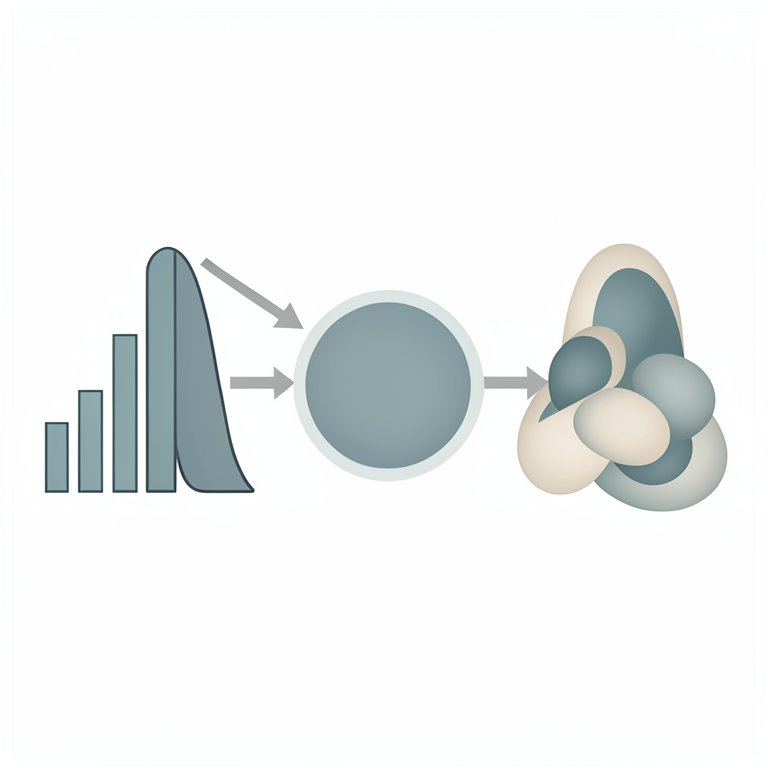
Conceptual Flow of Binomial Mixture Construction
AI-generated conceptual illustration (Mathematical probability distributions represented as geometric curves). It explains the idea and does not show study data.
View source evidence ↗Introduction
Mixing two distributions to produce another distribution is one way of constructing probability distributions. Suppose Y ~𝐵(𝑎, 𝑏) and 𝑋 is another random variable such that its distribution conditional on Y is a binomial distribution with parameters 𝑛 and p then we are dealing with one continuous random variable Y and one discrete random variable X . To find their joint probability distribution we proceed as if it were a probability density function. Suppose X has a binomial distribution conditional on Y then its conditional probability mass
And also given that Y has a beta distribution, then its density function is
From the above equation the joint probability density function can be factorized as
which is independent of parameter p . Skellam [7] mixed a binomial distribution with its parameters being the probability of success taking a beta distribution. The mixture is called beta-binomial distribution. In probability distributions many outcome data in real life situations tend to be in the form of binomial distribution. However the binomial distribution sometimes fail to fit these empirical binomial data outcome due to over-dispersion. This effect is caused by the tendency of a group responding in a more similar way to some treatment than members of other group. This creates a challenge of parameter estimation hence the need to cater for the unmodeled influences that affect all the components of the binomial outcome in a given binomial trials. A combination of binomial and beta distribution with the latter considered as prior, makes it easy to analyze data whose distribution is binomial in nature. This paper focusses on binomial mixture with four parameter generalized beta I distribution considered as the mixing distribution. Specifically it focusses on McDonald [5] and Gerstenkon [4] distributions as mixing distributions. Both explicit and expectation methods of construction will be applied. The resulting binomial mixtures will be proved to be a probability density functions and their moments obtained. The mixture obtained is important as it can be used in the analysis of real data which cannot be satisfactorily analyzed using binomial or negative binomial models which are the common models considered in health area.
Method
2.1 Formulation of the mathematical problem.
McDonald's Generalized four parameter beta (G4B) mixing distribution
Generalized four parameter beta distribution of first kind was introduced by McDonald [5] . It can be obtained from the classical beta distribution by using the transformation
where x is a random variable of classical beta distribution with parameters a and b .
Let
Let
,
,
Gerstenkon four parameter generalized beta (G4B) mixing distribution.
Gerstenkon [4] re-parameterized the classical beta distribution as
Construction of the Binomial Mixture 2.3 Binomial-McDonald G4B distribution
The Binomial-McDonald G4B distribution can be constructed using direct integration as
By the method of moments, we have
Not that equation [7] and [8] are the same, hence no proof of identity.
Binomial-Gerstenkon G4B distribution.
The Binomial-Gerstenkon G4B distribution is obtained by direct method as
By the method of moments, we have
Both methods give the same results, hence identity not proved.
Results
Results
Binomial-McDonald G4B distribution
One of the properties of a distribution of a random variable is that
Indicating that the mixture is a pdf.
The expected value of binomial-McDonald G4B distribution can be obtained by using r th factorial moment which is
Therefore the mean becomes
Discussion
From beta-Binomial distribution obtained above, it is noted that binomial distribution has the parameter n and p in which p is treated as a random variable. From generalized beta distributions four parameters are obtained making the prior distribution be much more flexible and improves the capacity of the binomial mixture to fit the empirical data more effectively. The mixture has been proved to be a pdf. Its properties such as expected value and variance have been obtained for both binomial-McDonald and Binomial-Gerstenkon G4B distributions. The two methods of constructions that is explicit and expectation forms have resulted into the same outcome of binomial mixture.
Conclusion
The mixed distribution can be obtained from binomial and generalized four parameter beta distributions of the first kind. Both distributions of the first kind. Both McDonald and Gerstenkon G4B distributions have been applied to form the mixed distributions accordingly. The mixture obtained can be used to model probability distributions whose data outcome are binomial.