
Research article · 2020 · Full text
International Journal of Statistics and Applied MathematicsComparing clustering algorithms performance using multiple-objective functions
Volume 5(4) · Pages 246–248
Research areasAdvanced Clustering Algorithms ResearchText and Document Classification Technologies
Abstract
Author-writtenClustering is the bunching of the data into groups of identical objects. Here each bunch is known as a cluster, each object is identical to its objects of the same cluster and different from other clusters. In this paper, we are doing an experimental study for comparing clustering algorithms using multiple-objective functions. We have investigated K-means a Partitioning-based clustering, Hierarchical clustering, Spectral clustering, Gaussian Mixture Model Clustering, and Clustering using Hidden Markov Model. The performance of these methods was compared using multiple objective functions. Multiple objectives have two core objectives: Cluster Homogeneity and separation. These multiple objective functions will be a great help to discover robust clusters in a more efficient way.
Summary
Source-checkedPlain-language reading of the full paper, prepared with AI and checked against the text. Each point links to the authors' own words.
Why it matters
- Data clustering is a critical unsupervised machine learning technique used for tasks such as target detection, summarization, and segmentation. View evidence ↗
- Despite its utility, evaluating different clusters remains a difficult task in data clustering. View evidence ↗
- The authors argue that a single objective function is insufficient for assessing clustering performance, necessitating the use of multiple objective functions. View evidence ↗
The question
- The study aims to experimentally compare the performance of various clustering algorithms using multiple-objective functions. View evidence ↗
What they did
- The researchers evaluated five specific algorithms: K-means, Hierarchical, Spectral, Gaussian Mixture Model (GMM), and Hidden Markov Model (HMM) clustering. View evidence ↗
- The experiments were conducted using seven datasets: four real-life datasets (Breast cancer, Liver patient, Pima Indian diabetes, and Iris) and three synthetic datasets. View evidence ↗
- The minimization objective function utilized the Davies-Bouldin Index (DBI) for homogeneity and the Rand Index (RI) and Jaccard Index (JI) for separation. View evidence ↗
- The maximization objective function employed the Silhouette Coefficient (SC) for homogeneity and V-Measure and Mutual Information (MI) for separation. View evidence ↗
What they found
- Under the minimization objective function, spectral clustering performed best across five datasets: Breast Cancer, Diabetes, Live patient, Synthetic-2, and Synthetic-3. View evidence ↗
- Under the minimization objective function, hierarchical clustering performed best on the Iris and Synthetic-1 datasets. View evidence ↗
- Under the maximization objective function, spectral clustering performed best on three datasets: Diabetes, Live patient, and Synthetic-2. View evidence ↗
- Under the maximization objective function, hierarchical clustering performed best on four datasets: Breast cancer, Synthetic-1, Synthetic-2, and Synthetic-3. View evidence ↗
- Most algorithms yielded similar scores for Synthetic-1 and Synthetic-2 datasets because these datasets contain well-separated spherical clusters. View evidence ↗
- The Synthetic-3 dataset showed lower scores compared to the other synthetic datasets due to its moon-shaped clusters. View evidence ↗
What it means
- The authors conclude that spectral and hierarchical clustering outperform the other tested algorithms and that multi-objective functions help in obtaining robust clusters. View evidence ↗
- The authors state that future work will focus on improving the objective functions and developing new clustering algorithms based on these multiple objectives. View evidence ↗
Visual summary
1 visualsIllustrations explain the paper; they do not show study data.
Multi-Objective Evaluation Framework
AI-generated conceptual illustration (Abstract data point clusters in a 3D coordinate space). It explains the idea and does not show study data.
View source evidence ↗Figures & tables
From the original paper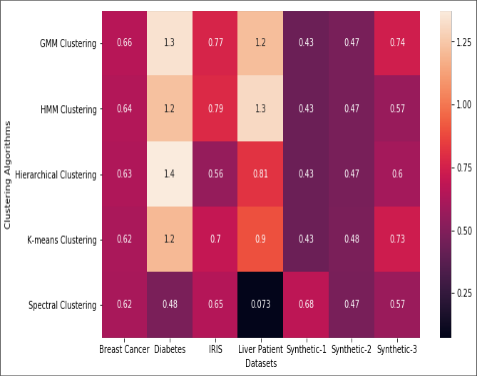 Figure 1
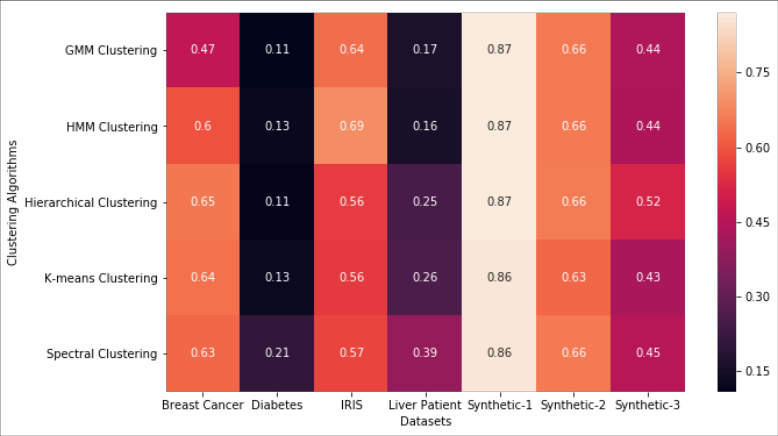 Figure 2
Introduction
Clustering is the task of grouping similar objects into the same category when separating objects, which are not similar. Clustering has been widely used since 40 years ago for solving various data mining problems. Data clustering that is known as an unsupervised classification technique is a very important field in machine learning that has applications in segmentation, summarization, and target detection (Jain and Dubes 1998) [6] . There are many different approaches introduced for clusterings such as Partitioning, Hierarchical, Density-Based, Probabilistic Model-Based, High-Dimensional, and Hidden Markov Model-Based Clustering. But still, there are some difficulties in cluster data based on evaluating different clusters and many studies are conducted and discussed the matter of cluster evaluation. In this paper, we have used homogeneity and separation measures used for Multi-objective function creation. These multiple objective functions can be applied to the clustered data to evaluate the performance of the clustering algorithm. The paper is organized as follows, clustering algorithms discussed in section II, multiple objective functions in section III, Experimental results and discussion in section IV. Finally, the paper is concluded and future work in section V.
Clustering Algorithms
Based on the definition, clustering is a data mining technique that helps to organize objects to different categories that are called clusters. Clustering algorithms work in such a way that all objects belong to a cluster are very similar and they are from the same type and those in other clusters are from different types (Aggarwal and Reddy. 2013) [1] . Let's discuss the clustering algorithm that we experimented in this paper: K-means Clustering K-means is a partitioning based method. Partitioning-based methods divide data into multiple cluster partitions and then iteratively each data point is assigned to a cluster that has the closest distance to the centroid. In K-means, dataset, and the number of clusters K is given input to the algorithm. Here, data is divided into K partitions and data points assigned to the centroid of the closest partition.
K-means initiated with random cluster centers and iteratively changes the centers until there is no change in the cluster objects. K-means is sensitive to initial random cluster centroids and outliers. It generates spherically shaped clusters (Li and Wu 2012) [7] .
Hierarchical Clustering
Hierarchical clustering usually is represented by a dendrogram that uses the similarity between two data points or two splits to create a tree-like cluster. Hierarchical clustering merges or splits the groups and builds a tree-like structure. This tree structure represents how groups are merged and split. Hierarchical clustering methods can be into agglomerative and divisive hierarchical clustering based merging or decomposition strategies such as bottom-up, top-down. In both types, a single cluster at the top and individual objects at the bottom (Han, et al. 2002) [5] .
In our experiments, we are using agglomerative hierarchical clustering; it is a bottom-up approach that merges the microclusters into macro clusters at each intersection.
Spectral Clustering
The spectral clustering is a graph-based method used to group the unsupervised dataset. It captures the data into a weighted graph, reduces the dimension of the data using eigenvectors of similarity matrix and forms similar groups (Nadler and Galun 2006) [9] . It is easy to implement and can be capable of solving using linear algebra (Von Luxburg, Belkin and Bousquet 2008) [12] . It factorizes the Laplacian matrix which is generated from similarity matrix and partitions data into disjoint clusters with high within-cluster similarity and low between cluster similarity. Spectral clustering offers various applications in image processing, pattern recognition, speech recognition, data mining, and machine learning.
HMM Clustering
Hidden Markov Models (HMMs) are broadly accepted in the model sequential processes and capable of managing the multivariate data. HMM is also used in grouping objects. Still, we have very few papers in this area. In HMM clustering, we compute the pairwise distance and create a symmetric matrix of log-likelihood of each sequence by training an HMM. This LL matrix is used to cluster the data using hierarchical algorithms (Bicego, Murino and Figueiredo n.d.).
GMM Clustering
The Gaussian Mixture Model clustering is a probabilistic model. It is more flexible and generalized compared to kmeans (McLachlan, Lee and Rathnayake 2019) [8] . GMM assumes that all the data points are a mixture of Gaussian distributions and maximizes the likelihood(Sahbi n.d.). GMM allows density estimation and uses information-theoretic penalties for model selection. Here, each data point belongs to each cluster with a specific probability (Guyeux, et al. 2019) [4] .
Multiple Objective Functions
In this paper, we will assess the clustering performance using two multiple objective functions because a single objective is not enough to assess the performance of the clustering algorithm. For more robust clustering results we need to take both homogeneity and separation objectives. Here, the first function is for the minimization problem and the second function is for the maximization problem. Both functions are inspired by (Saha and Mitra 2014) [10] paper. Let's see an example of a minimization problem:
Objective Function(Min. ) = α * DBI + (
Where α is the trade-off parameter between clustering quality and dissimilarity. Here, we have used the Davies-Bouldin Index (DBI) as internal evaluation parameters used to assess the cluster homogeneity and its lower value is preferable. Rand Index (RI), and Jaccard Index(JI) as an external evaluation parameter. Both explain the separation between clusters and lower values for both the measure is preferable. Let's see another objective function of the maximization problem:
Where α is the trade-off parameter between clustering quality and dissimilarity. In the above objective function, Here, we have used the Silhouette Coefficient (SC) as internal evaluation parameters used to explain the cluster homogeneity and higher value is preferable. V-Measure and Mutual Information (MI) score as an external evaluation parameter. Both used to explain the separation between clusters and the higher value of both measures preferable.
Experimental Results and Discussions
In this section, we evaluate and compare the performance of various clustering algorithms using multiple objective functions. Here the lower value of the minimum objective function and a large value for maximum objective function is considered as better clustering.
Datasets
In our experiments, we have used 7 datasets. Four of them are real-life datasets (Iris, Pima Indian diabetes, Liver patient, and Breast cancer) and 3 are synthetic datasets. The real-life datasets are taken from the UCI Repository (Dua and Graff 2017) [3] .
Results of Clustering Algorithms
In our experiment, we applied five clustering algorithms such as K-means clustering, Hierarchical clustering, Spectral clustering, Gaussian Mixture Model Clustering, and HMM Clustering on four real-life datasets (Iris, Pima Indian diabetes, Liver patient, and Breast cancer) and three synthetic datasets. The results for minimization objective function are depicted for all the clustering algorithm for each data set and shown using heatmap in Figure -1.
Conclusion
In this paper, an experimental study of five well-known clustering algorithms such as K-means clustering, Hierarchical clustering, Spectral clustering, Gaussian Mixture Model Clustering, and Clustering using Hidden Markov Model was analyzed. The performance of clustering algorithms compared using maximize and minimize multiple objective functions. We have used four real-life datasets and three synthetic datasets for experimentation. In our results, spectral and hierarchical clustering performs better compared to other algorithms. Multi-objective function measures can be helpful to get a robust set of clusters. In future work, we will try to improve these objective functions and develop clustering algorithms based on these multiple objectives.
Figures and tables from the paper
References
10 in the original paper- Aggarwal, Charu C, Chandan K Reddy. Data Clustering: Algorithms and Applications. CRC Press, 2013.
- Dua, Dheeru, Casey Graff, 2017. UCI Machine Learning Repository. http://archive.ics.uci.edu/ml/.
- Guyeux, Christophe, Stéphane Chrétien, Gaby Bou Tayeh, Jacques Demerjian, Jacques Bahi. Introducing and Comparing Recent Clustering Methods for Massive Data Management in the Internet of Things. Journal of Sensor and Actuator Networks (MDPI AG). 2019; 8(4):56.
- Han, Jiawei, Micheline Kamber, Fernando Berzal, Nicolás Marín. Data Mining: Concepts and Techniques. SIGMOD Record. 2002; 31(2):66-68.
- Jain, Anil K, Richard C Dubes. Algorithms for Clustering Data. Prentice-Hall, Inc, 1998.
- Li, Youguo, Haiyan Wu. A Clustering Method Based on K-Means Algorithm. Physics Procedia (Elsevier BV). 2012; 25:1104-1109.
- McLachlan, Geoffrey J, Sharon X Lee, Suren I Rathnayake. Finite Mixture Models. Annual Review of Statistics and Its Application (Annual Reviews). 2019; 6(1):355-378.
- Nadler, Boaz, Meirav Galun. Fundamental Limitations of Spectral Clustering. Proceedings of the 19th International Conference on Neural Information Processing Systems, 2006, 1017-1024.
- Saha, Moumita, Pabitra Mitra. VLGAAC: Variable length genetic algorithm based alternative clustering. Lecture Notes in Computer Science (including subseries Lecture Notes in Artificial Intelligence and Lecture Notes in Bioinformatics). Springer Verlag, 2014, 194-202.
- Von Luxburg, Ulrike, Mikhail Belkin, Olivier Bousquet. Consistency of Spectral Clustering. The Annals of Statistics. 2008; 36(2):555-586.