
Research article · 2020 · Full text
International Journal of Statistics and Applied MathematicsEffects of some physical parameters on the fluid flow through a sandy soil
Volume 5(1) · Pages 68–75
Research areasNanofluid Flow and Heat TransferHeat Transfer MechanismsHeat Transfer and Optimization
Abstract
Author-writtenEffects of some physical parameters on the fluid flow through a sandy soil were investigated. The dimensional governing equations were reduced to non-dimensional form with the use of some dimensionless parameters which resulted into second order partial differential equations. These equations were then reduced to ordinary differential equation with the use of perturbation method and afterward solved analytically. Effects of the solar radiation parameter, internal heat generation parameter, thermal Grashof number and the Prandtl number were examined on the velocity of the fluid pass a sandy soil. The flow of the fluid was also investigated when the thermal conductivity and the permeability of the soil varied. The numerical results of these physical parameters were computed using Matlab and displayed on graphs. The increasing solar radiation, internal heat generation and thermal Grashof number speed up the rate of flow of fluid through the sandy soil, whereas the Prandtl number decreased the velocity at the boundary layer.
Summary
Source-checkedPlain-language reading of the full paper, prepared with AI and checked against the text. Each point links to the authors' own words.
Why it matters
- Research into fluid dynamics and heat transfer is critical due to its wide-ranging applications across science, technology, and engineering. View evidence ↗
The question
- The study aims to investigate how various physical parameters influence the flow of fluid through sandy soil. View evidence ↗
What they did
- The researchers converted dimensional governing equations into non-dimensional second-order partial differential equations using dimensionless parameters. View evidence ↗
- A perturbation method was used to reduce the partial differential equations to ordinary differential equations, which were then solved analytically. View evidence ↗
- Numerical results for the physical parameters were calculated using Matlab software and visualized through graphs. View evidence ↗
- The average permeability of sandy soil was set at 5.00 cm/hour for the analysis. View evidence ↗
What they found
- Increasing solar radiation leads to an increase in the velocity of the fluid flow through the sandy soil. View evidence ↗
- An increase in internal heat generation accelerates the rate of fluid flow through the sandy soil. View evidence ↗
- Higher thermal buoyancy forces (represented by the thermal Grashof number) result in an increased fluid flow rate through the sandy soil. View evidence ↗
- An increase in the Prandtl number causes a decrease in the fluid flow velocity at the boundary layer of the sand. View evidence ↗
- The rate of fluid flow is accelerated when both the permeability and the thermal conductivity of the soil are increased. View evidence ↗
What it means
- The authors conclude that solar radiation, internal heat, and thermal buoyancy forces significantly impact fluid flow in sandy soil. View evidence ↗
- The authors state that higher soil permeability and thermal conductivity lead to faster fluid flow rates. View evidence ↗
Visual summary
1 visualsIllustrations explain the paper; they do not show study data.
Factors Influencing Fluid Flow Velocity
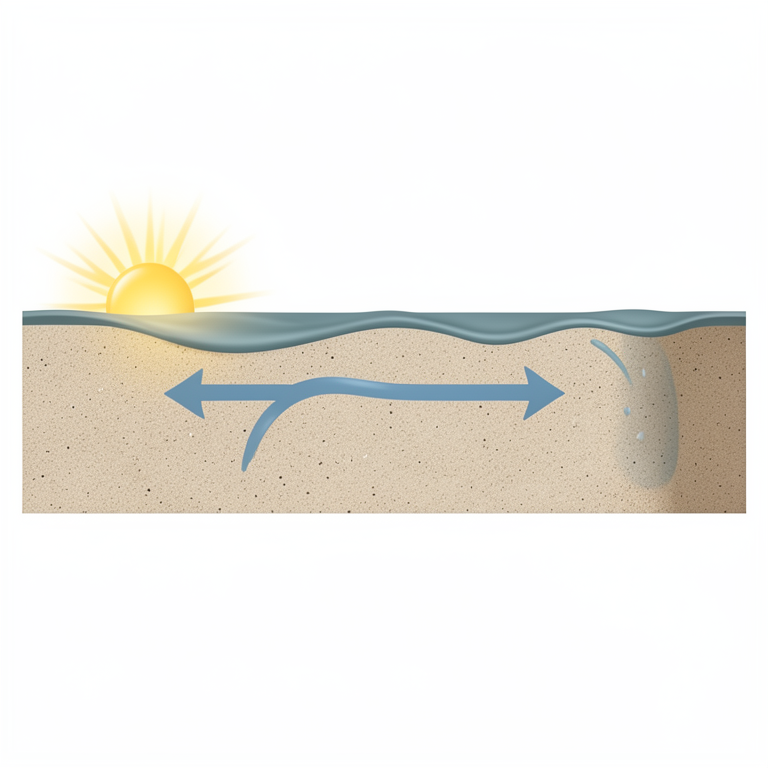
AI-generated conceptual illustration (fluid flowing through a cross-section of sandy soil). It explains the idea and does not show study data.
View source evidence ↗Figures & tables
From the original paper Table 1
 Table 2
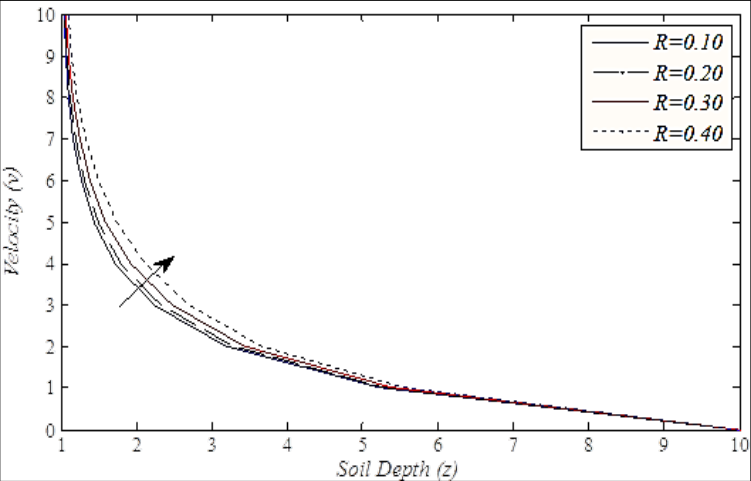 Figure 1
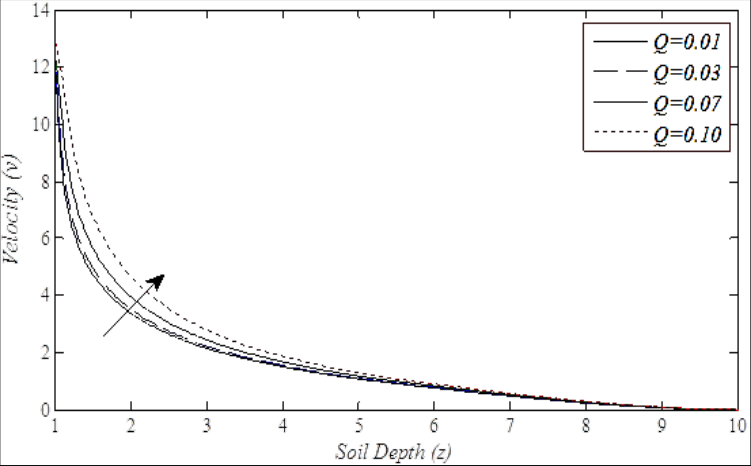 Figure 2
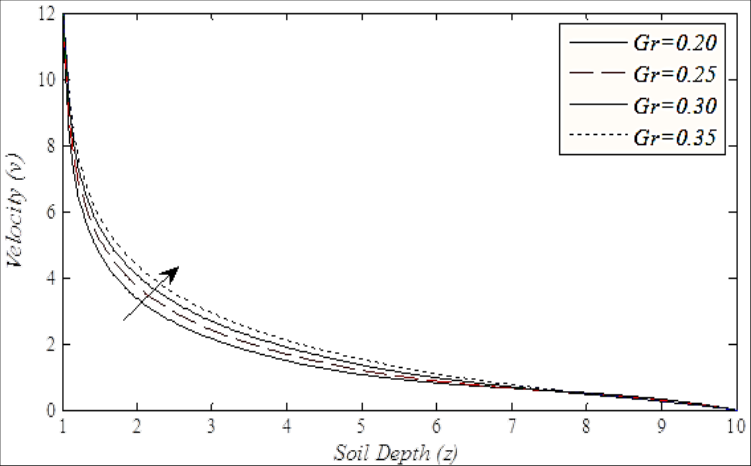 Figure 3
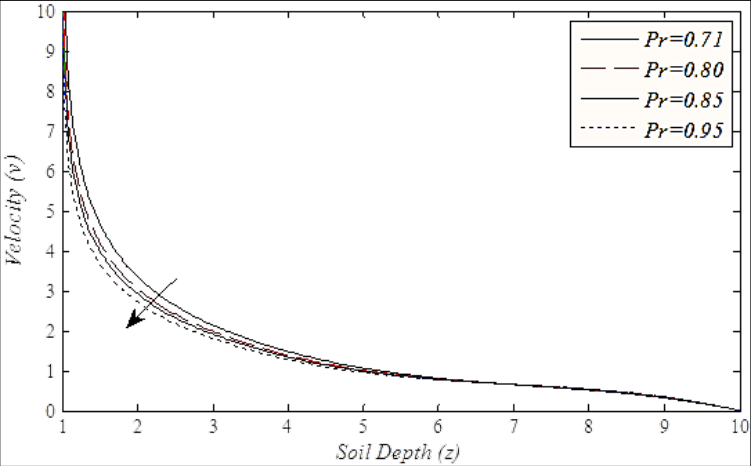 Figure 4
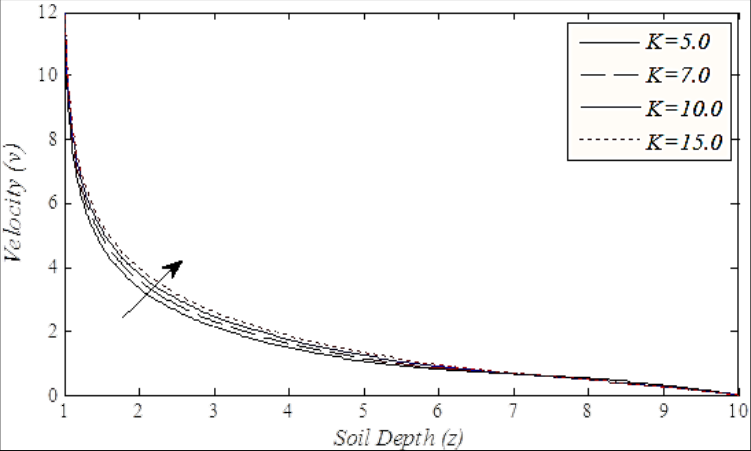 Figure 5
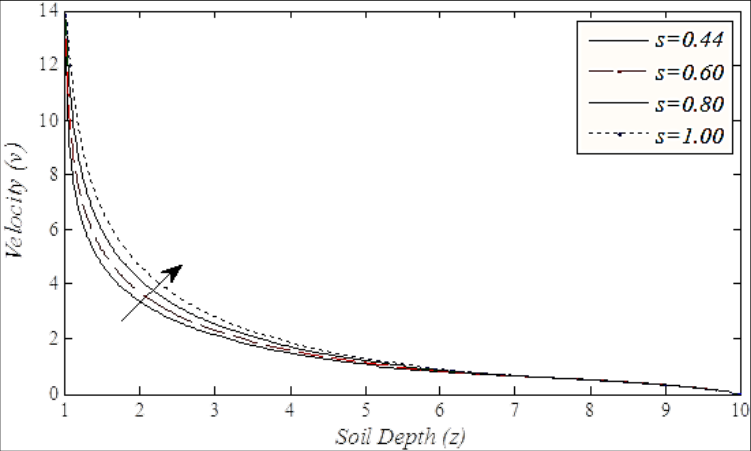 Figure 6
Introduction
The study of heat transfer and fluid dynamics generally has attracted many researchers over the years because of its vital role in many areas which includes science, engineering and technology. Noran et al [1] worked on the effects of radiation and chemical reaction on magnetohydrodynamics (MHD) flow past an exponentially stretching sheet with heat sink. Their results show that the reaction rate parameter influenced the concentration profiles considerably while the concentration thickness of boundary layer decreases as reaction rate parameter increases. Moreover, Kho et al [2] researched on effect of thermal radiation on magnetohydrodynamics (MHD) flow and heat transfer analysis of Williamson nano fluid past over a stretching sheet with constant wall temperature. The work established that the rate of heat transfer is higher for Williamson nano fluid compared to the classical viscous fluid. Furthermore Akinpelu et al [3] considered the effects of some physical parameters on ground temperature with time-dependent suction velocity in the presence of internal heat generation. Reddy et al [4] studied a free convection heat and mass transfer flow of a fluid that is chemically reactive and radiation absorption in an aligned magnetic field. Akinpelu et al [5] studied variations in ground temperature in the presence of radiative heat flux and spatial dependent soil thermo physical property. Rajesh and Varma [6] researched on the effects of radiation and mass transfer on MHD flow past an exponentially accelerated vertical plate with variable temperature. This study therefore centered on the effects of some physical parameters on the fluid flow through a sandy soil.
Mathematical Analysis
A flow of an unsteady two dimensional viscous incompressible fluid through a sandy soil (porous medium) was considered. The flow is taken to be relatively large (infinite) along the horizontal axis (i.e.
axis y
) where the vertical axis which is normal to it is considered to be inside the soil (i.e.
axis z
). So, the flow field is a function of z and t alone [7] , with a Dirichlet boundary condition. The soil is also taken to be an optically thin environment to allow the passage of the fluid flow through it. The radiation is directly towards the soil in a direction along the gravity. Under the assumptions, the governing equations under the usual Boussinesq's approximation became:
Where, z is the dimensional depth of the soil which is perpendicular to y . v is the dimensional velocity of the flow along z axis. Then t and w are the dimensional time and the suction velocity respectively. Using the dimensionless parameters as used by Mohammed [7] and Seshaiah et al [8] ,
As used by Nwaigwe [9] , the suction velocity given as ) 1 (
Where 0 w , A and are the initial suction velocity, the suction parameter and the frequency of oscillation respectively. A and are very small such that 1 A . Also, as used by Krishna and Reddy [10] the heat flux is given as
is the absorption coefficient. Moreover, as used by Akinpelu et al [5] , the time-dependent thermal conductivity is given as
Being the variable thermal conductivity parameter, time and the constant thermal conductivity respectively. Equations ( 2)-(3) become:
Method of Solution
Equations ( 10)- (11) are coupled second order partial differential equation. These can be reduce to ordinary differential equation using regular perturbation method and then solved analytically. The assumed solutions are given are as follow:
Substituting equation ( 12) and its derivatives into (9), and neglecting the higher order terms 2 ) ( o with further simplifications, we obtain
Where the primes represent ordinary differentiation with respect to z. Using the assumed solutions ( 14) -(15), corresponding boundary conditions ( 12) and (13) can be rewritten as follows:
Results and Discussion
The numerical result of the transient velocity profile was computed using Matlab. For better illustrations, these results were later displayed on graphs. The Solar radiation parameter (R), the internal heat generation parameter (Q), the thermal Grashof number (Gr) and the Prandtl number (Pr) were examined on the velocity of the sandy soil. Also, the effects of an increasing permeability of the soil and its thermal conductivity were also investigated. Tables 1 and2 below show the values of the thermal conductivity and permeability of the sandy soil.
Description
Thermal Conductivity (Btu/ft hr 0 F) Sand 0.44 Gary [11] The result shows that as the solar radiation increases, the velocity of sandy soil increase as well. Figure 2 represents the velocity profile for different values of internal heat generation parameter for the sandy soil. The increasing internal heat also speeds up the rate of flow through sandy soil. Figure 3 is the velocity profile of the thermal Grashof number at increasing depth of sand. When the thermal buoyancy force increases, the rate of flow of the fluid through the sandy soil also increases. In figure 4, as expected, the increasing value of the Prandtl number decreased the velocity of the fluid flow at the boundary layer of the sand. Moreover, the results in figures 5 and 6 show that when the permeability and the thermal conductivity of any soil increase, then the rate of flow of fluid is speed up.
Conclusion
Effects of some physical parameters on the fluid flow through a sandy soil have been considered. It is therefore evident that the solar radiation, the internal heat and the thermal buoyancy force have significant effects on the fluid flow. At any increase in these quantities, the rate of flow of fluid through a sandy soil is speed up. Moreover, the larger the value of thermal conductivity and permeability of any soil the faster the rate of flow of fluid through it.
Figures and tables from the paper
References
11 in the original paper- Noran Nur Wahida Khalili, Abdul Aziz Samson, Ahmad Sukri Abdul Aziz and Zaileha Md Ali. Chemical Reaction and Radiation Effects on MHD Flow past an Exponentially Stretching Sheet with Heat Sink. IOP Conf. Series: Journal of Physics: Conf. Series. 2017; 890:12-25. Doi:10.1088/1742-6596/890/1/012025
- Kho YB, Hussanan A, Mohamed MKA, Sarif NM, Ismail Z, Salleh MZ. Thermal Radiation Effect on MHD Flow and Heat Transfer Analysis of Williamson Nanofluid past Over a Stretching Sheet with Constant Wall Temperature. IOP Conf. Series: Journal of Physics: Conf. Series. 2017; 890:012034. Doi :10.1088/1742-6596/890/1/012034
- Akinpelu FO, Olaleye OA, Adewoye SK. The effects of some physical parameters on ground temperature with timedependent suction velocity in the presence of internal heat generation. Imperial Journal of Interdisciplinary Research (IJIR), 2017, 3(8). ISSN: 2454-1362, http://www.onlinejournal.in
- Reddy V, Prabhakara, Kumar Kiran RVMSS, Reddy G. Viswanatha, Prasad P, Durga, Varma SVK. Free Convection Heat and Mass Transfer Flow of Chemically Reactive and Radiation Absorption Fluid in an Aligned Magnetic Field. International Conference on Computational Heat and Mass Transfer; Procedia Engineering. 2015; 127:575-582. DOI: 10.1016/j.proeng.2015.11.347
- Akinpelu FO, Alabison RM, Olaleye OA. Variations in Ground Temperature in the presence of Radiative Heat Flux and Spatial Dependent soil thermo physical property. International Journal of Statistics and Applied mathematics. 2016; 2(1):5763.
- Rajesh V, Vijaya Kumar Varma S. Radiation and Mass Transfer Effects on MHD Free Convection Flow Past an Exponentially Accelerated Vertical Plate with Variable Temperature. ARPN Journal of Engineering and Applied Sciences, 2009, 4(6). ISSN 1819-6608
- Mohammed Ibrahim S. Radiation Effects on Mass Transfer Flow through a Highly Porous Medium with Heat Generation and Chemical Reaction. IRSN Computational Mathematics, 2013, Article ID 765408.
- Seshaiah B, Varma SVK, Raju MC. The Effects of Chemical Reaction and Radiation on Unsteady MHD free Convective Fluid Flow Embedded in a Porous Medium with TIme-Dependent Suction with Temperature Gradient Heat Source. International Journal of Scientific Knowledge. 2013; 3(2):12-24.
- Nwaigwe C. Mathematical Modeling of Ground Temperature with Suction Velocity and Radiation. American Journal of Scientific and Industrial Research, 2010, 238-241.
- Krishna M, Veera, Reddy M, Gangadhar. MHD Convective Rotating flow past an oscillating porous plate with Chemical Reaction and Hall Effects. IOP Conf. Series: Materials Science and Engineering. IOP Publishing, 2016, 149.
- Gary Reysa. Ground Temperatures as a Function of Location, Season and Depth. Build it Solar, The Renewable Energy Site for Do-It-Yourselfers, 2015. Retrieved at: www.builditsolar.com/Projects/Cooling/EarthTemperatures.htm 12. www.fao.org/tempref/FI.CDrom/FAO_Training/General/x6707e/x6706e09.htm