
Research article · 2018 · Full text
International Journal of Statistics and Applied MathematicsRole of sylow's theorem on permutation group and automorphic character
Volume 3(6) · Pages 146–147
Research areasMathematics and Applications
Abstract
Author-writtenIn the permutation group. Every group is isomorphic to a permutation group. In permutation group the smallest subgroup of Sn containing (12) and (1, 2, 3, , n) is Sn. The converse of lagranges theorem does not hold, in general, as O(An) is divisible by 6 but it has no sub group of order 6. It is also notable that quotient group of cyclic (abilian) groups are cyclic (abelian) but converse do not hold.
Summary
Source-checkedPlain-language reading of the full paper, prepared with AI and checked against the text. Each point links to the authors' own words.
Why it matters
- Permutation groups are fundamental in group theory because every group can be shown to be isomorphic to one. View evidence ↗
- The converse of Lagrange's theorem is not generally true, as demonstrated by the alternating group $A_n$, which may have an order divisible by 6 without possessing a subgroup of order 6. View evidence ↗
- While quotient groups of cyclic or abelian groups remain cyclic or abelian, the reverse relationship does not necessarily hold. View evidence ↗
The question
- The author aims to investigate and demonstrate specific results related to permutation groups and automorphism groups. View evidence ↗
What they did
- The paper uses a specific example of a group $G$ with order 60 and multiple Sylow 5-subgroups to analyze the conditions under which $G$ is simple. View evidence ↗
- The author presents a theorem to prove that if a Sylow p-subgroup $P$ of a subgroup $H$ is contained in a Sylow p-subgroup $S$ of the parent group $G$, then $P$ is exactly the intersection of $S$ and $H$. View evidence ↗
- The paper proposes an inductive method for constructing Sylow p-subgroups within the symmetric group $S_{p^k}$. View evidence ↗
What they found
- The author asserts and seeks to demonstrate that the alternating group $A_5$ is a simple group. View evidence ↗
- In the group $A_5$ of order 60, the subgroups generated by $(12345)$ and $(13245)$ serve as two distinct Sylow 5-subgroups. View evidence ↗
- In the symmetric group $S_p$, the order of the Sylow p-subgroup is $p$, and it is generated by the cycle $(1, 2..., p)$. View evidence ↗
What it means
- The author concludes the inductive proof by successfully identifying the required Sylow p-subgroup $P$ of the group $G$. View evidence ↗
Visual summary
1 visualsIllustrations explain the paper; they do not show study data.
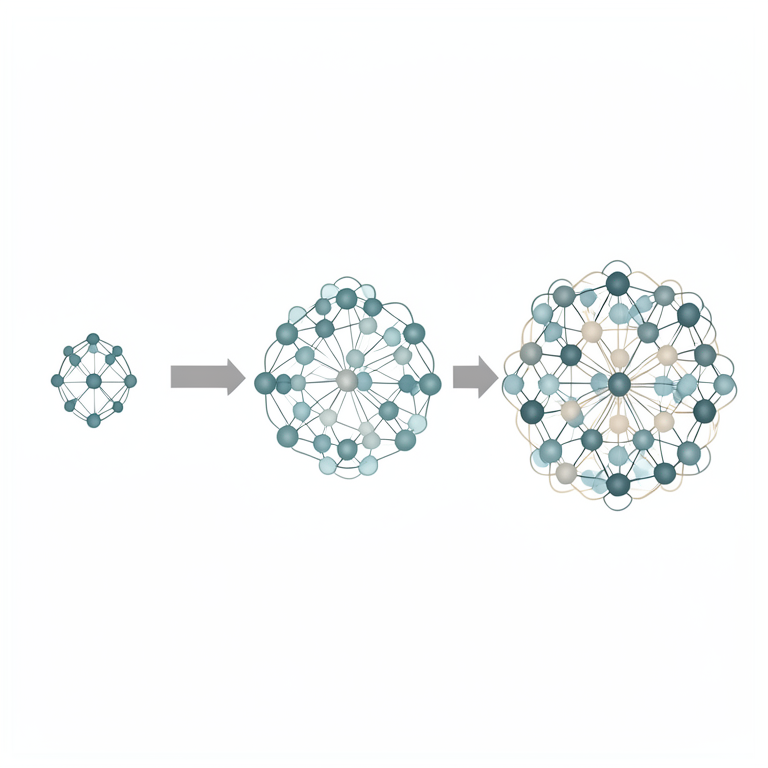
Inductive Construction of Sylow p-subgroups
AI-generated conceptual illustration (Abstract mathematical geometric representations of symmetric group structures). It explains the idea and does not show study data.
View source evidence ↗Introduction
We start by recalling that by an Automorphism we mean an isomorphism of a group G to itself. Also under permutation groups are noticed that the set of all permutation (1-1 onto maps) forms a group. We show the set of all automorphisms also forms a group, the two being closely elated. We intend studying a few result pertaining to these groups.
Example: Show that if G is a group of order 60 and has more than one sylow 5-subgroup then G is simple.
Soln. O (G) = 60 = 2 2 ×3×5. The number of sylow 5-subgroup is 1+5k st 1+5k/12 k = 0, 1 if K=0, then a unique normal sylow 5-subgroup. Since G has more than one sylow 5subgroup k=1 than 1+5k = 1+5-1 = 6 sylow 5-subgroup each of order 5 and hence these are 6×4 = 24 elements of order 5. Suppose G has a non trivial normal subgroup H i.e. G is not simple. Then possible values of (H). 2, 3, 4, 5, 6, 10, 12, 15, 20, 30 Case-1 : O(H) = 5, 10, 15, 20 or 30 i.e. 5/O(H) Then since 5 1+1 × O(H), We find H has a sylow 5-subgroup p. Then p H G if Q is any conjugate of p then Q = gHg -1 = H as HG. All the six conjugate (6 sylow 5-subgroup of H are conjugate) are contained in H all the 24 elements of order 5 are in H and also e H. So O (H) > 25 or that O(H)=30 is the only possibility. But a group of order 30 as has unique normal sylow 5-subgroup.
Case-2:
But the group of order 15, 20, 30 have a unique normal sylow 5
Which is not possible because of (1) Thus, Case (2) is also rouled out. Finally suppose O(H) = 6 or 12 then H contains a unique normal sylow subgroup, say N. The N is characteristic subgroup of H NG. Since N is a sylow subgroup of H and O(H) = 2×3 or O(H) = 2 2 ×3. Sylow subgroups are of order 2, 3 or 4. So O(N) = 2, 3, 4 which is not possible as given A5 is simple.
Theorem 1: Show that A5 is simple. 12345), ( 13524), ( 14253), ( 15432), I} and k = = {(13245), ( 12534), ( 14352), ( 15423), I} = , 2 , 3 , 4 , 5 are two sylow 5-subgroups of A5 as we know that A5 is simple.
Theorem 2: Let G be a finite group and HG. Suppose p is a prime dividing O(G). Let P be a sylow p-subgroup of H contained in some sylow p-subgroup S of G then P = SH.
Problem 1: If Q is another sylow p-subgroup of St. Q T we T = sylow p-subgroup of G then show ST if PQ As we know P = SH, Q = TH if S=T then P = Q. Proved.
Aim:
A p-group is a group in which every element has order p r . Where P=Prime, Hence P is same for all elements and r may vary. Fore example the group K4 = {1, (12) (34), (13) ( 24), ( 14) (23)} and the quaternion group are examples of finite pgroups. Here p=2 as me know in an finite group there is an element of finite order thus S3 is not a p-group.
Theorem 3: We now project a method of constructing Sylow p-subgroups Inductively in the symetric group Sp k .
Suppose P= Prime St. P r /¬n and p r+1 ׬n.
Then r = , where [x] represents greatest not greater then x. In particular of n = p k then r= p k-1 +P k-2 +.....+. We denote r by n (k) to the highest power of p dividing p¬k. when k=1, then clearly p of (Sp) = ¬p. and p 2 ׬p p/(p-1)....2.1 p/(p-r), 1rp-1 pp-r, which is a contradiction. Therefore order of Sylow p-subgroup in Sp is p and group generated by (1, 2.......p) is a Sylow p-subgroup. So we have constructed Sylow p-subgroup when k=1. Assume that we have constructed it for k-1. Consider Sp k . Divide the set of p k letters 1,2,........p k into p set each consisting of p k-1 letters as follows. {1, 2, ...................... p k-1 }, (p k-1 +1.........
But tA t is per mutation on p k-1 letters and so A Sp k-1 By induction hypothesis S p-1 has sylow p-subgroup.
Conclusion
p-subgroup P3 O(P1)= Pn (k-1) +......+ p i-2 let p2 = p 1 -1 , p3= r 2 =p1r -2 ,........, pp= n-1 pi pp= r p -1 P1 (p -1 ). Each pi Sp k . St. Pi P1 (when xp1 is ont -1 x -1 O (pi) = P (p1) = p n (k-1) Also r takes letters of first set into second. Set. Letter and so on.
So t A T -1 consists of letters from second set on TA means T(i) =i for all i > p k-1 . Similarly 2 t -2 will consists of letter from third second then so on. Here T=p1 p2, ....., pp Sp k . Also O (T) = O (P1)O (P2)......O (Pp)= Pp (n (k-1) ). = p 1+n (k -1 ). Thus O(p) = O (<> O(T) = p p2m (k -1 )+1 = p p (1+p+.......+p( (k-2) +1) = p pm (k -1 ) = p p (n (k-1) 1+1= pp1+P...........+p(k -2 )+1 = P 1 +P+........+ P k-1 = P n(k) . So P is required Sylow p-subgroup of G.