
Research article · 2019 · Full text
International Journal of Statistics and Applied MathematicsSoliton solution of korteweg-de vries equation
Volume 4(5) · Pages 45–48
Research areasAdvanced Fiber Optic SensorsWave and Wind Energy SystemsNonlinear Waves and Solitons
Abstract
Author-writtenThe Korteweg-de Vries (K-dV) equation plays an important role in studying of the propagation of low amplitude water waves in shallow water bodies and the remarkable discovery of soliton solution K-dV equation that leads to solitary waves. The importance of soliton solution one can predict how energy is transported from one part of medium to another and soliton carries energy away from its sources. Soliton solution has become a breakthrough in mechanics, nonlinear analysis and many developments in algebra, analysis, geometry and physics. We present the analytic solution of K-dV equation and then using finite element analysis to predict the soliton behavior in shallow water bodies. The propagation of long water wave equation is close to the soliton solution of our said equation has been investigated in this study. The valid analytical solution for k-dv equation is restricted to time and hence close to the initial position and time as well. Finite element analysis that leads to the soliton solution of k-dv equation has been observed and compare among the graphical representation in this research.
Summary
Source-checkedPlain-language reading of the full paper, prepared with AI and checked against the text. Each point links to the authors' own words.
Why it matters
- The Korteweg-de Vries (K-dV) equation is essential for studying how low-amplitude solitary waves, known as solitons, propagate in shallow water. View evidence ↗
- Soliton solutions are important because they allow for the prediction of how energy is transported through a medium. View evidence ↗
- The discovery of soliton solutions has significantly impacted various fields, including mechanics, physics, and nonlinear analysis. View evidence ↗
The question
- The study aims to provide an analytical solution to the K-dV equation and use finite element analysis to predict soliton behavior in shallow water. View evidence ↗
What they did
- The researchers employed finite element analysis to conduct a numerical study of the K-dV equation. View evidence ↗
- Numerical solutions were obtained using periodic boundary conditions with time (t) between 0 and 1.18 and space (x) restricted to the interval [-8, 8]. View evidence ↗
- For the purposes of this specific study, the parameter beta (𝛽) was set to 4. View evidence ↗
What they found
- The speed of a solitary wave is proportional to its amplitude, meaning larger waves travel faster than smaller ones. View evidence ↗
- Between time t=0 and 0.38, a soliton that is too large for the water depth splits into one large wave and one small wave. View evidence ↗
- The process of the soliton splitting into two separate solitons is completed by time t=0.32. View evidence ↗
- Observations show a larger soliton overtaking a smaller one, during which their heights become equal while their lengths increase. View evidence ↗
- After completely overtaking the smaller soliton, the larger soliton reaches its maximum wavelength and minimum height. View evidence ↗
What it means
- The authors conclude that these waves are stable and can travel long distances without flattening or toppling, unlike normal waves. View evidence ↗
- The authors state that solitons do not merge; instead, a larger wave simply overtakes a smaller one. View evidence ↗
- The study concludes that a wave will split into one large and one small wave if its size exceeds the capacity of the water depth. View evidence ↗
Visual summary
2 visualsIllustrations explain the paper; they do not show study data.
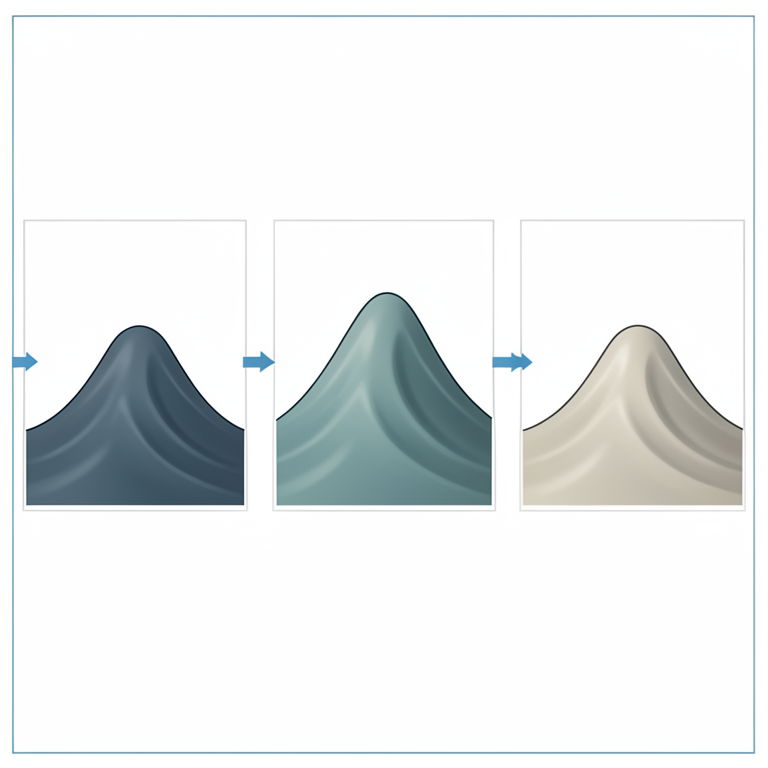
Soliton Overtaking Process
AI-generated conceptual illustration (water waves in a narrow channel). It explains the idea and does not show study data.
View source evidence ↗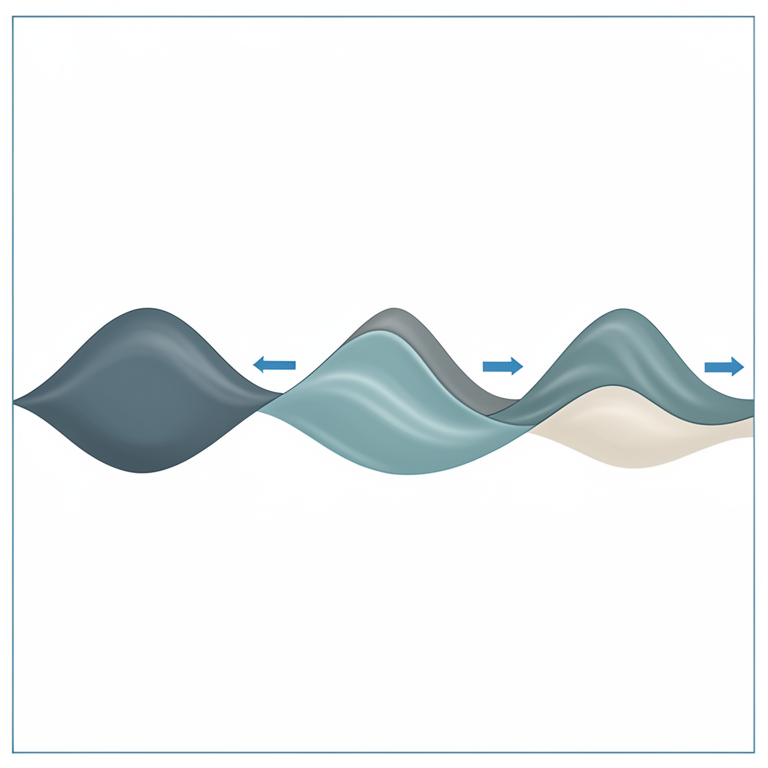
Soliton Splitting
AI-generated conceptual illustration (water waves in a shallow channel). It explains the idea and does not show study data.
View source evidence ↗Figures & tables
From the original paper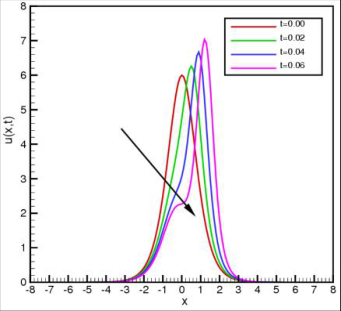 Figure 1
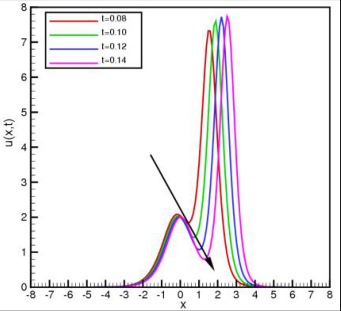 Figure 2
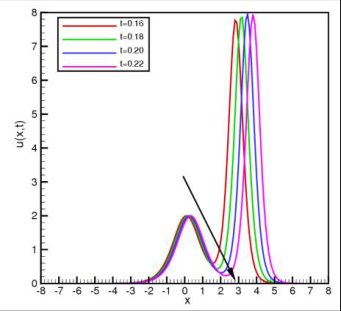 Figure 3
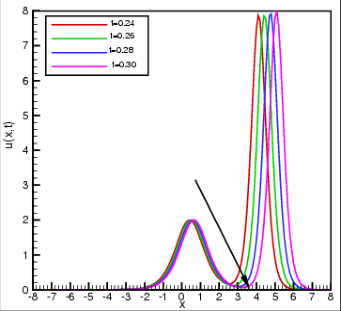 Figure 4
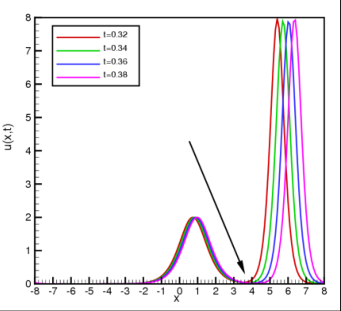 Figure 5
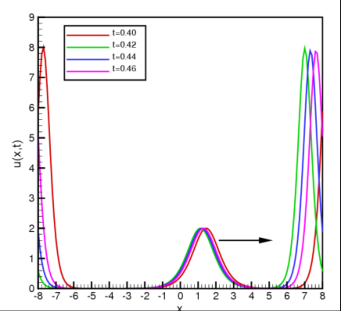 Figure 6
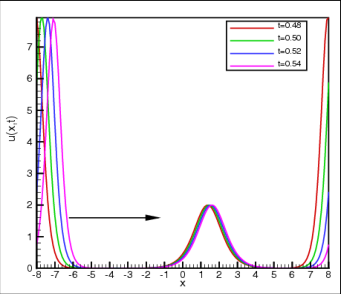 Figure 7
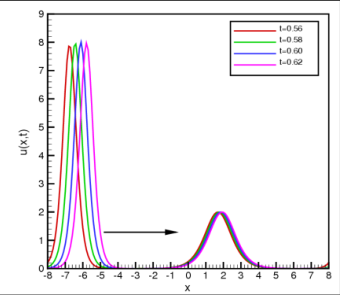 Figure 8
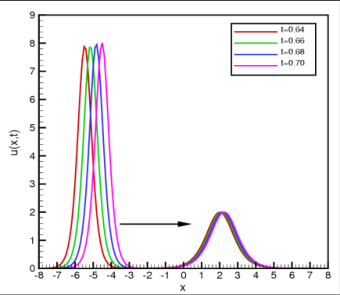 Figure 9
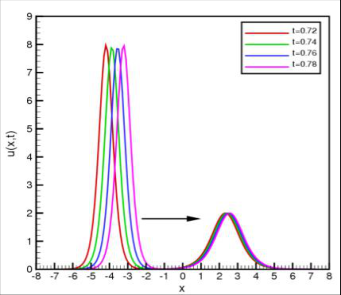 Figure 10
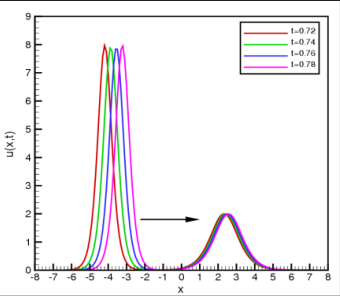 Figure 11
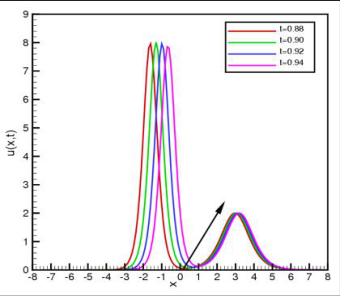 Figure 12
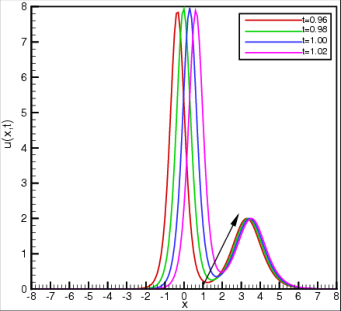 Figure 13
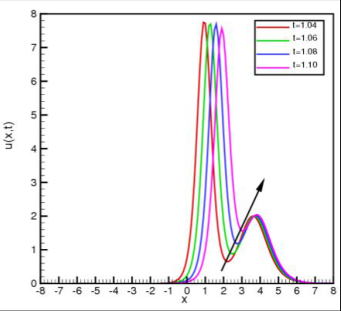 Figure 14
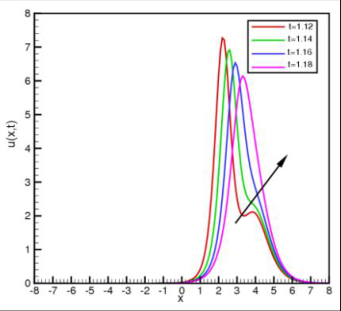 Figure 15
Introduction
The Korteweg-de Vries (K-dV) equation was not until the 1960s and the advent of modern computers that the significance of Scott Russell's discovery in physics, electronics, biology and especially Fiber optics started to become understood, leading to the modern general theory of solitons. Note that solitons are, by definition, unaltered in shape and speed by a collision with other solitons. So solitary waves on a water surface are near-solitons, but not exactlyafter the interaction of two (colliding or overtaking) solitary waves, they have changed a bit in amplitude and an oscillatory residual is left behind. Klaus Brauer (2000,2014), who has shown how to find an exact solution to the K-dV equation and who has used the tool of Bäcklund transform [7-9] to obtain an analytical solution and who -in addition to thatperforms non-linear superposition of two, three and more solutions corresponding to two, three or more soliton waves by using Bäcklund transform again. Numerical study using finite element analysis of K-dV equation will be done in this study.
Mathematical formulation
The usual expression of K-dV equation is
The above equation described by Russell can be expressed by a non-linear Partial Differential Equation of the third order. In practical applications where the PDE describes a dynamic process one of the variables has the meaning of the time denoted by t and the other normally only up to 3 variables have the meaning of the space denoted by , . x y and z
x describes the only one space variable and , U x t describes the elongation of the wave at the place x at time t .
Exact solution of K-dV equation
Travelling waves as solutions to the Korteweg de-Vries equation (K-dV) which is a non-linear Partial Differential Equation (PDE) of third order have been of some interest already since 150 years. We can present an analytical exact result to the K-dV equation by elementary operations. Let a trial solution
Just denoting the parameter c above by and the function f by z .
Substituting the trial solution (3) into (1), we get the ODE
Integrating both sides we've
Multiplication on both sides with dz d
Where ' z and '' z denote the first and second derivatives of the function z with respect to . Integration on both sides with r. to 2 32 12
from these requirements it follow 12 0 cc From equation ( 5) we can be written as 2 32 1 ( ) 0 22
By separation of variable with integration on both sides we get.
The integration of the left hand side of (3) can be done by using transformation
Instead of (4) we select the transformation
In the same way as we obtained the solution (12) we will obtain another solution which is
The solution ( 14) is an irregular solution to the K-dV Equation. It has a singularity for vanishing argument of the cosech-function, i.e. for the line in the xt plane.
Equations ( 5) and ( 7) are solutions to the original K-dV Equation [4, 5] .
Method of calculation
Many numerical methods are being used to find the approximate solutions which are very accurate for the evolutionary partial differential equations giving to solitary wave solutions [19] . The solution of K-dV equation is given by (x, t) 6 (x, t) (x, t) (x, t) 0 [ 8,8] ..
( 8, t) u(8, t) 2 (x, 0) 22
In order to have a real solution the quantity must be a positive number. It is seen from boundary conditions for 0 the solitary wave moves to the right. The second point is that the amplitude is proportional to the speed which is indicated by the value of . Thus larger amplitude solitary waves move with a higher speed than smaller amplitude waves. In particular, in this study we consider𝛽 = 4.
Result and Discussion
To obtain the numerical solutions, we used periodic boundary conditions for a region 0 t 1.18 and x is restricted in the interval [-8, 8] in most of the evolutionary K-dV equation. Then using finite element method we obtain the desired solution. For discussion we have represented the result graphically. The results of the computations, however, show graphical changes in the below mentioned quantities to time 0 t have been reached and after this at 𝑡 = (0,1.18) graphical change shown. Thus the solution for time 𝑡 = (0,1.18) is essential soliton solutions of the K-dV equation. Here, figure (1)(2)(3)(4)(5) show the soliton spilt into two waves one big and one small as the wave is too big for the depth of the water at time t=0 to 0.38. Fig. 1 represents that the soliton is stable at 𝑡 = 0.0. Then at time𝑡 = 0.02, the soliton obtains itsmaximum state compared with the depth of the water and it begins to split at time𝑡 = 0.04. The height of the soliton is increasing and at the same time the length of soliton is decreasing. The splitting situation of the soliton is also shown in fig. (2)(3)(4). The soliton is completely splitting into two solitons at time 𝑡 = 0.32. One is big and other is small. The big soliton is obtained its maximum height but its length is minimum. Then two solitons are moving forward at time 𝑡 = 0.34,0.36,0.38. These phenomena are shown in fig. (5). In figure (6)(7), one soliton is leaving in the domain 𝛺 = [-8,8] and another is entering in the domain𝛺 = [-8,8]. Fig. 8 represents one big soliton has entered in the domain𝛺 = [-8,8]. It is also going close to the small soliton. The soliton is obtained the closest position from fig. (9)(10)(11). At the same time the length and height remain same. The big soliton is overtaking the small solitonand the height of the two soliton is same but their length is increasing in fig. ( 12) & (13). Fig. 14 shows that the height is started to decrease and the length also increasing. The big soliton completely overtaken small soliton and obtained its maximum wavelength with minimum height is shown in fig. (15).
Conclusion
The major finding of our study is given below: The waves are stable, and can travel over very large distances (Normal waves would tend to either flatten out, or steepen and topple over) The speed depends on the size of the wave, and its width on the depth of water. Unlike normal waves they will never merge-so a small wave is overtaken by a large one, rather than the two combining. If a wave is too big for the depth of water, it splits into two, one big and one small. These behaviors are also observed by John Scott Russell. So we can say that our investigations are accurate.
Figures and tables from the paper
References
12 in the original paper- The Korteweg-de Vries Equation, History, exact Solutions, and graphical Representation, by Klaus Brauer, University of Osnabrück/Germany, May 2000
- The Korteweg-de Vries Equation, History, exact Solutions, and graphical Representation by Klaus Brauer, University of Osnabrück/Germany, Last Revision of this paper: February 2014.
- Korteweg DJ, de Vries G. On the Change of Long Waves Advancing in a Rectangular Canal, and On a New Type of Long Stationary Waves, Phil. Mag. 1895; 39:422-443.
- Miura RM. Backlund Transformations, the Inverse Scattering Method, Solitons, and Their applications, Lecture Notes in Math., Springer-Verlag, 1976, 515
- Rogers, Schief W. Backlund and Darboux Transformations, Geometry and Modern 10. Solitons and the Korteweg de Vries Equation: Starting with Shallow-Water Waves by Katie Banks, 2012
- An Introduction to Wave Equations and Solitons Richard S. Palais, The Morningside Center of Mathematics, Chinese Academy of Sciences, Beijing, Summer, 2000.
- Korteweg DJ, de Vries G. On the Change of Form of Long Waves Advancing in a Rectangular Canal, and on a New Type of Long Stationary Waves, Philosophical Magazine. 1895; 39(240):422-443, doi:10.1080/14786449508620739
- Zabusky NJ, Kruskal MD. Interaction of "Solitons" in a Collisionless Plasma and the Recurrence of Initial States, Phys. Rev. Lett. 1965; 15(6):240-243, Bibcode: 1965PhRvL.15.240Z, doi:10.1103/PhysRevLett.15.240
- Boussinesq J. Essai sur la theorie des eaux courantes, Memoires presentes par diver savants ` l'Acad. des Sci. Inst. Nat. France, XXIII, 1877, 1.
- Numerical K-dV equation by the Adomian decomposition method M. Akdi, M. B. Sedra. Numerical KDV Equation by the Adomian Decomposition Method. American Journal of Modern Physics. 2013; 2(3):111115 doi: 10.11648/j.ajmp.20130203.13
- Applications in Soliton Theory, Cambridge Texts in Applied Mathematics, Cambridge University Press, Cambridge, 2002.
- Billingham J, King AC. Wave Motion. Cambridge: Cambridge University Press, 2000.
Cited by 4
From OpenAlex, OpenCitations and reference lists read by Scinovex
- New local and nonlocal soliton solutions of a nonlocal reverse space-time mKdV equation using improved Hirota bilinear method ↗
Shabir Ahmad, Sayed Saifullah, Arshad Hussain Khan · Physics Letters A · 2022
❝ 65PDF - Analysis of interaction of lump solutions with kink-soliton solutions of the generalized perturbed KdV equation using Hirota-bilinear approach ↗
Sayed Saifullah, Shabir Ahmad, Maryam Ahmed Alyami · Physics Letters A · 2022
Using the Hirota bilinear method (HBM) and Cole-Hopf transformation, we extract the interaction between the lump and kink-soliton solutions for the generalized perturbed Korteweg–de Vries (KdV) equation in this manuscript. In the literature [15] , the authors have applied the Cole-Hopf transformation with a value of R to study the particular case of the generalized perturbed KdV equation, which is…
❝ 56PDF - Inextensible Flows of Null Cartan Curves in Minkowski Space R2,1 ↗
Samah Gaber, Abeer Al Elaiw · Universe · 2023
This research focused on studying the flows of a null Cartan curve specified by the velocity and acceleration fields. We have proven that the tangential and normal velocities are influenced by the binormal velocity along the motion. The velocity fields are used to drive the time evolution equations for the Cartan frame and the torsion of the null curve. The…
❝ 4PDF - N -soliton solutions and their dynamic analysis to the generalized complex mKdV equation ↗
Xinshan Li, Ting Su, Jingru Geng · Wave Motion · 2024
❝ 0