
Research article · 2020 · Full text
International Journal of Statistics and Applied MathematicsApproximate Roots to a Thue equation
Volume 5(5) · Pages 41–47
Research areasAlgebraic and Geometric Analysis
Abstract
Author-writtenThe roots of a Thue equation are investigated. A new form of the sixth-order equation is derived. The irreducibility of certain classes of polynomials of degree six over ℤ[x] is established. Conditions for factorizability by linear and quadratic factors are given.
Summary
Source-checkedPlain-language reading of the full paper, prepared with AI and checked against the text. Each point links to the authors' own words.
Why it matters
- The Thue equation is a specific type of equation involving two variables with integer coefficients that is homogeneous except for a constant term. View evidence ↗
- It is established that the number of solutions to a Thue equation is finite. View evidence ↗
The question
- The study aims to investigate the roots of Thue equations, derive a new form for sixth-order equations, and establish the irreducibility of specific degree-six polynomials over ℤ[x]. View evidence ↗
What they did
- The author analyzes Thue equations of the nth degree that can be factorized into a product of a quadratic polynomial and a polynomial of degree n-2. View evidence ↗
- Statistical methods are applied to the auxiliary equation to estimate the approximate location of roots within the complex plane. View evidence ↗
- Polynomial factorization is investigated by analyzing partitions of the maximal degree and using congruences to check for linear factors. View evidence ↗
What they found
- For the analyzed distribution of roots, the average value is found to be λ = -2. View evidence ↗
- The variance of the root distribution is calculated as (2n-10)/(n-3), resulting in a standard deviation of σ = √(2n-10)/(n-3). View evidence ↗
- Assuming a normal distribution, 99% of the roots are located within a circle defined by | λ + 2 | ≤ 3 √(2n-10)/(n-3). View evidence ↗
- The polynomial x6-Bx-1 is proven to be irreducible over ℤ[x] provided that B is not equal to zero. View evidence ↗
What it means
- The author concludes that the statistical estimates for root locations reduce the search time and refine the process of determining root values compared to previous bounds. View evidence ↗
- The author concludes that for even n ≥ 6, the polynomial Xn-BX-1 cannot be factorized with a quadratic factor over ℤ[x]. View evidence ↗
- The study identifies a remaining problem in establishing whether all polynomials with integer coefficients have at least two representations for certain sets of factor degrees. View evidence ↗
Visual summary
1 visualsIllustrations explain the paper; they do not show study data.
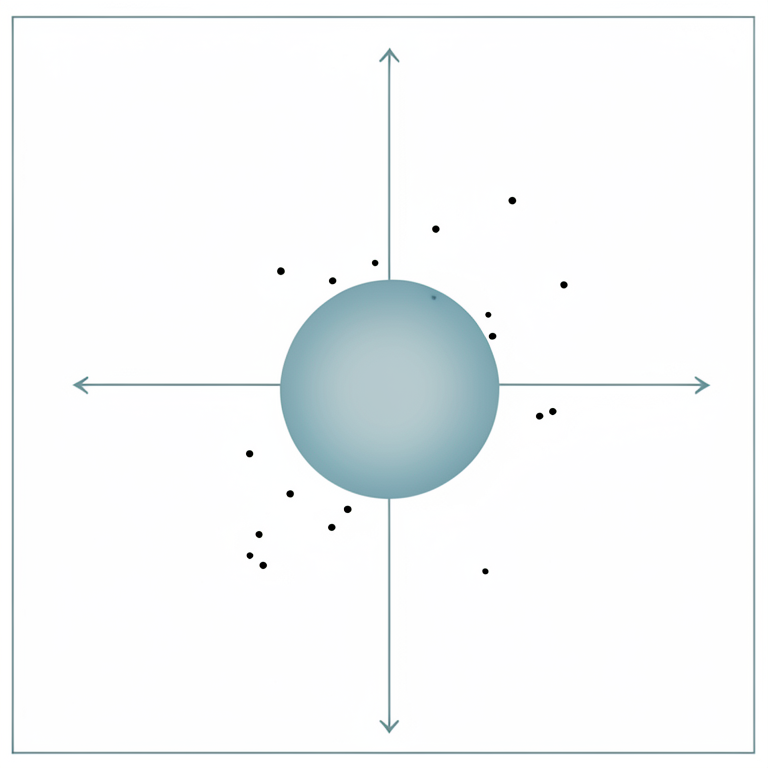
Root Distribution Region
AI-generated conceptual illustration (a complex plane coordinate system). It explains the idea and does not show study data.
View source evidence ↗Introduction
The Thue equation is an equation in two variables with integer coefficients which is homogeneous except for a constant term. When one of the variables is set equal to a fixed value, it becomes analgebraic equation in one variable that has a maximum number of roots equal to the degree. Similarly, the number of solutions to the Thue equation is finite [1] . It has been proven that the maximum number is five for binary cubic forms with integral coefficients [2] and a negative determinant and it equals seven for this class of forms with sufficiently large positive determinants [3] . An algorithm for deriving the bounds on magnitudes of the two variables in a solution to the equation also can be given [4] . The Thue equation for a relation of nth degree, which can be factorized into product of quadratic and degree n-2 polynomials, is analyzed. The coefficient of the linear term is known to be a solution to an equation of degree n-3 for odd n and n-4 for even n. Given the form of the auxiliary equation, statistical methods can be used to deduce the approximate location of the roots in the complex plane. From the mean and the variance, the range of the solutions may be determined with a probability of 99%. These estimates compare favourably with the bounds found from a basis reduction algorithm [2] . This analysis is extended to general sixth order equations. The condition of real integer roots restricts an arbitrary sixth-order equation to a special form. The factorization of these polynomials with is investigated methodically beginning with the partitions of the maximal degree. The factorizations with linear terms may be checked through congruences. Since the degree is 6, the products of quadratic and degree 4 polynomials together with the factorizations into two cubics will yield conditions on the coefficients which can be solved. It is found that the polynomial x 6 -Bx-1 is irreducible over ℤ[x] for B not equal to zero. Furthermore, the solutions to the conditions for the product of two cubics generates two different representations of x6-1. Such representations may determine for other degrees and factorizations. The irreducibility of more general polynomials of degree 6 is considered by deriving congruence conditions for linear and quadratic factors.
The Location of the Roots of the Thue Equation
Upon consideration of the factorization of Xn-BX-A, Xn-BX-A=(X2-bX-a)(Xn-2+cn-3Xn-3+...+c0) (2.1) Where A=ac0 B=ac1+bc0
(2.2) 0 = -ac2-bc1+c0: 0 = -b+cn-3. and f i (X,Y)=Y j Fi (X/Y) where j=[i/ 2] [5] . If n is even,
Suppose that A=1 and a=1. Then, it can be shown that the integer b belongs to the set of solutions to
Then the distribution of roots will have the average
Since the standard deviation equals ___________ σ= √(2n-10)/(n-3), (2.13) 99% of the roots in a normal distribution would be located within the circle | λ +2 | ≤ ___________ 3 √(2n-10)/(n-3) .
In the determination of the a factorization of the n th -order polynomial, the coefficient b in the quadratic factor X 2 -bx-a can be restricted approximately to the interval ___________ ___________ [-2-3 √(2n-10)/(n-3), 2+3√(2n-10)/(n-3) ].
For lower values of the odd degree, exceptional values might occur. For example, when n=5, there are only six known monic polynomials X 5 -X-A equal to a product of irreducible quadratic and cubic polynomials in Z[X], and if A=1, the only known factorization is
, for which b=1 and a=-1 [5] .
Since each of the coefficients is positive for n≥ 6, there are no real solutions for b. It follows that are no integer solutions for a factorization of the form X n -BX-1=(X 2 -bX-1)(X n-2 +c n-3 X n-3 +...+1) for even n larger than 4. This is consistent with Thue's theorem on the set of integer solutions to the to g(x,y)=m for a homogeneous polynomial g(X,Y), where G(X/Y)=1/Y deg g g(x,y) has three distinct roots [1]
The Distribution of Coefficients of the Linear Term when A≠1 and a≠1
The equations and the means and variances distributions of the roots may be found generally.
Again, there are no real solutions for b if a> A 2/n and a>0.
The roots would satisfy This special form has been derived entirely from the conditions on the coefficients.
Congruence Conditions for Factorization
Consider (5.9) t 5 ≡ (b 4 -3ab 2 +a 2 )t+a(b 3 -2ab) t 6 ≡ (-b 5 +4ab 3 -3a 2 b)t+a(b 4 -3ab 2 +a 2 ) and the polynomials t n -Bt-A divisible by t 2 +bt+a can be deduced from this list of congruences.
The factorization can be used to determine irreducibility criteria for polynomials of degree less than or equal to six.
Conclusion
The factorization of the polynomial X n -Bx-A yields a Thue equation for the linear coefficient in any quadratic factor over ℤ[x].
The auxiliary equations for n odd and n even have degrees n-3 and n-4 respectively. The average value of the roots and the variance may be determined by the expressions for the symmetric polynomials in terms of the coefficients. Given a random Gaussian distribution, the region including the roots with a probability of 99% may be defined. These estimates reduce the time necessary to search for the location of the roots and refine the procedure for determining their values through previous bounds.
It may be concluded from the Thue equation that there exists no factorization of X n -BX-1 with a quadratic factor over ℤ[x] if n≥6 is even. Therefore, any partitions of the degree n representing the products of factors with integer coefficients would not include 2. Therefore, this result improves the efficiency of the search for the factorization of this polynomial for even n. An example is given by n=6, where a linear factor is excluded by congruence conditions. There remains the product of two cubics which is found to be valid only for B=0. The two factorizations of x 6 -1 are (x 3 +1)(x 3 -1) and (x 3 +2x 2 +2x+1)(x 3 -2x 2 +2x-1). The polynomial X 6 -BX-1 is irreducible over ℤ[x] when B≠0. The polynomials x n -1 have unique factorizations with integer coefficients for n≤7 and n≠6. For each fachtorization, there will be a set of n-1 nonlinear conditions for n-2 undetermined coefficients which will not have integer solutions generally. This result raises the problem of establishing the existence of all polynomials with integer coefficients with a minimum of two representations for some set of degrees of the factors.
References
5 in the original paper- Thue A. Űber Annäherungswerte algebraischer Zahlen, J. Reine Angew. Math. 1909; 135:284-305.
- Tzanakis N, de Weger BMM. On the Practical Solution of the Thue Equation, J. Number Theory. 1989; 31:99-132.
- Delaunay B. Űber die Darstellung der Zahlen durch die binären kubischen Formen von negativer Diskriminante, Math. Zeit. 1930; 31:1-26.
- Nagell T. Darstellung ganzer Zahlen durch binäre kubische Formen mit negativer Diskriminante, Math. Zeit. 1928; 28:10-29.
- Ribenboim P. On the Factorization of Xn-BX-A, L'Enseignement Mathèmatique. 1991; 37:191-200.