
Research article · 2020 · Full text
International Journal of Statistics and Applied MathematicsDesign and development of relational repetitive group sampling plans - (RRGS - 1)
Volume 5(5) · Pages 104–107 · DOI: 10.22271/maths.2020.v5.i5b.588 ↗
Research areasAdvanced Statistical Process MonitoringStatistical Methods in Clinical TrialsOptimal Experimental Design Methods
Abstract
Author-writtenRepetitive Group Sampling Plans are widely used in industries for inspection of lots comprises of components or products. In RGS plans if the sample result does not lead to either acceptance or rejection of the lot then it is discarded and a new sample is drawn and the procedure is continued until the lot is sentenced. However in modern industries if the lots are not accepted based on the few sample results then there may be heavy loss in terms of money, huge cost in terms of sampling inspection, etc. Hence producer may face severe risk during such circumstances. Also customers may lose hope on the producer and the relationship between them may be at stake. The major setback of RGS while implementation is, it is not advantageous when the lot size is small. Hence to offset the disadvantages, new algorithm called as Relational Repetitive Group Sampling is given and new types of Relational Repetitive Group Sampling Plans are developed. It is termed as RRGS Inspection plans and the efficiency measures are derived. Tables are constructed to facilitate quality control engineers.
Summary
Source-checkedPlain-language reading of the full paper, prepared with AI and checked against the text. Each point links to the authors' own words.
Why it matters
- Repetitive Group Sampling (RGS) plans are commonly employed in industrial settings to inspect lots of products or components. View evidence ↗
- In standard RGS plans, if a sample result is inconclusive, the sample is discarded and the process repeats until a decision is reached. View evidence ↗
- A significant limitation of RGS is its inefficiency for small lots, as the algorithm can potentially lead to an infinite number of iterations. View evidence ↗
The question
- The authors aim to develop a new algorithm called Relational Repetitive Group Sampling (RRGS) to overcome the disadvantages of standard RGS. View evidence ↗
What they did
- The RRGS method linearly increases the sample size for each subsequent repetition if the lot is not accepted in the first sample. View evidence ↗
- The sample size progression in RRGS follows a linear pattern: the first sample is size n, the second is 2n, and the third is 3n. View evidence ↗
- The repetition parameter k can be determined by the ratio of the lot size (N) to the initial sample size (n). View evidence ↗
What they found
- Linearly increasing the sample size reduces the probability of lot acceptance, which pressures producers to maintain higher quality. View evidence ↗
- The RRGS plan is designed to reach a decision in fewer trials than standard RGS, potentially reducing inspection time and costs. View evidence ↗
- Analysis shows that the probability of acceptance decreases rapidly as the sample size increases. View evidence ↗
- The Operating Characteristic (OC) values decrease rapidly even with small increases in the allowable repetition index k. View evidence ↗
What it means
- The authors conclude that the RRGS algorithm is advantageous because it reaches decisions faster, thereby reducing time and cost. View evidence ↗
- The authors recommend using a small value for the repetition index k when designing sampling protocols. View evidence ↗
Visual summary
2 visualsIllustrations explain the paper; charts are replotted from the paper's own table values.
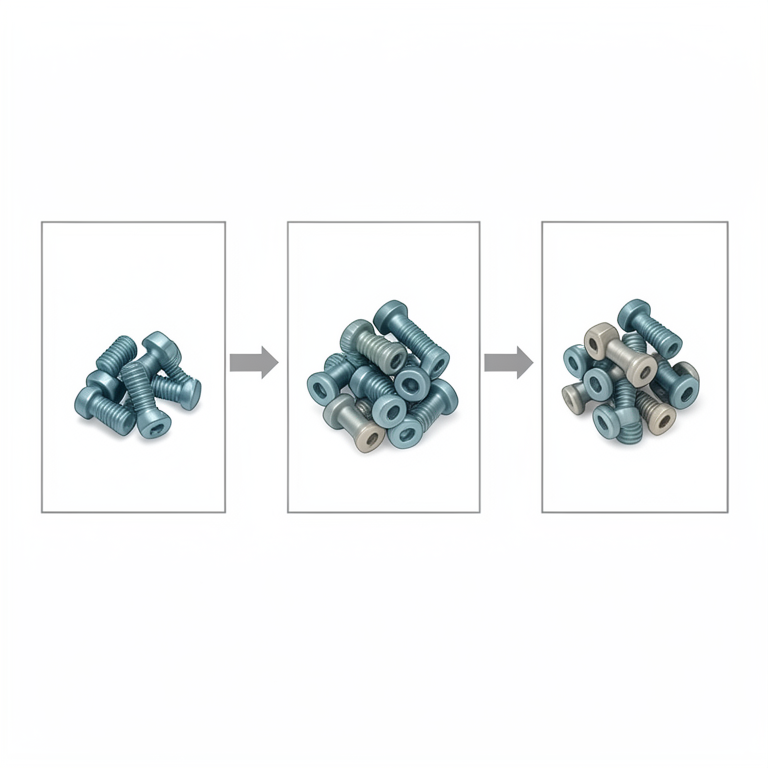
Linear Sample Size Progression
AI-generated conceptual illustration (industrial metal bolts). It explains the idea and does not show study data.
View source evidence ↗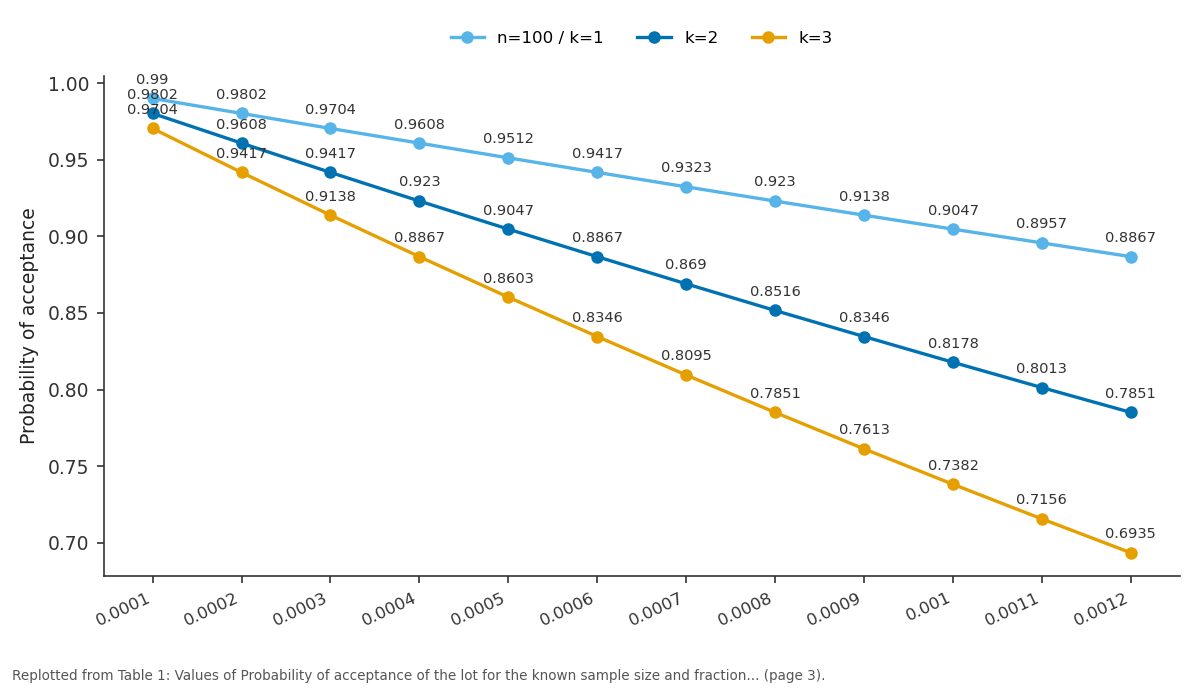
n=100 / k=1 and k=2 and more: 0.0001 vs 0.0002 vs 0.0003 vs 0.0004 vs 0.0005
Replotted from Table 1 (page 3) of the original paper. Every bar is the paper's own table value.
View source evidence ↗Figures & tables
From the original paper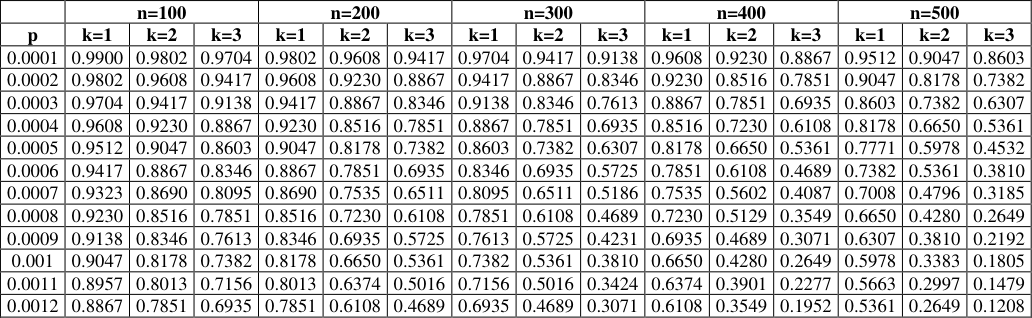 Table 1
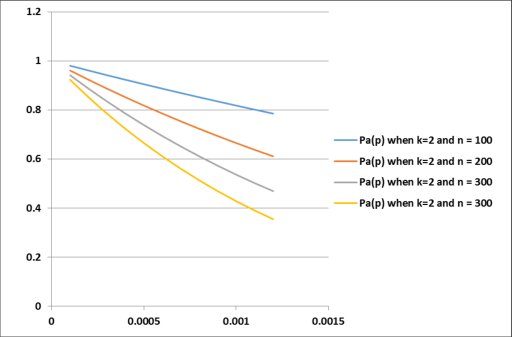 Figure 1
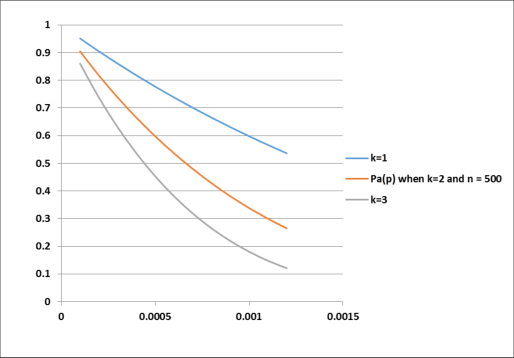 Figure 2
Introduction
In industries Single Sampling Plans for attributes quality characteristics are widely used because of its simplicity. However when the lot is not accepted on the basis of sample result then there is some suspicion about the quality of the product and hence the producer may face high risk due to rejection of products or lots. Therefore, double sampling, sequential sampling plans, etc., were developed which has its own advantages and disadvantages. Since single sampling plan procedure is easy to apply in shaft floor, Robert Sherman (1965) [10] has developed Repetitive Group Sampling plans based on SSP procedure. The operating procedure of RGS plan is very simple, draw a random sample of size n from the lot and find the number of defective units d. If d ≤ c1, accept the lot. If d > c2, then reject the lot. If d lies in between c1 and c2, then repeat the inspection until a decision is made on the lot. Thus the parameters of RGS are n,c1 and c2. In RGS plans if the sample result does not leads to either acceptance or rejection of the lot then it is discarded and new sample is drawn and it is continued until the lot is sentenced. If the decision is not made based on the sample results, then inspection continues, again and again sample is discarded. However in modern industries if the lots are not accepted based on the few sample results then there may be heavy loss in terms of money, high cost in sampling inspection, etc. which may affect the production cost. During such circumstances the producer may face severe risk in terms of sampling cost, production cost and finally competitive cost. Also customers may lose hope on the producer and the relationship between them may be at stake. The main drawback of RGS is, it is not an advantage plan for small lots since the sampling algorithm of RGS goes infinite number of iterations. Hence to offset the disadvantages of RGS a novel RRGS plans are developed. In order to satisfy the need of the consumer and at the same time to maintain the quality of the products, if the lots are not accepted then immediately the sampling inspection parameter n of RRGS is being linearly related with number of repetition within the same lot while sampling continues. Quality control engineers need special type of repetitive sampling plans in order to achieve quality criteria for small lots.
During the Relational Repetitive Group Sampling inspection if the first sample result does not lead to the acceptance then immediately the sample size is linearly increased in the next coming sampling inspections and this should be continued until the lot is either accepted or rejected based on the new protocol. Hence based on new sampling procedure the efficiency measures are derived and given. In this paper an attempt has been made to develop new type of Relational Repetitive Group Sampling plans and is termed as RRGS sampling plans. In RGS plans the repetition continues until the lot is either accepted or rejected and sometimes the inspection continues for a large number of trials. There is no pressure or criteria on the producer in terms of sampling plan parameters. Quality of the lot may be at stake, since same sample size is constantly repeated with same acceptance numbers. Hence to maintain the quality of the products and also to give pressure on the producer during inspection, if the lots are not accepted based on first sample, then immediately the sampling inspection parameter especially the sample size is linearly increased in relation with number of repetitions. Thus pressure is given to the producer by increasing the sample size during the inspection. Therefore the lot will be either accepted or rejected at the earliest within smaller number of trials and inspection. Hence time and cost may be reduced while implementing the new RRGS inspection plans. The number of trials is reduced during the sampling and consequently the sampling protocol is also reduced. Even though many authors have contributed to RGS plans there is a research gap in pressurizing the producer to maintain the quality of the lots through the sample size. Hence new RRGS plans are developed and accordingly the designing procedure is presented. Based on the designing procedure tables are constructed for easy implementation in industries. Soundararajan and Ramaswamy (1984) [14] have constructed tables of sampling plans based on Sherman's procedure. Balamurali et al. [2015] [4][5] , Singh et al.
[1989] [13] have developed RGS plan for variable characteristics. Shankar (1993) have developed GERT based RGS plans. Gauri Shankar et al. (2001) [11] , have developed Two-Stage Conditional Repetitive Group Sampling Plans. Sang-Ho Lee, et al. (2012) [8] , have developed Repetitive Group Sampling Plans With Double Specification Limits. Senthil Kumar D, et al. (2015) [9] have studied constructed table for Repetitive Deferred Variables Sampling (RDVS) Plan Indexed by Quality Levels.
Formulation and Operating Procedure of RRGS
In this new RRGS plans, the sample size is linearly increased in relation to number of repetition during inspection. For instance, the first sample size is n, if the second repetition occurs then the second sample size is 2 times of n, if the third repetition continues then the third sample size is 3n and this is continues until the lot is either accepted or rejected with the same acceptance number. If the sample size is increased linearly then the probability acceptance of the lot will be lesser. This will create very high pressure on the producer to maintain the quality of the lots. k is number of allowable repetition 12. Repeat steps 2 to 5 until the lot is either accepted or rejected. 13. If the lot is not accepted or rejected till k, inspection is stopped and then the lot is sentenced to screening. 14. All the rejected lots are screened 100%.
Let
Let
Selection of k:
The repetition parameter can be chosen such that k=N/n, Where N is the lot size. Also k ≥ 1.
Theorem
The Operating Characteristics function of RRGS plans is given as Where nk = k*n Case(i), Case(ii),...etc., are all mutually exclusive events. Therefore by addition theorem on Probability we get,
Proof
Proof
Generalization of OC function:
In Average sample number ASN is defined as the expected number of units required to make a unique decision on the lots.
Advantages of RRGS Plans
1. Since RRGS is truncated at k th sample, the decision is arrived earlier than infinite number of sample inspections. 2. Since sample size is linearly increased with same acceptance number c1 and c2, the lot will be rejected very soon if the quality deteriorate within the lot. 3. The RRGS is effective when the lot size is not very large. 4. The parameter of the sampling plans are c1,c2,k and n only. The subsequent sample sizes n2, n3...nk are all not the parameters since they are all multiples of n. Hence the estimation of parameters with regard to sample size is minimum.
Designing RRGS plans indexed through AQL.
Step 1: Determine the process average from the production process.
Step 2: Let α be the producer risk.
Step 3: Determine the parameters of RRGS such that Pa(p1) ≥ 1 -α
Step 5: Construct the required tables for various AQL.
Tables are being constructed for selection of RRGS-1 indexed through AQL, LQL, IQL, Mintan method, crossover point, through MAPD, etc., 7. Screen the entire rejected lot.
Summary
In this paper, if the lots are not accepted then immediately the sampling inspection parameter 'n' of RRGS is being linearly related with number of repetition within the same lot while sampling continues. The New algorithm makes the lot either accepted or rejected at the earliest within smaller number of trials and inspection. Hence the advantage is time and cost may be reduced while implementing the new RRGS inspection plans. It is found that when quality deteriorates then there is a decrease in the probability of acceptance of the lot.
Figures and tables from the paper
| — | n=100 | — | — | n=200 | — | — | n=300 | — | — | n=400 | — | — | n=500 | — | — |
|---|---|---|---|---|---|---|---|---|---|---|---|---|---|---|---|
| p | k=1 | k=2 | k=3 | k=1 | k=2 | k=3 | k=1 | k=2 | k=3 | k=1 | k=2 | k=3 | k=1 | k=2 | k=3 |
| 0.0001 | 0.9900 | 0.9802 | 0.9704 | 0.9802 | 0.9608 | 0.9417 | 0.9704 | 0.9417 | 0.9138 | 0.9608 | 0.9230 | 0.8867 | 0.9512 | 0.9047 | 0.8603 |
| 0.0002 | 0.9802 | 0.9608 | 0.9417 | 0.9608 | 0.9230 | 0.8867 | 0.9417 | 0.8867 | 0.8346 | 0.9230 | 0.8516 | 0.7851 | 0.9047 | 0.8178 | 0.7382 |
| 0.0003 | 0.9704 | 0.9417 | 0.9138 | 0.9417 | 0.8867 | 0.8346 | 0.9138 | 0.8346 | 0.7613 | 0.8867 | 0.7851 | 0.6935 | 0.8603 | 0.7382 | 0.6307 |
| 0.0004 | 0.9608 | 0.9230 | 0.8867 | 0.9230 | 0.8516 | 0.7851 | 0.8867 | 0.7851 | 0.6935 | 0.8516 | 0.7230 | 0.6108 | 0.8178 | 0.6650 | 0.5361 |
| 0.0005 | 0.9512 | 0.9047 | 0.8603 | 0.9047 | 0.8178 | 0.7382 | 0.8603 | 0.7382 | 0.6307 | 0.8178 | 0.6650 | 0.5361 | 0.7771 | 0.5978 | 0.4532 |
| 0.0006 | 0.9417 | 0.8867 | 0.8346 | 0.8867 | 0.7851 | 0.6935 | 0.8346 | 0.6935 | 0.5725 | 0.7851 | 0.6108 | 0.4689 | 0.7382 | 0.5361 | 0.3810 |
| 0.0007 | 0.9323 | 0.8690 | 0.8095 | 0.8690 | 0.7535 | 0.6511 | 0.8095 | 0.6511 | 0.5186 | 0.7535 | 0.5602 | 0.4087 | 0.7008 | 0.4796 | 0.3185 |
| 0.0008 | 0.9230 | 0.8516 | 0.7851 | 0.8516 | 0.7230 | 0.6108 | 0.7851 | 0.6108 | 0.4689 | 0.7230 | 0.5129 | 0.3549 | 0.6650 | 0.4280 | 0.2649 |
| 0.0009 | 0.9138 | 0.8346 | 0.7613 | 0.8346 | 0.6935 | 0.5725 | 0.7613 | 0.5725 | 0.4231 | 0.6935 | 0.4689 | 0.3071 | 0.6307 | 0.3810 | 0.2192 |
| 0.001 | 0.9047 | 0.8178 | 0.7382 | 0.8178 | 0.6650 | 0.5361 | 0.7382 | 0.5361 | 0.3810 | 0.6650 | 0.4280 | 0.2649 | 0.5978 | 0.3383 | 0.1805 |
| 0.0011 | 0.8957 | 0.8013 | 0.7156 | 0.8013 | 0.6374 | 0.5016 | 0.7156 | 0.5016 | 0.3424 | 0.6374 | 0.3901 | 0.2277 | 0.5663 | 0.2997 | 0.1479 |
| 0.0012 | 0.8867 | 0.7851 | 0.6935 | 0.7851 | 0.6108 | 0.4689 | 0.6935 | 0.4689 | 0.3071 | 0.6108 | 0.3549 | 0.1952 | 0.5361 | 0.2649 | 0.1208 |
Table text extracted from the original PDF; superscript letters are shown inline. The original table image is below.
View original table image
References
15 in the original paper- Aslam M, C-H Yen, C-H Jun."Variable Repetitive Group Sampling Plans with Process Loss Consideration." Journal of Statistical Computation and Simulation. 2011; 81(11):1417-1432. doi:10.1080/ 00949655.2010.487826.
- Aslam M, YL Lio, C-H. Jun. "Repetitive Acceptance Sampling Plans for Burr Type XII Percentiles." International journal of Advanced Manufacturing Technology. 2013; 68:495-507. doi:10.1007/s00170-0134747-x.
- Aslam M, Azam M, C-H Jun. "A Mixed Repetitive Sampling Plan Based on Process Capability Index." Applied Mathematical Modeling. 2013; 37(24):1002710035. DOI: 10.1016/j.apm.2013.05.058.
- Balamurali S, Muhammad Aslam, Chi-Hyuck Jun Repetitive Group Sampling Plan Under Gamma-Poisson Distribution, Sci. Int. (Lahore). 2015; 27(5):3949-3956. ISSN 1013-5316.
- Balamurali S, C-H. Jun. Repetitive Group Sampling Procedure for Variables Inspection." Journal of Applied Statistics.2006; 33(3):327-338.
- Gauri Shankar AK, Sahu RK. Srivastava Two-Stage Conditional Repetitive Group Sampling Plan, Defence Science Journal. 2001; 51(3):297-302.
- Jun C-H, Lee H, Lee SH, Balamurali S. "A Variables Repetitive Group Sampling Plan under Failure-Censored Reliability Tests for Weibull Distribution." Journal of Applied Statistics. 2010; 37(3):453-460.
- Sang-Ho Lee, Muhammad Aslam, Chi-Hyuck Jun. Repetitive Group Sampling Plans With Double Specification Limits, Pakistan Journal Of Statistics. 2012; 28(1):41-57.
- Senthil Kumar D, Ramya SR, Esha Raffie B. "Construction and Selection of Repetitive Deferred Variables Sampling (RDVS) Plan Indexed by Quality Levels", Journal of Academia and Industrial Research (JAIR). 2015; 3(10):497-497-503.
- Sherman RE. Design and evaluation of repetitive group sampling plan. Technometrics. 1965; 9(7):11-21.
- Shankar G, Mohapatra BN. GERT analysis of conditional repetitive group sampling plan. IJQRM. 1993; 10(2):5062.
- Shankar G. GERT methods used in quality control. Economic Quality Control. 1993; 8(4):209-214.
- Singh HR, Shankar G, Mohapatra BN. GERT analysis of repetitive group sampling plan. Metron. 1989; 47(1-4): 339-49.
- Soundararajan V, Ramaswamy MM. Designing repetitive group sampling (RGS) plan indexed by AQL and LQL. IAPQR Transactions. 1984; 9(1):9-14.
- Suresh KK, Saminathan R. "Construction And Selection Of Repetitive Deferred Sampling (RDS) Plan Through Acceptable And Limiting Quality Levels", International Journal of Pure and Applied Mathematics. 2010; 65(3):257-264.
Cited by 1
From OpenAlex, OpenCitations and reference lists read by Scinovex
- Formation of Repetitive Group Sampling Plan for Life Tests Based on Percentiles using Odd Frechet Inverse Rayleigh Distribution ↗
P. K. Neena Krishna, S Jayalakshmi · Indian Journal of Science and Technology · 2024
Objectives: This paper presents the idea of Repetitive Group Sampling Plans using Odd Frechet Inverse Rayleigh Distribution, when the life test is truncated at a pre-specified time. The main objective of the proposed sampling plan is to minimize the sample size because the analogous inspection time and inspection cost will be reduced. Methods: A truncated life test may be conducted…
❝ 1PDF