
Research article · 2020 · Full text
International Journal of Statistics and Applied MathematicsEta-Ricci soliton on W3-Semi symmetric LP Sasakian Manifolfds
Volume 5(5) · Pages 48–52 · DOI: 10.22271/maths.2020.v5.i5a.584 ↗
Research areasGeometric Analysis and Curvature FlowsGeometry and complex manifoldsAdvanced Differential Geometry Research
Abstract
Author-writtenIn this paper, we study ƞ-Ricci solitons on Lorentzian para-Sasakian manifold satisfying the semi symmetric conditions R(ξ,X)•W3 (Y,Z) U=0 and W3 (ξ,X)•R(Y,Z)U=0. At the end of this paper, we show that the LP-Sasakian manifold accepting a ƞ-Ricci solitons structure is Einstain.
Summary
Source-checkedPlain-language reading of the full paper, prepared with AI and checked against the text. Each point links to the authors' own words.
Why it matters
- Ricci-flow serves as an evolution equation for the metric of a Riemannian manifold. View evidence ↗
- The eta-Ricci soliton is a generalized concept of the Ricci-flow. View evidence ↗
- In Lorentzian Para-Sasakian (LP-Sasakian) manifolds, the W3 curvature tensor exhibits semi-symmetric and cyclic properties similar to Weyl's projective tensor. View evidence ↗
The question
- The study aims to analyze eta-Ricci solitons on Lorentzian para-Sasakian manifolds that satisfy specific semi-symmetric conditions involving the W3 curvature tensor. View evidence ↗
What they did
- The research utilizes an n-dimensional smooth manifold M equipped with a Lorentzian Para-Sasakian structure consisting of a tensor field, a vector field, a 1-form, and a Lorentzian metric. View evidence ↗
- The authors define a Sasakian manifold as W3-semi-symmetric if the condition R(ξ, X). W3(Y, Z) = 0 is met. View evidence ↗
- The analysis examines the relationship between the constants lambda (λ) and mu (μ) of an eta-Ricci soliton under the W3-semi-symmetric condition. View evidence ↗
What they found
- For a Lorentzian Para-Sasakian manifold that is W3-semi-symmetric, the eta-Ricci soliton constants are λ=1 when μ=n. View evidence ↗
- A Lorentzian Para-Sasakian manifold admitting an eta-Ricci soliton and satisfying the W3-semi-symmetric condition R(ξ, X). W3(Y, Z) = 0 is an Einstein manifold. View evidence ↗
- Under the condition S(ξ, X). W3(Y, Z) = 0, the eta-Ricci soliton on a Lorentzian Para-Sasakian manifold also results in λ=1 when μ=n. View evidence ↗
- A Lorentzian Para-Sasakian manifold admitting an eta-Ricci soliton and satisfying the condition S(ξ, X). W3(Y, Z) = 0 is an Einstein manifold. View evidence ↗
What it means
- The authors conclude that an LP-Sasakian manifold that accepts an eta-Ricci soliton structure is an Einstein manifold. View evidence ↗
- The authors suggest that the W3 curvature tensor and Weyl's projective tensor can be used interchangeably to study the geometric and physical characteristics of manifolds. View evidence ↗
Visual summary
1 visualsIllustrations explain the paper; they do not show study data.
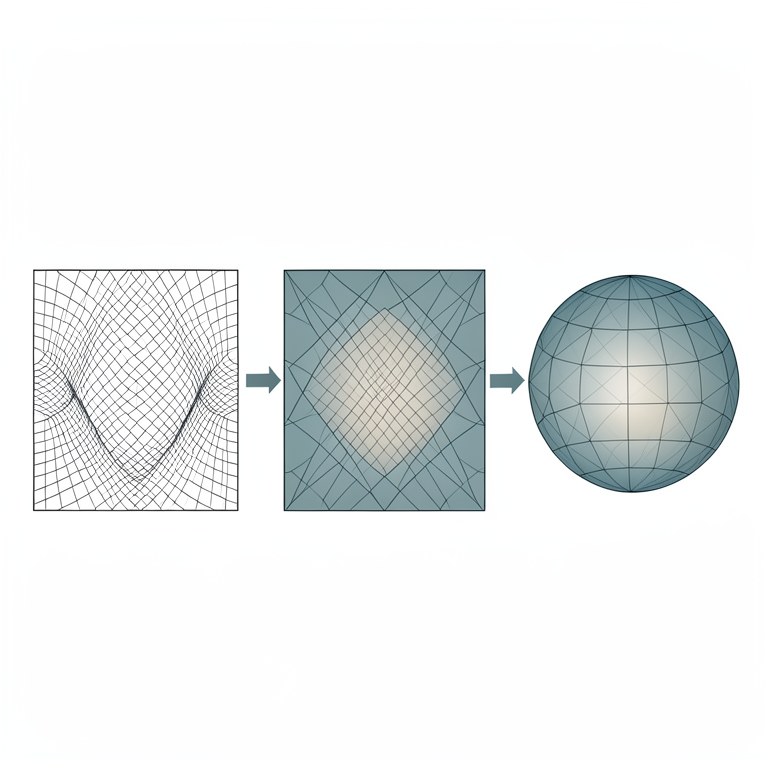
Conceptual Flow of the Proof
AI-generated conceptual illustration (A four-dimensional curved Lorentzian manifold represented as a warped geometric grid surface). It explains the idea and does not show study data.
View source evidence ↗Introduction
Ricci-flow is an evolution equation for metric on a Riemannian manifold. The Ricci-flow equation is given 𝜕𝑔 𝜕𝑡 = -2𝑆 [see [1] ] (0.1) on a compact Riemannian manifold M with metric g. Ricci-soliton is a special solution to the Ricci-flow, but only if it moves by a one parameter family of diffeomorphism and scaling. The Ricci-soliton is given by 𝐿𝑣 𝑔 + 2𝑆 + 2 𝜆𝑔 = 0 (0.2)
Where, 𝐿𝑣 is Lie derivative in the V direction, S is Ricci curvature tensor, g is a Riemannian metric, V is a vector field and λ is a scalar. ƞ-Ricci soliton is a more general notion of the Ricci-flow. This idea was put forward by J.J Cho and Makoto Kimura [5] , and they gave its equation by 𝐿𝜉𝑔 + 2𝑆 = -2𝜆𝑔 -2 𝜇ƞ⨂ƞλ and μ are constants. Where R is the Riemannian curvature tensor of rank (𝑟) = 𝑛 -1
Preliminaries
We also observe that the data (g, ξ,λ ,μ), If it sufficiently satisfy equation (0.2), then it is said to be a ƞ-Ricci soliton on the manifold M [2] . More particularly, if we let μ=0, then (g ξ,λ) is a Ricci soliton according to R.S Hamilton [9] . And thus, equation (0.2) is said to be is Shrinking (λ< 0), steady (λ=0) or expanding (λ> 0) [2] .
Generalised Lorentzian Para-Sasakian Manifolds
Let M be an n-dimensional smooth manifold, 𝜙 a tensor field of (1,1)-type, ξ a vector field, ƞ a 1-form and 𝑔 a Lorentzian metric on M, We say that, (𝜙, 𝜉, ƞ, 𝑔) is a Lorentzian Para-Sasakian structure of M [06] if:
1. 𝜑𝜉 = 0, ƞ ○ 𝜑 = 0 2. ƞ(𝜉) = -1, 𝜑2 = 1 + ƞ⨂𝜉 3. 𝑔(𝜑°, 𝜑°) = 𝑔 + ƞ⨂ƞ 4. (𝛻𝑥𝑌) = 𝑔(𝑋, 𝑌)𝜉 + 2ƞ(𝑋)ƞ(𝑌) + ƞ(𝑌)𝑋 for any 𝑋, 𝑌 ∈ 𝔛(𝑀),
From the definition, it follows that ƞ is the g-dual of ξ, that is, ƞ(𝑋) = 𝑔(𝑋, 𝜉)for any X ∈ 𝔛(M), ξ then satisfies (0.6) 𝑔(𝜉, 𝜉) = -1
Here, φ is a g-symmetric operator, i.e.
𝑔(𝜑𝑋, 𝑌) = 𝑔(𝑋, 𝜑𝑌) for any 𝑋, 𝑌 ∈ 𝔛(𝑀).
These structures, (from equation 1-4) have their properties given in the following remark.
Remark 1.1
In [3] , and [4] , different authors have proved that, On a Lorentzian Para-Sasakian manifold (𝑀, 𝜑, 𝜉, ƞ, 𝑔), for any 𝑋, 𝑌, 𝑍 ∈ 𝔛(𝑀), the following relations holds:
Where 𝑅 is the Riemannian Curvature tensor field, and ∇, the Levi-Civita associated to 𝑔.
The proofs of these properties are given by Adara [1] 2.0 eta-Ricci Soliton on W3-Semi Symmetric LP Sasakian Manifolfds U.C De and N. Guha [10] gave the definition of semi-symmetric as 𝑅(𝑋, 𝑌). 𝑅(𝑍, 𝑈) = 0 On the same line, we can also have,
Definition 2.1:
A Sasakian manifold is said to be W 3 -semi-symmetric if 𝑅(𝜉, 𝑋). 𝑊 3 (𝑌, 𝑍) = 0 (2.1) Theorem 2.2: If (φ,ξ,ƞ,g) is a Lorentzian Para-Sasakian structure on the manifold Mn,and if (g,ξ,λ,μ) is a ƞ-Ricci soliton on Mn, and 𝑅(𝜉, 𝑋). 𝑊 3 (𝑌, 𝑍) = 0, then λ=1, when μ=n.
Proof
The condition that W3 must satisfy is given by, 𝑊 3 (𝑅(𝜉, 𝑋)𝑌, 𝑍) + 𝑊 3 (𝑌, 𝑅(𝜉, 𝑋)𝑍 = 0 (2.2) For 𝑋, 𝑌, 𝑍 ∈ 𝔛(𝑀)
Using the definition (0.4) in LP-Sasakian, we obtain ƞ-Ricci Soliton (eqn 0.1). Now, using the relation, 𝑅(𝜉, 𝑋)𝑍 = 𝑔(𝑋, 𝑍)𝜉 -ƞ(𝑍)𝑋 Corollary 2.3: If (𝜑, 𝜉, ƞ, 𝑔) is a Lorentzian Para-Sasakian structure on the Manifold Mn, (𝑔, 𝜉, 𝜆, 𝜇) is a ƞ-Ricci Soliton on Mn, and if 𝑅(𝜉, 𝑋). 𝑊 3 (𝑌, 𝑍) = 0, then (Mn,g) is Einstein Manifold Theorem 2.4: If (𝜇, 𝜉, ƞ, 𝑔) is a Lorentzian Para-Sasakian structure on the manifold Mn, and if (𝑔, 𝜉, 𝜆, 𝜇) is a ƞ-Ricci soliton on Mn, and 𝑆(𝜉, 𝑋). 𝑊 3 (𝑌, 𝑍) = 0, then λ=1, when μ=n.
Proof:
If the Sasakian space is a 𝑊 3 -semi-symmetric, then 𝑆(𝜉, 𝑋). 𝑊 3 (𝑌, 𝑍) = 0 And the condition that W3 must satisfy is given by, 𝑆(𝑋, 𝑊 3
Again, from Pokhariyal's definition of 𝑊 3 [8] , and by putting U=Z=ξ into (2.20), we have ƞ(𝑊 3 (𝑌, 𝜉)𝜉) = 0
Computing the third term, we see that 𝑔(𝜑𝑋, 𝑊 3 (𝑌, 𝜉)𝜉) = -𝑔(𝜑𝑋, 𝑌) + And thus, whenever μ=n, then λ=1. Hence the theorem.
Corollary 2.5: If (μ,ξ,ƞ,g) is a Lorentzian Para-Sasakian structure on the Manifold Mn, (g,ξ,λ,μ) is a ƞ-Ricci Soliton on Mn, and if 𝑆(𝜉, 𝑋). 𝑊 3 (𝑌, 𝑍) = 0, then (Mn,g) is Einstein Manifold
Discussion
In LP-Sasakian manifold, W3 curvature tensor satisfies semi-symmetric and cyclic properties with fixed X [8] . The properties are similar to those of Weyl's projective tensor. Therefore, the two tensors can be used alternatively to study the physical and geometrical characteristics of manifolds.
Acknowledgement
AcknowledgementTo the referees, the author would like to pass his sincere gratitude for your valuable suggestions and remarks which has immensely improved and brought this paper to existence.
References
9 in the original paper- Adara Blaga M. eta-Ricci Solitons on Lorentzian Para-Sasakian Manifolds. Filomat. 2016; 30(2):484-496.
- Chow B, Lu P, Ni L. Hamilton Ricci Flow, Graduate Studies on Mathematics, AMS providence RI, USA, 2006, 77.
- Chauby SK, Ojha RH. On The m-projectile curvature tensor of a Kenmotsu manifolds, Differential Geometry. 2010; 12:5260.
- Mihai I, Shaikh AA, De UC. On Lorentzian Para-Sasakian Manifolds, Rendiconti del seminario matematico di messino, serie II, 1999.
- Cho TJ, Kimura M. eta-Ricci Solitons and real Hypersurfaces in a complex space form. Tohoku Math. J 2009; 61(2):205-212.
- Adati T, Miyazawa T. On a Riemannian space with recurrent conformal curvature, Tensor, N.S. 1967; 18:348-35.
- Pokhariyal GP, Mishra RS. Curvature tensors and their relativistic significance (11) Yokohama math J. 1971; 19(2):97-103.
- Hamilton RS. The Ricci Flow on Surfaces, Math. And general relativity (santa cruz, CA,), contemp Math. 71(1988, AMS), 1986, 237-262.
- DC UC, Guha N, On coharmonically recurrent sasakian manifold, Indian J Math. 1992; 34:209-215.
Cited by 2
From OpenAlex, OpenCitations and reference lists read by Scinovex
- Some Solitons on Anti-Invariant Submanifolds of Para-Sasakian Manifold Admitting Semi-Symmetric Non-Metric Connection ↗
Abhijit Mandal, Mustafa Yıldırım, Adel Mohammed Ali Al-Qashbari, Mohammad Nazrul Islam Khan · Symmetry · 2025
The objective of this study is to investigate ρ-Einstein solitons on submanifolds of a para-Sasakian manifold under certain curvature conditions. The novelty of this work lies in the characterization of ρ-Einstein solitons on anti-invariant submanifolds of a para-Sasakian manifold equipped with a semi-symmetric non-metric connection, where the structure vector field is taken as the potential vector field. We establish several…
❝ 4PDF - $$\widetilde{Q}_3$$-curvature tensor on a semi-Riemannian manifold ↗
Rana Pratap Singh YADAV, Bhagwat Prasad, Puneet Mathur, Ashwamedh Mourya, Sunil Kumar Srivastava · Proceedings of the Indian National Science Academy · 2026
❝ 0