
Research article · 2020 · Full text
International Journal of Advanced Biochemistry ResearchLipid peroxidation and antioxidant status in cigarette smokers ischemic heart disease (IHD) patients
Volume 4(2) · Pages 17–19 · DOI: 10.33545/26174693.2020.v4.i2a.50 ↗
Research areasCardiovascular Disease and Adiposity
Abstract
Author-writtenMethods: The study group consisted of 50 smokers and 50 healthy individuals aged between 35-65 years. During the course of study, some smokers presented with clinical signs and symptoms of ischemic heart disease. ECG of the individuals of the study group was done and accordingly they were classified as smokers with and without IHD, Lipid peroxidation, antioxidant status, Serum Total Cholesterol and its fractions, Triglyceride, HDL, LDL and VLDL were estimated. Out of the total number of smokers (n=50) involved in the study, 22 individuals presented with changes in their ECG pattern diagnostic of IHD (44% conversion rate). Most of these individuals who presented with changes in ECG pattern of IHD were chain smokers (heavy smokers) or individuals smoking for more than 30 years. All of these individuals were non-diabetic. Results: The level of Serum Cholesterol, triglycerides, VLDL, LDL, hs-CRP and MDA were found to be significantly raised in smokers while HDL cholesterol, ratio of esterified cholesterol to free cholesterol and Glutathione was significantly decreased (p
Summary
Source-checkedPlain-language reading of the full paper, prepared with AI and checked against the text. Each point links to the authors' own words.
Why it matters
- Cigarette smoking is recognized as a potential risk factor for Ischemic Heart Disease (IHD) due to its close relationship with atherosclerosis. View evidence ↗
- High sensitive C-reactive protein (hs-CRP) serves as a marker for systemic inflammation and is produced by the liver during inflammatory conditions. View evidence ↗
- Malondialdehyde (MDA) is a common biomarker for lipid peroxidation, while reduced glutathione (GSH) is the primary non-enzymatic cellular antioxidant. View evidence ↗
The question
- The study aimed to determine how smoking affects lipid profiles, increases oxidative stress and inflammatory responses, and subsequently increases cardiac risk. View evidence ↗
What they did
- Based on ECG results, the smoker group was further divided into those with IHD (n=22) and those without IHD (n=28). View evidence ↗
- The researchers measured systemic inflammation (hs-CRP), oxidative stress (MDA, GSH), and a full lipid profile including total cholesterol, triglycerides, HDL, LDL, and VLDL. View evidence ↗
- Data were analyzed using SPSS with student's t-tests, reporting results as mean ±SD or median (range), with significance set at p < 0.05. View evidence ↗
What they found
- Total smokers showed significantly higher levels of hs-CRP (0.8 mg/L vs 0.4 mg/L) and MDA (3.3 ± 1.0 μmol/L vs 0.9 ± 0.4 μmol/L), and lower GSH (7.7 mg/dl vs 13 mg/dl) compared to normal individuals. View evidence ↗
- Smokers with IHD exhibited significantly higher MDA levels (3.9 ± 1.0 μmol/L) than smokers without IHD (3.5 ± 1.1 μmol/L). View evidence ↗
- The ratio of cholesterol ester to free cholesterol was significantly decreased in all smoker groups compared to normal individuals, suggesting nicotine affects cholesterol esterification. View evidence ↗
What it means
- The authors conclude that the significant decrease in HDL levels across all smoker categories is the most critical parameter for diagnosing impending cardiac risk. View evidence ↗
- The authors recommend regular lipid profile checks for smokers, noting that HDL decreases even in mild smokers. View evidence ↗
Visual summary
1 visualsIllustrations explain the paper; they do not show study data.
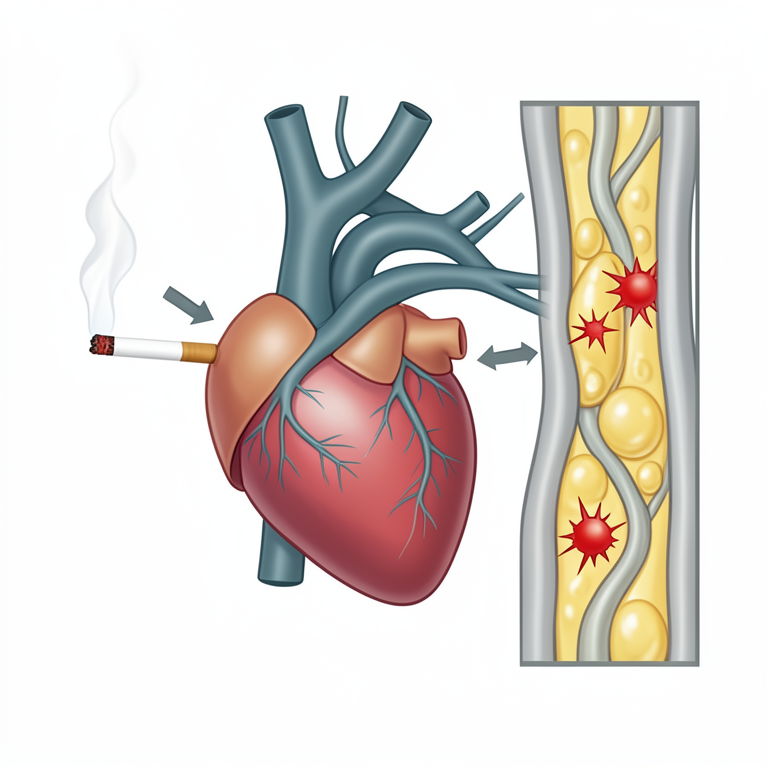
Impact of Smoking on Health Markers
AI-generated conceptual illustration (human heart and blood vessels). It explains the idea and does not show study data.
View source evidence ↗Figures & tables
From the original paper Table 1
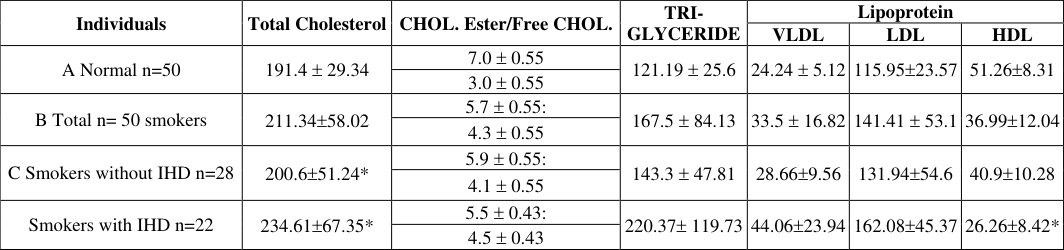 Table 2
Introduction
In the developed and developing countries like India, Tobacco consumption is on the increase may be as a status symbol in affluent society or because of addition in lower strata. The death rate is increasing day by day. 40 to 60% of individuals below the age of 40 years who suffered from heart disease include chain smokers (heavy smokers). Several epidemiological studies indicated a close relationship between cigarette smoking and atherosclerosis, considering smoking as a potential risk factor for Ischemic heart disease and the one in which cessation has been shown to reduce the risk. High sensitive C-reactive protein (hs-CRP) is one of the major acute phase proteins produced by the liver in many inflammatory conditions [1][2][3][4][5] and is a marker of systemic inflammation. Oxidative stress has been implicated in the pathogenesis of Ischemic Heart Disease. One of the most frequently used biomarkers providing an indication of the overall lipid peroxidation level is malondialdehyde (MDA). There are a number of antioxidants present in the body derived from the diet. Main non-enzymatic cellular antioxidant is reduced glutathione (GSH). Significantly raised Serum Cholesterol, Triglyceride, LDL and VLDL and decreased HDL levels in smokers have been reported by several workers [6][7][8] . On the contrary few workers have observed no significant rise in Cholesterol or Triglyceride level [9,10] or decrease in HDL level [11] in smokers. In view of this, present study was undertaken to ascertain the role of smoking in deranging lipid profile, increased oxidative stress, including direct damage by radical species and the inflammatory response which further leads to cardiac risk in some smokers.
Materials and Methods
The present study was carried out in Govt. Medical College, Jalaun at Department of Biochemistry. The Subjects included for study was 50 smokers and 50 normal individuals aged between 35-65 years. A detailed history of all the normal individuals and smokers was taken. All the subjects were clinically examined and ECG was done before the start of study of assess cardiac functions. Duration of smoking was counted from the time when person started smoking regularly. During the course of study, 22/50 smokers showed changes in their electrocardiogram and Clinical Diagnosed as cases of IHD. This prompted us to classify the total smokers (n=50) in to smokers without IHD (n=28) and with IHD (n=22) so as to assess the impending cardiac risk in apparently healthy smokers. Venous blood samples were collected after overnight fasting. Serum hs-CRP (Immunoturbidimetry), MDA (Thiobarbituric acid reactive substance TARBS), GSH (Ellman's method), Serum Total Cholesterol and its Fractions (Zak et al) [12] , Serum Triglyceride (McGowan et al) [13] , Serum HDL (Burstein et al) [14] , Serum LDL (Bates et al) [15] and VLDL (Lowenstein et al) [16] were estimated.
Statistical Analysis
The statistical analysis performed using SPSS. The results are shown as mean ±SD (Standard Deviation) and median (range). The data was analyzed using the student's t-test. The p value of <0.05 was denoted as statistically significant.
Results and Discussions
The levels of hs-CRP, MDA and GSH in various groups have been presented in (Table I). Serum Cholesterol, Triglyceride, and ratio of Cholesterol ester to free Cholesterol, HDL, LDL and VLDL in various groups have been presented in (Table II). hs-CRP levels were significantly elevated across the all groups (Table I) hs-CRP was significantly elevated in both the group of smokers with and without, when compared to controls. Moreover, hs-CRP elevation in smokers with IHD was significant when compared to smokers without IHD. These findings suggest that increase in hs-CRP levels was more pronounced in smokers with IHD patients when compared to smokers without IHD and controls. (Table I) Moreover, significantly elevated MDA were observed in smokers with IHD when compared to smokers without IHD. (Table I) GSH were significantly lower in both the groups of smokers with and without IHD when compared to controls. (Table I). Smoking as a risk factor for CAD is closely associated with increased oxidative stress, and the number of cigarettes smoked plays an important role in increasing the level of oxidative damage and reducing antioxidant defence. [21] Raised, but not very significant, levels of cholesterol were observed in smokers without IHD as compared to nonsmokers (p<0.05, table II), while smokers having IHD had significantly increased cholesterol levels as compared to smokers without IHD (p<0.001, table III). Ratio of Cholesterol ester to free cholesterol was significantly decreased in all groups of smokers (p<0.001, table II) as compared to normal individuals indicating the effect of nicotine inhalation on Esterification of Cholesterol by LCAT enzyme in Plasma. These findings are consistent to those of Kulkarni et al [17] . Serum Triglyceride levels were found to be raised, very significantly, in each category of smokers (p<0.001, table II) may be due to the fact that nicotine delays the gastric emptying time and also causes and increase in the secretion of nor-adrenaline which activates lipoprotein lipase of adipose tissue resulting in lipolysis and more production of free Triglyceride, Supporting the proposed mechanism of action of inhaled nicotine by Elkeles et al [18] , Muscat et al [19] , Simon LA [20] and NS Neki [8] . Pattern of VLDL levels were found to be similar to that of Triglyceride in all groups of smokers as compared to Non-smokers (Table I). A Significant increase in LDL levels had also been observed in all categories (p<0.001, Table II) of smokers as compared to Non-smokers. The cause of raised Serum LDL in smokers may be that virtually all VLDL in human is converted to LDL by the process in which IDL is the intermediate product. The process is catalyzed by lipoprotein lipase, the action of which is enhanced by nicotine inhalation, as suggested earlier. A very significant decrease in HDL levels virtually in all categories of smokers (p<0.001, table II) makes it the most important parameter to check deranged lipid profile and hence diagnosing the impending cardiac risk to smokers [22][23] . A significant decrease in HDL even in case of mild smokers is really alarming and indicates towards the need of getting lipid profile checked regularly. The decrease in HDL may be due to improper handling of oral fat by nicotine inhalation, which affects gastric emptying time and due to effect of nicotine on LCAT activity. As suggested, normally LCAT bound to HDL-3 converts' free cholesterol to esterified cholesterol which creates a concentration gradient and free cholesterol is drawn from tissues for transport to excretory system in the liver by antiatherogenic HDL-2. Since nicotine hampers LCAT activity, HDL-3 decreases with a concomitant decrease in HDL-2. So scavenging action of HDL is disturbed, resulting in an increased risk of atherosclerosis as proved by significantly decreased levels of HDL-C also in smokers without IHD in our study. The data were expressed as mean ±SD. The data was analyzed using the student's, t-test. * indicates p<0.05 and statistically significant.
Acknowledgement
AcknowledgementThe authors are thankful to the normal healthy subjects and cigarette smokers who volunteered to give blood samples for the present study.
Figures and tables from the paper
| Individuals | hs-CRP (mg/L) | MDA (mol/L) | GSH (mg/dl) |
|---|---|---|---|
| A Normal n=50 | 0.4 (0.2-0.6) | 0.9 0.4 | 13 (11.6-18.8) |
| B Total n= 50 smokers | 0.8 (0.7-1.0)* | 3.3 1.0* | 7.7 (6.5-8.4)* |
| C Smokers without IHD n=28 | 0.7 (0.6-1.1)* | 3.5 1.1* | 8.1 (7.1-9.6)* |
| Smokers with IHD n=22 | 1.1 (0.7-1.8)* | 3.9 1.0* | 7.5 (6.4-8.7)* |
Table text extracted from the original PDF; superscript letters are shown inline. The original table image is below.
View original table image
| Individuals | Total Cholesterol | CHOL. Ester/Free CHOL. | TRI- GLYCERIDE | Lipoprotein | — | — |
|---|---|---|---|---|---|---|
| VLDL | LDL | HDL | ||||
| A Normal n=50 | 191.4 29.34 | 7.0 0.55 | 121.19 25.6 | 24.24 5.12 | 115.9523.57 | 51.268.31 |
| 3.0 0.55 | ||||||
| B Total n= 50 smokers | 211.3458.02 | 5.7 0.55: | 167.5 84.13 | 33.5 16.82 | 141.41 53.1 | 36.9912.04 |
| 4.3 0.55 | ||||||
| C Smokers without IHD n=28 | 200.651.24* | 5.9 0.55: | 143.3 47.81 | 28.669.56 | 131.9454.6 | 40.910.28 |
| 4.1 0.55 | ||||||
| Smokers with IHD n=22 | 234.6167.35* | 5.5 0.43: | 220.37 119.73 | 44.0623.94 | 162.0845.37 | 26.268.42* |
| 4.5 0.43 |
Table text extracted from the original PDF; superscript letters are shown inline. The original table image is below.
View original table image
References
23 in the original paper- Gorden T, Kannel WB, McGee D, Daroben TR: Death and cornary attacks in men after giving up ug smoking; a report from the Framingham study. Lancet. 1974; 2:1345-1348.
- ten year follow up. J Am Coll Cardiao. 1992; 20:287294.
- Critchley JA, M. Sc. M. Phil, Capewell S, MD, FRCPE. Mortality Risk Reduction Associated with smoking Cessation in patients with Coronary Heart Disease JAMA. 2003; 290:86-97
- Brischetto CS, Connor WE, Connor SL, Metarazzo JD: Plasma lipids and lipoprotein profiles of Cigarette smokers from randomly selected families: Enhancement of hyperlipidemia and depression of HDL. AmJ Cardiol 1983; 52(7):675-80.
- Rastogi R, Srivastava SSI, Mehrotra TN, Singh VS, Gupta MK: Lipid profile in smokers. JAPI 1989; 37(12):264.
- Garg JP, Gupta RS, Agrawal MP, Bhandari VM: Effect of smoking on serum lipids and lipoproteins in healthy subjects and patients of mycocardial infraction and hypertension. Indian Journal of Medical Science. 1983; 37:63.
- Whig J, Singh CB, Soni GL, Bansal AK: Serum lipids and lipoprotein profile of cigarette smokers and passive smokers. Indian J Med Res. (B). 1992; 96:282.
- NS Neki: Lipid profile in Chronic Smokers-A clinical Study JIACM. 2002; 3(1):51-4.
- Kontinen A, Rajasalami M: Effect of heavy cigarette smoking on post-prandial triglycerides, free fatty acids and cholesterol. BMJ 1963; 1:850.
- Richmond W, Seviour PW, Teal TK, Elkeles RS: Impaired intravascular lipolysis with changes in concentration of high density lipoprotein subclasses in young smokers. BMJ. 1987; 295:246.
- Gordon T, Castelli WP, Hjortland M, Cannel WB, Dawber TR: HDL as a protective factor against coronary heart disease. The Framingham study. Am J Med. 1977; 62:707.
- Zlatikis A, Zak B, Boyle AJ: A new method for direct determination of serum cholesterol. J Lab Clinical Med. 1953; 41:486.
- Mcgowan MW, Artiss JD, Strandbergh DR, Zak B: A peroxidase coupled method for the colorimetric determination of Serum Triglycerides. Clin. Chem. 1988; 29(3):538.
- Brustein M, Shiarcvich HR, MOrfin R: Method of estimation of HDL-cholesterol. J Lipid Research. 1970; 11:583.
- Bates CM, Warren GS: South Med. J 1989; 82:570.
- Lowenstein AG Varrier: Am J Med 1984; 76:80.
- Kulkarni KA, Durgawale P, Lanjekar P, More K: A study on quantitation of compositional changes in the level of total cholesterol and HDL fraction in smokers and its correlation with that on non-smokers. Indian J of Clinical Biochem 1991; 6:131.
- Elkeles RS, Khan SR, Chowdhary V: Effect of smoking on oral fat tolerance and HDLC. Clinical Science 1985; 65:665.
- Muscat JE, Harris RE: Cigarette smoking and plasma cholesterol. Am Heart journal. 1991; 121:141.
- Simons LA, Simons J, Jones AS: The interaction of body weight, age, Cigarette smoking and hormone usage with blood pressure and plasma lipids in an Australian Community. Aus NZ J Med. 1984; 14:21521.
- G Kamceva, ZA Sarafinovska, T Ruskovska, M Zdravkovska et al. Cigarette smoking and oxidative stress in patients with coronary artery disease. Open Access Maced J Med Sci. 2016; 4(4):636-640.
- Kharb S, Singh GP: Effect of smoking on lipid profile, lipid peroxidation and antioxidant status in normal subjects and in patients during and after acute myocardial infarction. Clin Chim Acta. 2000; 302(1-2):213-9.
- Metta S, Basalingappa DR, Uppala S, Mitta G. Erythrocyte Antioxidant Defenses Against Cigarette Smoking in Ischemic Heart Disease. J Clin Diagn Res. 2015; 9(6):BC08-11.
Cited by 3
From OpenAlex, OpenCitations and reference lists read by Scinovex
- Computational and physicochemical insight into 4-hydroxy-2-nonenal induced structural and functional perturbations in human low-density lipoprotein ↗
Neda Tufail, Minhal Abidi, Mohd Sharib Warsi, Tasneem Kausar, Shahid M. Nayeem, Moinuddin · Journal of Biomolecular Structure and Dynamics · 2023
Lipid peroxidation (LPO) is a biological process that frequently occurs under physiological conditions. Undue oxidative stress increases the level of LPO; which may further contribute to the development of cancer. 4-Hydroxy-2-nonenal (HNE), one of the principal by-products of LPO, is present in high concentrations in oxidatively stressed cells. HNE rapidly reacts with various biological components, including DNA and proteins; however,…
❝ 5 - Assessment of Biochemical Risk Factors of Coronary Artery Disease in North and South Indian population ↗
Shashwat Singh -, Suchit Swaroop · International Journal For Multidisciplinary Research · 2025
Coronary artery disease (CAD) in India is closely linked to elevated body mass index (BMI), dyslipidemia, and metabolic risk factors. Studies from Northern India, including Himachal Pradesh, Uttar Pradesh, and Jammu & Kashmir, show high obesity prevalence, especially in rural and tribal populations, with low HDL and borderline triglyceride levels. Advanced lipid markers like oxidized LDL (ox-LDL) and small dense…
❝ 0PDF - HUBUNGAN HIPERURISEMIA DENGAN KEJADIAN PENYAKIT JANTUNG KORONER ↗
Hesty Wahyuningsih, Andina Putri Aulia, Prima Rizky Nur Rasyid, Ajat Sudrajat, Riefky Ikhsan Pratama · Medika Kartika Jurnal Kedokteran dan Kesehatan · 2023
Penyakit jantung koroner (PJK) merupakan penyakit dengan tingkat kematian tinggi. Beberapa kondisi yang menjadi faktor risiko PJK antara lain dislipidemia, diabetes melitus, merokok, dan obesitas. Hiperurisemia diduga mempunyai hubungan dengan kejadian PJK dalam beberapa tahun terakhir, namun masih terdapat kontroversi. Penelitian ini bertujuan untuk mengetahui hubungan antara hiperurisemia dengan PJK di Rumah Sakit Islam Sultan Agung Semarang. Rancangan penelitian yang…
❝ 0PDF