
Research article · 2020 · Full text
International Journal of Advanced Biochemistry ResearchPrealbumin variation in neonatal bacterial infections
Volume 4(2) · Pages 04–07 · DOI: 10.33545/26174693.2020.v4.i2a.47 ↗
Research areasNeonatal Health and BiochemistryInflammatory Biomarkers in Disease Prognosis
Abstract
Author-writtenThis is a prospective cross-sectional study carried out at the department of pediatric of the Diamniadio children's hospital in 2016. This includes subjects aged between 0 and 28 days admitted for neonatal infection according to clinical and anamnestic criteria. Prealbumin assay was carried out using the immuno-turbidimetry technique with the A15 automate of Biosystems®. In 50 newborns, bacterial neonatal infection was confirmed in 24% of the population. Prealbumin concentration of newborns with isolated germs (179.08±108.87 mg / L) is lower compared to the group where no germ was isolated (199.41±108.87 mg / L) but without significant difference. However, Gram-negative infection was responsible for a greater decrease in prealbumin. It is therefore important to include the dosage of prealbumin in the monitoring of neonatal bacterial infections to prevent complications.
Summary
Source-checkedPlain-language reading of the full paper, prepared with AI and checked against the text. Each point links to the authors' own words.
Why it matters
- Prealbumin, also known as transthyretin (TTR), is a plasma protein used as a biochemical marker to reflect a patient's nutritional status. View evidence ↗
- Prealbumin levels typically drop quickly during acute events like surgery, trauma, and bacterial infections as the body prioritizes inflammatory proteins. View evidence ↗
- Managing bacterial infections in newborns is challenging because clinical signs and existing laboratory markers are often non-specific. View evidence ↗
What they did
- The researchers conducted a prospective cross-sectional study in 2016 at the Diamniadio Children's Hospital. View evidence ↗
- The study included newborns aged 0 to 28 days who were hospitalized for suspected neonatal infection based on clinical and anamnestic criteria. View evidence ↗
- Prealbumin levels in serum were measured using the immuno-turbidimetry technique on a Biosystems® A15 auto analyzer. View evidence ↗
- The study population consisted of 50 newborns, with bacterial infection confirmed in 24% of them. View evidence ↗
What they found
- A significant majority of the patients (70%, n=35) had normal prealbumin levels, while 15% (n=15) had abnormal levels (p=0.010). View evidence ↗
- No significant difference in prealbumin levels was found between males (200.88±86.05 mg/L) and females (187.71±90.22 mg/L), with a p-value of 0.83. View evidence ↗
- Prealbumin concentrations were lower in newborns infected with Gram-negative bacilli (including enterobacteria and non-fermentative bacteria) compared to those infected with cocci, although the difference was not significant. View evidence ↗
What it means
- The authors conclude that confirmed bacterial infections and specifically Gram-negative bacilli are associated with lower prealbumin concentrations, likely due to the virulence of the bacteria. View evidence ↗
- The authors recommend including prealbumin dosage in the monitoring of neonatal bacterial infections to help prevent complications. View evidence ↗
Visual summary
2 visualsIllustrations explain the paper; charts are replotted from the paper's own table values.
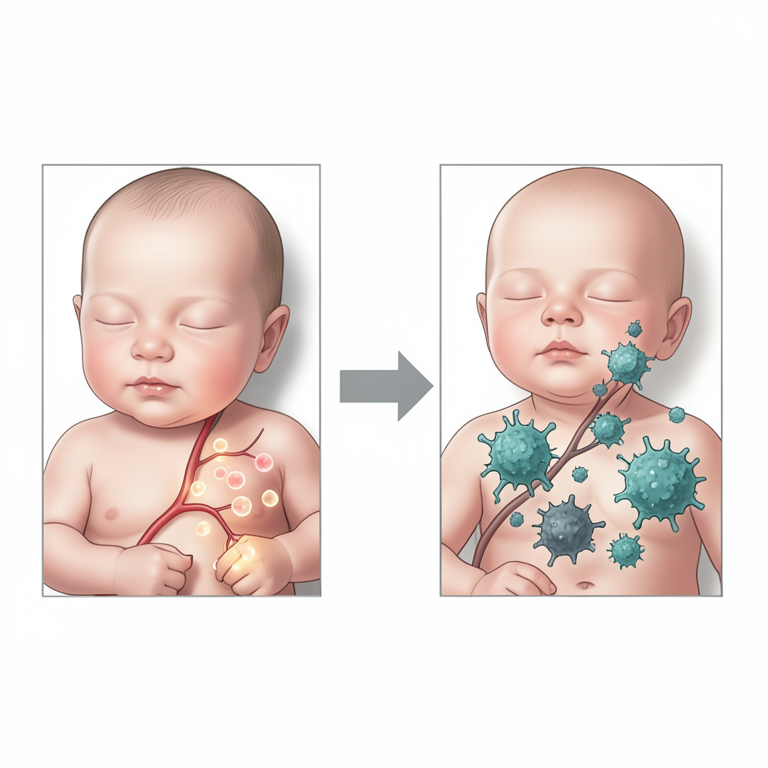
Prealbumin Response to Infection
AI-generated conceptual illustration (neonatal blood plasma and Gram-negative bacilli bacteria). It explains the idea and does not show study data.
View source evidence ↗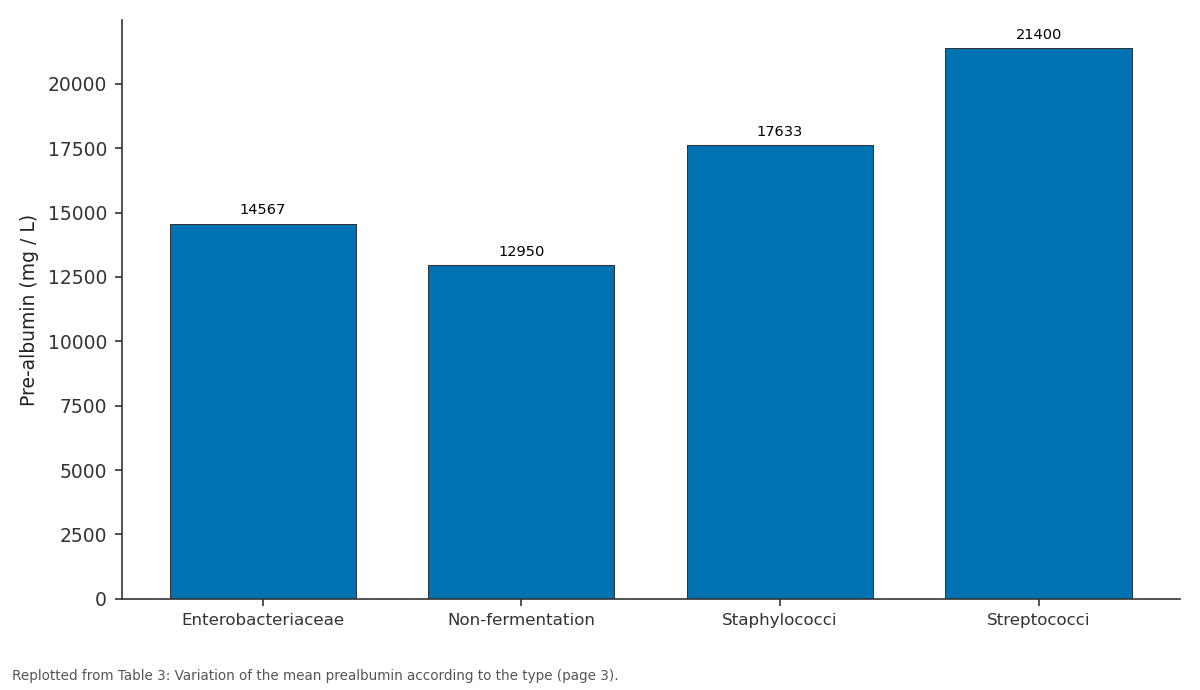
Pre-albumin (mg / L): Enterobacteriaceae vs Non-fermentation vs Staphylococci vs Streptococci
Replotted from Table 3 (page 3) of the original paper. Every bar is the paper's own table value.
View source evidence ↗Figures & tables
From the original paper Table 1
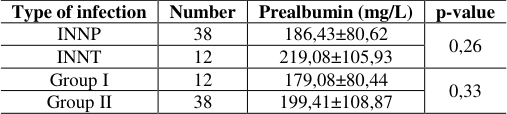 Table 2
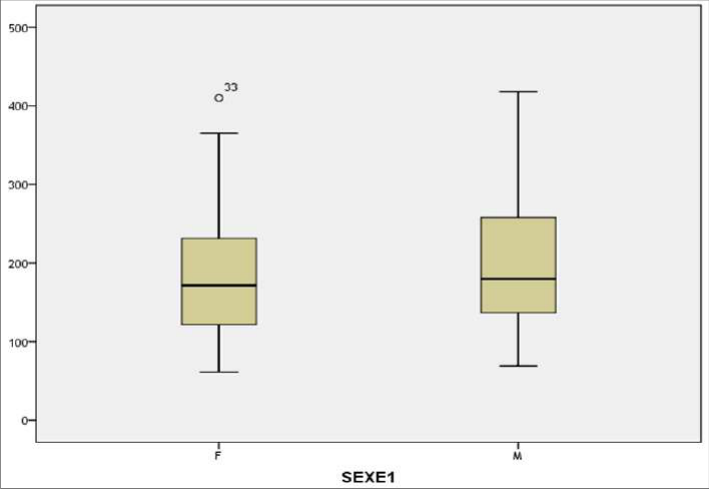 Figure 1
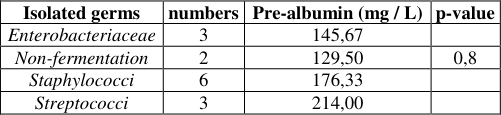 Table 3
Introduction
Prealbumin also called transthyretin (TTR) is known as a biochemical marker that reflects the nutritional status of patients. It is a plasma protein mainly synthesized by the liver. Its half-life ranges from 2 to 4 days [1] . Small amounts of TTR are also synthesized by the choroid plexus [2] , pancreas and retina, but they probably do not affect serum protein concentration [3] . As per its characteristics, it is a protein marker of interest in the biological diagnosis of early malnutrition [4] . It is quickly lowered during acute attacks such as those resulting from trauma, surgery, and especially bacterial infections [5] in favor of many inflammatory proteins. The interaction between nutritional status and infections has been studied extensively [6,7] . In intensive care units, the combination of low concentrations of TTR and albumin can help identify patients at high risk of developing sepsis [8] . In newborns, the levels of transthyretin may be affected by several factors such as gestational age, inflammation, infection, and surgery [9] . Though all pathologies can be accompanied by malnutrition, extreme ages are mostly affected due to physiological peculiarities, especially in newborns. Malnutrition is often unknown in hospitals and more specifically in pediatrics [10] . When combined with other markers, variation in prealbumin concentration can help understand the severity of a disease [2] and the change in the nutritional status of a patient, which may result in the increasing of the length of hospitalization [11] . Early recognition of malnutrition is necessary in the prevention of sepsis, morbidity, as well as mortality [11] from a possible related disease. Thus, TTR may have the potential to detect and reflect various types of clinical circumstances as a biomarker [12] such as in systemic inflammatory response syndrome (SIRS) where its synthesis is reduced in favor of acute phase proteins [13] . In this study, our objective was to assess concentrations of the plasma prealbumin and to analyze whether these plasma concentrations can predict neonatal infection.
Type of study
This is a prospective cross-sectional study carried out in newborns of consenting parents admitted to the pediatric department of the Diamniadio Children's Hospital for neonatal infection in 2016.
Study population
Patients aged between 0 and 28 days, hospitalized in the neonatology unit of the pediatric department for a suspected neonatal infection according to clinical-anamnestic criteria were included in this study.
Sampling
Samples are taken at the hospitalization Unit by qualified personnel on a dry tube and on a blood culture bag.
Determination of prealbumin
The A15 auto analyzer by Biosystems® was used. The prealbumin assay was made from serum using the immunoturbidimetry technique with the reagent from Biosystems®. An internal quality control was carried out to validate the results.
Principle
The presence of prealbumin in the sample precipitates in the presence of anti-human prealbumin antibodies. The light s attering generated by the antigen-antibody complexes was proportional to the prealbumin concentration and can be quantified by turbidimetry.
Statistical analysis
Statistical analysis was performed using SPSS version 20 software. The statistical analysis methods used are Fisher's F tests and KHI-DEUX test. A p> 0.05 is considered significant. where bacterial infection was confirmed with isolation of a germ had a lower prealbumin concentration (179.08±80.44 mg / L) than those in group II (199.41±108, 87) where infection was not confirmed but without significant difference.
Results
Results
Fig 1: Variation of the mean prealbumin according to sex
The mean level of prealbumin in female patients was 187.71 with a standard deviation ±90.221 while the mean level of prealbumin in male patients was 200.88 with a standard deviation ±165.36 (figure 1). Prealbumin was lower for subjects infected with bacilli, non-fermentative bacteria and enterobacteria, compared to cocci, but without a significant difference.
Discussion
In our population consisting of 50 newborns, 70% had normal prealbumin values (Table I) with a significant difference (p = 0.01). In newborns, real malnutrition was rare [14] . At birth, plasma TTR concentrations were approximately two-thirds of those measured in healthy mothers, and then increase linearly as the infant grows [5] .
Based on the type of infection, particularly in the case of early neonatal infection (INNP) which occurs between D0 and D7 and late neonatal infection (INNT) which occurs between D8 and D28, no significant difference was observed (Table II). However, subjects with an NNRT had higher prealbumin values. This comparison also corresponds to the study of the variation of prealbumin as a function of age, which was therefore not significant.
The result was contradictory with the one of Johnson [15] who demonstrated that prealbumin varied with age. Jono's multicenter study [12] also demonstrated variation with age for both sexes. This contradiction may be related to the size and age difference between our populations and theirs. Also regarding sex, the difference was not significant with a pvalue equal to 0.83 between an average prealbumin equal to 200.88±86.05 mg / L in males and 187, 71±90.22 mg / L for female subjects (Figure 1). According to Ingenbleek [16] , the difference based on sex was apparent because of androgenic hormones on anabolic processes. Similarly, Aliyazıcıoğlu [17] noted a difference according to gender for a determination of prealbumin in the umbilical cord. As per his findings, the levels of gonadotropins in the umbilical cord were significantly higher in men than in women. This explains the differences found in relation to our results. Moreover, the evaluation of prealbumin based on the isolation of germs allowed us to obtain an average of 179.08±108.87 mg / L for group I and of 199.41±108.87 mg / L for group II (Table IV). The average of the prealbumin concentration of the group where a germ was isolated was lower compared to the group where no germ was isolated but without significance with a p-value equal to 0.33 well above 0.05. However, no difference was observed that may depend on the type of germs isolated. Subjects infected with Gram negative bacilli had lower prealbumin concentrations (Table III). This is because bacteria in this group can express pathogenicity factors that allow them to overcome various obstacles in the body's specific and non-specific defenses. They can then directly access the targeted tissues or allow toxins to diffuse therein, which could lead to temporary or permanent cellular alterations [18] . Nonfermenting Pseudomonas aeruginosa for example, is very pathogenic in subjects with impaired means of defense.
As evidenced by the study by Cynober et al. [19] which reported that burns with sepsis had very low serum TTR levels compared to those who did not. He concluded that low serum TTR levels seemed to predict fatal outcomes for patients. Bernstein's study [13] also demonstrated among hospitalized patients that the TTR was lower in patients with Systemic Inflammatory Response Syndrome with an increased white blood cell count of over 12,000 / µl, and procalcitonin (PCT) of more than 2.0 pg / ml.
Conclusion
Our results highlighted normal values for most of our targeted population. The group with a confirmed bacterial neonatal infection had a lower average prealbumin concentration whereas neonates infected with Gramnegative bacilli had lower TTR concentrations, probably related to their virulence.
Figures and tables from the paper
| Normal prealbumin | Number | Percentage |
|---|---|---|
| NO | 15 | 30% |
| YES | 35 | 70% |
| Total | 50 | 100% |
Table text extracted from the original PDF; superscript letters are shown inline. The original table image is below.
View original table image
| Type of infection | Number | Prealbumin (mg/L) | p-value |
|---|---|---|---|
| INNP | 38 | 186,43±80,62 | 0,26 |
| INNT | 12 | 219,08±105,93 | |
| Group I | 12 | 179,08±80,44 | 0,33 |
| Group II | 38 | 199,41±108,87 |
Table text extracted from the original PDF; superscript letters are shown inline. The original table image is below.
View original table image
| Isolated germs | numbers | Pre-albumin (mg / L) | p-value |
|---|---|---|---|
| Enterobacteriaceae | 3 | 145,67 | |
| Non-fermentation | 2 | 129,50 | 0,8 |
| Staphylococci | 6 | 176,33 | |
| Streptococci | 3 | 214,00 |
Table text extracted from the original PDF; superscript letters are shown inline. The original table image is below.
View original table image
References
19 in the original paper- Yang HT, Yim H, Cho YS et al. Serum Transthyretin Level is associated with clinical severity rather than nutrition status in Massively Burned Patients. Journal of Parenteral and Enteral Nutrition. 2014; 38(89):966-72.
- Ambrosius W, Slawomir M, Kazmierski R et al. Predictive value of serum transthyretin for outcome in acute ischemic stroke. PLoS ONE. 2017; 12(6):e0179806.
- International Federation of Clinical Chemistry and Laboratory Medicine (IFCC). Clinical indications for plasma protein assays: transthyretin (prealbumin) in inflammation and malnutrition. Clin Chem Lab Med. 2007; 45(3):419-426.
- Aussel C, Ziegler F. Évaluation de l'état nutritionnel. Revue Francophone des Laboratoires - septembre/octobre, 2014 -N°465, cahier 1.
- Ingenbleek Y, Bernstein LH. Plasma Transthyretin as a Biomarker of Lean Body Mass and Catabolic States. Adv Nutr. 2015; 6:572-80.
- Chevalier Ph, Delpeuch E et Maire B. Le complexe malnutrition-infection: premier problème de santé publique chez les populations défavorisées. Méd Mal Infect. 1996; 26:366-70.
- Scrimshaw NS, Taylor CE, Gordon JE. Interactions entre l'état nutritionnel et les infections. Genève; OMS, 1971, n°57.
- Devakonda A, George L, Raoofet S. Transthyretin as a marker to predict outcome in critically ill patients. Clinical Biochemistry. 2008; (41):1126-1130.
- Nash P, MSN NNP-BC. Transthyretin (aka Prealbumin): Why Is It Part of TPN Labs? Neonatal Network. 2009; 28(n°5):339-341.
- Joosten KFM, Hulst JM. Nutritional screening tools for hospitalized children: Methodological considerations. Clin Nutr. Févr. 2014; 33(1):1-5.
- Cunningham LL, Madsen MJ, Van Sickels JE. Using Prealbumin as an Inflammatory Marker for Patients with Deep Space Infections of Odontogenic Origin. J Oral Maxillofac Surg. 2006; 64:375-378.
- Jono H, SU Y, Obayashi K et al. Sources of variation of transthyretin in healthy subjects in East and Southeast Asia: Clinical and experimental evidence for the effect of alcohol on transthyretin metabolism. Clinica Chimica Acta. 2016; 458:5-11.
- Bernstein LH, Transthyretin and the Systemic Inflammatory Response. Current Nutrition & Food Science. 2009; 5:71-74.
- Picaud JC. Dénutrition périnatale: prise en charge nutritionnelle spécifique du nouveau-né. Nutrition clinique et métabolisme, Numéro hors-série Archives de pédiatrie. 2005; 19(vol. 12, n° 4):1238-243.
- Johnson AM, MerlinI G, Sheldon J et al. Clinical indications for plasma protein assays: transthyretin (prealbumin) in inflammation and malnutrition. Clin Chem Lab Med. 2007; 45(3):419-426.
- Ingenbleek Y, Young VR. Significance of Transthyretin in Protein Metabolism. Clin Chem Lab Med. 2002; 40(12):1281-1291.
- Aliyazıcıoğlu Y, Değer O, Caner Karahan S et al. Reference values of cord blood transferrin, ceruloplasmin, alpha-1 antitrypsin, prealbumin, and alpha-2 macroglobulin concentrations in healthy term newborns. The Turkish Journal of Pediatrics. 2007; 49:52-54.
- Sansonetti P. Déterminants de virulence chez les bacilles à Gram négatif. Medecine Sciences. 1987; 3:68-74.
- Cynober L, Prugnaud O, Lioret N et al. Serum transthyretin levels in patients with burn injury. Surgery. 1991; 109:640-644.
Cited by 3
From OpenAlex, OpenCitations and reference lists read by Scinovex
- Knowledge and attitude towards antibiotics use among mothers attending pediatric clinics in king Saud medical city, Riyadh, Saudi Arabia 2021 ↗
Hamood Alturaigi, Mohannad Alshaya, Muhannad Aldubaykhi, Ali Almhawas, Khaled Alshehri · International Journal of Advanced Community Medicine · 2021
Background: Upper respiratory tract infections (URTIs) are particularly common in children and are a major source of antibiotic misuse, which leads to antibiotic resistance development. Aims: To assess the Knowledge and Attitude towards antibiotics use among mothers Attending pediatric clinics in King Saud medical city |(KSMC), Riyadh, Saudi Arabia. Materials and Methods: This cross sectional study was conducted in pediatric…
❝ 2PDF - A study on impact of perioperative nutrition support in surgical gastroenterology patients in era of eras ↗
Dr. Md. Akheeluddin Khaja, Amar Chand · International Journal of Surgery Science · 2021
Background: Preoperative malnutrition is common in surgical patients and has been associated with poor clinical outcomes. Aim and Objective: This study is undertaken to assess the role of perioperative nutrition on mortality and morbidity in surgical patients who are moderately and severely undernourished in Indian patients. Methodology: Prospective randomized control study, approved from budget committee and research methology and ethical…
❝ 0PDF - Patterns of disease and outcomes of neonatal admissions at Fallujah teaching hospital for women and children ↗
Mohammed Shuckur, Majeed Hameed Al Ajeli · International journal of applied research · 2020
❝ 0Found by Scinovex