
Research article · 2020 · Full text
International Journal of Veterinary Sciences and Animal HusbandryPrevalence of Dirofilaria immitis in stray dogs from Sofia, Bulgaria
Volume 5(4) · Pages 40–43
Research areasParasitic Diseases Research and TreatmentParasite Biology and Host Interactions
Abstract
Author-writtenDirofilaria immitis is a nematode parasite which is the causative agent of a serious pulmonary-cardiac disorder called Heartworm disease. It affects mainly dogs and rarely cats. The infection is transmitted by mosquitoes thus stray dogs and wild carnivores are expected to be an important reservoir of the infection. The aim of the study is to update the current knowledge about the distribution of D. immitis among stray dogs from Sofia, Bulgaria. The survey included 293 dogs which were examined with rapid blood test for circulating D. immitis antigens. The percentage of positive animals was 11.26 % which is comparable with the results of similar studies from different regions of Bulgaria. The epidemiological datareceived indicates that D. immitis infection is endemic in stray dogs in Sofia.
Summary
Source-checkedPlain-language reading of the full paper, prepared with AI and checked against the text. Each point links to the authors' own words.
Why it matters
- Dirofilaria immitis is a nematode parasite that causes Heartworm disease, a serious disorder affecting the pulmonary and cardiac systems. View evidence ↗
- Because the infection is transmitted via mosquitoes, stray dogs and wild carnivores are considered significant reservoirs for the parasite. View evidence ↗
- Heartworm disease is spreading to wider territories due to factors such as climate change, the introduction of new mosquito vector species, and the movement of infected dogs. View evidence ↗
The question
- The study aimed to update information regarding the prevalence of Dirofilaria immitis among stray dogs in Sofia, Bulgaria. View evidence ↗
What they did
- The survey was conducted in the Sofia region from January to December 2017, involving 293 stray dogs from the city and surrounding metropolitan areas. View evidence ↗
- The sample consisted of mixed-breed dogs over 8 months of age, with 58% males and 42% females. View evidence ↗
- Researchers used the Anigen Rapid CaniV-4Test Kit, a chromatographic immunoassay with 94.4% sensitivity and 100% specificity, to detect D. immitis antigens. View evidence ↗
What they found
- The prevalence of D. immitis in the studied population of stray dogs was 11.26% (33 out of 293 dogs). View evidence ↗
- Male dogs had a higher incidence of infection at 66.7% (22/33) compared to female dogs at 33.3% (11/33). View evidence ↗
- The prevalence in stray dogs was higher than in pet dogs in Sofia, where a similar survey found only 7.5% (12/160) positive animals. View evidence ↗
- Other Bulgarian data showed higher prevalence in wild carnivores, with golden jackals at 37.54% and red foxes at 25.22%. View evidence ↗
- In Serbia's Vojvodina province, the distribution rate was 7.2% in dogs and varied between 1.43% and 7.32% in wild carnivores. View evidence ↗
What it means
- The authors conclude that Sofia is an endemic area for D. immitis, with a significant portion of the stray dog population acting as carriers. View evidence ↗
- The authors recommend further examination and testing of stray dog populations in Bulgarian urban areas due to their role in the parasite's life cycle. View evidence ↗
- The authors state that controlling the stray dog population should be a priority for national health agencies and competent authorities. View evidence ↗
Visual summary
1 visualsIllustrations explain the paper; they do not show study data.
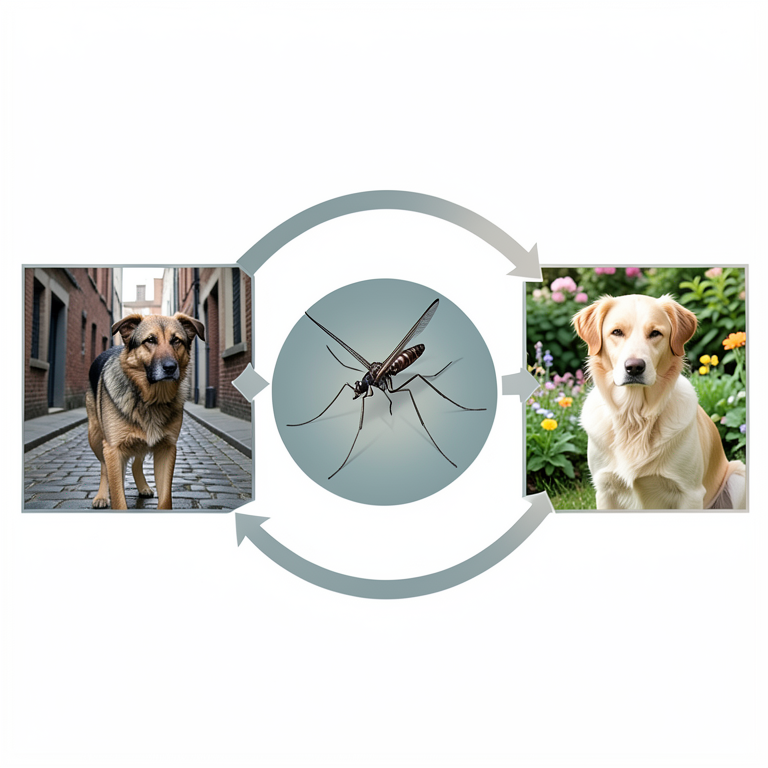
Transmission Cycle and Reservoirs
AI-generated conceptual illustration (stray dogs, pet dogs, and mosquitoes in an urban setting). It explains the idea and does not show study data.
View source evidence ↗Introduction
The progressive spread of vector-borne nematode diseases in the face of climate changes is a real veterinary challenge [1] . Heartworm disease (HWD) is a worldwide parasitic disorder caused by Dirofilaria immitis (Leidy, 1856), a representative of the Onchocercidae family. Despite the name the main residential location of the parasite is the pulmonary artery which leads to pulmonary hypertension and in some cases to right-sided heart failure. However the disease is often asymptomatic. Infection is transmitted by blood sucking arthropodsmosquitos (Culex spp., Aedes spp. and Anopheles spp.) [5,29] . The final hosts are mainly wild and domestic carnivores. Dirofilaria immitis possesses some zoonotic potential [24] although humans are usually affected by D. repens which is localized in the subcutaneous tissue [6,10] . By the time this article is issued human dirofilariasis cases in Bulgaria are caused by D. repens only [34] . Heartworm disease shows almost worldwide spread. In Europe the long established endemic areas are around the Mediterranean basin (Italy, South Frace, Spain) and follow the distribution of mosquitos. There is a progressive tendency of HWD spread to north and east Europe. It now became endemic in countries where it used to be a rare find. Underlying factors include the intense movement of infected dogs across Europe, increased attention toward the disease, emergence of new vector species, wild carnivore population dynamics as well as changes in ecosystem due to human activity [21] . However the climate changes and the introduction of new vector species are among the leading factors for HWD progression to wider territories [12] . The climate change in the past decades is the reason autochthonous heartworm disease to be detected also in central and northern parts of Europe [18] . A main reservoir of the nematode can be the domestic dog (Canis familiaris, L., 1758)-pet, stray, hunting etc. and different wild carnivoreswolf (Canis lupus, L., 1758), red fox (Vulpes vulpes, L., 1758), jackal (Canis aureus, L., 1758). Dirofiaria immitis in dogs was detected for the first time in Bulgaria at the end of the XX century and since then there is increasing data for the distribution of the parasite among canines, mainly pet dogs, in different regions of the country. Bulgaria is located in south-eastern Europe in the southern part of the North Temperate Zone. However it has some subtropical influence. This transitional location between two zones gives its reflection over the climate, soils, flora and fauna [9] . Sofia is the capital of the country with app. 1.5 million citizens. It is located in the western part of the territory at 550/600 meters above sea level. The city has continental climate characterized by cold winters and warm summers. Stray dogs are a serious ecological, social, medical and veterinary problem worldwide. In the last decade the number of stray dogs in Sofia is gradually decreased as a result of spay programs and legislation measures and nowadays their count is app. 24 194 in 2017 in the country (unofficial data). In Sofia district the figures point around 3844 [15] . In urban and suburban areas stray dogs can be an important source for parasite distribution to pet dogs and eventually humans [30] . The aim of this study was to update the information about Dirofilaria immitis prevalence in stray dogs from Sofia area.
Materials and Methods
Materials and Methods
Study area and animals
The survey was carried out in Sofia region between January and December 2017. Study included 293 stray dogs from different parts of the city and neighbored metropolitan areas. All animals were mix breed, from both sex (male -58 %, female -42 %), the age of all tested dogs was above 8 months. There was no information about prophylactic measures against parasites.
Clinical materials
Blood samples were collected from v. saphena lateralis or v. cephalica antebrachii through standard technique in tubes with EDTA. The rapid diagnostic test was performed ex tempore.
Diagnostic assay
The used assay was Anigen Rapid CaniV-4Test Kit (BioNote Inc., South Korea) -a chromatographic immunoassay which includes the qualitative detection of Dirofilaria immitis antigens. Sensitivity for heartworm is 94.4% and specificity -100%. The tests were performed according to the manufacturer's instructions.
Results and Discussion
The prevalence of D. immitis in the studied canine population was 11.26 % (33/293). By sex, male dogs showed a higher incidence 66.7 % (22/33) compared to females 33.3 % (11/33). The results of the current study were comparable to Radev [28] which reported 15 % positive dogs from 33 tested animals in a shelter in Sofia. At the same time our data were inconsistent with Stoyanova [30] which announced that 31.25 % (25/80) of tested stray dogs in Sofia were carriers of D.immitis. By sex, both studies confirmed that male dogs showed a higher incidence. Similar epidemiological survey for Sofia but for pet dogs resulted in 7.5 % positive animals (12/160) [4] . Despite the variation in D. immitis prevalence in different canine populations, it can be inferred from the accumulated epidemiological data that Sofia is an endemic area and both domestic and stray dogs population are constant parasite carriers. If we follow the results of previous studies we can concluded that at least for the few decades canines in various parts of the country were stably infected with D. immitis. According to Georgieva [13] 12.5 % of tested stray dogs and only 1.4 % of pet dogs were carriers. Results of necropsies of Kirkova [16] for Stara Zagora region (south Bulgaria) showed 10.7 % and comparable were the results of Kostadinov [17] which included 56 stray dogs from Burgas (East Bulgaria) -12.5 % were infested. Another survey from Stara Zagora region indicated that 16.2 % (27/167) of the examined with rapid antigenic test were positive for HWD [26] . The percentage range of all these surveys was 1.4 % -16.2%. Our result for Sofia (11.26%) falls in the same interval. All projects which included only pet dogs disclosed lower HWD prevalence (1.4 % -7.5 %). The possible explanations can be that owned dogs in the city live mostly indoors and are treated with repellent substances which decreased the possibility for mosquito biting and transmission of infection. Wild carnivores are among the main reservoirs of vectorborne nematodes. The necropsy of golden jackals (Canis aureus, L.), red foxes (Vulpes vulpes, L.) and stray dogs from different parts of Bulgaria demonstrated infection prevalence of 37.54 %, 25.22% and 33.33 % respectively [25] . The distribution of HWD in jackals from Pazardzik region (100 km west of Sofia) was even more pronounced -73.1 % (19/26) [20] . Bulgaria borders with five countries -Greece to the south, Romania to the north, Serbia and North Macedoniato the west and Turkey -to the south-east. According to Diacou [8] the prevalence of HWD in Greece was 4.1 % (31/750). In the northern part of the country (Thessaloniki) the spread was 14 % in comparison to 0.7 % in Attica. The geographical mismatch can be explained by the increased humidity and mosquito distribution in the north. The results of Angelou [2] were in confirmity -D. immitis prevalence among 1000 pet dogs was 9 %. In Romania the reported prevalence of HWD was 3.3 % (38/1146) with significant regional variationsbetween 2.9 % to 31% [19] . The highest percent was located in Tulcea region near Danube delta where more favorable ecological conditions for the vector development are available. The distribution rate of HWD in Serbia (Vojvodina province) was 7.2% [32] and in wild carnivores -golden jackals, red foxes and wolves -7.32 %, 1.55 % and 1.43 % respectively [27] . Turkey has quite different ecological and climate regions which can explain the divergence in results. In Sivas Province of Turkey (central Anatolia) Atas [3] reported 3.7 % in stray and 1.7 % in owned dogs and the highest prevalence in Turkey was reported to be 46.2% in Van Province (east Turkey) [1] . The huge difference can be due to the long snowy winter and dry warm summer in Sivas province therefore mosquito activity lasts less than 3 months. In the European part of Turkey some of the available results showed that in Istanbul the infection affects 1.52% of dogs [22] and 2% in the area of Gemlik in Bursa [7] . The available epidemiological data from the neighboring countries allows the conclusion that HWD is an endemic parasite in domestic and wild canine species in whole southeastern Europe. The retrospective study of Széll [31] based on necropsy finding of the parasite demonstrated rise of HWD prevalence from 0.5 % to 8.0 % for eleven years. Although the survey concerned central Europe (Hungary), it clearly demonstrated the rapid progression of infection spread within a short period of time resulting from climate-driven ecological changes and also the impact of wild carnivores in HWD epidemiology. Stray dogs are highly exposed to a range of zoonotic parasites including D. immitis and may become important reservoir for human and pet infection [23] . The limitation of stray dog population should be in the focus of competent authorities, health agencies and institutions in the country. According to the concept of "one health" the control and prevention of social and economically important infections require a multidisciplinary approach based on coordinated collaboration between governments, citizens, medical, veterinary and ecological authorities to achieve improvement of human and animal health [14,33] .
Conclusions
The current epidemiological survey demonstrated that Sofia, Bulgaria is an endemic area for Dirofilaria immitis and a significant part of stray dogs in the city are carriers. Because of the potentially substantial role in the life cycle of D. immitis, stray dog population in urban areas of Bulgaria should be further examined and tested for heartworm infection.
Conflict of Interest
The author reports no conflict of interests.
Acknowledgments
The author is grateful and would like to thank for the cooperation to Dr. Victoria Marincheva for her invaluable help during sample collection and testing.
References
32 in the original paper- Ağaoğlu Z, Akgul Y, Ceylan E, Akkan H. The incidence of Dirofilaria immitis in dogs in Van Province. Yuzuncu Yıl Universitesi Veteriner Fakultesi Dergisi. 2000; 11:4143. (in Turkish with abstract in English).
- Angelou A, Gelasakis A, Verde N, Pantchev N, Schaper R, Chandrashekar R et al. Prevalence and risk factors for selected canine vector-borne diseases in Greece. Parasites & Vectors. 2019; 12:283.
- Atas A, Altay K, Alim A, Ozkan E. Survey of Dirofilaria immitis in dogs from Sivas Province in the Central Anatolia Region of Turkey. Turk J Vet Anim Sci. 2018; 42:130-134.
- Borisov B, Marinov G, Panayotov P, Zlateva N. Vector born in dogs -Dirofilariosisand Anaplasmosis. A clinical study. Tradition and modernity in Veterinary Medicine. 2017; 2(1)(2):59-66.
- Cancrini G, Magi M, Gabrielli G, Arispici M, Tolari F, Dell'omodarme M et al. Natural Vectors of Dirofilariasis in Rural and Urban Areas of the Tuscan Region, Central Italy. J Med. Entomol. 2006; 43(3):574-579.
- Capelli G, Genchi C, Baneth G, Bourdeau P, Brianti E, Cardoso L et al. Recent advances on Dirofilaria repens in dogs and humans in Europe. Parasites & Vectors. 2018; 11:663.
- Civelek T, Yildirim A, Ica A, Duzlu O. Prevalence of canine heartworm disease in the Gemlik area of Bursa Province, Turkey, In Dirofilaria immitis and D. repens in Dog and Cat and Human Infections, eds C. Genchi, L. Rinaldi, and G. Cringoli (Zagreb: Rolando Editore), 2007, 207.
- Diakou A, Kapantaidakis E, Tamvakis A, Giannakis V, Strus N. Dirofilaria infections in dogs in different areas of Greece. Parasites & Vectors. 2016; 9:508.
- Dimitrov S. Geographic location and contemporary state borders of Bulgaria. Espaço e Economia [Online], 2015, https://journals.openedition.org/espacoeconomia/1857. 16. April, 2020.
- Genchi C, Kramer L. Subcutaneous dirofilariosis (Dirofilaria repens): an infection spreading throughout the old world. Parasites & Vectors. 2017; 10(Suppl 2):517.
- Georgieva D, Kirkova Z, Ivanov A. A study on the incidence and diagnostics of dirofilariosis (heartworm disease) in carnivores. Bulgarian Journal of Veterinary Medicine. 2001; 4:231-236.
- Hristovski M, Cvetkovik A, Cvetkovik I, Dukoska V. Concept of One Health -a New Professional Imperative. Macedonian Journal of Medical Sciences. 2010-15; 3(3):229-232.
- Ivanova M, Genchev Y. Four Paws Bulgaria Report on census of stray animals on the territory of Sofia Municipality, 2016. Retrieved March 18, 2020 from http://www.fourpaws.bg/files/Bulgaria/Document/2016_Report_Sofia_E N.pdf.
- Kirkova Z, Ivanov A, Georgieva D. Dirofilariosis in Dogs and Wild Carnivores. In: Bulgaria. In: Genchi C, Rinaldi L, Cringoli G. (Eds) Dirofilaria immitis and D. repens in dog and cat and human infections. Naples, Italy: Rolando Editore, 2007, 204.
- Kostadinov M. Prevalence of Dirofilaria immitis and Dirofilaria repens in 56 stray dogs from Burgas. ln: Proceedings of the IX National Conference of Parasitology (Abstracts) Plovdiv, Bulgaria, 2013, 32-33. (in Bulgarian).
- Masny A, Gołąb E, Cielecka D, Sałamatin R. Vectorborne helminths of dogs and humans -focus on central and eastern parts of Europe. Parasites & Vectors. 2013; 6:38.
- Mircean V, Dumitrache M, Gyoirke A, Pantchev N, Jodies R, Mihalca A et al. Seroprevalencе and geographic distribution of Dirofilaria immitis and, tickborne infections (Anaplasma phagocytophilum, Borelia burgdorferi sensu 1ato, and Ehrlichia canis) in dogs from Romania. Vector-Borne and Zoonotic Diseases. 2012; 12:595-604.
- Mirchev R, Trifonova A. The prevalence of Dirofilaria immitis (leidy, 1856) in jackals (Canis aureus, L.1758) from Pazardzik region, Bulgaria. Seminar of Ecology - 2012 Proceedings and Abstracts 26-27 April, 2012, Sofia.
- Morchón R, Carretón E, González-Miguel J, MelladoHernández I, Heartworm disease (Dirofilaria immitis) and their vectors in Europe -new distribution trends. Frontiers in Physiology. 2012; 3:196.
- Öncel T, Vural G. Seroprevalence of Dirofilaria immitis in stray dogs in Istanbul and Izmir. Turk. J Vet. Anim. Sci. 2005; 29:785-789.
- Otranto D, Dantas-Torres F, Mihalca A, Traub R, Lappin M, Baneth G. Zoonotic Parasites of Sheltered and Stray Dogs in the Era of the Global Economic and Political Crisis. Trends in Parasitology. 2017; 33(10):813-825.
- Pampiglione S, Rivasi F, Vakalis N. Human pulmonary dirofilariasis: the first case observed in Greece. Ann Pathol. 2000; 20:626-8.
- Panayotova-Pencheva M, Mirchev RL, Trifonova AP. Dirofilaria immitis infection in carnivores from Bulgaria: 2012-2013 update. Bulgarian Journal of Veterinary Medicine. 2016; 19(2):153-162.
- Pantchev N, Schnyder M, Globokar Vrhovec M, Schaper R, Tsachev I. Current Surveys of the Seroprevalence of Borrelia burgdorferi, Ehrlichia canis, Anaplasma phagocytophilum, Leishmania infantum, Babesia canis, Angiostrongylus vasorum and Dirofilaria immitis in Dogs in Bulgaria. Parasitol Res. 2015; 114:S111-S124.
- Penezić A, Selaković S, Pavlović I, Ćirović D. First findings and prevalence of adult heartworms (Dirofilaria immitis) in wild carnivores from Serbia. Parasitol Res, 2014. DOI 10.1007/s00436-014-3991-9.
- Radev V, Lalkovski N, Zhelyazkov P, Kostova T, Sabev P, Nedelchev N et al. Prevalence of gastrointestinal parasites and Dirofilaria spp. in stray dogs from some regions in Bulgaria. Bulgarian Journal of Veterinary Medicine. 2016; 19(1):57-62.
- Silaghi C, Beck Capelli G, Montarsi F, Mathis A. Development of Dirofilaria immitis and Dirofilaria repens in Aedes japonicus and Aedes geniculatus. Parasites Vectors. 2017; 10:94.
- Stoyanova H, Carreton E, Montoya-Alonso JA. Stray dogs of Sofia (Bulgaria) could be an important reservoir of heartworm (Dirofilaria immitis). Helminthologia. 2019; 56(4):329-33.
- Széll Z, Bacsadi A, Szeredi L, Nemes C, Fézer B, Bakcsa E et al. Rapid spread and emergence of heartworm resulting from climate and climate-driven ecological changes in Hungary. Veterinary Parasitology. 2020; 280:109067.
- Tasic A, Rossi L, Tasic S, Tasic N, Ilic T, Dimitrijevic S. Survey of canine dirofilariosis in Vojvodina, Serbia. Parasitol. Res. 2008; 103:1297-1302.
- Tahir D, Davoust B, Parola F. Vector-borne nematode diseases in pets and humans in the Mediterranean Basin: An update. Veterinary World. 2019; EISSN: 2231-0916.
- Velev V, Vutova K, Pelov T, Tsachev I. Human dirofilariasis in Bulgaria between 2009 and 2018. Helminthologia. 2019; 56(3):247-251.
Cited by 2
From OpenAlex, OpenCitations and reference lists read by Scinovex
- The long-distance relationship between Dirofilaria and the UK: case report and literature review ↗
Rossella Panarese, Rhiannon Moore, Antony P. Page, Mike McDonald, Emma MacDonald, William Weir · Frontiers in Veterinary Science · 2023
Over the last two decades, vector-borne pathogens (VBPs) have changed their distribution across the globe as a consequence of a variety of environmental, socioeconomic and geopolitical factors. Dirofilaria immitis and Dirofilaria repens are perfect exemplars of European VBPs of One Health concern that have undergone profound changes in their distribution, with new hotspots of infection appearing in previously non-endemic countries.…
❝ 25PDF - Prevalence and factors associated with Dirofilaria immitis infection in dogs in Sertão Paraibano, Northeast Brazil ↗
Laynaslan Abreu Soares, Isabela Calixto Matias, Caroline Gomes da Silva, Hodias Sousa de Oliveira Filho, Paula Manuela de Miranda Alves, Higor Gabriel Figueiredo de Sousa et al. · Pesquisa Veterinária Brasileira · 2022
ABSTRACT: Dirofilaria immitis is a heart and large vessel parasite that mainly affects domestic dogs and has shown a re-emerging zoonosis in recent years. The objective of this study was to determine the prevalence, associated factors, and geographic areas of D. immitis in dogs in the city of Sousa, Paraíba, Northeast Brazil. A total of 320 dogs were selected and…
❝ 4PDF