
Research article · 2024 · Full text
International Journal of Veterinary Sciences and Animal HusbandryInfluence of sodium hypochlorite on the pharmacokinetics of enrofloxacin in broiler chicken
Volume 9(5S) · Pages 299–301 · DOI: 10.22271/veterinary.2024.v9.i5se.1754 ↗
Research areasAntibiotics Pharmacokinetics and EfficacyAnalytical Chemistry and ChromatographyDrug Transport and Resistance Mechanisms
Abstract
Author-writtenInfluence of sodium hypochlorite on the pharmacokinetics of enrofloxacin was studied in broiler chicken (n=24) of 4 weeks age divided into three equal groups each of 8 birds. Group I birds were given normal drinking water and enrofloxacin orally @ 10 mg.kg-1 body weight. Group II birds were received drinking water containing sodium hypochlorite @ 10 mL/100 L for 7 days followed by enrofloxacin in the same dose as per group I birds but in sodium hypochlorite containing water. Group III birds also received drinking water as per group II birds, but were given enrofloxacin as in group I in normal drinking water 12 h post-withdrawal of sodium hypochlorite containing water. Blood samples were collected at different time intervals to know the plasma concentration of enrofloxacin by using HPLC method. Various pharmacokinetic parameters like elimination rate constant, Cmax, Vd, AUC0-t, AUC0-α, AUMC and MRT were calculated. The findings revealed that sodium hypochlorite administration altered the pharmacokinetics of enrofloxacin and the effect of sodium hypochlorite persisted even after its withdrawal 12 h before administration of enrofloxacin.
Summary
Source-checkedPlain-language reading of the full paper, prepared with AI and checked against the text. Each point links to the authors' own words.
Why it matters
- Maintaining high drinking water quality is essential for managing poultry diseases and ensuring the overall success of poultry farming. View evidence ↗
- Because water can be a primary source of infection, disinfecting it is a critical step in providing a hygienic supply to flocks. View evidence ↗
- Sodium hypochlorite is a chlorine-based sanitizer with high oxidation reactivity, which may cause chemical reactions that alter the absorption and bioavailability of the antibiotic enrofloxacin. View evidence ↗
The question
- The study aimed to determine how sodium hypochlorite in drinking water affects the pharmacokinetics of enrofloxacin when administered orally to chickens. View evidence ↗
What they did
- The experiment used 24 broiler chickens, 4 weeks of age, divided into three groups of 8 birds each. View evidence ↗
- Group I received normal water and enrofloxacin (10 mg/kg); Group II received sodium hypochlorite (10 mL/100 L) for 7 days and enrofloxacin in hypochlorite water; Group III received hypochlorite water for 7 days, followed by enrofloxacin in normal water 12 hours after hypochlorite withdrawal. View evidence ↗
What they found
- The elimination rate constant (β) was significantly higher in birds exposed to sodium hypochlorite (Group II: 0.071±0.009 l/h; Group III: 0.077±0.005 l/h) than in the control group (Group I: 0.040±0.002 l/h). View evidence ↗
- The area under the plasma concentration curve (AUC0-α) significantly declined in Group II (32.978±4.087 μg/mL.h) compared to Group I (50.648±6.111 μg/mL.h), indicating reduced total drug exposure. View evidence ↗
- Both the Area Under the First Moment Curve (AUMC) and Mean Residence Time (MRT) were significantly lower in Groups II and III compared to Group I, meaning the drug spent less time in the body. View evidence ↗
- Total body clearance (ClB/F) was significantly higher in Group II (0.329±0.031 l/kg/h) and Group III (0.310±0.032 l/kg/h) than in Group I (0.216±0.022 l/kg/h). View evidence ↗
- A decline in peak concentration (Cmax) was observed in Group II (1.793±0.160 μg/mL) and Group III (1.958±0.147 μg/mL) compared to Group I (2.153±0.245 μg/mL), suggesting decreased bioavailability. View evidence ↗
What it means
- The authors conclude that sodium hypochlorite alters the pharmacokinetics of enrofloxacin, and this effect remains present even if the sanitizer is withdrawn 12 hours before the drug is administered. View evidence ↗
Visual summary
3 visualsIllustrations explain the paper; charts are replotted from the paper's own table values.
Experimental Grouping
AI-generated conceptual illustration (broiler chickens). It explains the idea and does not show study data.
View source evidence ↗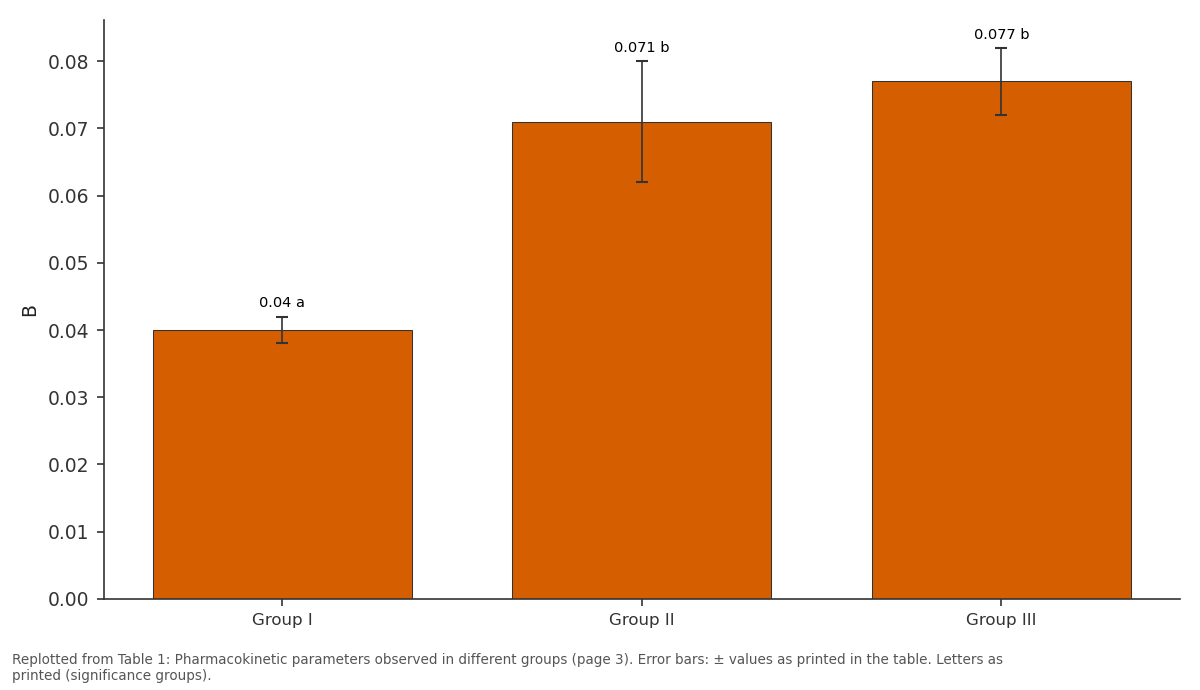
Β: Group I vs Group II vs Group III
Replotted from Table 1 (page 3) of the original paper. Every bar is the paper's own table value.
View source evidence ↗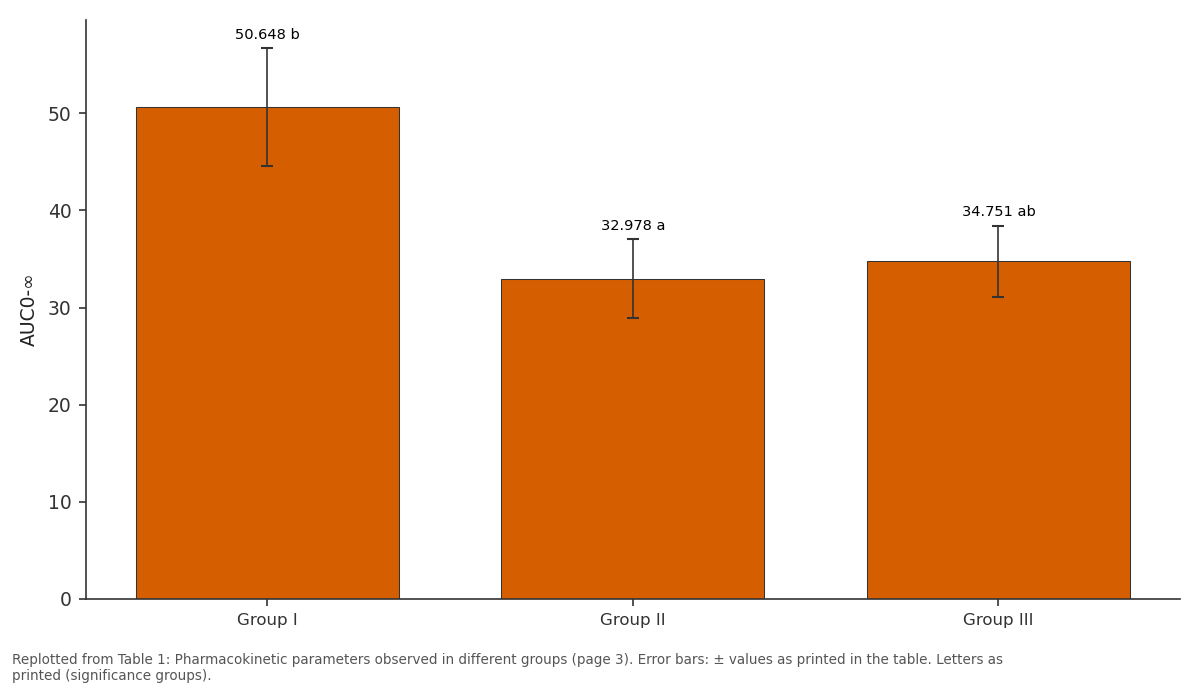
AUC0-∞: Group I vs Group II vs Group III
Replotted from Table 1 (page 3) of the original paper. Every bar is the paper's own table value.
View source evidence ↗Figures & tables
From the original paper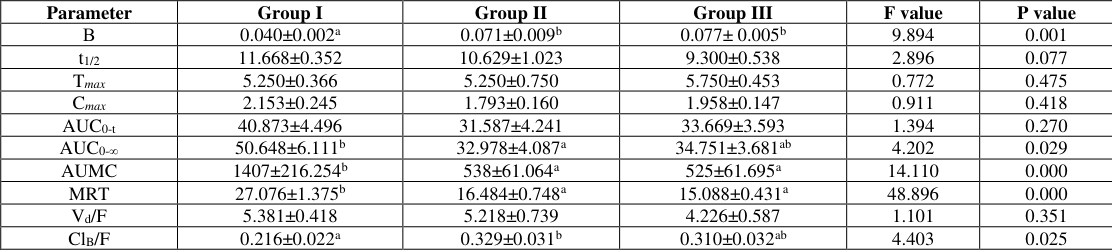 Table 1
Introduction
Management of diseases in poultry is crucial in the success of poultry farming and improving drinking water quality can greatly help in maintaining the flock health. Water being an important source of infection, disinfection of drinking water is considered a major step to ensure hygienic water supply. Multiple disinfectants and sanitizers such as those belonging to chlorides, iodides, quaternary ammonium compounds etc., are widely used in the poultry farms to optimize a good water quality program. Enrofloxacin is the most potent antibacterial drug so far used in poultry medicine. Enrofloxacin is administered usually through oral route in poultry. As chlorine-based sanitizers like sodium hypochlorite possess high oxidation reactivity [1] , their simultaneous administration with enrofloxacin can possibly result in chemical reactions leading to altered absorption and bioavailability of the later. The aim of present study was to investigate the influence of sodium hypochlorite in drinking water on the pharmacokinetics of orally administered enrofloxacin in chicken.
Materials and Methods
Materials and Methods
Experimental Design
This work was approved by IAEC with reference No. 14/IAEC/NTR CVSc/2019 Dated: 29/06/19. Four-week-old broiler birds (n=24) that were used in the experiment were procured from M/s Srinivasa Hatcheries, Vijayawada. They were maintained under standard conditions for two weeks for acclimatization at Livestock Farm complex, NTR College of Veterinary Science, Gannavaram (AP, India). All the chemicals used in the study were of analytical grade and were procured from Merck Life Science Pvt. Ltd., Mumbai. During these two weeks, the feed and water were devoid of any antibiotics, anticoccidials and toxin binders. Thus, at the time of experiment the birds were 6-week-old weighing around 2 kg. A total of 24 birds were randomly divided into three groups with eight birds in each and were kept off feed for 12 h prior to the experimentation, while water was withheld 2 h prior to first collection of blood.
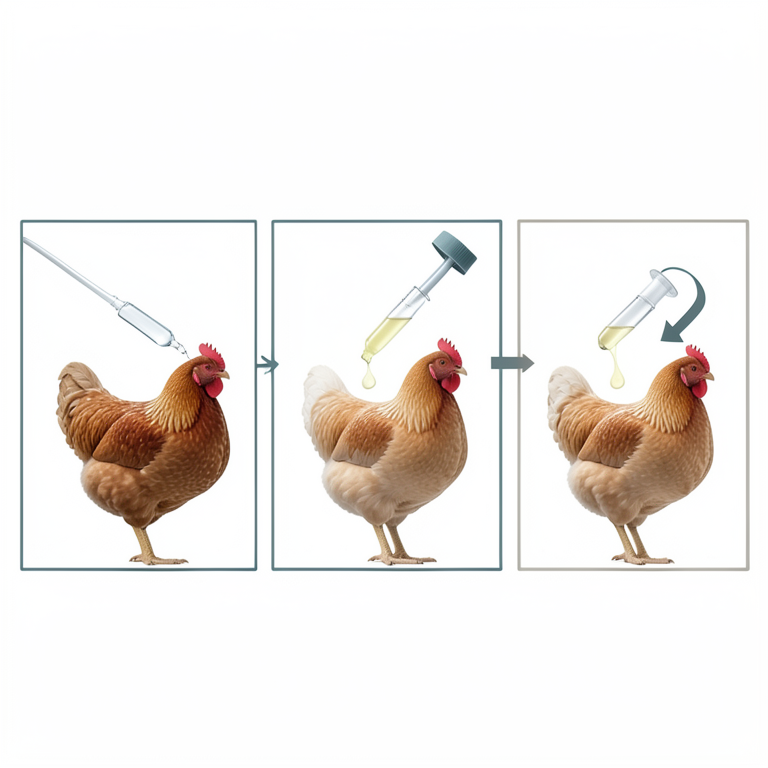
Access to feed and water was given, respectively, after 6 and 4 h post enrofloxacin dosing. Treatment for the three groups was as follows. Group I birds were given normal drinking water and enrofloxacin orally in water at the dose rate of 10 mg.kg -1 body weight. Group II birds were maintained on drinking water containing sodium hypochlorite at the rate of 10 mL/100 L for 7 days followed by enrofloxacin in the same dose as per group I birds, but in sodium hypochlorite containing water. Group III birds also received drinking water as per group II birds, but were given enrofloxacin as in group I in normal drinking water 12 h post-withdrawal of sodium hypochlorite containing water. From all birds, blood samples (1 mL) were collected with fresh disposable needles and syringe either from left or right tarsal vein into heparinized micro centrifuge tubes. The collection timings were at 0 (blank), 0.16, 0.33, 0.5, 0.75, 1, 1.5, 2, 4, 6, 8, 12, 24 and 48 h post-dosing. The sample tubes were centrifuged at 3000rpm for 5 min separate the plasma and were stored at -20 ᵒC until further use.
Preparation of Standard Solutions
Enrofloxacin standard solutions and working standards in distilled water and plasma, respectively, were made. Standard calibration curve for enrofloxacin was constructed from the peak areas of the chromatogram verses concentration.
Standardisation of HPLC Conditions for Enrofloxacin
Enrofloxacin assay was carried out as per the methods described by Mekala et al. (2014) [2] and Nielsen and Gyrd-Hansen (1997) [3] with slight modifications in the extraction procedure by using HPLC. Working standard solutions of enrofloxacin were prepared in the concentration ranges of 100 μg/ml to 0.3125 μg/ml by diluting the stock solution with HPLC water. HPLC with the stationary phase of C18 reversed-phase column (particle size 5 µm, 4.6 mm x 250 mm) and photo diode array detector was used. Solution consisting of potassium dihydrogen phosphate buffer (70%), acetonitrile 28 (20%) and methanol (10%) was used as mobile phase at a flow rate of 0.8 mL/min with 7 min run time. Buffer pH was adjusted to 2.37 with 0.3% ortho-phosphoric acid and 0.3% of triethylamine. Column oven temperature was set to 40 ºC and photo diode array detector (SPD-20A) wave length was set at 277 nm. Plasma concentration versus time data of enrofloxacin obtained for three groups were utilized for calculating various pharmacokinetic parameters in broilers with an interactive programme for personal computer software PK Solver Version.2.0 [4] .
Results and Discussion
The peak areas (from 33318 to 441609 mAU) obtained from chromatograms against different concentrations of enrofloxacin (from 0.3125 to 10 µg/mL) was plotted on a standard curve. The curves were linear from 0.3125 to 10 μg/mL with regression coefficient of 0.999. Various pharmacokinetic parameters of enrofloxacin that were observed in three groups are depicted in Table 1. The pharmacokinetic parameters observed in Group I birds, that received enrofloxacin alone in normal drinking water were in accordance with the previous observations of Garacia-Ovando et al. (1999) [5] and Mekala et al. (2017) [6] . The elimination rate constant (β) of enrofloxacin observed in Group II (0.071±0.009 l/h) and Group III (0.077±0.005 l/h) birds was significantly (p<0.05) higher compared to that in Group I (0.040±0.002 l/h) birds. There was a noticeable decline in peak concentration (Cmax) of enrofloxacin in Group II and Group III birds over Group I birds, although not statistically significant (p<0.05). Sodium hypochlorite being an alkaline solution the disturbance in the absorption of enrofloxacin might be due to altered gut pH [7] in both Group II and as well as in Group III birds due to persistence of its influence even 12 h after withdrawal. There was no significant difference in elimination half-life (t1/2) and in Tmax of enrofloxacin among the three groups. There was a noticeable decline in Cmax of enrofloxacin in Group II (1.793±0.160 μg/mL) and Group III (1.958±0.147 μg/mL) birds over Group I (2.153±0.245 μg/mL) birds, the decreased Cmax might be on account of decreased bioavailability. Enrofloxacin when administered along with orange oils had shown significant decrease in rate and extent of absorption [8] . Similarly, probiotics also have similar effect on the absorption rate of enrofloxacin when co-administered with enrofloxacin [9] . There were statistically significant differences in the pharmacokinetic variables like maximum serum concentration, area under curve vs. concentration curves, and half-lives of the elimination phases in birds that received different kinds of water. The means of these values showed a linear decay of maximum serum concentration from one group to next as water hardness increased [10] . Assuming linear pharmacokinetics of enrofloxacin in birds, it can be concluded that AUC0-t is proportional to the total drug absorbed from the gut. In the present study, the area under plasma concentration curve (AUC0-t) apparently declined in both the sodium hypochlorite administered groups (Group II and III). There was significant (p<0.05) decline in area under plasma concentration curve (AUC0-α) in Group II (32.978±4.087 μg/mL.h) compared to that in Group I (50.648±6.111 μg/mL.h) birds. Thus, the influence of sodium hypochlorite on total exposure to enrofloxacin across time is evident. Likewise, administration of enrofloxacin 12 h postwithdrawal of sodium hypochlorite (Group III) also reduced AUC0-α (34.751±3.681 μg/mL.h) of enrofloxacin, though not significant statistically. Bioactive compounds like curcumin and piperine when coadministered with enrofloxacin enhanced the bioavailability of quinolones. The pharmacokinetic data revealed higher AUC and AUMC [11] , [12] which is in contradiction to present study. The AUMC and MRT values in the present study were found decreased significantly (p<0.05) in Group II (538.396±61.064 µg/mL.h 2 and 16.484±0.748 h) and Group III (525.468±61.695 µg/mL.h 2 and 15.088±0.431 h) birds compared with those of Group I (1407.185±216.254 µg/mL.h 2 and 27.076±1.375 h) birds. MRT is specific for the average total time the molecules (enrofloxacin or its metabolites) spend in the body. Thus, sodium hypochlorite exposure or its exposure until 12 h before the administration of enrofloxacin could not retain the enrofloxacin molecules for a period like that of control Group I. Although there was no influence of sodium hypochlorite on volume of distribution (Vd/F), the total clearance from the body (ClB/F) in Group II (0.329±0.031 l/kg/h) and Group III (0.310±0.032 l/kg/h) birds was significantly (p<0.05) higher when compared to that in Group I (0.216±0.022 l/kg/h) birds, and it can be attributed to altered environment in the renal mechanisms involved in elimination of enrofloxacin or it metabolite(s). Further, sodium hypochlorite exposure might have played a role in tissue binding pattern of enrofloxacin, since it is a highly lipid soluble agent among fluroquinolones.
| Parameter | Group I | Group II | Group III | F value | P value |
|---|---|---|---|---|---|
| Β | 0.040±0.002a | 0.071±0.009b | 0.077± 0.005b | 9.894 | 0.001 |
| t1/2 | 11.668±0.352 | 10.629±1.023 | 9.300±0.538 | 2.896 | 0.077 |
| Tmax | 5.250±0.366 | 5.250±0.750 | 5.750±0.453 | 0.772 | 0.475 |
| Cmax | 2.153±0.245 | 1.793±0.160 | 1.958±0.147 | 0.911 | 0.418 |
| AUC0-t | 40.873±4.496 | 31.587±4.241 | 33.669±3.593 | 1.394 | 0.270 |
| AUC0-∞ | 50.648±6.111b | 32.978±4.087a | 34.751±3.681ab | 4.202 | 0.029 |
| AUMC | 1407±216.254b | 538±61.064a | 525±61.695a | 14.110 | 0.000 |
| MRT | 27.076±1.375b | 16.484±0.748a | 15.088±0.431a | 48.896 | 0.000 |
| Vd/F | 5.381±0.418 | 5.218±0.739 | 4.226±0.587 | 1.101 | 0.351 |
| ClB/F | 0.216±0.022a | 0.329±0.031b | 0.310±0.032ab | 4.403 | 0.025 |
Table text extracted from the original PDF; superscript letters are shown inline. The original table image is below.
View original table image
Conclusion
It can be concluded that sodium hypochlorite administration altered the pharmacokinetics of enrofloxacin and the effect of sodium hypochlorite persisted even after its withdrawal 12 h before administration of enrofloxacin.
Acknowledgement
AcknowledgementAuthors acknowledge the help received from the authorities of Sri Venkateswara Veterinary University, Tirupati, in carrying out this research work.
References
12 in the original paper- Acero JL, Benitez FJ, Real FJ, Roldan G. Kinetics of aqueous chlorination of some pharmaceuticals and their elimination from water matrices. Water Res. 2010;44(14):4158-4170.
- Mekala P, Jagadeeswaran A, Arivuchelvan A, Senthilkumar P, Nanjappan K, Krishnamurthy TG, et al. Pharmacokinetics of enrofloxacin after single intravenous and oral bolus administration in broiler chicken. Int J Adv Vet Sci Technol. 2014;3(1):99-105.
- Nielsen P, Gyrd-Hansen N. Bioavailability of enrofloxacin after oral administration to fed and fasted pigs. Pharmacol Toxicol. 1997;80(5):246-250.
- Zhang Y, Huo M, Zhou J, Xie S. PK Solver: An add-in program for pharmacokinetic and pharmacodynamic data analysis in Microsoft Excel. Comput Methods Programs Biomed. 2010;99(3):306-314.
- Garacia-Ovando H, Luders C, Gorla N, Erracalde C, Prieto G. Intravenous pharmacokinetics of enrofloxacin and ciprofloxacin in broiler chickens. J Vet Pharmacol Ther. 1999;20:203-204.
- Mekala P, Jagadeeswaran A, Arivuchelvan A, Sethilkumar P, Nanjappan K, Krishnamurthy TG, et al. Comparison of pharmacokinetics of enrofloxacin after single oral bolus and pulse dose administration in broiler chicken. Proc Natl Acad Sci India Sect B Biol Sci. 2017;87:679-683.
- Ledesma C, Rosario C, Gracia-Mora J, Tapia G, Sumano H, Gutiérrez L, et al. Influence of chlorine, iodine, and citrate-based water sanitizers on the oral bioavailability of enrofloxacin in broiler chickens. J Appl Poult Res. 2017;27(1):71-80.
- Lim JH, Kim MS, Hwang YH, Song IB, Kim TW, Yun HI, et al. Effect of orange oil on the oral absorption of enrofloxacin in rats. Exp Anim. 2012;61(1):71-75.
- Pavlova I, Danova S, Naidenski H, Tropcheva R, Milanova A. Effect of probiotics on enrofloxacin disposition in gastrointestinal tract of poultry. J Vet Pharmacol Ther. 2015;38(6):549-555.
- Sumano LH, Gutierrez OL, Aguilera R, Rosiles MR, Bernard BMJ, Gracia MJ, et al. Influence of hard water on the bioavailability of enrofloxacin in broilers. Poult Sci. 2004;83(5):726-731.
- Pavithra BH, Prakash N, Jayakumar K. Modification of pharmacokinetics of norfloxacin following oral administration of curcumin in rabbits. J Vet Sci. 2009;10(4):293-297.
- Patel S, Devada S, Patel H, Patel N, Bhavsar S, Thaker A, et al. Influence of co-administration of piperine on pharmacokinetic profile of gatifloxacin in layer birds. Global Veterinaria. 2011;7(5):427-432.