
Research article · 2019 · Full text
International Journal of Agriculture Extension and Social DevelopmentExtension and advisory services roles in creating resilient value chain of smallholder rural farmers in Imo State, Nigeria
Volume 2(2) · Pages 16–19 · DOI: 10.33545/26180723.2019.v2.i2a.26 ↗
Research areasAgricultural risk and resilience
Abstract
Author-writtenSmallholder farmers are most affected by climate change shocks and weather related disasters the world over, and they are also vulnerable to market fluctuations and poor governance, conflicts and even diseases. Extension and advisory services provide an opportunity for strengthening resilience of rural farming households by increasing their access to both material and non material resources. This paper sought to explain how Extension Services Providers build resilience of rural farmers in Imo State, Nigeria. The researcher selected 120 Extension workers and 230 rural farmers for interview. Questionnaire was given to both respondents, and complimented by oral discussion. Data collected were analyzed descriptively. With a discriminating mean (M) score of 2.0, it was seen that climate change affects the farmers adversely. Climate change damages crops in farm and field (M=2.50), reduced quality/quality of crops (M=2.45), leads to sudden death of crops (M=2.70) among others. To build resilience of rural farmers, extension workers promoted the following resilient approaches - diversification of income sources (M=2.81), market information provisioning (M=2.79), behavioural change campaigns (M=2.54), crop diversification (M=2.67), among many others. The farmers face the challenge of insufficient incomes, poor monitoring, low understanding of climate change, resilient options etc.
Summary
Source-checkedPlain-language reading of the full paper, prepared with AI and checked against the text. Each point links to the authors' own words.
Why it matters
- Smallholder farmers globally are highly susceptible to climate change shocks, weather disasters, market instability, and poor governance. View evidence ↗
- Agricultural extension services act as a critical link between research and farmers, providing the education and technology needed to cope with climate change and improve living standards. View evidence ↗
- Integrating smallholder farmers into value chains is essential for increasing productivity, reducing risks, and building overall resilience. View evidence ↗
The question
- The study aimed to explain the methods used by extension service providers to build resilience among rural farmers in Imo State, Nigeria. View evidence ↗
What they did
- The researchers used purposive sampling to select 120 extension agents and 230 smallholder farmers in Imo State. View evidence ↗
- Data was gathered through primary field surveys using questionnaires and supplemented by secondary data from reports, journals, and literature. View evidence ↗
- The study primarily employed descriptive statistics, including frequency counts and percentages, for data analysis. View evidence ↗
- To assess climate change effects, a 3-point Likert scale was used, where a mean score of 2.0 or higher indicated a significant effect. View evidence ↗
What they found
- Climate change adversely affects farmers, with significant impacts including higher crop prices (M=2.81), sudden crop death (M=2.70), and delayed seed germination (M=2.60). View evidence ↗
- Extension workers promoted market development strategies such as income diversification (M=2.81), financial service access (M=2.80), and market information (M=2.79). View evidence ↗
- Biodiversity management strategies were heavily promoted, particularly organic farming (M=3.70), agroforestry (M=3.70), and water harvesting (M=3.54). View evidence ↗
- Social safety nets promoted by extension services included borrowing from family or friends (M=3.51) and investing in farm products (M=3.01). View evidence ↗
- Farmers face severe barriers to adopting resilient strategies, most notably low awareness of resilient options (98.2%), insufficient finances (91.3%), and a lack of understanding of climate change (91.3%). View evidence ↗
What it means
- The authors conclude that extension workers have successfully introduced various resilient strategies, including organic farming and crop rotation, to help farmers cope with climate change. View evidence ↗
- The authors identify that the effectiveness of these strategies is limited by the farmers' low understanding of climate change responses and resilient options. View evidence ↗
Visual summary
3 visualsIllustrations explain the paper; charts are replotted from the paper's own table values.
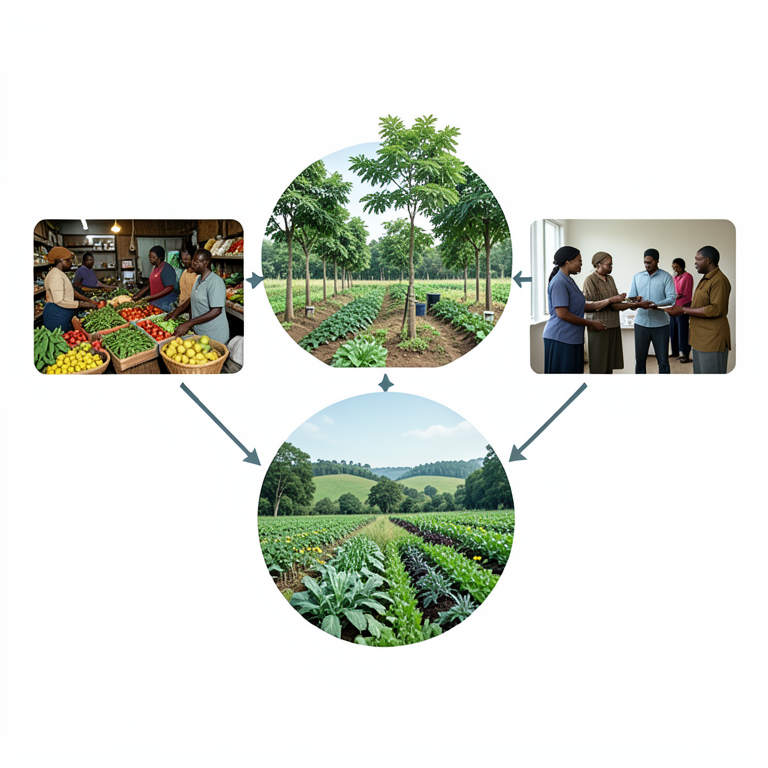
Resilience Strategy Framework
AI-generated conceptual illustration (Smallholder rural farmers in Imo State, Nigeria). It explains the idea and does not show study data.
View source evidence ↗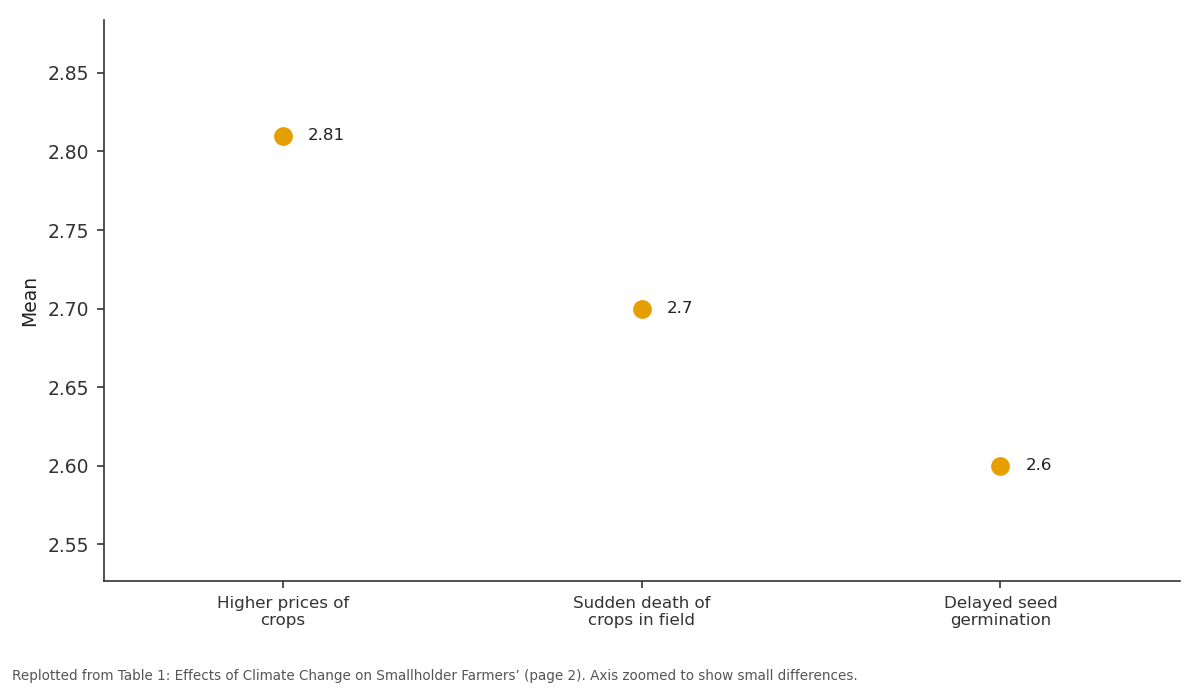
Mean: Higher prices of crops vs Sudden death of crops... vs Delayed seed germination
Replotted from Table 1 (page 2) of the original paper. Every bar is the paper's own table value.
View source evidence ↗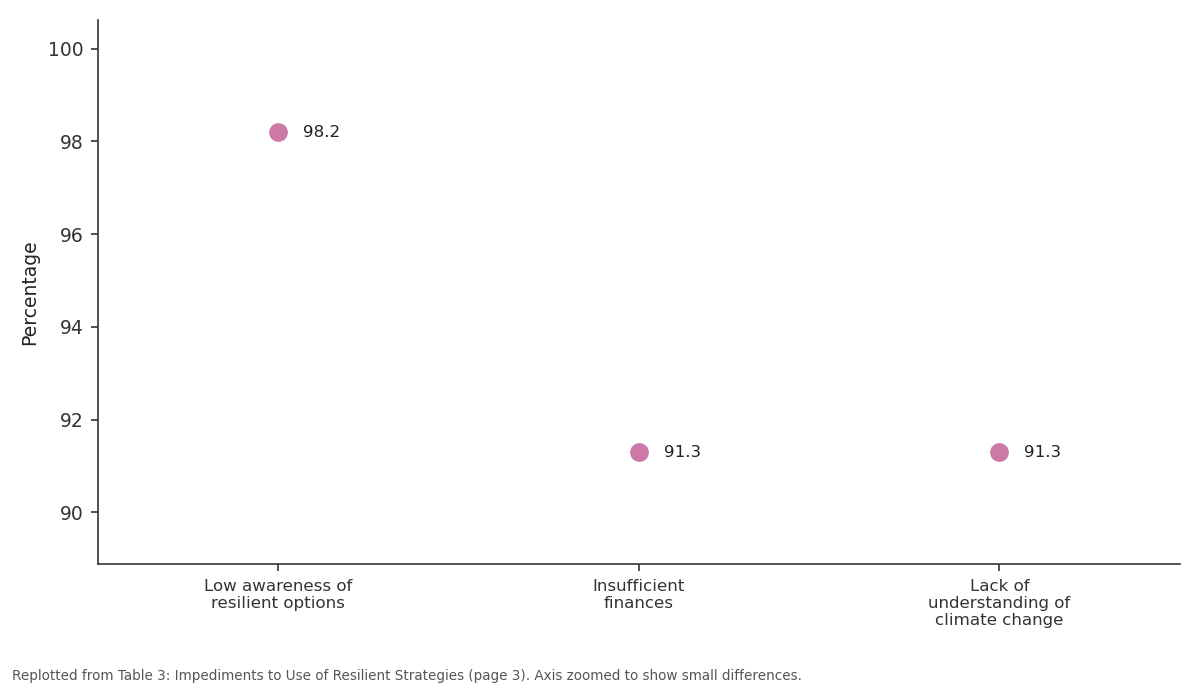
Percentage: Low awareness of... vs Insufficient finances vs Lack of understanding...
Replotted from Table 3 (page 3) of the original paper. Every bar is the paper's own table value.
View source evidence ↗Figures & tables
From the original paper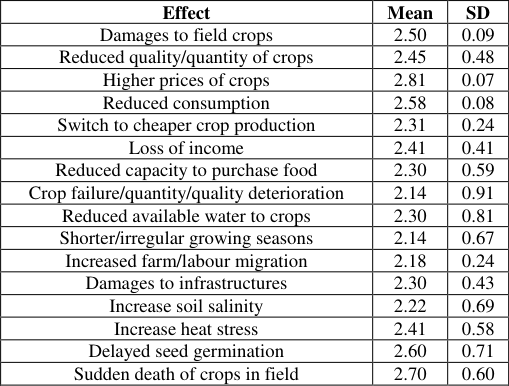 Table 1
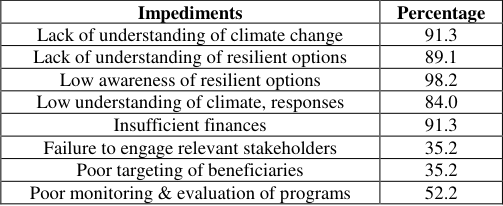 Table 3
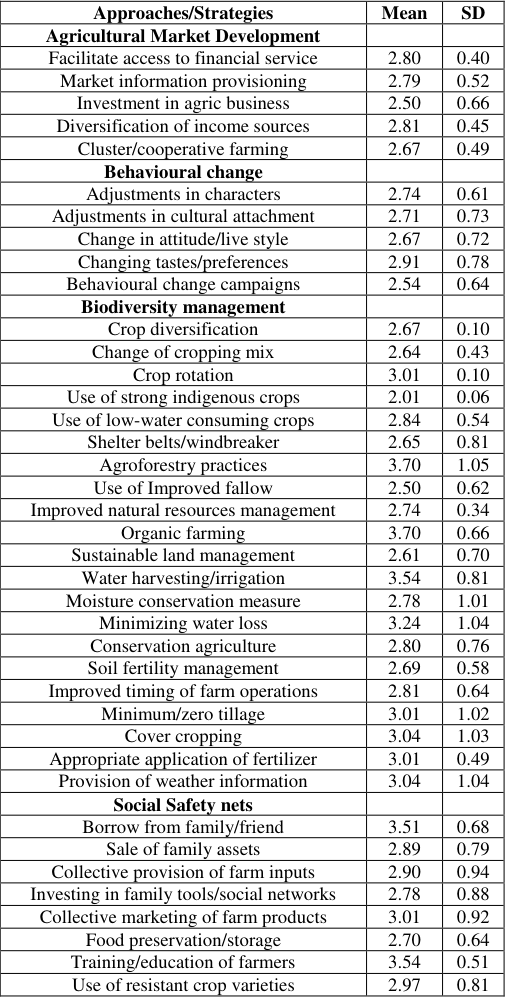 Table 2
Introduction
Today, because of increased globalization and urbanization, African smallholder farmers face challenges greater than those faced by Asian farmers during the Green Revolution. Increased urban demand for more and better food can provide opportunities to increase and diversify food production in rural areas (Graziano da Silva & Fan, 2017) [8] . African smallholder farmers not only need to produce more efficiently, but also to face far more complex and competitive markets. Growing specialization, rapidly changing consumer preferences, and increasingly intricate technical specifications place significant demands on the average smallholder. Institutional and technical innovations, including better access to input and output markets, and enhancing rural-urban linkages constitute key components of future agricultural transformation strategies. A successful agricultural and livelihood transformation depends on the effective and inclusive integration of smallholder farmers in value chains. Such integration, up and down the value chain, will increase productivity and value; increase diversity in the chain; reduce risks and greater resilience. Physical goods flow down the chain until they reach consumption, in exchange for financial flows that flow up the chain from the final consumer back to the original producer (Conway, 2012) [3] . Each actor along the chain retains a share of the final price, which is necessary to make his/her business profitable and sustainable.
According to The Montpellier Panel, (2012), resilience is the capacity of an agricultural value chain and its elements to withstand or recover from stresses and shocks and thus bounce back to the previous level of growth and development. Agricultural extension, the bridge between research and farmers plays key roles in agriculture by providing farmers with information, new technologies and education on how to mitigate GHGs and cope with climate change so as to increase production and ameliorate living standards (Singh and Grover, 2013) [14] . Extension's major activities over time has been dissemination of useful information from research to farmers and taking farmer's problems to researchers and this is even more important in the light of climate change and its impact on agriculture (Obiora, 2013) [13] . Exposure to extension services influence the capacity of farmers to adapt to climate change (Maponya and Mpandeli, 2013) [12] because they educate farmers for example on how to develop and disseminate local cultivars of drought resistant crop varieties with information about the crops' advantages and disadvantages. According to Maponya and Mpandeli, (2013) [12] , climate change and its associated uncertainties implies that agricultural extension services need to regularly access new knowledge and disseminate it in an adequate and timely manner to the farmers. Extension has the advantage over other sources of information on adaptation that it www.extensionjournal.com necessitates follow-up from the sender to receiver and feedback mechanism. The role of Agricultural extension in adaptation cannot be under-estimated as they initiate changes in knowledge, attitudes, resilience capacities and skills of the people. However why some studies have shown that extension is effectively carrying out this role of information dissemination (Maponya and Mpandeli, 2013) [12] others have simply stated that is not doing enough especially in providing farmers with resilient and adaptation information (Ugwoke et al., 2012) [15] . A value chain can be defined as the process of transformation of a physical product from input and production through processing and consumption (Conway, 2012) [3] . This research therefore seeks to ascertain the role of agricultural extension in building resilient capacity of farmers to ensure their livelihood in the face of climate change event.
Methodology
The (NPC, 2006). The State has two dominant seasons, that is, rainy and dry seasons. Rainfall is between April and October, while the dry season starts from November to early March. Purposive sampling technique was employed to select the respondents. A sample size of 120 extension agents available in Imo State, as obtained from the ADP staff list and 230 smallholder farmers were selected for the study. The two main sources of data collection used in this research were the primary data and the secondary data. The primary data was collected from the field survey, using questionnaires. The secondary data were collected from books, reports, journals, existing literature review, information from library, ADP etc. Basically, descriptive statistics were used to analyze most of the data. This involves the use of percentages and frequency counts, presented in tabular form to achieve objective 3. While objective 1 was analyzed using a 3-point likert type scale of strongly agree, agree and disagree to rate the effects of climate change on farmers value chain. The responses were assigned weight of 3, 2 and 1 respectively and added to give 6 divided by 3 to give a mean of 2.0. A mean score of 2.0 and above indicated effect, while a mean score lower than 2.0 indicated no effects. While objective 2 was analyzed using a 4-point likert scale of strongly agree, agree, disagree and strongly agree to rate roles of extension in building resilient strategy of farmer. The responses were assigned weight of 4, 3, 2 and 1 respectively and added to give 10 divided by 4 to give a mean of 2.50. A mean score of 2.50 and above indicated resilient approach, while a mean score lower than 2.50 indicated none.
Effects of Climate Change on Smallholder Farmers' Value Chain
Climate change impact smallholder farmers' in the area as shown in Table 1. With a discriminating mean index of 2.00, climate change damages crops in field/farm (M=2.50), reduced the quality/quantity of crops (M = 2.45), higher prices of crops (M=2.81), reduced consumption (M=2.58), loss of income (M=2.41), sudden death of crops in field/farm (M=2.70), delayed seed germination (M=2.60), switch to cheaper crop production (M=2.30) and damages to infrastructure (M= 2.30). Based on stakeholder discussions, drought affects all crop and animal value chains in different ways. For example, drought affects availability and quality of seed, reduced dairy production and breeding, leads to poor quantity and quality of pasture and fodder, and increased costs in buying feed. In terms of the production stage, crops suffer from low germination rates, hardened soils and increased incidence of pests and diseases; animals become emaciated and lose resistance to pests and diseases. Drought most adversely affects production activities in crops: planting requires more time and labor due to hard soils; low germination increases the need for irrigation; and water stress leads to greater crop susceptibility to pest and diseases, low yields and poor quality produce.
| Effect | Mean | SD |
|---|---|---|
| Damages to field crops | 2.50 | 0.09 |
| Reduced quality/quantity of crops | 2.45 | 0.48 |
| Higher prices of crops | 2.81 | 0.07 |
| Reduced consumption | 2.58 | 0.08 |
| Switch to cheaper crop production | 2.31 | 0.24 |
| Loss of income | 2.41 | 0.41 |
| Reduced capacity to purchase food | 2.30 | 0.59 |
| Crop failure/quantity/quality deterioration | 2.14 | 0.91 |
| Reduced available water to crops | 2.30 | 0.81 |
| Shorter/irregular growing seasons | 2.14 | 0.67 |
| Increased farm/labour migration | 2.18 | 0.24 |
| Damages to infrastructures | 2.30 | 0.43 |
| Increase soil salinity | 2.22 | 0.69 |
| Increase heat stress | 2.41 | 0.58 |
| Delayed seed germination | 2.60 | 0.71 |
| Sudden death of crops in field | 2.70 | 0.60 |
Table text extracted from the original PDF; superscript letters are shown inline. The original table image is below.
View original table image
Resilient Approaches Promoted by Extension and Advisory Services Providers
Climate resilience is the capacity of a socio-ecological system to (a) absorb stress and maintain function in the face of external stresses imposed upon it by climate change, and (b) adapt, reorganize, and evolve into more desirable configurations to improve the climate impacts (Folks, 2006; Nelson, et al., 2002) Based on these definitions, the extension and advisory services providers were asked to rate their agreement on the resilient strategies promoted by them. The promoted strategies were divided into 4 areas namely agricultural market development, behavioural change, biodiversity management, and social safety nets. The agricultural market development resilient strategies promoted included facilitating access to financial services (M = 2.80), diversification of income sources (M = 2.81), cluster/cooperative farming (M=2.67), and market information provisioning (M=2.79). Behavioural change strategies were character adjustment www.extensionjournal.com (M=2.74), adjustments in cultural attachment (M=2.71), change in attitude (M=2.67), change in taste/preferences (M = 2.91) and behavioural change campaign (M = 2.54). Biodiversity management resilient strategies promoted included crop diversification (M = 2.67), changing crop mix (M=2.64), crop rotation (M=3.01), use of low water consuming crops (M=2.84), agro forestry practices (M=3.70), organic farming (M=3.70), water harvesting (M=3.54), minimizing water loss (M=3.24), minimum/zero tillage (M=3.01), cover cropping (M=3.04), appropriate application of fertilizer (M=3.01), provision of weather information (M=3.05). Social safety net strategies were borrowing from family/friends (M=3.51), sale of family assets (M=2.89), collective provision of farm inputs (M=2.90), investing in farm products (M=3.01), food preservation/storage (M=2.70), use of resistant crop varieties (M=2.97). [1,5,11,10,4,9,2]
Conclusion
Climate change is a global issue with serious implications. It damages field crops, reduces their quantity and quality, delays seed germination, increases stress, damages infracstructure and so on. Extension workers have introduced and promoted several resilient strategies such as crop rotation, crop diversification, organic farming, sustainable land management, cover cropping, access to market and finances to help farmers cope. The challenges faced were low understanding of resilient options, climate change responses among others.
Figures and tables from the paper
| Impediments | Percentage |
|---|---|
| Lack of understanding of climate change | 91.3 |
| Lack of understanding of resilient options | 89.1 |
| Low awareness of resilient options | 98.2 |
| Low understanding of climate, responses | 84.0 |
| Insufficient finances | 91.3 |
| Failure to engage relevant stakeholders | 35.2 |
| Poor targeting of beneficiaries | 35.2 |
| Poor monitoring & evaluation of programs | 52.2 |
Table text extracted from the original PDF; superscript letters are shown inline. The original table image is below.
View original table image
| Approaches/Strategies | Mean | SD |
|---|---|---|
| Agricultural Market Development | ||
| Facilitate access to financial service | 2.80 | 0.40 |
| Market information provisioning | 2.79 | 0.52 |
| Investment in agric business | 2.50 | 0.66 |
| Diversification of income sources | 2.81 | 0.45 |
| Cluster/cooperative farming | 2.67 | 0.49 |
| Behavioural change | ||
| Adjustments in characters | 2.74 | 0.61 |
| Adjustments in cultural attachment | 2.71 | 0.73 |
| Change in attitude/live style | 2.67 | 0.72 |
| Changing tastes/preferences | 2.91 | 0.78 |
| Behavioural change campaigns | 2.54 | 0.64 |
| Biodiversity management | ||
| Crop diversification | 2.67 | 0.10 |
| Change of cropping mix | 2.64 | 0.43 |
| Crop rotation | 3.01 | 0.10 |
| Use of strong indigenous crops | 2.01 | 0.06 |
| Use of low-water consuming crops | 2.84 | 0.54 |
| Shelter belts/windbreaker | 2.65 | 0.81 |
| Agroforestry practices | 3.70 | 1.05 |
| Use of Improved fallow | 2.50 | 0.62 |
| Improved natural resources management | 2.74 | 0.34 |
| Organic farming | 3.70 | 0.66 |
| Sustainable land management | 2.61 | 0.70 |
| Water harvesting/irrigation | 3.54 | 0.81 |
| Moisture conservation measure | 2.78 | 1.01 |
| Minimizing water loss | 3.24 | 1.04 |
| Conservation agriculture | 2.80 | 0.76 |
| Soil fertility management | 2.69 | 0.58 |
| Improved timing of farm operations | 2.81 | 0.64 |
| Minimum/zero tillage | 3.01 | 1.02 |
| Cover cropping | 3.04 | 1.03 |
| Appropriate application of fertilizer | 3.01 | 0.49 |
| Provision of weather information | 3.04 | 1.04 |
| Social Safety nets | ||
| Borrow from family/friend | 3.51 | 0.68 |
| Sale of family assets | 2.89 | 0.79 |
| Collective provision of farm inputs | 2.90 | 0.94 |
| Investing in family tools/social networks | 2.78 | 0.88 |
| Collective marketing of farm products | 3.01 | 0.92 |
| Food preservation/storage | 2.70 | 0.64 |
| Training/education of farmers | 3.54 | 0.51 |
| Use of resistant crop varieties | 2.97 | 0.81 |
Table text extracted from the original PDF; superscript letters are shown inline. The original table image is below.
View original table image
References
15 in the original paper- Adger WN, Dessai S, Goulden M, Hulme M, Lorenzoni I, Nelson DR et al. Are there social limits to adaptation to climate change? Climatic Change. 2009; 93:335-354.
- Biesbroek GR, Klostermann JEM, Termeer CJAM, Kabat P. On the nature of barriers to climate change adaptation. Regional Environmental Change. 2013; 13(5):1119-1129.
- Conway G. One billion hungry, can we feed the world? Ithaca and London: Cornell University Press, 2012.
- Crane TA, Roncoli C, Hoogenboom G. Adaptation to climate change and climate variability: The importance of understanding agriculture as performance. NJAS - Wageningen Journal of Life Sciences. 2011; 57(34):179-185.
- Deressa TT, Hassan RM, Ringler C, Alemu T, Yesuf M. Determinants of farmers' choice of adaptation methods to climate change in the Nile Basin of Ethiopia. Global Environmental Change. 2009; 19(2):248-255.
- Donald R, Nelson W. Neil Adger, and Katrina Brown. Adaptation to Environmental Change: Contributions of www.extensionjournal.com a Resilience Framework, Annu. Rev. Environ. Resour. 2007; 32:395-419
- Folke C. Resilience: The Emergence of a Perspective for Socio-Ecological Systems AnalysesGlobal Environmental Change, 2006; 16(3):253-267. DOI: 10.1016/j.gloenvcha.2006.04.002
- Graziano da Silva J, Fan S. Smallholders and urbanization: Strengthening rural-urban linkages to end hunger and malnutrition. In 2017 Global Food Policy Report, 2017, 14-23. Washington, DC: International Food Policy Research Institute (IFPRI). https://doi.org/10.2499/9780896292529_02
- Gifford R. The dragons of inaction: Psychological barriers that limit climate change mitigation and adaptation. American Psychologist, 2011; 66(4):290302. doi:10.1037/a0023566.
- Nielsen JO, Reenberg A. Cultural barriers to climate change adaptation: A case study from Northern Burkina Faso. Global Environmental Change-Human and Policy Dimensions. 2010; 20(1):142-152. doi:10.1016/j.gloenvcha.2009.10.002
- Moser SC, Ekstrom JA. A framework to diagnose barriers to climate change adaptation. Proceedings of the National Academy of Sciences. 2010; 107(51):22026-22031
- Maponya P, Mpandeli S. The role of extension services in climate change adaptation in Limpopo province, South Africa, 2013.
- Obiora CJ. Challenges Facing Agricultural Extension Agents in Disseminating Climate Change Innovations to Farmers: Insight from Anambra State, Nigeria. Greener Journal of Agricultural Sciences, 2013, ISSN: 2276-7770, 3.
- Singh I, Grover J. Role of extension agencies in climate change related adaptation strategies. International Journal of Farm Sciences. 2013; 3(1):144-155.
- Ugwoke FO, Nnadi FN, Anaeto CF, Aja OO, Nwakwasi RN. Crop Farmers' Perception of and Adaptation to Climate Change in Orlu Agricultural Zone of Imo State, Nigeria. Journal of Agricultural Extension, 2012, 16. http://dx.doi.org/10.4314/jae.v16i2.16
Cited by 1
From OpenAlex, OpenCitations and reference lists read by Scinovex
- AGRICULTURAL EXTENSION SERVICES: ARE THESE BARRIERS OR OPPORTUNITIES FOR SMALL-SCALE SUBSISTENCE CROP PRODUCTION IN THE ERA OF CLIMATE CHANGE? ↗
Sejabaledi Agnes Rankoana · Russian Journal of Agricultural and Socio-Economic Sciences · 2023
The livelihoods of smallholder farmers in semi-arid regions are being threatened by climate change and variability.The combination of rising temperatures and less rainfall poses a significant challenge to crop productivity and food security for these farmers.Consequently, the implementation of agricultural extension services is regarded as a more effective approach to bolstering small-scale agricultural productivity.This review describes the contributions made by…
❝ 1PDF