
Research article · 2019 · Full text
International Journal of Agriculture and Food ScienceConstraints associated with stakeholders` activities on agricultural production in rivers state, Nigeria
Volume 1(4) · Pages 01–06 · DOI: 10.33545/2664844x.2019.v1.i4a.12 ↗
Research areasEconomic Growth and DevelopmentAgricultural Innovations and Practices
Abstract
Author-writtenThe study examined constraints associated with stakeholders` activities on agricultural production in Rivers State, Nigeria. Six Local Government Areas out of 23were randomly selected from the three Senatorial Districts of Rivers State and a total of 180 respondents were selected for the study using the multi stage sampling technique. Primary data were used with the aid of a structural questionnaire. Face and content validity were used to test the consistency of the questionnaire. The reliability of the data instrument was 0.88%. Data for the study were analyzed using descriptive statistics, analysis of variance, regression analysis and correlation statistics. The result of the findings showed that more (64%) of the stakeholders were males, and 70% were married in all three Senatorial Districts. Women farmers were the current major stakeholders in agriculture as they ranked the first position with 59.4%, followed by men farmers and youth farmers with 50.6% and 38.9% respectively. Constraints to stakeholders` activities in agriculture showed that corruption assumed the highest with a mean of 3.66, followed by lack of farm machinery with 3.60, conflicts (3.46) and lack of agricultural workers with 3.46. The study recommends that, since the women were more involved as stakeholders, there is need for more government support to them. Secondly, government should foster good leadership free from corruption, set up arbitration panel to settle conflicts and train more agricultural extension workers with incentives including attractive benefits to boost agricultural production.
Summary
Source-checkedPlain-language reading of the full paper, prepared with AI and checked against the text. Each point links to the authors' own words.
Why it matters
- Agricultural development in Nigeria is hindered by limited arable land, a lack of research and trained personnel, and insufficient funding. View evidence ↗
- Over-reliance on the crude oil sector has negatively impacted agricultural productivity and contributed to economic stagnation in Nigeria. View evidence ↗
- Stakeholders in agriculture are key drivers of rural social change, but they face various obstacles that prevent them from fully harnessing agricultural development. View evidence ↗
The question
- The study aimed to identify the current major stakeholders in agriculture and the constraints affecting their activities in agricultural production. View evidence ↗
What they did
- The researchers used a multi-stage sampling technique to select 180 respondents from six randomly chosen Local Government Areas across three Senatorial Districts in Rivers State. View evidence ↗
- Data were collected via a field survey using a Likert-scale questionnaire to measure the extent of various constraints. View evidence ↗
- A mean score of 2.50 or higher was used as the benchmark to identify a factor as a significant constraint. View evidence ↗
- The study employed descriptive statistics, analysis of variance (ANOVA), regression analysis, and correlation statistics for data analysis. View evidence ↗
What they found
- Women farmers were identified as the primary stakeholders in agriculture (59.4%), followed by men farmers (50.6%) and youth farmers (38.9%). View evidence ↗
- Several factors were identified as constraints, with corruption (mean 3.66) and lack of farm machinery (mean 3.60) being among the most significant. View evidence ↗
- ANOVA results indicated no significant difference in the constraints faced by agricultural stakeholders across the three Senatorial Districts. View evidence ↗
What it means
- The authors recommend that the government provide more support to women, as they are the most involved stakeholders in agriculture. View evidence ↗
- To boost production, the authors suggest that the government implement fair governance, establish arbitration panels for conflicts, and provide incentives for trained extension workers. View evidence ↗
Visual summary
1 visualsIllustrations explain the paper; charts are replotted from the paper's own table values.
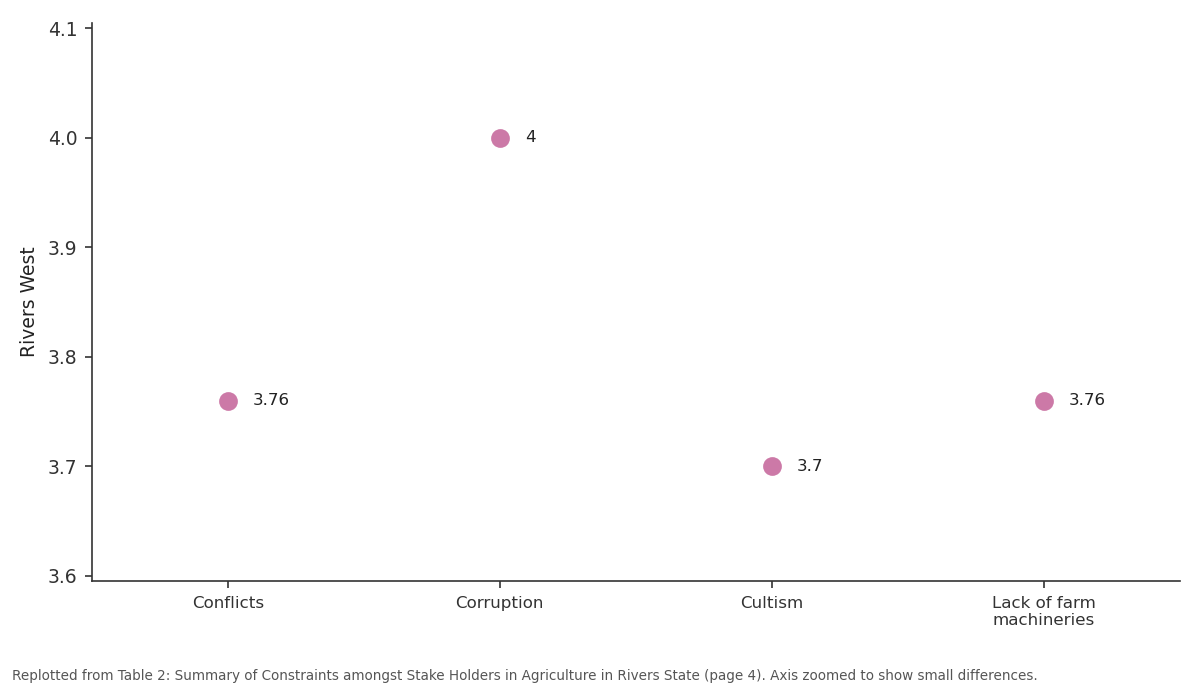
Rivers West: Conflicts vs Corruption vs Cultism vs Lack of farm machineries
Replotted from Table 2 (page 4) of the original paper. Every bar is the paper's own table value.
View source evidence ↗Figures & tables
From the original paper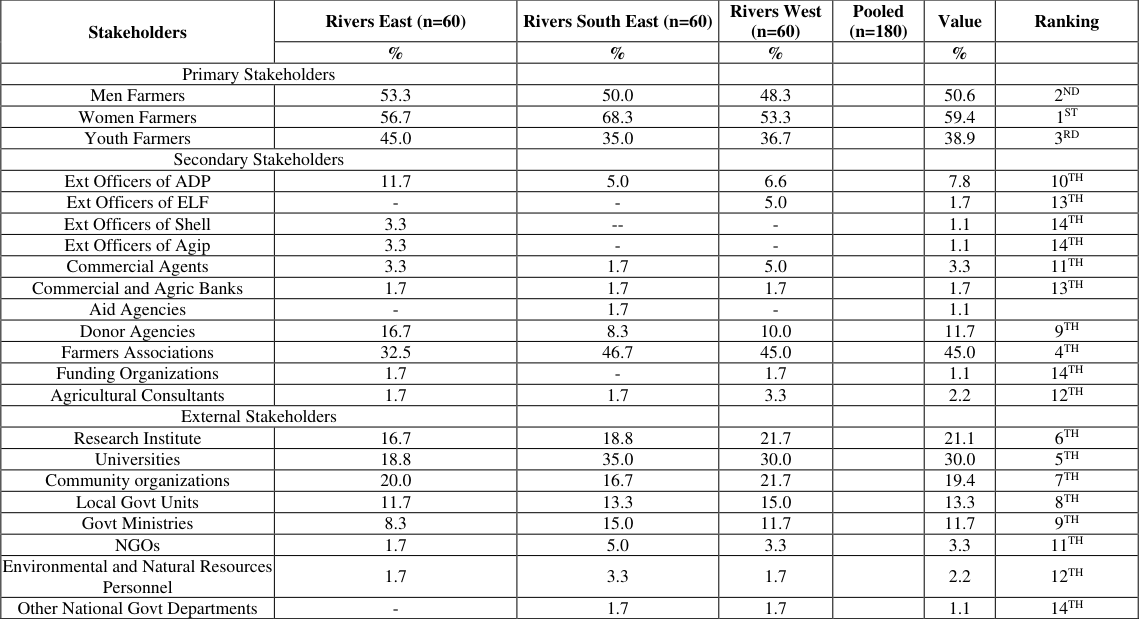 Table 1
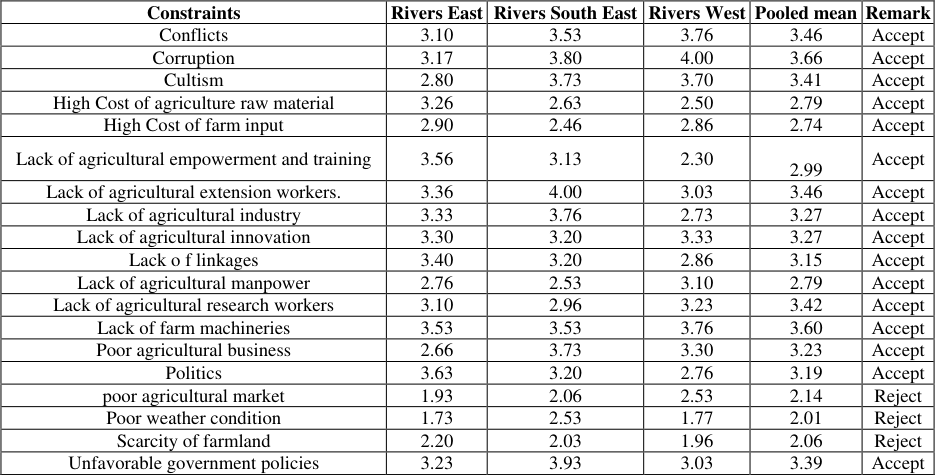 Table 2
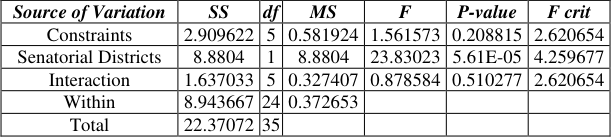 Table 3
Introduction
Agrarians all over the continents have increasingly been competing for massive food production, employment in the agricultural sector and foreign exchange earnings from agricultural raw materials. The drive for agricultural development in Nigeria is a growing concern due to the limited arable land, insufficient agricultural funds and lack of research and trained extension personnel. Agricultural sector in Nigeria and other parts of the world have experienced a decrease in the process as a result of illiteracy, inability to adapt to change, negligence on the part of government and stakeholders, inadequate information and lack of modern technology to supplement local tools; which has led to stagnation and deficiency in agricultural process (Adewale, 2017) [2] . The low productivity of Africa agriculture has received considerable attention of researchers, policy makers and development agencies in recent past and the stakeholders are the domain of change, while the central portion of the pathway of change is the innovation platform (Adekunle and Fatunbi, 2014) [1] . The inadequacy of this approach to meet the challenges faced by Africa, which had been apparent from the beginning especially as those problems stubbornly persisted and became more apparent with the systemic institutional collapse of one of the pivotal institutions like the extension services (Adekunle and Fatunbi, 2014) [1] . Maetz (2017) [11] , identified major stakeholders in agriculture to include: the states and their various organizations, international and regional intergovernmental organizations, national and International Civil Society (professional organizations; including private sector, Non-Governmental Organizations and lobbies) and Multinational corporations whose importance has been growing over the last decade. Stake holders in agricultural production revolve around the non-profit service enterprise individual/household (private), membership organization/ cooperative (membership) and central government/local government (public). Howlett, Bond, Woodhouse and Rigby (2000) [8] , stated that stakeholders in agriculture are classified into three categories namely: (Howlett, et al, 2000) [8] According to Maetz (2017) [11] , the main issues that have mobilized stakeholders in the past include: a. Natural resources (land, water, forests and genetic resources) b. International trade of agricultural commodities c. Food quality and safety d. Food security e. Exclusion f. Food, environment and health g. Policies for transition h. Climate change, food and agriculture (Maetz, 2017) [11] .
From the literary view, these issues are necessary to curb some societal ills such as; Conflicts, corruption, cultism, devaluation of Nigerian currency, high cost of agricultural raw material and farm input, lack of agricultural empowerment and training, lack of agricultural extension workers, lack of agricultural industry, lack of agricultural innovation, poor agricultural linkage, lack of agricultural manpower, lack of agricultural research workers, over reliance on non-agricultural business, poor agricultural market, scarcity of farmland, etc.
Statement of the problem
Agricultural stakeholders are instrument of rural social change but faced with obstacles to harness agricultural development. Agricultural stakeholders will scarcely thrive in such situation that affects the economy of a country. Dependence and over reliance on crude oil has gone viral thus, resulting to economic stagnation and negative influence on agricultural productivity. The Nigeria oil sector has been found to adversely affect both the agricultural sector and the economy (Sekumade, 2009) [18] . The huge investment potentials and export diversification in order to get the Nigeria agricultural sector to add to the economy as it does before (1960s) have remained locked and untapped, because of a number of constraints and factors that must be addressed (Oni, 2013). The Nigerian populace has been defaced incognizance with our traditional heritage (farming) due to the intricacies surrounding agricultural production and its success. This has attracted discouragement, lack of interest by agricultural stakeholders' involvement and poor response to farm activities. Stakeholder`s intervention to improve agricultural research and agricultural extension workers is skeletal. All stakeholders (the government, non-governmental organizations, extension agencies, rural institutions among others) should intensify efforts to build cooperative and peaceful coexistence between farmers and pastoralists through public enlightenment, education and campaign in agrarian communities (Dimelu, Salifu, Enwelu and Igbokwe, 2017) [4] . Interruption of basic agricultural interest and foreign aid should not be an oversight. This will enable the ability in strategizing the potentials required by agricultural stakeholders to facilitate agricultural business. Rural dwellers need support from agricultural stakeholders such as; frequent home and farm visit, group interaction, farm upgrade through knowledge transfer mechanism and in keeping with the traditional norms, ethics and values of the rural people. Scarcity of farmland is a major hindrance to agricultural investors and lacks stakeholder's involvement. Nlerum and Wechie (2018) [7] assert that transforming agriculture and land conversion in rural-urban fringe eats into agricultural land, thus leading to the reduction in the quantity and quality of land for farming. High cost of farm input cuts deep into discouraging most charitable organizations. Stakeholders will experience an unstable atmosphere in a state of insecurity and political instability. Agricultural stakeholders will continue to freeze in dilemma in the face of multiple inferences and problem hindering their involvement and rural livelihood. Agricultural stakeholders are not recognized by leaders who do not attach value to the agricultural sector, perhaps they are ignorant of the importance of farming as the main stay in the developed economy. The study on constraints to stakeholders` activities on agricultural production was addressed by finding answers to the following research questions: who are the current major stakeholders in agriculture? What are the constraints of stakeholder's activities in agricultural production?
Objective of the Study
The objectives of the study were to: a. identify the current stakeholders in agricultural production in the State, b. identify the constraints to stakeholders` activities in agricultural production in Rivers State.
Hypothesis of the Study
Ho 1 : There is no significant difference in the constraints to stake-holders` participation in agricultural activities in the three senatorial zones of Rivers State.
Methodology
The Data collected were from primary source to extract information required for this study. The primary source of data was field survey using questionnaire as the main instrument. The instrument was designed along the Likert format of Very High Extent, (VHE), High Extent (HE), Low Extent (LE) and very low Extent (VLE). A cut off mark of 2.50 and above was a benchmark for a constraint while less (<) 2.50 was rejected The inferential statistics used was Analysis of Variance to test the hypothesis of the study.
Results and Discussion Current Major Stakeholders in Agriculture in the Study Area
The result in Table 1 revealed that a good number of the respondents from Rivers East (56.7%), Rivers South East (68.3%) and Rivers West (53.3%) indicated that women farmers were the current major stakeholders in agriculture as they ranked the first position followed by men farmers and youth farmers with 50.6% and 38.9% respectively.. Farmers association ranked the fourth position from the secondary stakeholders with 45% and universities ranked the fifth position from external stakeholders with 30%. The results imply that current major stakeholders in agriculture included primary, secondary and external sources. The result is in line with the assertion that effective institutional linkages among extension service providers, research organizations, educational institutes, and farmers are inevitable for an efficacious agricultural knowledge and information system (Ashraf, Muhammad and Chaudhry 2007) [3] . (3.19) etc. were all regarded as constraints militating against stakeholders in agriculture. The study also showed that; poor agricultural market had a cut-off mean of (2.14), poor weather condition (2.01) and scarcity of farmland (2.06) were below the cut-off mean. In all the three senatorial districts conflict, corruption, cultism, lack of extension agents, lack of innovation, lack of farm machinery, lack of linkages were common constraints. Poor agricultural markets, scarcity of farmland, poor weather condition were not seen as constraints in the various senatorial districts. Harry and Wechie (2018) [13] concluded that lack of agricultural shows and awareness ranked first as major constraint to farmers satisfaction with Niger Delta Development Commission`s agricultural activities while scarcity of farmland was not a constraint to farmers. Multiple stakeholders process (MSP) is emerging as a promising mechanism of the innovation system on which stakeholders interact to jointly identify problems, device solutions, implement solutions and evaluate the cycle (Schut, Klerkx, Sartas, Lamers, Campbell, Ogbonna, Kaushik, Atta, Krahand, Leeuwis, 2015). Sangotegbe, Taofeeq and Oluwasusi (2013) [15] , recommends that there should be a greater cooperation between the extension agencies especially the Agricultural Development Project (ADP) and the research institutes in the campaign and provision of information on improved production of rice with great consideration for gender implication. Kuwornu, Demi and Amegashie (2013) [10] also, recommended that Government in collaboration with the formal and informal financial institutions should work collectively and ensure the availability of production credit and resources to farmers like seeds, fertilizers, pesticides and others. Such back-up will increase chances of households to boost production and improve food security in the families. Isife and Okorie (2014) [9] found that government should make financial credit more accessible to farmers, check variability of climate conditions, strengthen extension services and provide production inputs and farm implements where necessary. The major constraint to rural human capital development of agricultural entrepreneurs in the study area was poor access to training opportunities (Elenwa and Ile, 2019) [5] . Since most of the agricultural activities were carried out in the rural area, the government must turn to the rural area and invest a lot in the infrastructure and development of the rural area as this will greatly help in combating the constraints (Ufiobor, 2017) [19] . Results in Table 3 indicated that F-ratio (1.561573) for the state variation was less than the F-critical (2.620654) with a P-value of 0.208815 which is greater than 0.05. The null hypothesis was therefore accepted as true. In view of this result the conclusion was a none significant difference amongst the three Districts in constraints of stake-holders in agriculture.
| Source of Variation | SS | df | MS | F | P-value | F crit |
|---|---|---|---|---|---|---|
| Constraints | 2.909622 | 5 | 0.581924 | 1.561573 | 0.208815 | 2.620654 |
| Senatorial Districts | 8.8804 | 1 | 8.8804 | 23.83023 | 5.61E-05 | 4.259677 |
| Interaction | 1.637033 | 5 | 0.327407 | 0.878584 | 0.510277 | 2.620654 |
| Within | 8.943667 | 24 | 0.372653 | |||
| Total | 22.37072 | 35 |
Table text extracted from the original PDF; superscript letters are shown inline. The original table image is below.
View original table image
| Stakeholders | Rivers East (n=60) | Rivers South East (n=60) | Rivers West (n=60) | Pooled (n=180) | Value | Ranking |
|---|---|---|---|---|---|---|
| % | % | % | % | |||
| Primary Stakeholders | ||||||
| Men Farmers | 53.3 | 50.0 | 48.3 | 50.6 | 2ND | |
| Women Farmers | 56.7 | 68.3 | 53.3 | 59.4 | 1ST | |
| Youth Farmers | 45.0 | 35.0 | 36.7 | 38.9 | 3RD | |
| Secondary Stakeholders | ||||||
| Ext Officers of ADP | 11.7 | 5.0 | 6.6 | 7.8 | 10TH | |
| Ext Officers of ELF | - | - | 5.0 | 1.7 | 13TH | |
| Ext Officers of Shell | 3.3 | -- | - | 1.1 | 14TH | |
| Ext Officers of Agip | 3.3 | - | - | 1.1 | 14TH | |
| Commercial Agents | 3.3 | 1.7 | 5.0 | 3.3 | 11TH | |
| Commercial and Agric Banks | 1.7 | 1.7 | 1.7 | 1.7 | 13TH | |
| Aid Agencies | - | 1.7 | - | 1.1 | ||
| Donor Agencies | 16.7 | 8.3 | 10.0 | 11.7 | 9TH | |
| Farmers Associations | 32.5 | 46.7 | 45.0 | 45.0 | 4TH | |
| Funding Organizations | 1.7 | - | 1.7 | 1.1 | 14TH | |
| Agricultural Consultants | 1.7 | 1.7 | 3.3 | 2.2 | 12TH | |
| External Stakeholders | ||||||
| Research Institute | 16.7 | 18.8 | 21.7 | 21.1 | 6TH | |
| Universities | 18.8 | 35.0 | 30.0 | 30.0 | 5TH | |
| Community organizations | 20.0 | 16.7 | 21.7 | 19.4 | 7TH | |
| Local Govt Units | 11.7 | 13.3 | 15.0 | 13.3 | 8TH | |
| Govt Ministries | 8.3 | 15.0 | 11.7 | 11.7 | 9TH | |
| NGOs | 1.7 | 5.0 | 3.3 | 3.3 | 11TH | |
| Environmental and Natural Resources Personnel | 1.7 | 3.3 | 1.7 | 2.2 | 12TH | |
| Other National Govt Departments | - | 1.7 | 1.7 | 1.1 | 14TH |
Table text extracted from the original PDF; superscript letters are shown inline. The original table image is below.
View original table image
Constraints to Stakeholders` Activities in Agricultural Development in Rivers State
Constraints to Stakeholders` Activities in Agricultural Development in Rivers State
Conclusion and Recommendations
Agricultural stakeholders were faced with such major constraints as corruption, lack of farm machinery, conflicts and lack of extension workers. The study recommends that since corruption, lack of farm machinery, conflicts, were some of the major constraints militating against stakeholders involvement in agricultural development, government should be fair in governance, provide support and set up arbitration panel to settle conflicts. Government should also, train more agricultural extension workers with incentives including attractive benefits to boost agricultural production.
Figures and tables from the paper
| Constraints | Rivers East | Rivers South East | Rivers West | Pooled mean | Remark |
|---|---|---|---|---|---|
| Conflicts | 3.10 | 3.53 | 3.76 | 3.46 | Accept |
| Corruption | 3.17 | 3.80 | 4.00 | 3.66 | Accept |
| Cultism | 2.80 | 3.73 | 3.70 | 3.41 | Accept |
| High Cost of agriculture raw material | 3.26 | 2.63 | 2.50 | 2.79 | Accept |
| High Cost of farm input | 2.90 | 2.46 | 2.86 | 2.74 | Accept |
| Lack of agricultural empowerment and training | 3.56 | 3.13 | 2.30 | 2.99 | Accept |
| Lack of agricultural extension workers. | 3.36 | 4.00 | 3.03 | 3.46 | Accept |
| Lack of agricultural industry | 3.33 | 3.76 | 2.73 | 3.27 | Accept |
| Lack of agricultural innovation | 3.30 | 3.20 | 3.33 | 3.27 | Accept |
| Lack o f linkages | 3.40 | 3.20 | 2.86 | 3.15 | Accept |
| Lack of agricultural manpower | 2.76 | 2.53 | 3.10 | 2.79 | Accept |
| Lack of agricultural research workers | 3.10 | 2.96 | 3.23 | 3.42 | Accept |
| Lack of farm machineries | 3.53 | 3.53 | 3.76 | 3.60 | Accept |
| Poor agricultural business | 2.66 | 3.73 | 3.30 | 3.23 | Accept |
| Politics | 3.63 | 3.20 | 2.76 | 3.19 | Accept |
| poor agricultural market | 1.93 | 2.06 | 2.53 | 2.14 | Reject |
| Poor weather condition | 1.73 | 2.53 | 1.77 | 2.01 | Reject |
| Scarcity of farmland | 2.20 | 2.03 | 1.96 | 2.06 | Reject |
| Unfavorable government policies | 3.23 | 3.93 | 3.03 | 3.39 | Accept |
Table text extracted from the original PDF; superscript letters are shown inline. The original table image is below.
View original table image
References
18 in the original paper- Adewale AA. Influence of socio-economic factors on farmers' use of mobile Phonesfor agricultural information in Nigeria. Library Philosophy and Practice (e-journal). 1688. Retrieved on 31 st , July, 2019 from hpp:// digitacommons.unl.edu/libphilprac/1688, 2017.
- Ashraf I, Muhammad S, Chaudhry KM. Effect of decentralization on linkage among research, extension and farming community. Pak. Journal of Agricultural. Science. 2007; 44(4):660-665.
- Dimelu MU, Salifu DE, Enwelu AI, Igbokwe EM. Challenges of herdsmen farmers' conflict in livestock production in Nigeria. African Journal of Agricultural Research. 2017; 12(8):642-650.
- Elenwa CO, Ile CP. Human capital development in the growth of Agricultural entrepreneurship in Ogba Egbema Ndoni Local Government Area of Rivers State, Nigeria. The International Journal of Agriculture, Management and Technology. 2019; 3(1):37-43. Retrieved on 23 rd September, 2019 from ww.ijamt.ng.com
- Government of Rivers State of Nigeria. Greater Port Harcourt information booklet, 2009. E-mail: [email protected], Retrieved from Website:www.greaterphc.com. Tel:084-465650.
- Harry AT, Wechie E. Constraints Associated with Farmers from Being Satisfied with NDDC Agricultural Activities in Etche LGAs of Rivers State, Nigeria. IIARD International Journal of Economics and Business Management. 2018; 4(8):2489-0065. www.iiardpub.org
- Howlett D, Bond R, Woodhouse P, Rigby D. Sustainability Indicators for natural resource management & policy. Working paper 5. Stakeholder analysis and local identification of indicators of the success and sustainability of farming-based livelihood systems, 2000. Retrieved on 6 th March, 2019 from: www.fao.org/.../nr/...documents/.../ug_nrm_indicators_sust ainable_livelihoods.pdf
- Isife BI, Okorie JN. Stakeholders' perception and challenges of commercial agricultural programme in Rivers State, Southern Nigeria. Arabian Journal of Business and Management Review (Nigerian Chapter). 2014; 2(7):30-37.
- Kuwornu JKM, Demi SM, Amegashie DPK. Comparative analysis of food security status of farming households in the coastal and forest communities of the central region of Ghana. Asian Journal of Empirical Research. 2013; 3(1):39-61. Retrieved on 20 th April, 2019 from journal homepage: http://aessweb.com/journal-detail.php?id=5004
- Maetz M. Food and agriculture: Stakeholders and issues, 2017. Retrieved on 6thAugust,2019 from https://www.hungerexplained.org/Hungerexplained/Hunger __actors_and_issues.html
- Nigeria population census. Population census arranged by State (Percentages calculated by NigerianMuse.com), 2006.
- Nlerum FE, Wechie E. Greater Port Harcourt City Urbanization Project and its Socio-economic effect on affected farming communities in Rivers State. Journal of Sociological Research. 2018; 9(1):1948-5468. Retrieved on 7 th June, 2019 from http://www.macrothink. org/journal/index.php/jsr/article/view/12552.
- Oni TO. Challenges & prospects of agriculture in Nigeria: The way forward. Journalof Economics and Sustainable Development, 2013, 4(16).2013
- Sangotegbe NS, Taofeeq TA, Oluwasusi JO. Gender analysis of Rice production in Obafemi Owode Local Government. Nigerian Journal of Rural Sociology, 2013, 14(1). https://www.researchgate.net/publication/280715811
- Saengsupavanich C, Gallardo WG, Sajor E, Murray WW. Constraints influencing stakeholder participation in collective environmental management. 2012; 66(7):18171829.
- Schut M, Klerkx L, Satas M, et al. "Innovation platforms: Experiences with their institutional embedding in agricultural research for development." Journal ofExperimental Agriculture. 2015; 52(4):1-25.
- Sekumade AB. The effects of petroleum dependency on agricultural trade in Nigeria: An error correlation modeling (ECM) approach scientific research and essay. Academic Journals. 2009; 4(11):1385-1391.
- Ufiobo KA. Nigeria agriculture and sustainability: Problems and solutions. Thesis forbachelor of sustainable coastal management, 2017. Retrieved on 6th March, 2019 from https://www.theseus.fi/bitstream/handle/1002