
Research article · 2019 · Full text
International Journal of Agriculture and Food ScienceAssessment of commercial woodfuel harvesting in Jema’a local government area, Kaduna State, Nigeria
Volume 1(4) · Pages 18–24 · DOI: 10.33545/2664844x.201a9.v1.i4a.21 ↗
Research areasEnergy and Environment Impacts
Abstract
Author-writtenEnergy is the essential ingredient or tool for socio-economic development and index for prosperity in any state or nation. Nigeria is endowed with a variety of clean energy sources, such as hydropower, geothermal, wind, and solar, but both rural and urban households in Nigeria depend heavily on biomass fuel such as dung, wood fuel and charcoal for their energy needs. This paper assesses commercial woodfuel harvesting in Jema’a Local Government, Kaduna State, Nigeria with a view to providing information for decision making. Data for this study was obtained through the questionnaire, Focus group discussion, in-depth interview, and direct field observation. Data were analyzed using descriptive statistics. Result shows that Poverty, unemployment, seasonality of job, adequacy of food, source of income, increase in human population, availability of wood fuel resources in the area are the factors responsible for increased commercial woodfuel harvesting in the study area. The tree species that are the most preferred ones for commercial woodfuel harvesting in Jema’a local government are Madobiya, Baushe, Kashin awaki, Kafaffago, Marke, Jan yaro and Kujeme. Most of these species are the most preferred ones because of their flammability, conversion of the woodfuel to charcoal after used, low smoke production and easy to resize. It is recommended that clean and alternative sources of energy should be made available to people at affordable rate in every part of the country.
Summary
Source-checkedPlain-language reading of the full paper, prepared with AI and checked against the text. Each point links to the authors' own words.
Why it matters
- Despite having access to clean energy sources like solar and wind, many Nigerian households in both rural and urban areas rely heavily on biomass fuels, including woodfuel and charcoal. View evidence ↗
- A significant portion of the population, reported as over 60%, depends on woodfuel for domestic needs and cooking. View evidence ↗
- The commercialization of woodfuel and charcoal provides important income and employment opportunities in rural areas of developing nations. View evidence ↗
The question
- The study aims to assess commercial woodfuel harvesting in the Jema’a Local Government area of Kaduna State, Nigeria, to provide data for decision-making. View evidence ↗
What they did
- The researchers administered questionnaires to a sample of 195 respondents, selected from a population of 320 woodfuel cutters/producers and 20 wholesalers. View evidence ↗
- Data collection involved a combination of questionnaires, focus group discussions, in-depth interviews, and direct field observations. View evidence ↗
- Quantitative data from the study were analyzed using descriptive statistics, specifically percentages and tables. View evidence ↗
What they found
- Poverty is a major driver of commercial woodfuel harvesting, with 58.5% of respondents strongly agreeing and 40.5% agreeing. View evidence ↗
- Unemployment contributes to the practice, with 6.7% strongly agreeing and 30.8% agreeing that it is a responsible factor. View evidence ↗
- Job seasonality is a significant factor, with 66.7% strongly agreeing and 29.7% agreeing that it drives woodfuel harvesting. View evidence ↗
- Food shortage is a strong motivator for harvesting, with 76.9% strongly agreeing and 20% agreeing that food adequacy is a responsible factor. View evidence ↗
- Income generation is a key driver, with 61% strongly agreeing and 21% agreeing that it is responsible for the activity. View evidence ↗
- The availability of woodfuel resources in the area is a factor, with 39.5% strongly agreeing and 54.9% agreeing. View evidence ↗
- Population growth increases demand, with 20.5% strongly agreeing and 64.1% agreeing that it is responsible for harvesting. View evidence ↗
- Family inheritance plays a role, with 45.64% strongly agreeing and 41.54% agreeing that parents are responsible for the children's involvement in the business. View evidence ↗
- The most preferred tree species for harvesting include Kafaffago, Madobiya, Baushe, Marke, Jan yaro, Kashin awaki, and Kujeme, as identified by 48.7% of respondents. View evidence ↗
- Low smoke production is a primary reason for species preference, with 81% strongly agreeing and 19% agreeing. View evidence ↗
- The ability to convert woodfuel into charcoal after use is highly valued, with 84.6% strongly agreeing and 12.8% agreeing. View evidence ↗
What it means
- The authors recommend providing affordable alternative energy sources and allowing collectors to harvest branches rather than felling entire trees. View evidence ↗
Visual summary
2 visualsIllustrations explain the paper; charts are replotted from the paper's own table values.
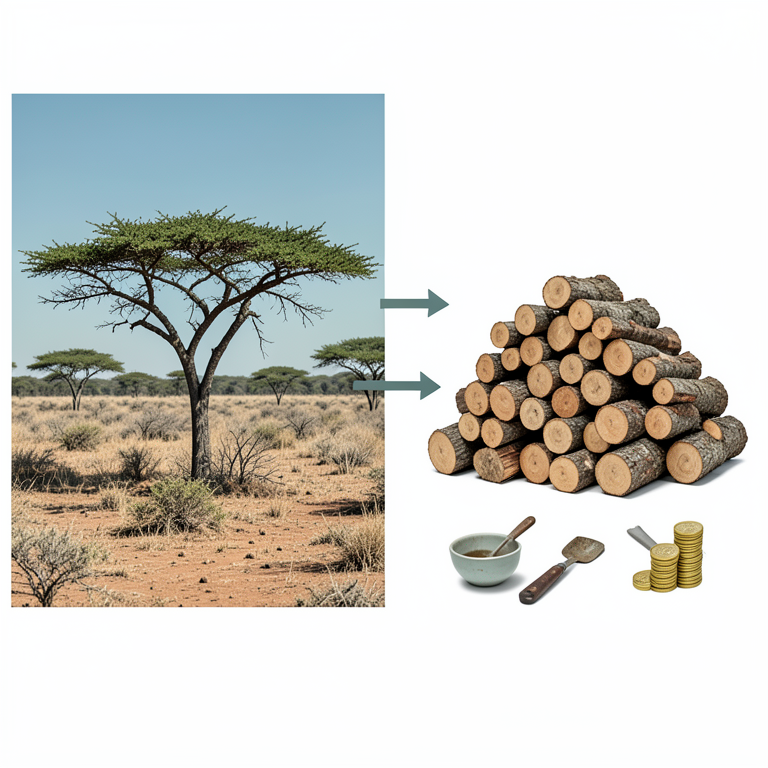
Drivers of Woodfuel Harvesting
AI-generated conceptual illustration (Acacia and savanna woodland trees in Kaduna State, Nigeria). It explains the idea and does not show study data.
View source evidence ↗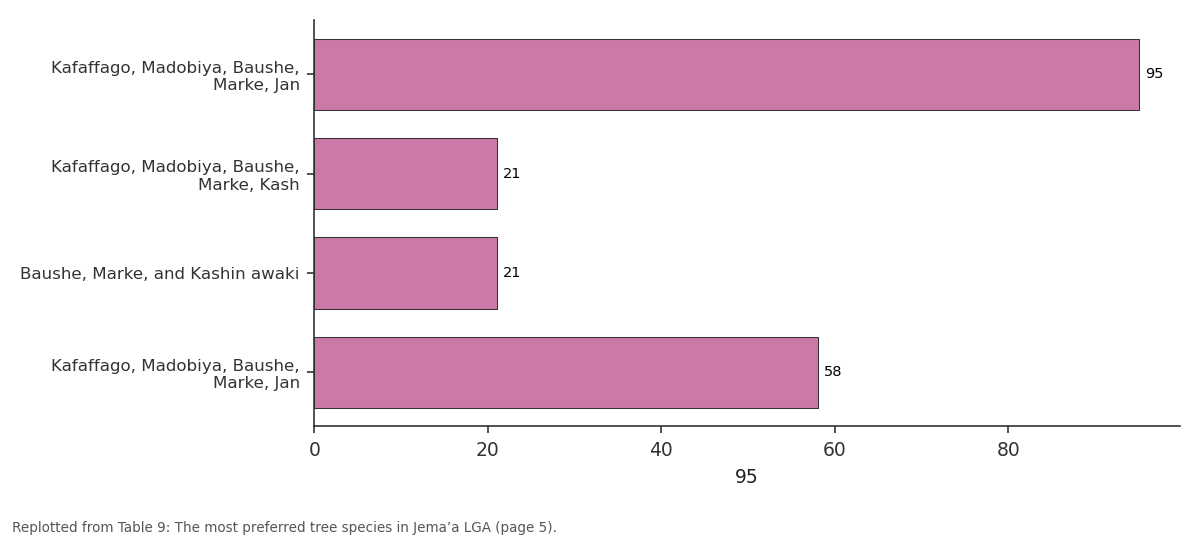
95: Kafaffago, Madobiya... vs Kafaffago, Madobiya... vs Baushe, Marke, and... vs Kafaffago, Madobiya...
Replotted from Table 9 (page 5) of the original paper. Every bar is the paper's own table value.
View source evidence ↗Figures & tables
From the original paper Table 1
 Table 2
 Table 3
 Table 4
 Table 5
 Table 6
 Table 8
 Table 7
 Table 9
 Table 11
 Table 10
 Table 12
 Table 13
Introduction
Energy has a major impact on every aspect of our socio-economic life. Energy is the essential ingredient or tool for socio-economic development and index for prosperity in any state or nation (Akuru and Animalu, 2009). Inadequate supply of energy restricts socio-economic activities, limits economic growth and adversely affects the quality of life (Energy Commission of Nigeria [ECN], 2003). Although Nigeria is endowed with a variety of clean energy sources, such as hydropower, geothermal, wind, and solar, both rural and urban households in Nigeria depend heavily on biomass fuel such as dung, woodfuel and charcoal for their energy needs. For example, ECN (2003) reported that over 60% of Nigeria's population depends on woodfuel for cooking and other domestic uses. This is an indication of income and energy poverty. The consumption of woodfuel is worsened by the widespread use of inefficient cooking methods, the most common of which is still an open fire which has provided an opportunity for commercial woodfuel harvesting especially in developing countries. For example, the current nature of woodfuel collection has changed from subsistence to a commercial status because of the variety of engagements and the job opportunities it creates (Naibi, 2015) [11] . The commercial production and distribution of woodfuel and charcoal generates significant employment and income in rural areas of developing countries (WEO, 2006) [17] . For example, biomass production and distribution creates more than 200,000 jobs and generates more than 50 million dollars income every year.
A lack of energy in an economy or its inadequacy lead to social and economic poverty, underdevelopment, unemployment, high level of illiteracy, and increased migration (Hermann. N.D, in Ajayi, 2013) [3] . Within the ecological zones of Northern Nigeria, trees are cut down for woodfuel and marketed across all ecological regions in Nigeria and despite the existence of forest reserves and National Parks; the volume of woodfuel production appears to be on the increase (Ewah, 2014) [7] . The demand for woodfuel increases daily as rural migrations into urban centres in northern Nigeria is not defined. There is always a market for woodfuel, thereby making it the driving force for the continuous increase in the volume of trees harvested (Adewuyi and Olofin, 2014) [2] . There is the need for deliberate and consistent effort towards improvement in our energy sector in Nigeria so that the populace would have an improvement in their standard of living. Accurate and adequate information on the reasons for increase commercial woodfuel harvesting/businesses is an important step for decision making towards our energy production and distribution. No details study has been documented in Jema'a
Local Government area on commercialization of woodfuel harvesting to know why people involves in the woodfuel business which is a vital instrument to measure the level of our income and energy distribution, looking at this area which serves as the hub of Southern Kaduna, couple with its high population growth and different commercial activities. Therefore, this paper assesses commercial woodfuel harvesting/businesses in Jema'a Local Government, Kaduna State, Nigeria with a view to provide information for decision making.
Materials and Methods
Materials and Methods
Study Area
The study area is Jema'a Local Government Area of Kaduna State. Jema'a local government is located between latitudes 9 ͦ 11′ to 9 o 30′ N and longitudes 8 o 00′ to 8 o 30′ east of the Greenwich Meridian. It has AW type of climate, as classified by Koppen which is characterized by two distinct seasons: wet and dry. The wet season begins in April and end in October with a peak of rainfall in August, while, the dry season starts from November to March. These seasons are influenced by the tropical maritime and tropical continental air masses. The mean annual rainfall is about 1800mm and the mean monthly temperature is 25 0 C, while relative humidity is about 62% (Abaje and Giwa 2007, as cited in Ishaya and Abaje 2008). The vegetation of the study area is a Guinea savanna type (Buba, 2015) [6] . It is savanna woodland, characterized by tall trees of about 20-40m high, shrubs and tall grasses up to 3m tall. Some of the tree species found in the area includes: Ceiba petandra, Parkia biglobosa, Khaya senegalensis, Mangifera indica, Vitex doniana, Anogeissus leiocarpus, Borrasus aethiopum, Piliostigma thonningii, and Prosopis Africana, and grasses like elephant grass, Pennisetum purpureum, Andropon gayanus and Tridax procuben are common. The natural plant covers of the study area have been greatly modified by human activities such as bush burning, woodfuel logging, farming, timber extraction and animal grazing (Abdul, 2010) [1] . For instance, it was observed that the study area has different wood lands such as the Nindem and Sanga forest reserves that have being degraded by human activities.
Procedure for data Collection and Analysis 2.2.1 Type and Sources of Data
The data for this study was acquired from primary source through the questionnaire, Focus Group Discussion (FGD), in-depth interview and direct field observation. The targeted population for the study includes wood fuel cutters/producers, wholesalers, traditional rulers and forest officials in the study area. The questionnaire consisted of close ended questions and was administered to respondents using availability sampling procedure. The information obtained from the questionnaire includes demographic characteristics of the respondents, the most preferred tree species and why they are the most preferred ones in the study area, factors responsible for commercial wood fuel harvesting in the study area. The documentary source was also obtained from journals, unpublished dissertations and theses.
Sampling Technique
A field survey was carried out in the study area to obtain the primary data for the study. In order to obtain the primary data for the study, questionnaire survey, FGD, in-depth interview and direct field observation were carried out. A total of 195 questionnaires were administered to respondents across the study area using availability sampling procedure. Availability sampling technique was employed because most of the respondents combine commercial wood fuel businesses with farming and other civil works which does not allow them to be available always. The samples were collected based on the availability of commercial wood fuel businesses in the study area. The respondents for the questionnaire administration were stratified into two: woodfuel cutters/suppliers and wholesalers. The sample size of 195 respondents for the questionnaire administration was drawn from the population of registered members of woodfuel cutters/producers (320) and wholesalers (20) (Krejcie and Morgan, 1970). Purposive sampling procedure was used to select the sample villages. The study had two focus groups that included woodfuel cutters and wholesalers who did not participate in the questionnaire survey. Each individual for the focus group was purposively selected to be a discussant in the group. A group of 6-10 people of a particular category were selected in a place, followed by another category in chronological order to discuss issues and questions itemized for the study. The FGD was done in order to complement the result obtained from the questionnaire survey. Direct field observation was also carried out to areas where they were harvesting trees for commercial woodfuel production and the selling points to observe the most preferred tree species in the study area. In-depth interview was also carried with the key informant officers in the study area that included traditional rulers and officials of forest department in the local government.
Procedure for Data Analysis:
The data obtained from the field survey were in two categories: qualitative and quantitative data. The qualitative data were subject into transcription and represented in narrative format to further strengthen the quantitative data while, the quantitative data was analyzed using descriptive statistics such as, tables and percentage.
Results and Discussion
Results and Discussion
Demographic Characteristics of the Respondents in the Study Area
In this study about 66.7% of the study population was farmers, 3.6% artisan, 5.6% traders and 24.1% engaged in farming and trading. Even those who claimed not to be farmers also engaged in little agricultural activities such as keeping of livestock and cultivation of crops. About 64% were females while 36% were males. This study indicates that women dominate the ladder in terms of commercial wood fuel production. 77% were married, 1% single, 20.5% widows while 1.5% divorce and 3.6% fall between 20 to 29 years, 28.2% fall between 30 to 39 years, 51.3% fall between the age of 40 to 49 years, while 16.9% falls between the age of 50 years and above. Here most of those involved in commercial wood fuel businesses are the youth (30-49 years) and very energetic people that supposed to be in the workforce to help in the development of the country but are the ones causing serious damage or mismanaging of the environmental resources. In terms of education, 33% have had primary education, 39.4% secondary education, 15% tertiary education while 20% have other forms of education or knowledge.
Factors responsible for commercial wood fuel harvesting in Jema'a local government area
There are so many factors which are responsible for commercial wood fuel harvesting in Jema'a local government. These factors include poverty, unemployment, seasonality of job, adequacy of food, source of income, increase in human population, and availability of wood fuel resources in the study area as well as inheritance of the wood fuel business from parent. The findings reveals that 58.5% and 40.5% strongly agreed and agreed that poverty is responsible for increased commercial woodfuel harvesting in Jema'a local government (table 1). They claimed that poverty has forced most of the key actors to be engaged in the woodfuel business. The commercial woodfuel harvesting helps them to reduce poverty level by providing jobs, income and other family needs. This agrees with Bashir (2015) [5] and United Nation Development Programme {UNDP} (2008) [14] which reported that woodfuel business reduces poverty among many youths who are engaging in cutting, resizing, transporting, loading and off-loading and selling of the woodfuel and marketing of biomass such as woodfuel and charcoal may lead to achieving Sustainable Development Goals (SDGs) of poverty eradication, unemployment, due to biomass harvesting and sales could significantly contribute a lot to many poor families throughout the third world countries. But 1% and 0.5% argued that poverty cannot be the responsible factor for commercial woodfuel harvesting. They noted that they take advantage of the wide range of market for commercial woodfuel business due to unavailability of other forms of energy in the study area. It was observed that many people are involved in the commercial woodfuel business to earn a living which is not friendly to the environment. However, woodfuel business serves as one of their sources of livelihood. They get involved in the woodfuel business because of the high level of poverty in the area. The woodfuel business helps them to solve their family needs such as buying of food, ingredients, paying of children school fees and buying of their books. Many of them find it difficult to eat food three times a day. But their involvement in the woodfuel business gives them the opportunity to solve most of their family needs. This perception is well-illustrated by the chief imam of Dangwa Village: We get involved in commercial woodfuel harvesting because of the high level of poverty in our area. We find it difficult to eat food three times daily due to poverty but our involvement in commercial woodfuel business has enabled us to solve our family needs such as buying of food, payment of school fees to our children and buying of books (Mohammed, Per. Com, August, 2017) [18] . A lot of money is generated through woodfuel business which forces many people to be involved in commercial woodfuel harvesting. But when poverty is reduced to a level that warrants them to carter for their family needs such as paying school fees for their children, provision of food, clothes and settling medical bill without going to their stores, this will prevent people from going into the forest for commercial woodfuel harvesting. This was illustrated by a woman in Bade village: Though we get money from woodfuel business but if poverty is reduced to the level that we cannot longer go to our stores to pay children school fees, buying of clothes and settling of medical bill would stop us from going to the forest for commercial woodfuel harvesting (Joseph, Per, Com, August, 2017) [22] . In practice, high number of poor people in developing countries will continue to rely on woodfuel as source of their livelihood such as generating income and employment due to poverty. There are others who load and off-load the woodfuel from trucks. These sets of people are paid through the services they rendered to their masters. However, unemployment is one of the major causes of commercial woodfuel harvesting due to the fact that many of the key actors have higher qualifications such as Diploma and NCE but do not have any job to do. No one would finish his/her studies and wish to stay unemployed. This has forced them to look for alternative source of livelihood which is commercial woodfuel business. If jobs or loan are being provided, this will discourage them from going into the forest for commercial woodfuel collection which has adverse effects on the vegetation, soil and wildlife. As quoted from a woman at Tafan village: Many of us have higher qualifications such as Diploma and Nigeria Certificate in Education (NCE) but do not have any job apart from farming that cannot feed us throughout the year. Remember that no one wishes to finish his or her studies and stay idle in the society. That is why we involved in commercial woodfuel business to help ourselves (Yohanna, Per. Com. August, 2017) [25] . People need food for their living. But lack of food forces many people to get involved in any kind of business just for survival. Most of the key actors sometimes lack food which forced them to get involved in commercial woodfuel harvesting. The sale from the woodfuel enables them to buy more food for their families. This agrees with Regional Wood Energy Development Programme in Asia (1997) [12] , which stated that in times of hardship, or when harvests are insufficient for subsistence, the opportunity to generate income in woodfuel business provides a safety-net for poor persons However, they also get involved in commercial woodfuel harvesting in order to reserve/store their farm produce for future use or long period of time. Money raise from selling of wood is used for buying of more food to reduce pressure on the produced from their farms, since they are peasant farmers who cannot produce enough for their families. As such food is reserved for the next rainy season. As quoted from a man at New-York Village, Gidan Waya: I involved in commercial woodfuel business because it helps me not to put more pressure on my store as the money I obtain from selling of the woodfuel assists me in buying more food for my family, and to reserve the one I have produced for a very long time, since I do not produce much that would take care of my family for a very long period of time due to financial constraints (Danladi, Per. Com. August, 2017) [20] . strongly disagreed and disagreed. Based on this finding, it can be concluded that income generation causes increase commercial woodfuel harvesting in Jema'a local government area. This is because most of the key actors use the opportunity of high cost of other forms of energy to cut down woodfuel for the market in order to generate income. This finding is similar to Regional Wood Energy Development Programme in Asia (1997) [12] and Feka and Manzano (2008) [9] , USAID (2006) [16] which reported that woodfuel business is the main source of income for about 10% of rural households, and for about 40% of their cash earnings and that money raised from selling of woodfuel helps them to meet urgent and basic needs such as household rationing, and purchase of books for children and about three in four poor people live in rural areas, where they depend on natural resources for their livelihoods, and about 90 percent of them depend on forests for at least some part of their income. They get involved in commercial woodfuel harvesting to generate income to solve their family needs. They use the woodfuel business to raised money for themselves without relying on any other person. And that woodfuel business has employed many people today, even in the urban centres, such as Kafanchan, Keffi and Jos, where some of them become transporters, vendors, retailers and wholesalers, and others who are engaged in resizing of the woodfuel. Money raised from the woodfuel business is used to solve their family needs such as paying children school fees, health, and buying of ingredients which have reduced conflict among relations especially family members who used to depend on their relations for a living. This is because it has given them the opportunity to collect money in advance to solve their family needs, and whenever the woodfuel is ready they asked their customers to come for the product without disturbing relationships to give them money as in the past. As quoted from a woman at Dangwa:
| SA | A | SD | D | Total |
|---|---|---|---|---|
| 114 | 78 | 2 | 1 | 195 |
| 58.5% | 40.% | 1.0% | 0.5% | 100% |
Table text extracted from the original PDF; superscript letters are shown inline. The original table image is below.
View original table image
Woodfuel business has reduced conflict between me and my inlaws because I used to disturb my relations (brothers) in the past for money, food and other needs which sometimes lead to conflict in the family. But when I started the woodfuel business, I don't
ask for money any more from any one to solve my family needs anymore because I have every opportunity now collect money from my customers if I have any need and whenever the woodfuel is ready they would come for it (Barde, Per. Com. August, 2017). There is the availability of woodfuel resource around them which also scarce somewhere that need it and that gives them the opportunity to extract vegetation for the market. Increase in population coupled with high prices of kerosene and other sources of energy that the populace cannot afford for their household consumption have prompted them to cut trees and sale since they are available in the bush/forest. The presence of bakeries in Jagindi Tasha, Godogodo, Gidan Waya and Kafanchan and other areas that need woodfuel for the production of bread, hotels, Suya spots and Akara sellers who also demand woodfuel provide many opportunities for people to get involved in commercial woodfuel business in Jema'a local government. Increase in population leads to competition which makes people to exert more pressure on the available resources. The result in table 7 indicates 20.5% and 64.1% strongly agreed and agreed that increase in population is responsible for commercial woodfuel harvesting in Jema'a local government. But 21 (10.8%) and 4.6% strongly disagreed and disagreed. Increase in population creates wide market for goods and services. Increase population in the recent years in Nigeria has paved way for different businesses such as commercial woodfuel business. Prices of other forms of energy such as kerosene and liquefied natural gas are not at affordable rate and this has forced people to go for cheap, available and affordable ones which are woodfuel and charcoal. This gives the producers the opportunity to extract woodfuel for the market. This finding agrees with United Nation Sudano-Sahelian office (1992) [15] which reported that the demand for woodfuel has been rising especially in large towns due to increase in population growth and other factors such as poverty and high cost of other sources of energy. The result in table 8 has shown that 45.64% and 41.54% strongly agreed and agreed that parents are responsible for commercial woodfuel harvesting in Jema'a local government. On the other hand, 7.18% and 5.64%strongly disagreed and disagreed.
| SA | A | SD | D | Total |
|---|---|---|---|---|
| 40 | 125 | 21 | 9 | 195 |
| 20.5% | 64.1% | 10.8% | 4.6% | 100% |
Table text extracted from the original PDF; superscript letters are shown inline. The original table image is below.
View original table image
| SA | A | SD | D | Total |
|---|---|---|---|---|
| 89 | 81 | 14 | 11 | 195 |
| 45.64% | 41.54% | 7.18% | 5.64% | 100% |
Table text extracted from the original PDF; superscript letters are shown inline. The original table image is below.
View original table image
Children whose parents involved in commercial woodfuel business are likely to get involve commercial woodfuel business. As they grow up, sometimes they are been influenced by their parents to inherit the kind of business they do. It was observed that some parents influenced their children to get involved in commercial woodfuel business. They inherited the woodfuel business, whether harvesting or selling of the wood, from their parents who also did it. Some of the children discovered that commercial woodfuel harvesting generates a lot of money for their parents which attract most of them to be involved in the woodfuel business. Their parents used it to buy clothes, food and paid school fees for them when they were young which made them to apply the same thing to their own children.
Tree Species Preferences in Jema'a Local Government Area
This section looks at the most preferred tree species in the study area. It also discusses the reasons why people prefer them to other woodfuel. 9). But it was observed that Pterocarpus erinaceus has high patronage in the market because of it flammability. Most of the species identified by the respondents are woody species that absorbed low water, produces little smoke, catch fire very well and are easy to resize. This gives them (producers) the opportunity to extract those species for the market in the study area. When these woody species are in the market, nobody cares to buy woodfuel from other tree species. This finding is contrary to Isma'il et al, (2015) [10] who identified Locust bean, Acacia, Tamarindus, baobab and Neem as the most preferred tree species for woodfuel in Ikara local Government area of Kaduna state. Baobab is hardly used as woodfuel mainly due to its spongy constitution which renders it difficult to sustain fire.
Reasons for the most preferred Tree Species in the Study Area
This section discusses the reasons why some of these tree species become the most preferred ones in the study area. However, most people preferred woodfuel from tree species above because of the following reasons: flammability of the woodfuel, smoke produced by the woodfuel, conversion of the woodfuel to charcoal after use and easy to resize, among others. [21] The species identified by the respondents absorbed little or no water even during the rainy season which makes people to prefer them to other woody species. But 17 (8.7%) argued that high flammability of the woodfuel is not the reason for the most preferred tree species in the study area but is a matter of choice. Some people do go for the most available ones in the market and not the flammability. The result in table 12 shows 84.6% and 12.8% claimed that conversion of the woodfuel to charcoal after use makes people to seek for them than other woodfuel. After cooking the users do pour water on it to quench the fire and obtain charcoal for use later which reduces their expenses for the purchase of woodfuel every day. This attracts users to patronize them than woodfuel from other trees such as species such as Daniellia oliveri which doesn't sustain fire talk more of producing charcoal because a lot of ashes are produced by such species. Most of them identified charcoal which is derived from the woodfuel as a reason why users patronize the woody species. They take advantage of the conversion of the woodfuel to charcoal which makes them to span less money in buying woodfuel every day for consumption. Table 13 indicates that 49.2% and 46.7% claimed that the easier of the woodfuel to be resized the more people prefer them. In this case, the wholesalers look for woodfuel that are easy to resize because if the wood is harder, it gives those who they employed tough time to resize it. For instance woodfuel such as those from Kafaffago, Madobiya and Baushe are easy to resize. People who are employed to resize them can finish in a moment without wasting too much of their time. Those who resize the woodfuel are always happy whenever they see woodfuel from Kafaffago, Madobiya and Baushe because they would finish their work on time.
| SA | A | SD | D | Total |
|---|---|---|---|---|
| 96 | 91 | 3 | 5 | 195 |
| 49.2% | 46.7% | 1.5% | 2.6% | 100% |
Table text extracted from the original PDF; superscript letters are shown inline. The original table image is below.
View original table image
| SA | A | SD | D | Total |
|---|---|---|---|---|
| 165 | 25 | 4 | 1 | 195 |
| 84.6% | 12.8% | 2.1% | 0.5% | 100% |
Table text extracted from the original PDF; superscript letters are shown inline. The original table image is below.
View original table image
Conclusion
Vegetation resources are used for the development of mankind. Human population depends on vegetation resources for food, medicinal value and shelter. Commercial woodfuel harvesting/business is an activity that people do in developing world especially Sub-Saharan Africa mostly due to inadequate power supply and other forms of alternative sources of energy. This has prompted many people to get involved in commercial woodfuel harvesting especially the poor who live in the rural areas. This study indicates that there are several reasons that have accounted for commercial woodfuel harvesting/businesses in Jema'a local government, which include poverty, availability of woody resources, and source of income generation. This occurs mostly due to the negligence of the rural population by the authority concern to supply them with basic amenities to support their life. Harvesting of woodfuel for commercial purpose depends on the needs of the users which allow the producers to extract tree species that have high demand in the market. Asking people not to go into the forest for commercial woodfuel harvesting will lead to loss of jobs, increase poverty and crime rate. As such it is recommended that woodfuel collectors should be allowed to cut the branches of trees instead of removing the whole stand. Clean and alternative sources of energy should be provided to people at affordable rate in every part of the country.
Figures and tables from the paper
| SA | A | SD | D | Total |
|---|---|---|---|---|
| 130 | 60 | 3 | 2 | 195 |
| 66.7% | 30.8% | 1.5% | 1.0% | 100% |
Table text extracted from the original PDF; superscript letters are shown inline. The original table image is below.
View original table image
| SA | A | SD | D | Total |
|---|---|---|---|---|
| 130 | 58 | 4 | 3 | 195 |
| 66.7% | 29.7% | 2.1% | 1.5% | 100% |
Table text extracted from the original PDF; superscript letters are shown inline. The original table image is below.
View original table image
| SA | A | SD | D | Total |
|---|---|---|---|---|
| 150 | 39 | 2 | 4 | 195 |
| 76.9% | 20% | 1% | 2.1% | 100% |
Table text extracted from the original PDF; superscript letters are shown inline. The original table image is below.
View original table image
| SA | A | SD | D | Total |
|---|---|---|---|---|
| 119 | 41 | 14 | 21 | 195 |
| 61% | 21% | 7.2% | 10.8% | 100% |
Table text extracted from the original PDF; superscript letters are shown inline. The original table image is below.
View original table image
| SA | A | SD | D | Total |
|---|---|---|---|---|
| 77 | 107 | 11 | 0 | 195 |
| 39.5% | 54.9% | 5.6% | 0% | 100% |
Table text extracted from the original PDF; superscript letters are shown inline. The original table image is below.
View original table image
| Kafaffago, Madobiya, Baushe, Marke, Jan yaro, Kashin awaki, and Kujeme | Kafaffago, Madobiya, Baushe, Marke, Kashin awaki | Baushe, Marke, and Kashin awaki | Kafaffago, Madobiya, Baushe, Marke, Jan yaro | Total |
|---|---|---|---|---|
| 95 | 21 | 21 | 58 | 195 |
| 48.7% | 10.8% | 10.8% | 29.7% | 100% |
Table text extracted from the original PDF; superscript letters are shown inline. The original table image is below.
View original table image
| SA | A | SD | D | Total |
|---|---|---|---|---|
| 158 | 37 | 0 | 0 | 195 |
| 81% | 19% | 0% | 0% | 100% |
Table text extracted from the original PDF; superscript letters are shown inline. The original table image is below.
View original table image
| SA | A | SD | D | Total |
|---|---|---|---|---|
| 137 | 41 | 0 | 17 | 195 |
| 70.3% | 21% | 0% | 8.7% | 100% |
Table text extracted from the original PDF; superscript letters are shown inline. The original table image is below.
View original table image
References
25 in the original paper- Abdul J. Impact of Man Activities on the Vegetation of Nindem and Tsonje Forest Reserve, Kaduna State, Nigeria: Unpublished Undergraduate Project Submitted to the Department of Geography, BUK, 2010.
- Adewuyi TO, Olofin EA. Sustainability of Fuel Wood Harvesting from Afaka Forest Reserve, Kaduna State, Nigeria Journal of Agricultural Science. 2015; 7(1):129-137.
- Ajayi OO. Sustainable Energy Development and Environmental Protection: Implication for Selected States in West Africa: Renewable and Sustainable energy Reviews. 2013; 26:532-539.
- Akuru UB, Chikuni E. Impact of renewable energy deployment on climate change in Nigeria. 2015; 26(3):125134.
- Bashir MB. The pattern of fuelwood Supply to Gombe Urban Area, Gombe State, Nigeria: Unpublished Msc Dissertation Submitted to the Department of Geography, BUK, 2015.
- Buba T. Impact of Different Species of Different Sizes on Spatial Distribution of Herbaceous Plants in the Nigeria Guinea Savanna Ecological Zone. Hindawi Publishing Corperation Sceintifica, 2015, 1-9.
- Ewah JO. Exploitation of Carbon Energy and the Integrity of Protected Rainforest Areas in Nigeria: International Journal of Humanities and Social Science. 2014; 4(6):206-215.
- Falola JA. Poverty: In Kano Envronment, Society and Development, Tanko A.I and Momale S.B (Eds.) London and Abuja, Adonis and Abbey Publishers Ltd, 2014.
- Feka NZ, Manzano MG. The implications of wood exploitation for fish smoking on mangrove ecosystem conservation in the South West Province, Cameroon: Mongabay.com Open Access Journal-Tropical Conservation Science. 2008; 1(3):222-241.
- Isma'il M. Maiwada A, Bashir A, Musa JJ, Adamu G, Babajo H, et al. Comparative Analysis of Woodfuel Utilization In-and-Aroud Ikara Local Government Area of Kaduna State, Nigeria: Global Journal of Reseach and Review. 2014; 2(3):125-135.
- Naibi AI. Traditional Energy Discourse: Situation Analysis of Urban Fuelwood Sourcing in Northern Nigeria: Resources and Environment. 2015; 5(6):192-199.
- Regional Wood Energy Development Programme in Asia. Regional Study on Wood Energy Today and Tomorrow in Asia: Asia-Pacific Forestry Sector Outlook Study Working Paper Series. 1997; 34:1-153.
- The Presidency Energy Commission of Nigeria. National Energy Policy: Federal Republic of Nigeria, 2003, 1-82.
- United Nations Development Programme-UNDP. Woodfuel as Percentage of Energy Consumption in Development Countries, 2008. http//undp.org/ fuelwood. htlm.com (accessed on 25th June 2011)
- United Nation Sudano-Sahelian office. Assessment of Desertification and Drought in the Sudano-Sahelian Region of Africa 1985-1991, New York, USA, 1992.
- United State Agency for International Development-USAID. Issues in Poverty reduction and natural resource Management: 1300 Pennsylvania Avenue, NW Washington, DC, 2006.
- World Energy Outlook (WEO). Energy For Cooking In Developing Countries. OECDVIEA. 2006; 15:419-445.
- Mohammed A. Dangwa, Farmer/woodfuel producer, Personal communication, 2017.
- Barde S Dangwa. Woodfuel producer, Personal communication, 2017.
- Danladi A. New York, Farmer/woodfuel producer, Personal communication, 2017.
- Gambo C Gwaska. Woodfuel producer, Personal communication, 2017.
- Joseph V Barde. Woodfuel producer, Personal communication, 2017.
- Mohammed I Dangwa. Woodfuel Producer/farmer, Personal communication, 2017.
- Yakusack M, Jagindi Tasha. Wholesaler, Personal communication August, 2017.
- Yohanna S Tafan. Wholesaler, Personal communication, 2017.