
Research article · 2019 · Full text
International Journal of Agriculture and Food ScienceAppraisal of extension service delivery to goat farmers in Kabba/Bunu Local Government Area of Kogi State, Nigeria
Volume 1(1) · Pages 27–31 · DOI: 10.33545/2664844x.2019.v1.i1a.5 ↗
Research areasAnimal Diversity and Health Studies
Abstract
Author-writtenThe study examined the farmers’ perception on the effectiveness of extension service delivery in goat production in Kabba/bunu Local Government Area of Kogi state. The study specifically: identified the socio-economic characteristics of goat farmers, identified the breeds of goat mostly reared by farmers, examined farmers’ perception on the effectiveness of extension service delivery, identified factors affecting effectiveness of extension service delivery. Primary data was obtained with the aid of a well-structured questionnaire. Five villages were purposively selected for this study. Data obtained was analysed using descriptive statistics such as frequencies, percentages and mean scores. Results of the findings revealed that goat farmers perceived extension messages on training/education on goat breeding ( ), awareness of improved breeds of goats ( ), animal nutrition ( ), proper housing of goats ( ) and goat/goats’ product marketing to be ineffective. It was indicated that high cost of vaccines ( ) and poor access roads ( ) were the major constraints perceived by farmers against effective extension service delivery in the study area, majority (68.6%) of respondents reared West African Dwarf goat. This study recommended that both government and the private sector should intervene in exercising some form of price control on vaccines and also provide good road network, extension agent should work to improve on their services through regular training as well as paying regular visit to the farmers in order to bring them up to speed with current innovations on goat production.
Summary
Source-checkedPlain-language reading of the full paper, prepared with AI and checked against the text. Each point links to the authors' own words.
Why it matters
- Extension service delivery is the process of providing farmers with technical advice, information on credits, farm inputs, and marketing innovations from research institutes. View evidence ↗
- Agricultural extension delivery in Nigeria has historically shown poor performance, particularly in farmer training and research systems. View evidence ↗
The question
- The study aimed to examine how goat farmers in the Kabba/Bunu Local Government Area of Kogi State perceive the effectiveness of extension service delivery. View evidence ↗
What they did
- The researchers used purposive sampling to select six villages with high goat farmer concentrations and simple random sampling to select 20 respondents per village, resulting in 118 completed questionnaires. View evidence ↗
- Data analysis involved descriptive statistics (mean, frequency, and percentage) and Ordered Probit Regression for specific objectives. View evidence ↗
- The study used a decision rule where a mean score of 2.0 or higher indicated a factor was 'very effective' or 'very serious,' while scores below 2.0 were considered 'not effective' or 'not serious.' View evidence ↗
What they found
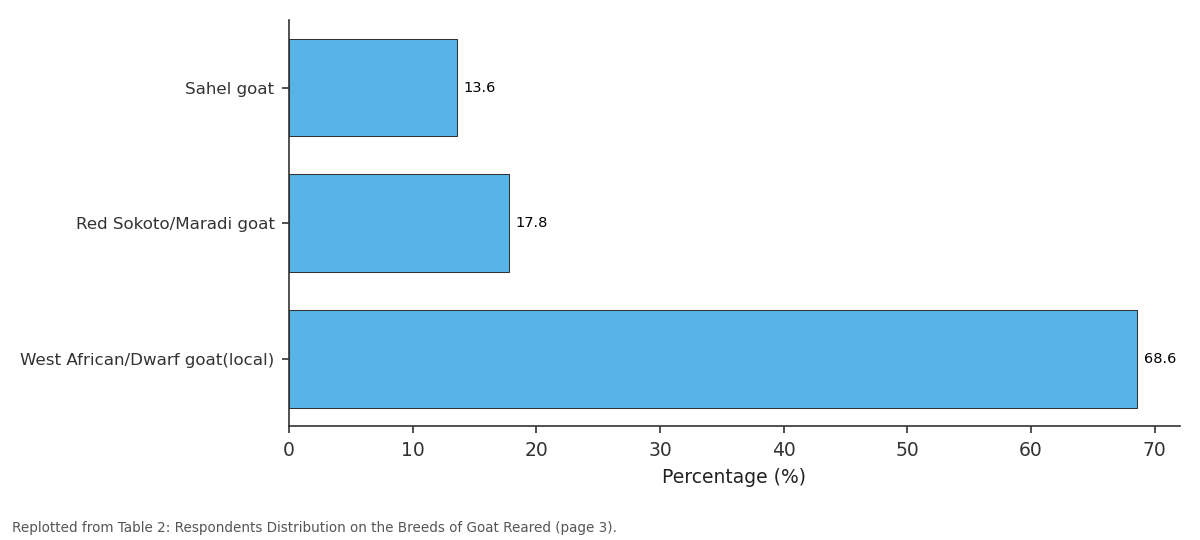
- The majority of farmers (68.6%) reared West African Dwarf goats, with smaller percentages rearing Red Sokoto/Maradi (17.8%) and Sahel (13.6%) goats. View evidence ↗
- Extension services for efficient goat marketing were perceived as effective to a great extent, with a mean score of 2.0. View evidence ↗
- Training and education on goat breeding was perceived as only 'somewhat effective,' with a mean score of 1.8. View evidence ↗
- The primary constraints to effective extension service delivery were poor access roads (mean = 2.1) and the high cost of vaccines (mean = 2.0). View evidence ↗
- Higher educational levels were associated with a higher probability of perceiving extension services as very effective, increasing by 1.4 percentage points per year of education. View evidence ↗
- Larger household sizes were linked to a decrease in the probability of perceiving extension services as very effective by 20.9 percentage points. View evidence ↗
What it means
- The authors concluded that goat farmers in the study area generally perceive extension service delivery as being effective only to some extent. View evidence ↗
- The authors recommend that the government and private sector implement price controls on vaccines and improve road networks to encourage production. View evidence ↗
Visual summary
2 visualsIllustrations explain the paper; charts are replotted from the paper's own table values.
Percentage (%): Sahel goat vs Red Sokoto/Maradi goat vs West African/Dwarf...
Replotted from Table 2 (page 3) of the original paper. Every bar is the paper's own table value.
View source evidence ↗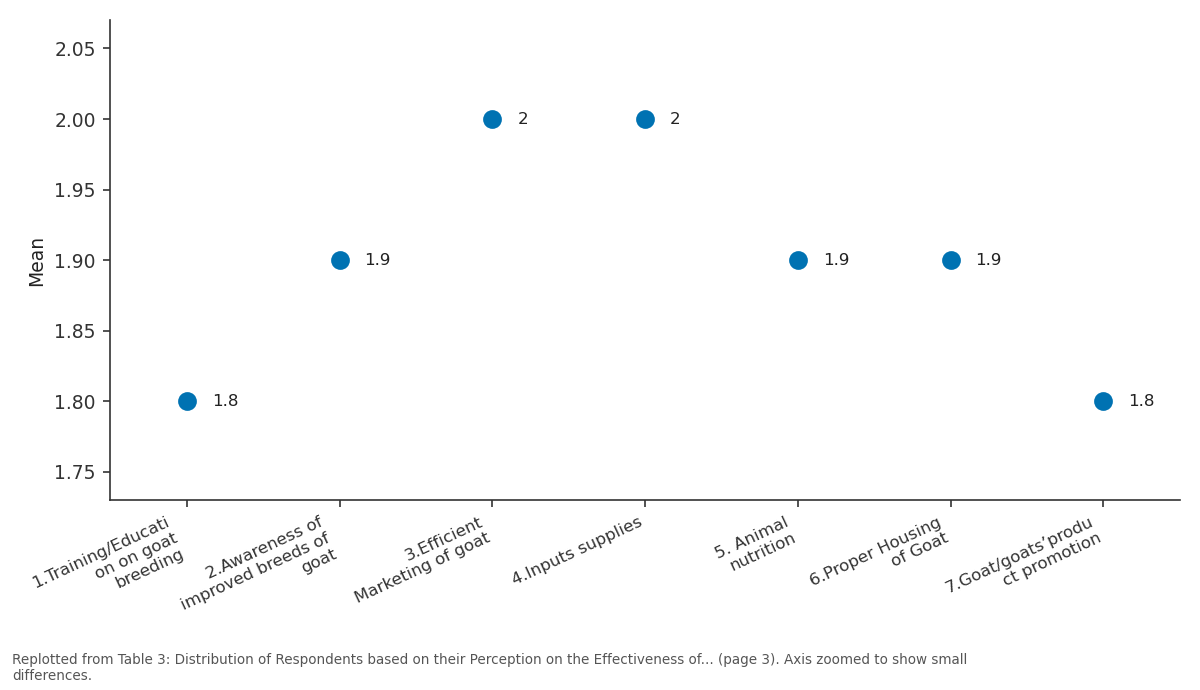
Mean: 1.Training/Education on... vs 2.Awareness of improved... vs 3.Efficient Marketing... vs 4.Inputs supplies vs 5. Animal nutrition
Replotted from Table 3 (page 3) of the original paper. Every bar is the paper's own table value.
View source evidence ↗Figures & tables
From the original paper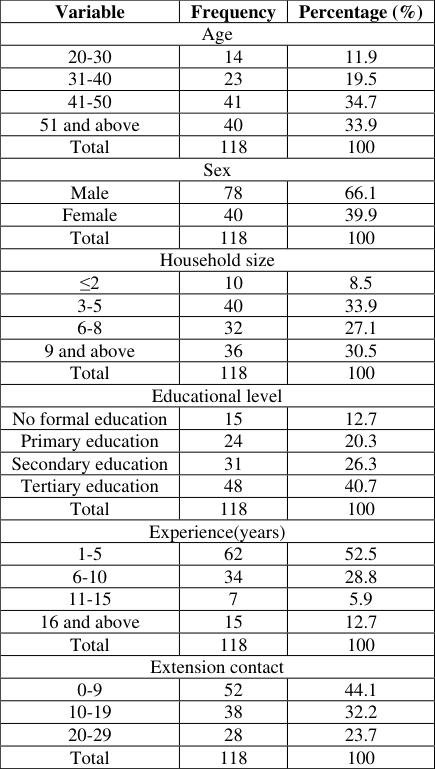 Table 1
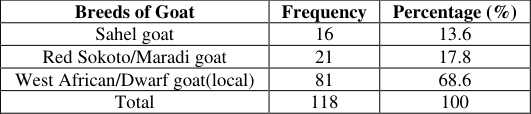 Table 2
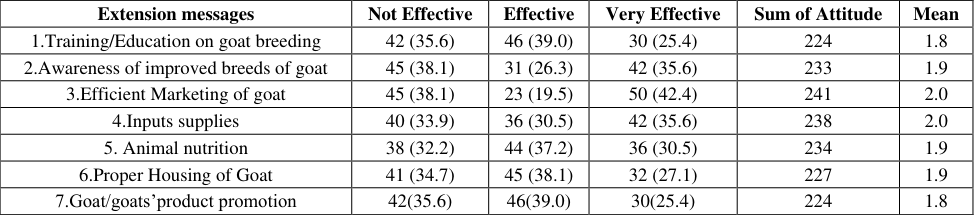 Table 3
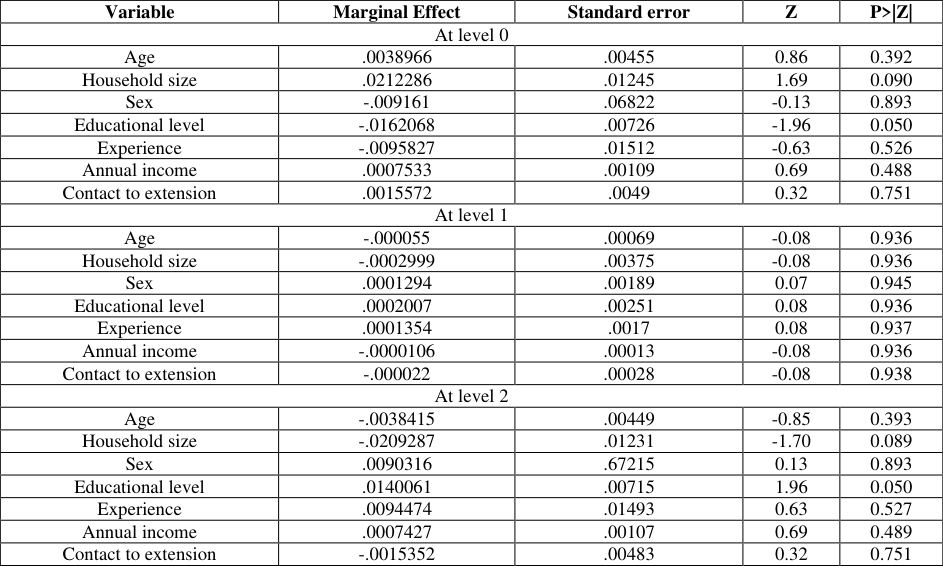 Table 4
Introduction
Farmers are often blamed for poor adoption of extension services on the ground that they are conservative. Then, people measure success or failure of extension delivery based on the level of adoption without consideration of the effectiveness of extension service delivery. Extension service delivery in words of Ogunremi and Olatunji (2013) [10] , is the process by which extension providers bring extension services in the form of technical advice, advice on credits and other farm inputs, marketing information and all other innovation from the research institutes to the farmer. The authors stressed further that it is the responsibility of extension providers to provide learning situations, make farmers aware of research findings and persuade them to change their behaviour in favour of the services. The change in behaviour of farmers towards adopting extension services is an indicator of the effectiveness of the programme. Effectiveness of extension services was explained by Misra (1999) as the observed impacts of the programme, expressed by ideal teaching and learning situation and positive change in behaviour of farmers. Adejo, et al (2012) [1] opined that, effectiveness of extension services is determined through the level of awareness created among farmers, number of visits paid to farmers by extension workers, regularity of field meetings, farmers' training sessions and number of farmers trained. Ajayi, (2005a) [4] came up with a model for evaluating effectiveness of extension programme which stresses assessment of the activities of extension personnel: training, supply of inputs, and technologies, and creation of awareness, these according to Ajayi, (2005b) [4] are the indicators of the effectiveness. In this model, extension programme is evaluated on the basis of achievement of project input delivery system. The model stresses determination of effectiveness through timeliness of input supply, distribution of machinery and their availability, among other variables. It has been observed that the extension delivery has recorded poor performance with regard to extension effectiveness indicators, especially with regard to farming systems research and farmer training programmes, which have been identified as weak links in the agricultural extension delivery in Nigeria (Uza et al.1999) [11] . it is in the light of the for-going that the researcher came up with the following objectives: to identify the socioeconomic characteristics of goat farmers in the study area, to identify the breeds of goat mostly reared by farmers, to determine the perceptions of goat farmers towards the effectiveness of agricultural extension service delivery, to ascertain the factors affecting goat farmers from perceiving the effectiveness of extension service delivery, to determine the effects of socioeconomic characteristics of goat farmers on the effectiveness of extension message they receive. [9] . The study area is located within latitudes 8 0 7'N and 8.117 0 N and longitude 6 0 9'E and 6.150 0 E. This study area is known to have a tropical savannah climate with distinct wet and dry seasons, the raining season ranges between April to October with optimum around August and September. This Area has a mean annual rainfall of 120-140mm and a mean annual temperature that varies between 27℃ and 37℃. The relative humidity (RH) is similarly variable with average between 70-80% in July/August. The soil in this study area is predominantly loamy and sandy soils that are very rich in organic matter. The major crops grown in this area includes Maize, Yam, Cassava, Cashew, Mango and the major livestock reared are Cattle, Swine, Poultry, Sheep and Goat. The study made use of primary data which was elicited from the respondents through the use of a well-structured questionnaire. Purposive sampling was used to select Kakun, Egbeda, Oke-Offin, Oke-bukun, Odo-Ape and Okedayo for the study because of the presence of large concentration of goat farmers in these villages. A simple random sampling technique was used to select 20 respondents from each of the villages selected giving a total of 120 respondents for the study but 118 completed questionnaire were returned.
Methodology
Methodology
Method of Data Analysis
Data collected were analyzed using descriptive statistics such as measures of central tendency such as mean, frequency and percentage while objective 5 was analyzed using Ordered Probit Regression.
Model Specifications = (mean) = Mean
Where ∑ = summation N = sample size F= frequency X= value assigned to each response.
Decision Rule
Any effect or factors ≥ 2.0 was regarded as very effective and very serious the one with < 2.0 was regarded as not effective and not serious.
Measurement of Variables.
i. Age: was measured in years. ii. Education: educational background was measured as no formal education, primary education, secondary education and tertiary education.
iii. Household size: number of persons living in the respondent's house. iv. Sex: Male (1), Female (2). v. Annual income: was measured in naira. vi. Experience: was measured in years. vii. Extension Contact: number of extension visits annually.
Results and Discussions
Table 1 presents the socioeconomic characteristics of the respondents. It shows that majority of the respondents 34.7% were within the age range of 41 -50 years. Table 1 also revealed that 11.9% of the respondents were within the age range of 20 -30 years, 19.5% were within the age range of 31 -40 years, while 33.9% were above 50 years of age. This result is in line with the work of Agbelemoge et al. (2013) [3] who reported that Majority (61.9%) of sampled respondents were between the ages of 41 and 60 years, at this age they were considered highly productive and active to undertake the strenuous tasks associated with farm work.
| Variable | Frequency | Percentage (%) |
|---|---|---|
| Age | ||
| 20-30 | 14 | 11.9 |
| 31-40 | 23 | 19.5 |
| 41-50 | 41 | 34.7 |
| 51 and above | 40 | 33.9 |
| Total | 118 | 100 |
| Sex | ||
| Male | 78 | 66.1 |
| Female | 40 | 39.9 |
| Total | 118 | 100 |
| Household size | ||
| ≤2 | 10 | 8.5 |
| 3-5 | 40 | 33.9 |
| 6-8 | 32 | 27.1 |
| 9 and above | 36 | 30.5 |
| Total | 118 | 100 |
| Educational level | ||
| No formal education | 15 | 12.7 |
| Primary education | 24 | 20.3 |
| Secondary education | 31 | 26.3 |
| Tertiary education | 48 | 40.7 |
| Total | 118 | 100 |
| Experience(years) | ||
| 1-5 | 62 | 52.5 |
| 6-10 | 34 | 28.8 |
| 11-15 | 7 | 5.9 |
| 16 and above | 15 | 12.7 |
| Total | 118 | 100 |
| Extension contact | ||
| 0-9 | 52 | 44.1 |
| 10-19 | 38 | 32.2 |
| 20-29 | 28 | 23.7 |
| Total | 118 | 100 |
Table text extracted from the original PDF; superscript letters are shown inline. The original table image is below.
View original table image
Result on sex distribution of the respondent's shows that 67.4 % of the farmers were males, while 32.5% were females. This implies that more male farmers were involved in goat production than female farmers which may likely reduce productivity rate. This is in line with the findings of Gidarakau, (2008) [7] who reported that women were found to have negative attitude towards participation on production and rearing of goats. also indicates that 8.5%, 33.9%, 27.1% and 30.5% of the respondents had a household size of 0-2, 3-5, 6-8, and 9 and above people respectively. This means that the goat farmers had no large household size. Ajayi, (2014) [5] reported that household size has both positive and negative effect. Positive in the sense that it is cheap and most reliable source of labour with the household head being able to care for their needs while negative if they refuse to render help in farming activities and the household head not being able to care for them. The table also shows that greater percentage (40.7%) of the respondents had tertiary education. This is in consonance with the findings of Bello, (2002) [6] who reported that farmers who were exposed to formal education and information have high ability towards improvement of goat production than those with less exposure. About 12.7% of the respondents had no formal education while 20.3% and 26.3% had primary and secondary education respectively. Table 1 further shows that majority (52.5%) of the respondents had farming experience of 1-5years, while 28.5%, 5.9% and 12.9% of the farmers had 6-10years, 11-15years and 16years and above respectively. This implies that majority of the respondents had low level of experience in goat production in the study area. This is in consonance with Ahmed and Adisa (2017) [2] who reported that most (44.3%) of the respondents had more than 20 years of experience in rice farming, which could have an effect on agricultural extension teaching and learning, since some experience farmers tend to depend more on their past experiences. This means that the goat farmers will be depending more on the extension agents rather than their low level of experience and this will snowball into increase in production.
Breeds of Goat Reared by the Respondents
The result in table 2 shows that majority (68.6%) of the respondents were rearing West African Dwarf goat, while 13.6% and 17.8% of the respondents reared Sahel and Red Sokoto/Maradi goat respectively. This implies that majority of the goat farmers reared the West African Dwarf goat (local goat) in the study area.
| Breeds of Goat | Frequency | Percentage (%) |
|---|---|---|
| Sahel goat | 16 | 13.6 |
| Red Sokoto/Maradi goat | 21 | 17.8 |
| West African/Dwarf goat(local) | 81 | 68.6 |
| Total | 118 | 100 |
Table text extracted from the original PDF; superscript letters are shown inline. The original table image is below.
View original table image
Effectiveness of extension agents as perceived by the farmers in goat production advisory services
The results in table 3 shows that 35.6%, 39.0% and 25.4% of the respondents perceived messages on training/education on goat breeding to be not effective, effective and very effective respectively with mean score of 1.8; which implies that extension messages on training/education on goat breeding is somewhat effective in the study area. With respect to extension service on awareness of improved breeds of goat, 38.1%, 26.3% and 35.6% of the respondents said it was not effective, effective and very effective respectively with mean score of 1.9 which signifies that awareness of improved breeds of goat is effective some extent in the study area. In terms of efficient marketing of goat, it shows that 38.1%, 19.5% and 42.4% of the respondents in the study area claimed that it was not effective, effective and very effective respectively with the mean score of 2.0 which means that respondents perceived extension training/education on efficient marketing of goat to be effective to a great extent. With respect to input availability and supplies, the result shows that 33.9%, 30.5% and 35.6% of the respondents said not effective, effective and very effective respectively, with the mean score of 2.0 which implies that majority of the respondents in the study area perceived availability of inputs and supplies to be effective to a great extent. The result also shows that 32.2%, 37.2% and 30.5% of the respondents claimed that training on animal nutrition was not effective, effective and very effective respectively with mean score of 1.9 which implies that majority of the respondent's perceived education on animal nutrition of goats to be effective to some extent. The result further shows that 32.2%, 38.1% and 27.1% of the respondents in the study area said extension training and education on proper housing of goats is not effective, effective and very effective respectively, with mean score of 1.9 which implies that majority (65.2%) of the respondents viewed extension training/education on proper housing of goat to be effective. In terms of goat/ goats' product marketing, 35.6%, 39.0% and 25.4% of the respondents reported that the extension agents were not effective, effective and very effective respectively, with mean score of 1.8 which implies that extension messages on goat product marketing is effective in the study.
| Extension messages | Not Effective | Effective | Very Effective | Sum of Attitude | Mean |
|---|---|---|---|---|---|
| 1.Training/Education on goat breeding | 42 (35.6) | 46 (39.0) | 30 (25.4) | 224 | 1.8 |
| 2.Awareness of improved breeds of goat | 45 (38.1) | 31 (26.3) | 42 (35.6) | 233 | 1.9 |
| 3.Efficient Marketing of goat | 45 (38.1) | 23 (19.5) | 50 (42.4) | 241 | 2.0 |
| 4.Inputs supplies | 40 (33.9) | 36 (30.5) | 42 (35.6) | 238 | 2.0 |
| 5. Animal nutrition | 38 (32.2) | 44 (37.2) | 36 (30.5) | 234 | 1.9 |
| 6.Proper Housing of Goat | 41 (34.7) | 45 (38.1) | 32 (27.1) | 227 | 1.9 |
| 7.Goat/goats’product promotion | 42(35.6) | 46(39.0) | 30(25.4) | 224 | 1.8 |
Table text extracted from the original PDF; superscript letters are shown inline. The original table image is below.
View original table image
Marginal Effect after Ordered Probit Regression Analysis
The result in Table 4 shows that a year increase in age will reduce the likelihood of the respondents to perceive extension service delivery to be effective by 0.3 percentage point. An increase in the size of the household will reduce the probability of the respondents perceiving extension service to be very effective by 20.9 percentage point. An increase in number of particular sex will increase the probability of the respondents perceiving extension service delivery to be effective by 0.9 percentage point. A year increase in educational level increases the probability of the respondents perceiving extension service delivery to be very effective by 1.4 percentage point. In terms of experience, a year increase in experience will increase the probability of the respondents perceiving extension service delivery to be very effective by 0.9 percentage point. The higher the annual income the higher the likelihood of the respondents to perceive extension service delivery to be effective by 0.07 percentage point. This result shows that respondents had less likelihood to perceive extension service delivery to be effective due to irregular visits of the extension agent by 0.1 percentage point.
| Variable | Marginal Effect | Standard error | Z | P>|Z| |
|---|---|---|---|---|
| At level 0 | ||||
| Age | .0038966 | .00455 | 0.86 | 0.392 |
| Household size | .0212286 | .01245 | 1.69 | 0.090 |
| Sex | -.009161 | .06822 | -0.13 | 0.893 |
| Educational level | -.0162068 | .00726 | -1.96 | 0.050 |
| Experience | -.0095827 | .01512 | -0.63 | 0.526 |
| Annual income | .0007533 | .00109 | 0.69 | 0.488 |
| Contact to extension | .0015572 | .0049 | 0.32 | 0.751 |
| At level 1 | ||||
| Age | -.000055 | .00069 | -0.08 | 0.936 |
| Household size | -.0002999 | .00375 | -0.08 | 0.936 |
| Sex | .0001294 | .00189 | 0.07 | 0.945 |
| Educational level | .0002007 | .00251 | 0.08 | 0.936 |
| Experience | .0001354 | .0017 | 0.08 | 0.937 |
| Annual income | -.0000106 | .00013 | -0.08 | 0.936 |
| Contact to extension | -.000022 | .00028 | -0.08 | 0.938 |
| At level 2 | ||||
| Age | -.0038415 | .00449 | -0.85 | 0.393 |
| Household size | -.0209287 | .01231 | -1.70 | 0.089 |
| Sex | .0090316 | .67215 | 0.13 | 0.893 |
| Educational level | .0140061 | .00715 | 1.96 | 0.050 |
| Experience | .0094474 | .01493 | 0.63 | 0.527 |
| Annual income | .0007427 | .00107 | 0.69 | 0.489 |
| Contact to extension | -.0015352 | .00483 | 0.32 | 0.751 |
Table text extracted from the original PDF; superscript letters are shown inline. The original table image is below.
View original table image
Conclusion and Recommendations
This study assessed the perceived effectiveness of extension service delivery to goat farmers in kabba/bunu local government area of kogi state, Nigeria. The result of the findings shows that goat farmers in the study area perceived extension service delivery in goat production to be effective to some extent. The extension agents are more efficient in linking the farmers with markets and inputs supplies. Majority of the sampled respondents were educated male farmers in their prime age with low level of farming experience in goat production. Also, Majority of the sampled respondents were rearing the West African Dwarf (local breed) goat and this may be due to some constraining factors such as high cost of vaccines, shortage of animal health extension agents, low level of literacy, lack of funds for acquiring and managing the exotic breeds. Based on the findings of this study, it is therefore recommended that: 1. Women should be encouraged by both public and private extension outfits in the production of goat so as to increase productivity in the study area 2. Extension agents should also work to improve on their services through regular training as well as making regular visits towards making farmers aware of innovations. 3. Government and the private sector should strive to address the major factors constraining extension service delivery in the study area especially price control on vaccines and good road network as these will go a long way to encourage production. 4. Government should motivate extension agents by improving on their allowances, salaries and also in the provision of logistics.
References
11 in the original paper- Adejo PE, Okwu OJ, Ibrahim MK. Challenges and Prospects of Privatization of Agricultural Extension Service Delivery in Nigeria Journal of Agricultural Extension and Rural Devolopment. 2012; 4(3):63-68.
- Ahmed TA, Adisa RS. Perceived Effectiveness of Agricultural Extension Methods Used to Disseminate Improved Technologies to Rice Farmers in Kogi State, Nigeria. International Journal of Agricultural Science, Research and Technology in Extension and Education Systems (IJASRT in EESs), 2017: 7(1):27-34. Available online on: http://ijasrt.iau-shoushtar.ac.ir.
- Agbelemoge A, Dada OM, Alabi OT. Assessment of Information and Communication Technologies Used for Disseminating Innovations by Extension Agents in Ogun State, Nigeria. British Journal of Applied Science and Technology. 2013; 6(1):15-23.
- Ajayi AR. Programme Planning, Monitoring and Evaluation in Agricultural Extension, in Nigeria. Ilorin. Agricultural Extension Society of Nigeria, 2005.
- Nigeria Agriculture and Teachers Education. 2014; 4(2):110.
- Bello A, Adamu F. Agriculture Contributes More to Nigerian Economy, 2002, 12-20.
- Gidarakau A, Konavachuk P. A Small-Scale Agricultural Alternative: Dairy and Meat Goats, 2008, 10-18.
- Misra DC. Monitoring Extension Programme and Resources. A References Manual (2 nd ), 1999, 151-160.
- National Population Commission (NPC). Population and housing census enumerators manual. Federal Republic of Nigeria, National Population Commission, Nigeria, 2006, 116.
- Ogunremi JB, Olatunji SO. Perception of Agricultural Extension Agents on the privatization of Service Delivery towards Rural Goat Farmers in Ondo State. Journal of Resources and Environment. 2013; 3(4):87-85.
- Uza A. Agricultural Research and Extension Delivery in Sub-Saharan Africa.Calabar University of Calabar Press, 1999, 34-46.
Cited by 2
From OpenAlex, OpenCitations and reference lists read by Scinovex
- Understanding the Nexus of Extension Teaching Methods and Adoption of Improved Agricultural Production Technologies: Empirical Evidence from Cowpea Farmers in Kogi State, Nigeria ↗
Adejo Patrick Emmanuel, Shaibu Damilola Omojola, U Shaibu · Tekirdağ Ziraat Fakültesi Dergisi · 2025
This study assessed the nexus of extension teaching methods and the adoption of improved production technologies. A three-staged sampling technique was adopted in selecting two hundred (200) cowpea farmers. Primary data obtained using the Kobocollect toolbox was analyzed with adoption score/index and ordered probit regression model. Findings from this study showed that 79 % of the respondents were males while…
❝ 1PDF - Extension strategies in adaptation to climate change with a special reference to goat farming ↗
Duraisamy Thirunavukkarasu, Sohel Rana, R. Sangameswaran, Malvika Chaudhary, N. Akila, Andrew Chongwe et al. · Elsevier eBooks · 2025
❝ 1