
Research article · 2018 · Full text
International Journal of Statistics and Applied MathematicsThree dimensional Debye model on elastic waves of solids
Volume 3(2) · Pages 227–229
Research areasElasticity and Wave PropagationThermoelastic and Magnetoelastic PhenomenaUltrasonics and Acoustic Wave Propagation
Abstract
Author-writtenThis paper based on principal of three dimensional Debye‘s Model of specific heat of solids. We assumed that the energy of the elastic standing waves is quantized. Expression for total number of vibrational mode of solid is obtained. We obtained relation between the vibration and frequency of waves and find total number of vibrational modes of wave analytically by applying mathematical computation.
Summary
Source-checkedPlain-language reading of the full paper, prepared with AI and checked against the text. Each point links to the authors' own words.
Why it matters
- The Debye model, created in 1912, is used to estimate how phonons contribute to the specific heat capacity of solid materials. View evidence ↗
- This model is significant because it accurately explains that heat capacity at low temperatures is proportional to the cube of the temperature (T3). View evidence ↗
The question
- The study aims to derive an expression for the total number of vibrational modes in a solid by assuming the energy of elastic standing waves is quantized. View evidence ↗
What they did
- The author models the system as a three-dimensional continuous string of length L, fixed at both ends and vibrating longitudinally. View evidence ↗
- The continuous medium is represented as a cube with side length 'a' and fixed forces to solve the standing wave equation. View evidence ↗
What they found
- In a perfect continuum where frequencies range from 0 to infinity, the number of possible vibrations increases with the square of the frequency. View evidence ↗
- The study identifies that solids generally experience two types of elastic waves: longitudinal and transverse waves. View evidence ↗
What it means
- The author concludes that for a perfect continuum, the total number of vibrational modes for both longitudinal and transverse waves is derived from the fact that vibrations increase with the square of the frequency. View evidence ↗
Visual summary
1 visualsIllustrations explain the paper; they do not show study data.
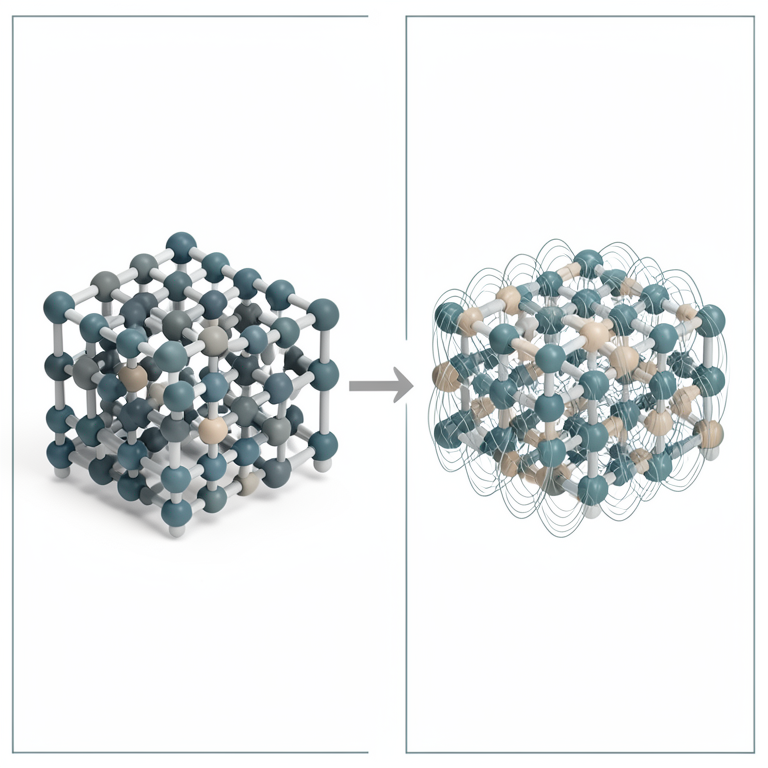
Study overview
AI-generated conceptual illustration (a three-dimensional cubic crystal lattice of a solid material). It explains the idea and does not show study data.
View source evidence ↗Introduction
Debye model is a method developed by Peter Debye in 1912 for estimating the phonon contribution to the specific heat (heat capacity) in a solid. This model correctly explains the low temperature dependence of the heat capacity, which is proportional to T3. Oganov, A.R.et al. (2000) gives the Comparative study of quasi-harmonic lattice dynamics, molecular dynamics and Debye model applied to MgSiO3 perovskite. Shun-Li Shang (2010) gives the First-principles thermodynamics from phonon and Debye model: Application to Ni and Ni3Al.
Degueldre, C. et al. Specific heat capacity and Debye temperature of zirconia and its solid solution. In presented paper we assumed that the energy of the elastic standing waves is quantized. Expression for total number of vibrational mode of solid is obtained.
We obtained relation between the vibration and frequency of waves and find total number of vibrational modes of wave analytically by applying mathematical competition. 2. Formulation of problem We consider the three dimensional continuous string of Length L Which is fixed at both the ends and vibrating in a longitudinal mode. If the displacement of the string at any point 1 2 3 ( , , ) x x x at any instant of time t is 1 2 3 ( , , , ) V x x x t then the wave equation is written as 2 2 2 2 (1) 1 V V V V x x x t 2 2 2 2 2 1 2 3 Taking the three dimensional continuous medium in form of cube of side a with force fixed and solving standing wave equation (1) the solution is of form (2) 3 1 2 3 1 2 1 2 3 ( , , , ) sin sin sin cos2 x x x n x n x n x V x x x t D t a a a Where 1 2 3 , , x x x n n n are positive integer 1 . Differentiating E.Q. (2) twice with respect to 1x we obtain. 2 2 3 1 1 2 sin sin sin cos2 x x x x n x n n x n x V D t x a a a a 3 1 2 2 1 Maths 2018; 3(2): 227-229 Anu Chohla Department of Mathematics, Guru Jambheshwar University, Hisar, Haryana, India Correspondence Anu Chohla Department of Mathematics, Guru Jambheshwar University, Hisar, Haryana, India 2 2 1 Implies (3) ( , , , ) xn V V x x x t x a 1 2 3 2 1 Similarly differentiating E.Q. (2) twice with respect to 2 3 , , x x t respectively we get 2 2 2 (4) ( , , , ) xn V V x x x t x a 1 2 3 2 2 2 2 3 (5) ( , , , ) xn V V x x x t x a 1 2 3 2 3 2 2 (6) 1 2 3 2 2 ( , , , ) V V x x x t t Substituting these in equation (1) we get 3 1 2 (7) 2 2 2 2 2 2 2 2 1 4 4 x x x n n n v a a a 2 2 2 2 2 2 4 x x x 3 1 2 a v n n n (8) This equation gives the possible mode of vibration.
Three integers 1 2 3 , , x x x n n n determine frequency of possible mode of vibrations. 2.1 Possible mode of vibration To find out the possible no of modes of vibration ( ) D v dv in the frequency range v and v dv . We consider the network of points, the position of each point being given by three Cartesian positive integer coordinates 1 2 3 , , x x x n n n .Thus the radius vector R from the origin at any point is given by 2 2 2 2 x x x n n n R (9) 3 1 2 Comparing equation (8) and (9) gives 2av R (10) 2adv dR (11) Since each point occupies on the average a unit volume in the integer space the number of point in the spherical shell between radii R and R dR is equal to volume of an octant of spherical shell in integer space. 2 4 Volume of octant of spherical shell = R dR (12) 8 This give the no of possible modes of vibration in a given range because each point corresponding to a set of 1 2 3 , , x x x n n n and these gives the mode of vibration according to equation (8) 3 4 ( ) 8 D v dv R dR (13) Substituting the value of R and dR from (10) and (13) we get, 3 (14) 2 3 ( ) 4 a D v dv v dv Put 3 a V the volume of solid cube. This implies that the (15) 3 3 1 ( ) 4 D v dv v dv Equation (14) gives the number of modes of vibration between v and v+dv. For a perfect continuum, frequency vary from 0 to and here the number of possible vibration increase with square of frequency as shown.
In general there are two type of elastic wave occur in solid i.e.; longitudinal and transverse wave. In such case total no of vibration mode is given by (16) 3 3 3 1 1 ( ) 4 l t D v dv v dv
Conclusions
This paper is based on the principal of three dimensional Debye’s model of specific heat of solids. For perfect continuum frequency vary from 0 to number of possible vibration is increased with square of frequency and gives the total number of vibrational mode for longitudinal and transverse waves.
Acknowledgments
Author is thankful to university grants commission, New Delhi, for financial support.
References
9 in the original paper- Degueldre C, Tissot P, Lartigue H, Pouchon M. Specific heat capacity and Debye temperature of zirconia and its solid solution. Thermochimica Acta. 2003; 403(2):267-273.
- Holzwarth U, Gibson N. The Scherrer equation versus the 'Debye-Scherrer equation'. Nature Nanotech. 2011; 6:534.
- Horning RD, Staudenmann JL. The Debye-Waller factor for polyatomic solids. Relationships between X-ray and specific-heat Debye temperatures. The Debye-Einstein model. Acta Crystallographica Section A Foundations of Crystallography. 1988; 44(2):136-142.
- Oganov AR, Brodholt JP, David Price G. Comparative study of quasi harmonic lattice dynamics, molecular dynamics and Debye model applied to MgSiO3 perovskite. Physics of the Earth and Planetary Interiors. 2000; 122(3-4):277-288.
- Paskin A. A reformulation of the temperature dependence of the Debye characteristic temperature and its effect on Debye- Waller theory. Acta Crystallographic a. 1957; 10(10):667-669.
- Patel HN, Ghodgaonkar DK. 3D level set based optimization of inverse scattering problem for microwave breast imaging. First IEEE MTT-S International Microwave Bio Conference (IMBIOC), 2017.
- Fowler Proceedings of the Royal Society of London. Series A, Mathematical and Physical Sciences. 1935; 151(872):1-22.
- Shang SL, Wang Y, Kim D, Liu ZK. First-principles thermodynamics from phonon and Debye model: Application to Ni and Ni3Al. Computational Materials Science. 2010; 47(4):1040-1048.
- Yang F, Du L, Yang L, Wei C, Wang Y, Ran L et al. A Parameterization Approach for the Dielectric Response Model of Oil Paper Insulation Using FDS Measurements. Energies. 2018; 11:622.