
Research article · 2020 · Full text
International Journal of Veterinary Sciences and Animal HusbandryA study on cattle tick of Chitwan district of Nepal in different seasons
Volume 5(1) · Pages 36–38
Research areasViral Infections and VectorsVector-Borne Animal DiseasesVector-borne infectious diseases
Abstract
Author-writtenHard ticks are more prevalent in the terai belt of Nepal. Ticks themselves suck blood from the animal body and act as vector for various pathogen causing diseases like babesiosis, anaplasmosis etc. To understand the pattern of seasonal prevalence of ticks a survey was done in the Madi, Chitwan in two different seasons i.e. summer and winter. Tick samples were collected manually and stored in ethanol (70%) and glycerin (5%) mixture. And identified with the guideline of MAFF (1998) and Walker et al. (2003). A total of 134 samples were collected out of which 82 (61.19%) were collected in summer and 52 (38.81%) in winter. Tick infestation in summer was higher than that of the winter. Statistically the result was non-significant. Similarly, among tick samples collected from various parts of cattle body, dewlap was found with highest infestation of 39.55% which was followed by followed by perineum and udder (23.88%), ear (16.42%), abdomen (8.21%), tail base (8.21%) and withers (3,73%). This relation was statistically non-significant. But scientifically the infestation is itself significant to cause negative impact in the health of cattle and its productivity.
Summary
Source-checkedPlain-language reading of the full paper, prepared with AI and checked against the text. Each point links to the authors' own words.
Why it matters
- Ticks negatively impact cattle productivity by acting as vectors for various protozoan, bacterial, and viral pathogens. View evidence ↗
- Heavy tick infestations can be dangerous for cattle because they cause significant blood loss from circulation. View evidence ↗
- Hard ticks are particularly prevalent in the terai belt region of Nepal. View evidence ↗
The question
- The study aimed to understand the seasonal prevalence patterns of ticks in Madi, Chitwan, by comparing summer and winter seasons. View evidence ↗
What they did
- Tick samples were collected from cattle in Madi, Chitwan district, Nepal (27.446625° N, 84.344922° E). View evidence ↗
- The researchers collected a total of 134 tick samples. View evidence ↗
- Ticks were manually collected and preserved in a mixture of 70% ethanol and 5% glycerin. View evidence ↗
- Tick identification was performed following the guidelines of MAFF (1986) and Walker et al. (2003). View evidence ↗
What they found
- Of the 134 samples, 82 (61.19%) were collected during the summer and 52 (38.81%) during the winter. View evidence ↗
- Although summer infestation was higher, the difference in tick availability between the two seasons was not statistically significant (P>0.05). View evidence ↗
- Rhipicephalus microplus was identified as the most abundant tick species across both seasons and all body parts. View evidence ↗
- The dewlap was the body part with the highest tick infestation rate at 39.55%. View evidence ↗
- The variation in tick infestation across different body parts was not statistically significant (P>0.05). View evidence ↗
What it means
- The authors conclude that tick infestation is directly related to the health and productivity of cattle. View evidence ↗
- The authors state there is a knowledge gap regarding the proper use of drugs and remedies for tick elimination, necessitating further research and extension. View evidence ↗
Visual summary
1 visualsIllustrations explain the paper; they do not show study data.
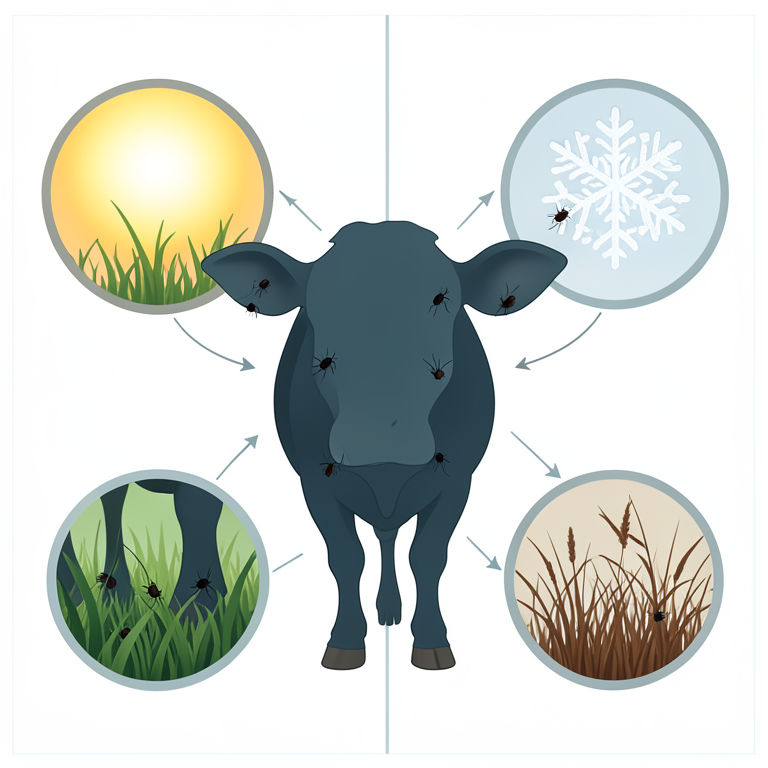
Conceptual Overview of Tick Survey
AI-generated conceptual illustration (cattle and ticks). It explains the idea and does not show study data.
View source evidence ↗Figures & tables
From the original paper Table 1
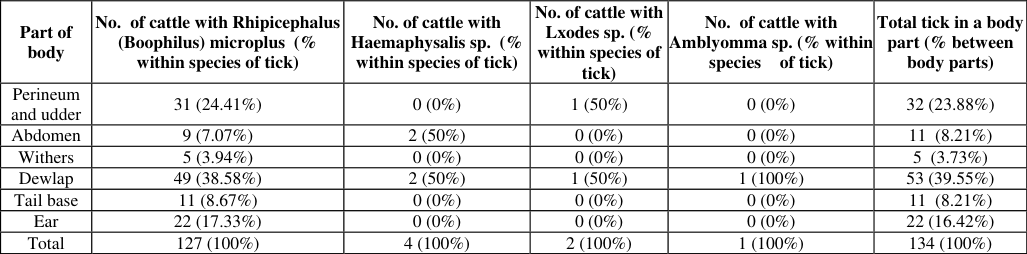 Table 2
Introduction
Ticks have effective and negative impact in the productivity of cattle. They act as vector to different disease pathogens that occur in the cattle, that can be protozoan, bacterial, viral etc. Ticks fed upon the blood of cattle. They rely on the blood as their source of energy and during that different stages pathogens are exchanged between the tick and cattle. During heavy infestation of the tick in the cattle can be dangerous due to loss of blood from the circulation. Rhipicephalus microplus is also known as Asian blue tick. Heavy infestation of this hard tick can damage hides. This tick can transmit babesiosis, anaplasmosis etc. This is single host tick as its lifecycle is completed in single animal. Adult and mated female detach from the cattle and deposits many eggs to the environment. Female tick dies after ovipositing the eggs in the environment. They undergo developmental stages: larva, nymph and adult. The larva is usually found in the soft skin. The larva molts to form nymph after feeding. Then adult is formed from the nymph after feeding once.
There are different genera of Haemaphysalis i.e. H. longicornis, H. punctate, H. leachi, H. sulcate. Haemaphysalis is the vector of diseases like theileriosis, babesiosis etc. Female ticks lay eggs in the environment which are hatched into larva in 60-90 days. Larva then attaches to vegetation and stick to the skin of cattle and remains there for feeding. Then the larva enlarges and drops to the ground. And undergoes moulting for 30 days in damp and moist place to develop into nymph. Again, attaches to the animal and matures. Lxodes sp. do have numerous genera. Lxodes act as vector for many diseases in animal and human. In animal it is associated with diseases like babesiosis, anaplasmosis etc. Its lifecycle is similar to that of Haemaphysalis, but the maturity of the nymph occurs in the ground taking time before adhering the cattle. Amblyomma sp. are hard ticks that are vector for many diseases in cattle. Lifecycle is similar to that of Haemaphysalis in the different stages of life i.e. eggs, larva, nymph, adult. It takes 2 years to complete its lifecycle.
Materials and methodology Region of study
The tick samples were collected from the cattle of Madi of Chitwan district of Nepal with the exact location of 27.446625° N, 84.344922° E. The study region is the western region of district and consists of the tropical climate. The samples were taken from the region in two seasons separately. A total of 134 samples were collected from the region.
Sample collection
Ticks were collected manually. The collected ticks were stored in container with ethanol (70%) and glycerin (5%).
Identification of ticks
Guideline of MAFF (1986) [12] and Walker et al. (2003) [6] were used for the identification of collected ticks.
Data analysis
Obtained data was entered in MS Excel 2016 and analyzed in IBM SPSS version 25.
Results
Results
Discussion
In the region Rhipicephalus microplus was most abundant tick in both season and among different body parts of cattle. The cattle with ticks were higher in the summer (61.19%) than in the winter (38.81%). But statistically there was no significance in the availability of tick in cattle in two different seasons (P>0.05). Higher number of cattle with tick in the summer can be due to the optimum temperature for the growth of the tick in the summer. And the lifecycle of the pattern of ticks require debris or decomposed materials for the feeding in the different stages. Decomposition of organic material occur more in the summer season. This can be another reason for higher infestation in the summer than in the winter. Similar findings were obtained by Bohara et al. (2016) [5] which showed the invading of tick in the summer to be 58.7% and 41.3% in the winter. Our survey showed higher number of cattle with ticks in the dewlap (39.55%). [2] .
Conclusion
Tick's prevalence was higher in summer than in the winter. But there was no statistical significance in the relation between tick's prevalence and the season. And dewlap was found to have highest infestation of tick among various body parts of the cattle. Tick infestation have direct relation with the health of cattle and the productivity as well. There is knowledge gap in the proper use of drugs and other remedy methods for the elimination of the tick from the cattle. So, this topic requires more study, observation, research and extension.
Acknowledgement
AcknowledgementI would like to express our gratitude to Prof. Dr. I.P. Dhakal, Vice-Chancellor, AFU; Prof. Dr. Sharda Thapaliya, Dean, FAVF, AFU; Prof. Dr. Naba Raj Devkota, Director, Directorate of Research and Extension; Prof. Dr. Bhuminand Devkota, HOD, Department of Therigenology; Prof. Dr. Hom Bahadur Basnet, HOD, Department of Veterinary Microbiology and Parasitology; Asst. Prof. Dr. Nirajan Bhattarai HOD, Department of Animal Breeding and Biotechnology; Prof. Dr. Asso. Prof. Dr. Dipesh Chhetri, Director, Veterinary Teaching Hospital; Asso. Prof. Dr. Krishna Kafle, HOD, Department of Theriogenology, IAAS, Paklihawa. I would like to acknowledge Prof. Dr. Mohan Sharma, Prof. Dr. Ram Prasad Poudel. We are indebted to Udit Lamichhane, Uday Lamichhane, Rakshya Adhikari, Dikshya Adhikari, Safal Adhikari, Diwas Kandel, Sachita Pokharel, Subash Sapkota, Roshan Ghimire, Kiran Bhandari, Naveen Pant, Mandeep Pokharel, Yasaswi Subedi, Pradip Bartaula, Sandesh Gaudel, Santosh Pokharel, Saroj Bista, Sachin Regmi. I am very much thankful for the help and support of Saroj Regmi during the research. I am also
Figures and tables from the paper
| Season | No. of cattle with Rhipicephalus (Boophilus) microplus (% within species of tick) | No. of cattle with Haemaphysalis sp. (% within species of tick) | No. of cattle with Lxodes sp. (% within species of tick) | No. of cattle with Amblyomma sp. (% within species of tick) | Total tick in a season (% between season) |
|---|---|---|---|---|---|
| Summer | 75 (59.06%) | 4 (100%) | 2 (100%) | 1 (100%) | 82 (61.19%) |
| Winter | 52 (40.94%) | 0 (100%) | 0 (100%) | 0 (100%) | 52 (38.81%) |
| Total | 127 (100%) | 4 (100%) | 2 (100%) | 1 (100%) | 134 (100%) |
Table text extracted from the original PDF; superscript letters are shown inline. The original table image is below.
View original table image
| Part of body | No. of cattle with Rhipicephalus (Boophilus) microplus (% within species of tick) | No. of cattle with Haemaphysalis sp. (% within species of tick) | No. of cattle with Lxodes sp. (% within species of tick) | No. of cattle with Amblyomma sp. (% within species of tick) | Total tick in a body part (% between body parts) |
|---|---|---|---|---|---|
| Perineum and udder | 31 (24.41%) | 0 (0%) | 1 (50%) | 0 (0%) | 32 (23.88%) |
| Abdomen | 9 (7.07%) | 2 (50%) | 0 (0%) | 0 (0%) | 11 (8.21%) |
| Withers | 5 (3.94%) | 0 (0%) | 0 (0%) | 0 (0%) | 5 (3.73%) |
| Dewlap | 49 (38.58%) | 2 (50%) | 1 (50%) | 1 (100%) | 53 (39.55%) |
| Tail base | 11 (8.67%) | 0 (0%) | 0 (0%) | 0 (0%) | 11 (8.21%) |
| Ear | 22 (17.33%) | 0 (0%) | 0 (0%) | 0 (0%) | 22 (16.42%) |
| Total | 127 (100%) | 4 (100%) | 2 (100%) | 1 (100%) | 134 (100%) |
Table text extracted from the original PDF; superscript letters are shown inline. The original table image is below.
View original table image
References
15 in the original paper- Jamroz RC, Guerrero FD, Pruett JH, Oehler DD, Miller RJ. Molecular and biochemical survey of acaricide resistance mechanisms in larvae from Mexican strains of the southern cattle tick, Boophilus microplus. Journal of Insect Physiology. 2000; 46(5):685-695.
- Atif FA, Khan MS, Iqbal HJ, Roheen T. Prevalence of tick-borne disease in Punjab(Pakistan) and hematological profile of Anaplasma marginale infection in indigenous and crossbred cattle. Pakistan Journal of Science. 2012; 64(1).
- Musa HI, Jajere SM, Adamu NB, Atsanda NN, Lawal JR, Adamu SG et al. Prevalence of tick infestation in different breeds of cattle in Maiduguri, Northeastern Nigeria. Bangladesh Journal of Veterinary Medicine. 2014; 12(2).
- Asmaa NM, ElBably MA, Shokier KA. Studies on prevalence, risk indicators and control options for tick infestation in ruminants. Beni-Suef University Journal of Basic and Applied Sciences. 2014; 3(1):68-73.
- Bohara TP, Shrestha SP. A study on cattle tick and tick borne pathogens of Mid Western Nepal. Nepalese Vet. J, 2015; 33:23-27.
- Walker AR. Ticks of domestic animals in Africa: a guide to identification of species Edinburgh: Bioscience Reports. 2003, 3-210.
- Madder M, Thys E, Geysen D, Baudoux C, Horak I. Boophilus microplus ticks found in West Africa. Experimental and Applied Acarology. 2007; 43(3):233234.
- Jonsson NN. The productivity effects of cattle tick (Boophilus microplus) infestation on cattle, with particular reference to Bos indicus cattle and their crosses. Veterinary parasitology, 2006; 137(1, 2):1-10.
- Ghosh S, Bansal GC, Gupta SC, Ray D, Khan MQ, Irshad H et al. Status of tick distribution in Bangladesh, India and Pakistan. Parasitology Research. 2007; 101(2):207-216.
- Kumar S, Paul S, Sharma AK, Kumar R, Tewari SS, Chaudhuri P et al. Diazinon resistant status in Rhipicephalus (Boophilus) microplus collected from different agro-climatic regions of India. Veterinary Parasitology. 2011; 181(2-4):274-281.
- Ahmed J, Alp H, Aksin M, Seitzer U. Current status of ticks in Asia. Parasitology research. 2007; 101(2):159162.
- Fisheries MAFF. Food, Reference Book: Manual of Veterinary Parasitological Laboratory Techniques, Ministry of Agriculture, 1986.
- Rajput ZI, Hu SH, Chen WJ, Arijo AG, Xiao CW. Importance of ticks and their chemical and immunological control in livestock. Journal of Zhejiang University Science B, 2006; 7(11):912-921.
- Frisch JE. Towards a permanent solution for controlling cattle ticks. International journal for parasitology. 1999; 29(1):57-71.
- Jongejan F, Uilenberg G. The global importance of ticks. Parasitology, 2004; 129(S1):S3-S14.
Cited by 1
From OpenAlex, OpenCitations and reference lists read by Scinovex
- Molecular Detection and Identification of Piroplasm in Cattle from Kathmandu Valley, Nepal ↗
Medhavi Dhakal, Tulsi Ram Gompo, Prakash Devkota, Sharmila Chapagain Kafle, Janak Raj Subedi, Haiyan Gong et al. · Pathogens · 2023
Background: Tick-borne protozoan parasites (TBPPs) cause significant problems for domestic animals’ health in Nepal. TBPPs are routinely diagnosed by labor-intensive blood smear microscopy. In Nepal, there are some reports of Babesia and Theileria in cattle, although species identification is rarely performed. Therefore, we performed conventional nested PCR (nPCR) followed by sequence analysis to identify TBPP species infecting cattle in Nepal.…
❝ 6PDF