
Research article · 2019 · Full text
International Journal of Agriculture Extension and Social DevelopmentThe existence of livestock as a dominant risk factor of pneumonia among Indonesian children aged 12-59 months
Volume 2(1) · Pages 07–10 · DOI: 10.33545/26180723.2019.v2.i1a.16 ↗
Research areasPublic Health and Nutrition
Abstract
Author-writtenThe study aimed to determine the risk factors of pneumonia among children under-5 years old. A case control study was carried out among the mothers having under five years children who were admitted and recorded in medical record in IMCI Clinic, Kebon Jeruk Sub District, West Jakarta in 2018. A simple random sampling technique was used to select 60 children with pneumonia and 120 children with non-pneumonia diseases. The results shows the existence of livestock is a dominant risk factor of pneumonia in children under-five. An increasing trend of pneumonia was observed among children aged 12-59 months, who live near the highway, non-exclusive breastfeeding, expose to indoor smoking parents, and low family income.
Summary
Source-checkedPlain-language reading of the full paper, prepared with AI and checked against the text. Each point links to the authors' own words.
Why it matters
- Indonesia is among the top 15 countries for pneumonia deaths in children under five, with 25,000 such deaths reported in 2015. View evidence ↗
- The pneumonia mortality rate for children in Indonesia fluctuated between 2014 and 2017, rising from 0.08% in 2014 to 0.30% in 2017. View evidence ↗
The question
- The researchers aimed to identify the risk factors associated with pneumonia in children under five years of age. View evidence ↗
What they did
- The study was a population-based case-control design conducted at the IMCI Clinic in Kebon Jeruk, West Jakarta, between August and September 2018. View evidence ↗
- Using simple random sampling, the study enrolled 60 children with pneumonia as cases and 120 children with other diseases as controls. View evidence ↗
- Data were collected through semi-structured interviews conducted with the mothers of the participating children. View evidence ↗
- The analysis used odds ratios (OR), 95% confidence intervals (CI), and p-values, with significance set at p < 0.05. View evidence ↗
What they found
- Multivariate analysis identified the existence of livestock as the dominant risk factor, increasing the odds of pneumonia by 6.4 times (OR 6.425, 95% CI: 2.484-16.615, p=0.000). View evidence ↗
What it means
- The authors conclude that the presence of livestock is the primary risk factor for pneumonia in children under five in the studied area of West Jakarta. View evidence ↗
- The authors recommend implementing parent education programs, interventions, and longitudinal studies to reduce respiratory illness morbidity and mortality in Jakarta. View evidence ↗
Visual summary
1 visualsIllustrations explain the paper; charts are replotted from the paper's own table values.
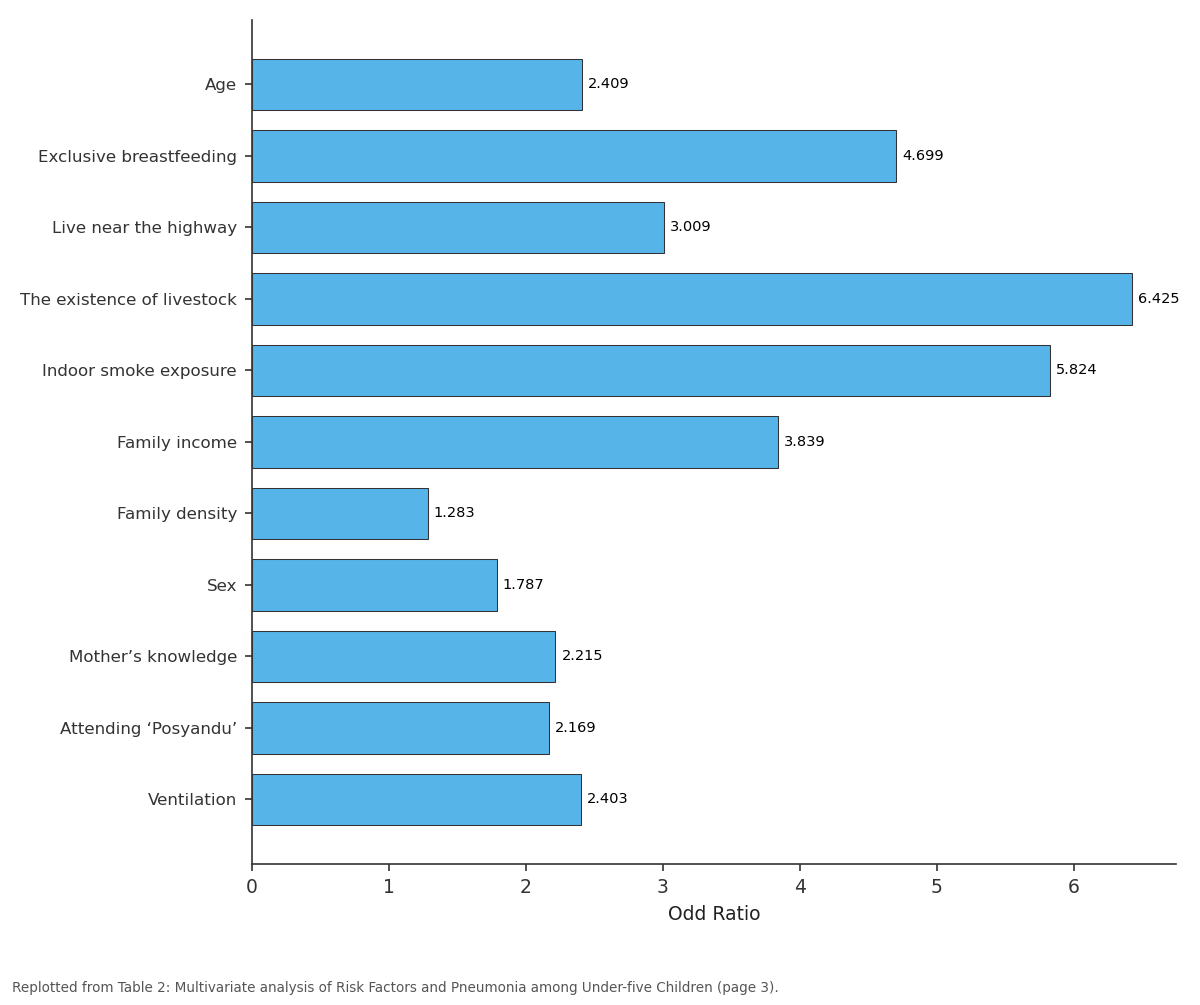
Odd Ratio: Age vs Exclusive breastfeeding vs Live near the highway vs The existence of... vs Indoor smoke exposure
Replotted from Table 2 (page 3) of the original paper. Every bar is the paper's own table value.
View source evidence ↗Figures & tables
From the original paper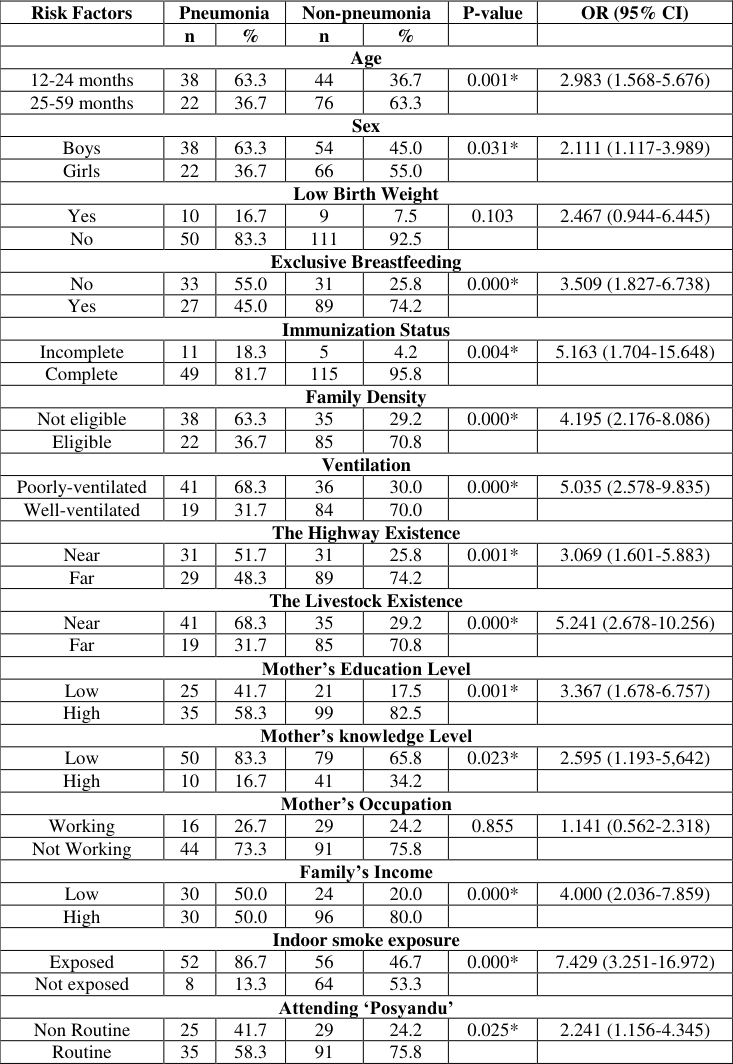 Table 1
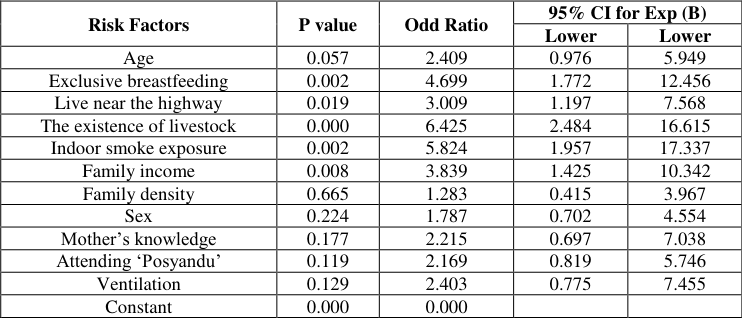 Table 2
Introduction
Pneumonia is the single largest infectious cause of death in children worldwide. Pneumonia killed 808 694 children under the age of 5 in 2017, accounting for 15% of all deaths of children under five years old (WHO 2019) [13] . Pneumonia is a preventable and curable disease in industrialized countries, but it remains deadly in some developing countries, where in 2015 it caused 1 in 6 child deaths. Pneumonia caused 16 per cent of all deaths among children under 5 in 2016 alone (UNICEF 2017) [10] . Indonesia was included in the Top 15 countries with the highest number of pneumonia deaths in children under 5 in 2015. Based on UNICEF data, there were 25,000 children under 5 years old in Indonesia die of pneumonia in 2015 (UNICEF 2016) [12] . The mortality rate due to children pneumonia in Indonesia was 0.08% in 2014 and experienced a significant increase in 2015 at 0.16% and decreased in 2016 at 0.11% but increased again in 2017 at 0.30% (Ministry of Health RI, 2018). In 2017, there were 2,106 pneumonia cases in children under five (West Jakarta District Health Office, 2018). The study aimed to determine the risk factors of pneumonia among children under-5 years old in Integrated Management of Childhood Illness (IMCI) Clinic in Kebon Jeruk, West Jakarta in 2018.
Materials and Methods
A population-based case-control study was conducted in Integrated Management of Childhood Illness (IMCI) Clinic in Kebon Jeruk Sub District, West Jakarta from August to September 2018. Informed verbal consent was obtained from each respondent prior to collecting data. The subjects were assured of the confidentiality of their information and they were assured that they would be allowed to refuse to participate in the study at any time if they wished. The mothers who recorded in a medical record as a patient with sick children aged 12 month -5 years were considered the study population for this research. Sixty children age 5 years and under who were admitted into the Clinic and recorded in medical records with pneumonia but with no underlying chronic illnesses such as Asthma, Heart disease, and Down Syndrome, were enrolled in the study as cases. Controls included children who were admitted to the ward during the study period with other diseases but no pneumonia and no under-lying chronic illnesses and recorded in medical records. A semi-structured interview with the mother of each child was used for data collection. The subjects were selected by using a a simple random sampling technique. The collected data were reviewed daily for completeness and accuracy. Edited data were entered into the Statistical Package for Social Science Software (SPSS). Odds rations (OR), 95% confidence intervals (CI) and p-values for unadjusted and adjusted models were estimated. A p-value of < 0.05 was considered significant in discussions of factors related to the odds of having pneumonia. This study received research permission from the Postgraduate School of University of Muhammadiyah Prof. Dr. HAMKA, Jakarta. In addition, informed consent was also given to mothers of children under five who were respondents in this study.
Result and Discussion
Table 1 shows that the majority of the case (63.3%) and control children (36.7%) were in the 12-24 months age group. Pneumonia was common in boys (63.3%) in case groups and girls (55.5%) in control group; and the majority of the children were born in a normal weight. As much as 68.3% of the house's ventilation and 63.3% of family density in the case (pneumonia) group was not eligible www.extensionjournal.com (poor). As much as 68.3% and 51.7% of cases (pneumonia) group were live near the livestock cage and near the highway, respectively. Most of mothers has high education level, low knowledge level about health and not working. 2 shows the existence of livestock in household increased the odds of having pneumonia significantly, with the risk 6.4 times greater than who did not have livestock (95% CI: 2.484-16.615, p=0.000). An increasing trend of pneumonia was observed among children aged 12-59 months, who live near the highway, non-exclusive breastfeeding, expose to indoor smoking parents, and low family income (p<0.05). As confounder variables were family density, sex, mother's knowledge, attend to health services and ventilation. www.extensionjournal.com [1,8,5] . Sex has a significant relationship in this study. This is similar to a research conducted in Sudan hospitals, where significantly the number of pneumonia patients is higher in boys than in girls (Gritly et al. 2018) [5] .
| Risk Factors | Pneumonia | — | Non-pneumonia | — | P-value | OR (95% CI) |
|---|---|---|---|---|---|---|
| n | % | n | % | |||
| Age | ||||||
| 12-24 months | 38 | 63.3 | 44 | 36.7 | 0.001* | 2.983 (1.568-5.676) |
| 25-59 months | 22 | 36.7 | 76 | 63.3 | ||
| Sex | ||||||
| Boys | 38 | 63.3 | 54 | 45.0 | 0.031* | 2.111 (1.117-3.989) |
| Girls | 22 | 36.7 | 66 | 55.0 | ||
| Low Birth Weight | ||||||
| Yes | 10 | 16.7 | 9 | 7.5 | 0.103 | 2.467 (0.944-6.445) |
| No | 50 | 83.3 | 111 | 92.5 | ||
| Exclusive Breastfeeding | ||||||
| No | 33 | 55.0 | 31 | 25.8 | 0.000* | 3.509 (1.827-6.738) |
| Yes | 27 | 45.0 | 89 | 74.2 | ||
| Immunization Status | ||||||
| Incomplete | 11 | 18.3 | 5 | 4.2 | 0.004* | 5.163 (1.704-15.648) |
| Complete | 49 | 81.7 | 115 | 95.8 | ||
| Family Density | ||||||
| Not eligible | 38 | 63.3 | 35 | 29.2 | 0.000* | 4.195 (2.176-8.086) |
| Eligible | 22 | 36.7 | 85 | 70.8 | ||
| Ventilation | ||||||
| Poorly-ventilated | 41 | 68.3 | 36 | 30.0 | 0.000* | 5.035 (2.578-9.835) |
| Well-ventilated | 19 | 31.7 | 84 | 70.0 | ||
| The Highway Existence | ||||||
| Near | 31 | 51.7 | 31 | 25.8 | 0.001* | 3.069 (1.601-5.883) |
| Far | 29 | 48.3 | 89 | 74.2 | ||
| The Livestock Existence | ||||||
| Near | 41 | 68.3 | 35 | 29.2 | 0.000* | 5.241 (2.678-10.256) |
| Far | 19 | 31.7 | 85 | 70.8 | ||
| Mother’s Education Level | ||||||
| Low | 25 | 41.7 | 21 | 17.5 | 0.001* | 3.367 (1.678-6.757) |
| High | 35 | 58.3 | 99 | 82.5 | ||
| Mother’s knowledge Level | ||||||
| Low | 50 | 83.3 | 79 | 65.8 | 0.023* | 2.595 (1.193-5,642) |
| High | 10 | 16.7 | 41 | 34.2 | ||
| Mother’s Occupation | ||||||
| Working | 16 | 26.7 | 29 | 24.2 | 0.855 | 1.141 (0.562-2.318) |
| Not Working | 44 | 73.3 | 91 | 75.8 | ||
| Family’s Income | ||||||
| Low | 30 | 50.0 | 24 | 20.0 | 0.000* | 4.000 (2.036-7.859) |
| High | 30 | 50.0 | 96 | 80.0 | ||
| Indoor smoke exposure | ||||||
| Exposed | 52 | 86.7 | 56 | 46.7 | 0.000* | 7.429 (3.251-16.972) |
| Not exposed | 8 | 13.3 | 64 | 53.3 | ||
| Attending ‘Posyandu’ | ||||||
| Non Routine | 25 | 41.7 | 29 | 24.2 | 0.025* | 2.241 (1.156-4.345) |
| Routine | 35 | 58.3 | 91 | 75.8 |
Table text extracted from the original PDF; superscript letters are shown inline. The original table image is below.
View original table image
Exclusive breastfeeding is a risk factor for pneumonia in this study. This was also proven by studies in Ethiopia and in India which found that there was a significant relationship between exclusive breastfeeding and pneumonia (Abuka 2017 and Srivastava et al. 2015) [1,15] . Exclusive breastfeeding for the first six months of life serves to increase the child's immune system. WHO recommendations said infants must be exclusively breastfed during the first six months of life to achieve optimal growth, development and health. After that, to meet growing nutritional needs, infants must obtain adequate and safe complementary food, while continuing to breastfeed for up to two years or more (WHO 2019) [3] . The study also revealed that family density has a significant relationship with children pneumonia. Studies of children pneumonia in Nigeria showed that the possibility of ARI in children who sleep with two adults was lower than those who sleep with more than two adults (AOR 1.739, CI 1.123-2.694, p <0.05) (Solomon et al. 2018) [14] . This was also proven by other studies that showed a correlation between occupancy density and children pneumonia (Lima et [8,4,15,9] . The livestock existence is a dominant risk factor of pneumonia among children. The other risk factor which contribute to pneumonia among children is the condition of ventilation. Ventilation has a function to control air circulation hence maintaining good air quality in the room and ensure that the air in the room is safe for respiratory system. Poor ventilation can cause an increase in indoor humidity due to the evaporation process (CDC 2013) [6] . The result of this study was also similar to the study in Ethiopia, which showed a significant association between ventilation and the incidence of children pneumonia (P = <0.05, OR = 2.64 95% CI 1.31-5.3) (Abuka 2017) [1] . This study also revealed that socio-economic factors such as mother's education, mother's knowledge, and family income have significant relationship with the incidence of pneumonia. Mothers who have low education level, low knowledge level and low family income increased the odds of having pneumonia significantly. Other studies have also found that there was a significant relationship between the mother's education and pneumonia (Gritly et [5,2,11,14,9] . Low incomes are generally closely related to many health problems faced, this is due to the inability and ignorance in overcoming such problems especially in health (Gritly et al. 2018, and Fekadu et al. 2014) [5,4] . The result of this study indicate that exposure to household smoke increases the incidence of pneumonia in children. This is similar to other previous studies which found a significant relationship between smoking habits at home with children pneumonia (Lima et al. 2016, and Solomon et al. 2018) [8,14] . A study in Nepal found that there was a tendency for an increased risk of pneumonia in children under five if both parents smoked (OR 2.21) (Karki et al. 2014) [7] . Posyandu (Integrated Health Services Post) is a community based vehicle to improve child survival and development. It is a monthly clinic for children and pregnant mothers. This study showed that attending Integrated Health Services Post (Posyandu) 'non routine' was significantly associated with a two-fold increased odds of having pneumonia. The Posyandu is held at the village to enable the community to access basic health services and provides antenatal care, postnatal care, family planning, immunization, nutrition, and diarrhea prevention. The role of Posyandu as primary health care services in implementing early detection and intervention for children health status.
Conclusion
The existence of livestock was a dominant risk factor of pneumonia among under-five children in Kebon Jeruk Sub-District, West Jakarta. Pneumonia are preventable through health promotion, preventive activities and effective child health programs. Reliable longitudinal studies, interventions, and programs to educate parents in prevention are important for reducing mortality and morbidities related to acute respiratory illnesses in Jakarta. www.extensionjournal.com
Figures and tables from the paper
| Risk Factors | P value | Odd Ratio | 95% CI for Exp (B) | — |
|---|---|---|---|---|
| Lower | Lower | |||
| Age | 0.057 | 2.409 | 0.976 | 5.949 |
| Exclusive breastfeeding | 0.002 | 4.699 | 1.772 | 12.456 |
| Live near the highway | 0.019 | 3.009 | 1.197 | 7.568 |
| The existence of livestock | 0.000 | 6.425 | 2.484 | 16.615 |
| Indoor smoke exposure | 0.002 | 5.824 | 1.957 | 17.337 |
| Family income | 0.008 | 3.839 | 1.425 | 10.342 |
| Family density | 0.665 | 1.283 | 0.415 | 3.967 |
| Sex | 0.224 | 1.787 | 0.702 | 4.554 |
| Mother’s knowledge | 0.177 | 2.215 | 0.697 | 7.038 |
| Attending ‘Posyandu’ | 0.119 | 2.169 | 0.819 | 5.746 |
| Ventilation | 0.129 | 2.403 | 0.775 | 7.455 |
| Constant | 0.000 | 0.000 |
Table text extracted from the original PDF; superscript letters are shown inline. The original table image is below.
View original table image
References
13 in the original paper- Abuka T. Prevalence of pneumonia and factors associated among children 2-59 months old in Wondo Genet district, Sidama zone, SNNPR, Ethiopia, Curr Pediatr Res. 2017; 21(1):19-25.
- Aftab S, Ejar I, Waqar U, Khan HI, Hanif A, Usman A et al. Risk factors for childhood Pneumonia in North Eastern Pakistan : A Case-Control Study. MJPCH-0422, 2016.
- Exclusive breastfeeding for optimal growth, development and health of infants. https://www.who.int/elena/titles/exclusive_breastfeedin g/en/., 2019.
- Fekadu GA, Terefe MW, Alemie GA. Prevalence of pneumonia among under-five children in Este town and the surrounding rural kebeles, Northwest Ethiopia ; A community based cross sectional study. Science Journal of Public Health. 2014; 2(3):150-155.
- Gritly SMO, Elamin MO, Rahimtullah H, Haji AY, Dhiblaw A, Mohamed EA et al. Risk factors of pneumonia among children under 5 years at a pediatric hospital in Sudan. Int J Med Res Health Sci. 2018; 7(4):60-68.
- Karki S, Fitzpatrick AL, Shrestha S. Risk Factors for pneumonia in children under 5 years in a teaching hospital in Nepal. Kathmandu University Medical Journal. 2014; 12(48):247-252.
- Lima EJF, Mello MJG, Albuquerque MFPM, Lopes MIS, Serra GHC, Lima DEP et al. Risk factors for community-acquired pneumonia in children under five years of age in the post-pneumococcal conjugate vaccine era in Brazil : a case control study. BMC Pediatrics. 2016; 16(157):1-9.
- Mirji G, Shashank KJ, Shrikant SW, Reddy D, Naik H. Socio-demographic profile of under five children admitted for acute lower respiratory tract infections in a tertiary care hospital. International Int J Contemp Pediatr. 2014; 1(2):106-109.
- New Health Technologies Crucial in Fight against Childhood Pneumonia. https://www.unicef.org/pressreleases/new-health-technologies-crucial-fight-againstchildhood-pneumonia-unicef-la-caixa. 3 November 2017.
- Nirmolia N, Mahanta TG, Boruah M, Rasaily R, Kotoky RP, Bora R. Prevalence and risk factors of pneumonia in under fi ve children living in slums of Dibrugarh town. Clinical Epidemiology and Global Health. 2018; 6(1):1-4.
- One is too many Ending child deaths from pneumonia and diarrhea. https://www.unicef.org/reports/one-toomany, 2016.
- Solomon OO, Odu OO, Amu EO, Solomon OA, Bamidele JO, Emmanuel E et al. Prevalence and risk factors of acute respiratory infection among under-fives in rural communities of Ekiti State, Nigeria. Global Journal of Medicine and Public Health. 2018; 7(1):112.
- Srivastava P, Mishra AK, Roy AK. Predisposing Factors of Community Acquired Pneumonia in UnderFive. Journal of Lung Diseases & Treatment. 2015; 1(1):10-13.