
Research article · 2020 · Full text
International Journal of Advanced Biochemistry ResearchStudy of random urinary calcium/creatinine ratio as a predictor of preeclampsia in and around Chitradurga
Volume 4(1) · Pages 12–15 · DOI: 10.33545/26174693.2020.v4.i1a.41 ↗
Research areasPregnancy and preeclampsia studiesRenal function and acid-base balance
Abstract
Author-writtenPre-eclampsia is defined as development of hypertension and proteinuria (>300 mg in 24 hours urine) after 20th week of gestation. The presence of proteinuria remains central to the diagnosis of pre-eclampsia. 24 hours urinary protein measurement is time-consuming and needs more assistance. Spot urinary calcium: creatinine ratio (CCR) has been used to determine the diagnostic accuracy of proteinuria in pre-eclampsia. A case control comparative study was done with women having pre-eclampsia and normal pregnant women admitted in Gynecology department at Basaveshwara Medical College Hospital, Chitradurga according to the criteria. There was a significant negative correlation between calcium: creatinine ratio and 24-hours urinary proteinuria (r= -0.51). Spot urinary calcium: creatinine ratio at cut off value of 0.18 shows 100% sensitivity and 84% specificity. We conclude that the urinary calcium: creatinine ratio should be considered as a potential alternative for 24-hours urine collection for proteinuria in pregnant women to detect pre-eclampsia.
Summary
Source-checkedPlain-language reading of the full paper, prepared with AI and checked against the text. Each point links to the authors' own words.
Why it matters
- The condition is characterized by the onset of hypertension and proteinuria (more than 300 mg of protein in 24-hour urine) after the 20th week of pregnancy. View evidence ↗
- While 24-hour proteinuria detection is the gold standard for diagnosis, it is time-consuming and prone to contamination errors. View evidence ↗
What they did
- The research was a case-control study conducted at Basaveshwara Medical College Hospital & RC in Chitradurga between December 2013 and September 2014. View evidence ↗
- The study enrolled 100 participants, divided equally into a control group (50 women) and a pre-eclampsia group (50 women). View evidence ↗
What they found
- The mean spot urinary calcium:creatinine ratio was significantly lower in pre-eclampsia cases (0.14 ± 0.08) compared to the control group (0.33 ± 0.14), with p < 0.05. View evidence ↗
- At a cut-off value of 0.18, the spot urinary CCR demonstrated 100% sensitivity, 84% specificity, 86.2% positive predictive value, and 95.45% negative predictive value. View evidence ↗
- Among the pre-eclampsia group, 48% of women had 24-hour protein excretion ≥ 1g, 18% had ≥ 3g, and 4% had ≥ 5g. View evidence ↗
- The diagnostic performance (sensitivity, specificity, PPV, NPV, and accuracy) of the CCR test improved as the levels of 24-hour proteinuria increased. View evidence ↗
What it means
- The authors conclude that the spot urinary calcium:creatinine ratio is a viable, rapid alternative to 24-hour urine collection for detecting pre-eclampsia. View evidence ↗
- The CCR test is recommended because it is cost-effective, non-invasive, easy to perform, and provides faster results than the 24-hour method. View evidence ↗
Visual summary
1 visualsIllustrations explain the paper; charts are replotted from the paper's own table values.
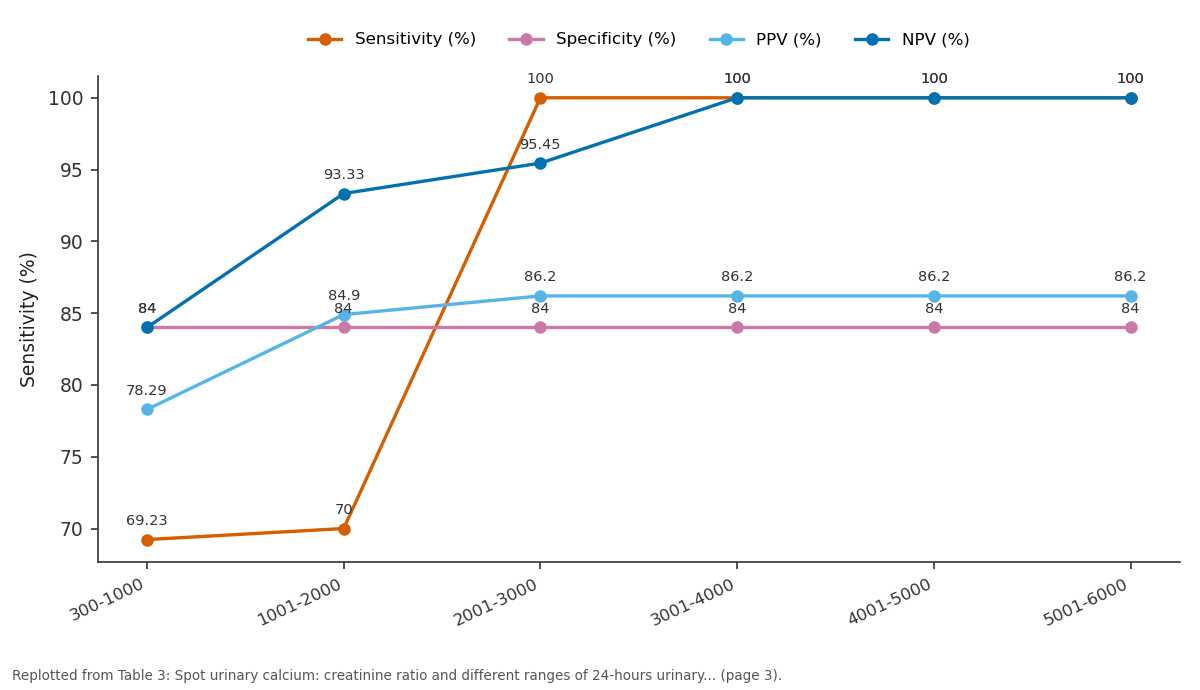
Sensitivity (%) and Specificity (%) and more: 300-1000 vs 1001-2000 vs 2001-3000 vs 3001-4000 vs 4001-5000
Replotted from Table 3 (page 3) of the original paper. Every bar is the paper's own table value.
View source evidence ↗Figures & tables
From the original paper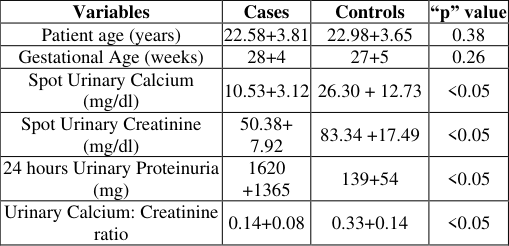 Table 1
 Table 2
 Table 3
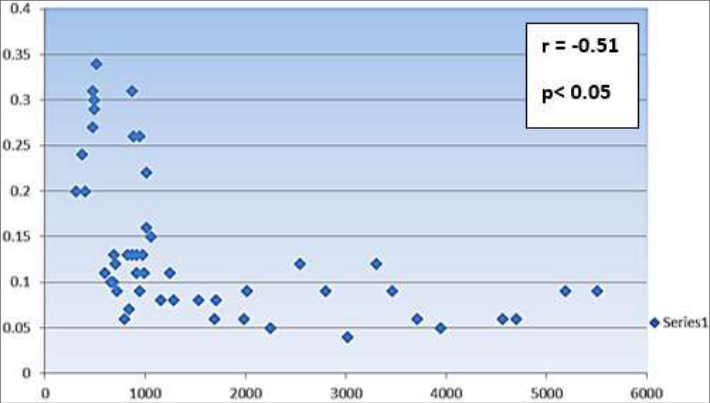 Figure 1
Introduction
Pregnancy is a desired biological function of a woman in reproductive age. It is an important phase in a woman's life when her body goes through physiological changes to adapt to fetal growth. Physiological changes that happen during pregnancies are not always smooth and can go through many complications and one such important complication is pre-eclampsia. Pre-eclampsia is defined as development of hypertension and proteinuria (>300 mg urinary protein in 24 hours urine estimation) after 20 th week of gestation. Hypertension is defined as a blood pressure greater than 140/90mm Hg or a rise in blood pressure of 30/15 mm Hg from the baseline confirmed by two measurements 6 hours apart. It is a hypertensive disease of unrecognized etiology characterized by proteinuria, coagulation abnormalities and other pathological systemic changes [1,2] . Preeclampsia is a leading cause of maternal and perinatal morbidity and mortality across the world. Developing nations bear 4-18% weight of total pre-eclampsia incidence. Around 9% of maternal death in Asia and Africa is because of hypertensive disease in pregnancy [3] . 5-7% of total pregnant woman experience preeclampsia. It affects the function of various organs involving metabolism. Preeclampsia is a "multisystem disorder". Vasospasm is one of the major pathological change of pre-eclampsia leading to decreased perfusion of the organ.It is amongst the most significant unsolved problems in obstetrics. If left untreated, pre-eclampsia can progress to eclampsia and HELLP syndrome. Calcium has a major role in muscle contraction and water regulation in a cell. It has been detected that decreased urinary excretion of calcium may be considered to be an important tool for early diagnosis of preeclampsia [4] . Therefore, the study was done to determine the relationship between preeclampsia and calcium: creatinine ratio for the early prediction of preeclampsia in a random urine sample. Hypertension is the most common feature in toxaemia of pregnancy, which is thought to be due to vasospastic phenomenon in multiple organs like kidney, uterus, placenta and brain. Early diagnosis and treatment can reduce the chances of hypertensive disorder of pregnancy and its complications. Proteinuria is seen as a sign of many complications. Proteinuria is a central diagnostic parameter for several conditions like urinary tract infection, chronic kidney disease and pregnancy related condition like pre-eclampsia. Proteinuria has both diagnostic and prognostic implications in preeclampsia [5] . Extensive changes occur in the renal system in pre-eclampsia. As a part of the end organ pathology, preeclamptic glomeruli undergo structural changes with pronounced endothelial vacuolization and hypertrophy of the cytoplasmic organelles. The gold standard method for diagnosis of preeclampsia is 24 hours proteinuria detection. Measuring 24 hours urine is time consuming and has chances of getting contaminated causing error in final estimation and diagnosis, which produces the need for a method which can provide faster screening method with better accuracy and validity. This may lead to faster decision making to initiate treatment, which is likely to reduce patients' anxiety, shorten the length of hospital stay with patient's cost savings [6] . Spot urinary calcium: creatinine ratio can be preferred for this purpose. Several studies show a strong association between spot Calcium to creatinine ratio and 24-hours proteinuria [7] . Calcium: creatinine ratio of a single voided urine specimen may have an important diagnostic role in the management of preeclamptic women which necessitates further research in the field. The aims of the study were 1 To explore correlation between 24 hours Proteinuria and Calcium: Creatinine ratio. 2 To determine diagnostic accuracy of random urine Calcium: Creatinine ratio for the detection of remarkable 24 hours urinary proteinuria and to evaluate the Calcium: Creatinine ratio for different proteinuria ranges in cases of the preeclampsia.
Materials& Methods
This was the Case control study carried out in Basaveshwara Medical College Hospital & RC, Chitradurga from December 2013 to September 2014. A case control comparative study was done with Pre-eclampsia and normal pregnant women according to the criteria. Samples were collected when patients were admitted in Gynecology Ward.
Selection of study group a) Inclusion criteria
Primigravida with pre-eclampsia in the age group of 18-35 years, without any previous history of hypertension, dyslipidemia or other organ dysfunctions above gestational age of 20 weeks.
b) Exclusion criteria
History of multigravida, diabetic mellitus, kidney disease. History of chronic hypertension and proteinuria before conception or development of hypertension before 20 weeks of gestation. Patients with chronic renal disease, pathological vaginal discharge. Patients with history of recurrent urinary tract infection Molar pregnancy.
Urine sample collection and processing
Approval for the study was obtained from the Ethical Committee of the Hospital. Signed consent forms were also obtained from all participants before enrolling in the study. Demographic and general information such as age, number of pregnancy and gestational age were recorded. All the patients underwent 24-hours urine collection as gold standard for diagnosis, 24 hours urine was collected with the assistance of nursing staff for all patients. Each container was marked with patient's name, number of container and collection time 10 ml sterilized urine cup was used to collect the urine and determine calcium to creatinine ratio. first urine sample from morning were not used. Urine analysis was performed in all samples. For spot urinary calcium: creatinine ratio, mid-stream urine sample was collected at random time during the same day.
Estimation of urinary calcium:
Urinary Calcium level was determined by the Arsenazo method in semi auto analyzer Erba Chem 5 Plus machine.
Estimation of urinary creatinine:
Urinary creatinine level was measured by a modified Jaffes method in fully auto analyzer Erba 200 machine.
Estimation of 24 hours urinary protein:
Urinary protein level was determined by the Pyrogallol method in semi auto analyzer Erba Chem 5 Plus machine.
Statistical analysis
The results were documented, entered and analyzed through Excel 2007. Results were reported as mean +standard deviation. Mean and standard deviation were calculated for age, gestation age, 24 hours proteinuria, urinary creatinine, urinary calcium and urinary calcium: creatinine ratio. The differences in continuous variables were compared by using analysis of variance (ANOVA). Pearson's correlation was used to study the correlation among the study parameters. Probability value (p) <0.05 was considered as statistically significant. There is a significant difference between spot urinary calcium, urinary creatinine, and urinary calcium: creatinine ratio and 24 hours urinary proteinuria (p< 0.05). Table 2 and figure 1 shows significant negative correlation (r=-0.51) between urinary calcium: creatinine ratio and 24 hours urine proteinuria. (p value< 0.05) in preeclampsia cases. Table 3 shows sensitivity, specificity, Positive predictive value, negative predictive value and accuracy in different level of preeclampsia, which shows as the excretion of 24 hours protein increases in urine, the sensitivity, specificity, Positive predictive value, negative predictive value and accuracy increases accordingly.
| Proteinuria (mg/day) | Spot CCR (cut off value) by ROC analysis | Sensitivity (%) | Specificity (%) | PPV (%) | NPV (%) | Accuracy (%) |
|---|---|---|---|---|---|---|
| 300-1000 | 0.32 | 69.23 | 84.00 | 78.29 | 84.00 | 79.00 |
| 1001-2000 | 0.24 | 70.00 | 84.00 | 84.90 | 93.33 | 82.00 |
| 2001-3000 | 0.18 | 100.00 | 84.00 | 86.2 | 95.45 | 85.00 |
| 3001-4000 | 0.12 | 100.00 | 84.00 | 86.20 | 100.00 | 85.00 |
| 4001-5000 | 0.03 | 100.00 | 84.00 | 86.20 | 100.00 | 85.00 |
| 5001-6000 | 0.02 | 100.00 | 84.00 | 86.20 | 100.00 | 85.00 |
Table text extracted from the original PDF; superscript letters are shown inline. The original table image is below.
View original table image
Results and Discussion
In the given study, total 100 patients were enrolled. From which 50 were of control and 50 were of pre-eclampsia. All patients underwent 24 hours urine measurement and spot urine calcium: creatinine ratio measurement. Our study showed that there was no significant difference in the age (p=0.38) and gestational age (p=0.26) between cases and controls [table 1]. There was the significant difference in BMI, Blood pressure, urinary 24 hours proteinuria and urinary spot calcium/creatinine ratio between cases and controls, which are statistically significant (p< 0.05).
The mean spot calcium: creatinine ratio was 0.14 in preeclampsia patients. 48% women had a 24 hours urine protein excretion of 1gm or higher, 18% of women had a 24 hours urine protein excretion of 3 gm or higher and 4% women had a 24 hours urine protein excretion 5 gm or higher. There was a significant negative correlation between the spot urinary calcium: creatinine ratio and 24-hours protein excretion, which was statistically significant (r= -0. [8,9,10] .
Our study showed that the sensitivity, specificity, PPV and NPV of urinary calcium: creatinine ratio was 100%, 84%, 86.2%, 95.45% respectively at cut off value of 0.18, It suggests that spot urinary calcium: creatinine ratio is able to diagnose all cases of preeclampsia, not even missing a single case and also able to exclude 84% non -preeclamptic cases [Table 3]. Our study showed that sensitivity, specificity, PPV, NPV and accuracy of the test was increased as the level of 24 hours proteinuria increased. Lekha Tejaswi Y. et al, also concluded that calcium creatinine ratio with sensitivity, specificity, PPV and NPV of 69%., 98%, 85.6% and 95.5% respectively which is in accordance with our study [11] . Saudan et al, reported that a threshold value for the development of preeclampsia was calcium: creatinine ratio of 0.10 which yielded a sensitivity of 68% and specificity of 70% [12] . CN Sheela et al, 11 who found calcium to creatinine ratio to be a good predictor of the disease [13] .
The cause of hypocalciuria in preeclamptic patients remains uncertain. It is likely due to the decreased intestinal absorption, increased tubular reabsorption or increased uptake by fetus [13] . The involvement of the renal system in pregnancy hypertension in the form of endotheliosis and the alteration in renal function is the basis for using urinary calcium: creatinine ratio as a predictor [15] .
Conclusion
In conclusion, we can say that spot urinary calcium/creatinine ratio is a good alternative screening and predictive test with high accuracy for significant proteinuria. The test is cost effective, noninvasive and easy to perform. The test is fast unlike 24 hours urine measurement. This quick method with high accuracy is very useful to prevent fetal and maternal morbidity and mortality in India. Therefore, it could be used as a rapid alternative test to prevent any delay in the diagnosis and implementation of treatment. We believe that the urinary calcium: creatinine ratio should be considered as a potential alternative for 24 hours proteinuria in pregnant women to detect preeclampsia.
Acknowledgement
AcknowledgmentsWe acknowledge the cooperation of all the authors of this study. We are very thankful to senior staff members and technical staff members of Biochemistry department. We are very thankful to hospital management for support and encouragement for carrying out this study.
References
13 in the original paper- Dutta DC, Konar H. In. DC Dutta's Textbook of Obstetrics, edited by H Konar, 8Th Edition, (JAYPEE The Health Service Publisher, New Delhi, 2013, 219240.
- Portelinha A, Belo L, Cerdeira AS, Braga J, Tejera E, Pinto F et al. Lipid levels including oxidized LDL in women with history of preeclampsia. Hypertension in pregnancy. 2010; 29(1):93-100.
- Villar J, Betran A, Gulmezoglu M. Epidemiological basis for the planning of maternal health services. WHO/RHR. 2001; 111:298-302.
- Hux YR, Yang Z, Zhonghua F, Chan K. Calcium metabolism in preeclampsia. Int. J Gynecology Obstet. 1999; 66(3):245-50.
- Abbate M, Benigni A, Bertani T, Remuzzi G. Nephrotoxicity of increased glomerular protein traffic. Nephrology, dialysis, transplantation: official publication of the European Dialysis and Transplant Association-European Renal Association. 1999; 14(2):304-312.
- Steinhäuslin F, Wauters JP. Quantitation of proteinuria in kidney transplant patients: accuracy of the urinary protein/creatinine ratio. Clinical nephrology. 1995; 43(2):110-115.
- Brown MA, Lindheimer MD, De Swiet M, Assche AV, Moutquin JM. The classification and diagnosis of the hypertensive disorders of pregnancy: statement from the International Society for the Study of Hypertension in Pregnancy (ISSHP), 2001.
- Kazerooni T, Hamze-Nejadi S. Calcium to creatinine ratio in a spot sample of urine for early prediction of preeclampsia. International Journal of Gynecology & Obstetrics. 2003; 80(3):279-83.
- Lekha Tejaswi Y, Preethi BP. Estimation of serum uric acid, urinary calcium-creatinine ratio and micro albuminuria in prediction of pre-eclampsia. International Journal of Clinical Biochemistry and Research. AprilJune. 2018; 5(2):277-283.
- Saudan PJ, Shaw L, Brown MA. Urinary calcium/creatinine ratio as a predictor of preeclampsia. American journal of hypertension. 1998; 11(7):839-43.
- Sheela CN, Beena SR, Mhaskar Arun. Calcium creatinine ratio and micro albuminuria. The journal of obstetrics and gynecology of India January/ February, 2011, 72-6.
- Taufield PA, Ales KL, Resnick LM, Druzin ML, Gertner JM, Laragh JH. Hypocalciuria in preeclampsia. New England Journal of Medicine. 1987; 316(12):715-8.
- Sheela CN, Beena SR, Mhaskar A. Calcium-creatinine ratio and micro albuminuria in prediction of preeclampsia. The Journal of Obstetrics and Gynecology of India. 2011; 61(1):72-6.
Cited by 2
From OpenAlex, OpenCitations and reference lists read by Scinovex
- Urine Calcium–Creatinine Ratio in Prediction of Pre-eclampsia ↗
Mannava Sai Tejaswi, Janu Mangala Kanthi, Vinya Paladugu, Renjitha Bhaskaran · The Journal of Obstetrics and Gynecology of India · 2022
❝ 3PDF - Comparative Study of Urinary Calcium Levels in Women With Preeclampsia Compared to Normotensive Pregnant Women in Lagos, Nigeria ↗
Nwabueze Gabriel Osuji, Christian C. Makwe, Kehinde S Okunade, Aloy Okechukwu Ugwu, Sunday Isaac Omisakin, Chinmeri U Achonu et al. · Journal of Clinical Medicine of Kazakhstan · 2024
Background: Preeclampsia is currently defined as multisystem progressive disorder characterized by the new onset of hypertension and proteinuria or the new onset of hypertension and significant end-organ dysfunction with or without proteinuria, typically presenting in the second half of pregnancy (after twenty weeks) or postpartum in a previously normotensive woman without proteinuria and resolves within six weeks postpartum Despite numerous…
❝ 0PDF