
Research article · 2019 · Full text
International Journal of Veterinary Sciences and Animal HusbandryComparative study on morphometric traits in Yalaga with Kenguri and Bannur sheep breeds of Karnataka
Volume 4(6) · Pages 19–21
Research areasLivestock Management and Performance ImprovementAgricultural Economics and PracticesAgricultural Systems and Practices
Abstract
Author-writtenCarcass characteristics and pork quality from finished pigs fed enzyme supplemented palm kernel cake-based diets as replacement for maize was evaluated. Thirty finisher pigs with average initial weight of between 21.5kg - 23.17kg were assigned to five dietary treatments in a Completely Randomized Design which lasted for twelve weeks. The first dietary treatment (T1), which was the control, contained 0%PKC and without enzyme supplementation. The second treatment (T2) contained 40%PKC + enzyme. The third treatment (T3) contained 40%PKC but without enzyme. The fourth treatment (T4) contained 60%PKC + enzyme while the fifth treatment (T5) contained 60%PKC but without enzyme. There were significant (P 0.05) differences between the Serum levels of total protein, cholesterol and the Urea of the experimental animals. However, there were Significant (P< 0.05) differences between the mean values of albumin and glucose. In conclusion, PKC inclusion of up to 60% did not have any deleterious effect on the serological and carcass characteristics as well as the general performance of finisher pigs. This study therefore provides useful information for farmers, nutritionists, researchers, research institutions and other stakeholders.
Summary
Source-checkedPlain-language reading of the full paper, prepared with AI and checked against the text. Each point links to the authors' own words.
Why it matters
- Sheep are a vital livestock species in India due to their high prolificacy, short gestation and inter-lambing periods, and ease of marketing. View evidence ↗
- Conserving indigenous sheep breeds is important because they possess traits such as disease resistance, heat tolerance, and the ability to produce under low-input or stressful conditions. View evidence ↗
- Identifying non-descript breeds that are efficient meat producers by comparing them to recognized mutton breeds is considered essential. View evidence ↗
The question
- The study aimed to measure the morphometric traits of Yalaga sheep and compare them with the Kenguri and Bannur breeds from Karnataka. View evidence ↗
What they did
- The researchers measured body weight, body length, body height, and chest girth in 60 male sheep per breed (Yalaga, Bannur, and Kenguri) within the 6 to 9 month age group. View evidence ↗
- Body weight was measured as fasted live weight using a scale, while body height, length, and chest girth were measured in centimeters using a measuring tape. View evidence ↗
What they found
- Yalaga sheep had a mean body weight of 25.23±0.54kg, which was significantly higher (p< 0.01) than Bannur (19.90±0.58kg) and non-significantly higher than Kenguri (24.40±0.61kg). View evidence ↗
- The body length of Yalaga sheep (65.89±0.79cm) was significantly higher (p< 0.01) than that of Bannur sheep (63.13±0.56cm). View evidence ↗
- Yalaga sheep exhibited a significantly higher (p< 0.01) body height of 70.22±0.78cm compared to Bannur sheep (60.40±0.61cm). View evidence ↗
- Yalaga sheep had a chest girth of 70.44±0.67cm, which was significantly wider than Kenguri (66.76±0.60cm) but non-significantly wider than Bannur (69.61±0.60cm). View evidence ↗
What it means
- The authors conclude that Yalaga sheep possess superior morphological traits compared to Kenguri and Bannur breeds, indicating a strong ability for mutton production. View evidence ↗
- The authors recommend that farmers rear Yalaga sheep for mutton production to achieve economic benefits. View evidence ↗
Visual summary
3 visualsIllustrations explain the paper; charts are replotted from the paper's own table values.
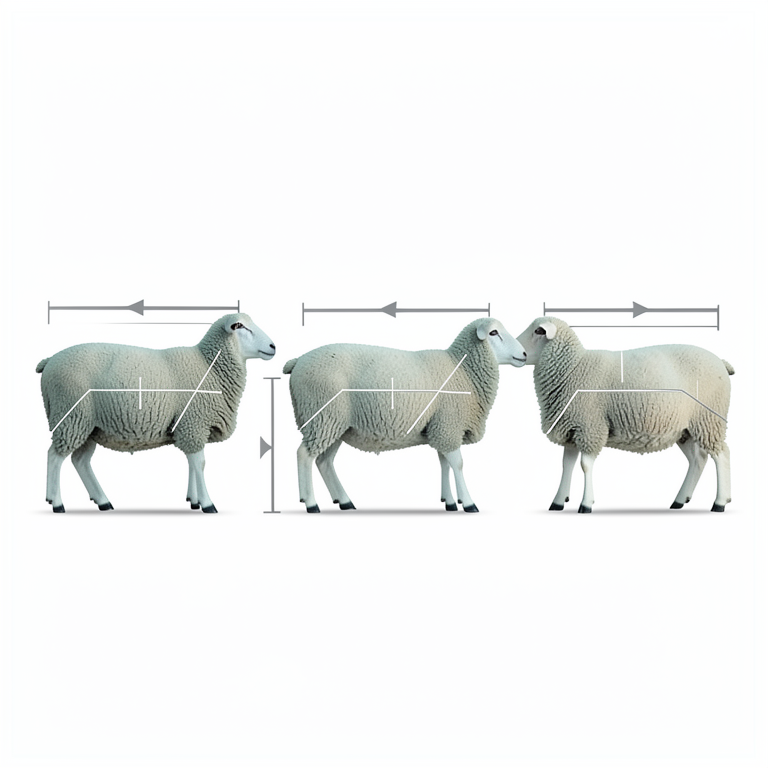
Study Design Overview
AI-generated conceptual illustration (Yalaga, Kenguri, and Bannur sheep breeds). It explains the idea and does not show study data.
View source evidence ↗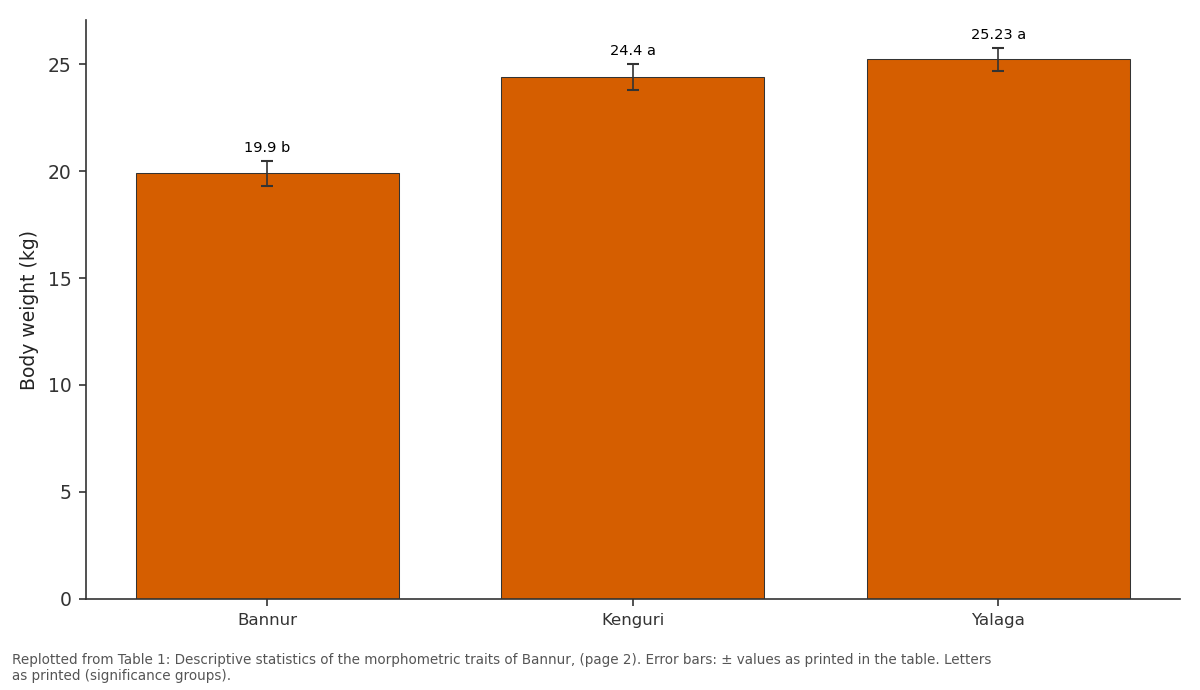
Body weight (kg): Bannur vs Kenguri vs Yalaga
Replotted from Table 1 (page 2) of the original paper. Every bar is the paper's own table value.
View source evidence ↗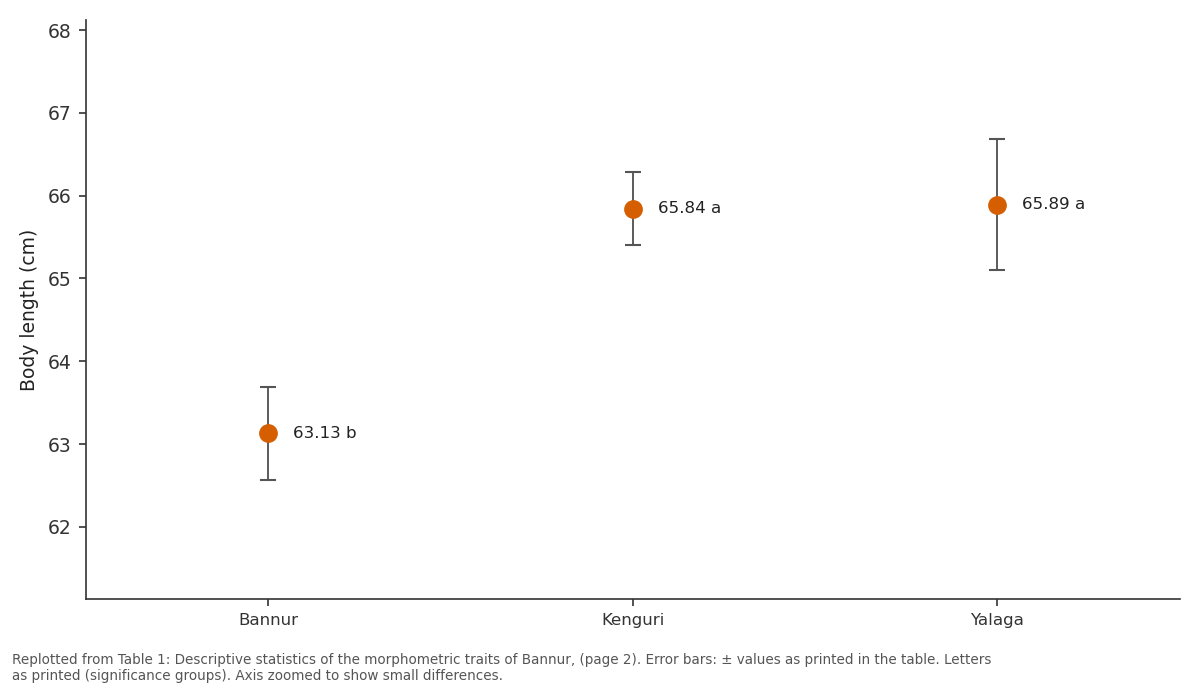
Body length (cm): Bannur vs Kenguri vs Yalaga
Replotted from Table 1 (page 2) of the original paper. Every bar is the paper's own table value.
View source evidence ↗Figures & tables
From the original paper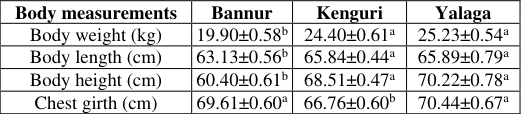 Table 1
Introduction
Sheep constitute a very important species of livestock in India, mainly on an account of their short gestation period, short inter lambing period, higher rate of prolificacy and the ease of marketing their products. They are considered to be very important due to their contribution to the economic development of people in rural zones. Indigenous breeds with qualities like heat tolerance, disease resistance, ability to survive and produce under stressful and low input conditions need to be conserved for future use. India has 42 well defined and recognised sheep breeds and many are non-descript viz. Yalaga (Dayanand, 2013) [4] and Mouli (Shashikant, 2014) [16] in Karnataka; Pattanam sheep (Ravimurgan et al., 2012) [14] , Chevaadu sheep (Ravimurgan and Panneerselvam, 2013) [13,15] and Kilakarsal sheep (Ravimurgan et al., 2013) [13 15] in Tamil Nadu. Yalaga sheep has the following body measurements as body weight 54.78±0.96kg, body height 86.29±0.49cm, body length 83.44±0.68cm and chest girth 92.32±0.77cm at an adult age group (Dayanand, 2013) [4] . It is essential to identify nondescript breeds which are efficient meat producer by comparing with other recognised mutton breeds of sheep. Hence, in the present study, attempts were made to measure morphometric traits of Yalaga sheep and to compare them with Kenguri and Bannur sheep of Karnataka.
Materials and Methods
The present study was conducted on 60 animals each of Yalaga, Bannur and Kenguri sheep which were brought for slaughter house to Karnataka Meat and Poultry Marketing Corporation (KAMPCO) slaughter house, Bruhath Bengaluru Mahanagar Palike slaughter house, Bengaluru and also various mutton shops present in and around Bengaluru. The morphometric traits viz. body weight (BW), body length (BL), body height (BH) and chest girth (CG) were recorded from 60 male sheep belonging 6 to 9 month age group in each breed. The BW (The fasted live weight, in kilograms) were recorded using a weighing scale and remaining three traits like BH (The height from the bottom of the front foot to the highest point of the shoulder between the withers, in centimetres), BL (The horizontal distance from the point of shoulder to the pin bone, in centimetres) and CG (The circumference of the body immediately behind the shoulder blades in a vertical plane, perpendicular to the long axis of the body, in centimetres) were recorded with a measuring tape after making the animal to stand squarely on an even ground. The age of the animal was estimated from its dentition pattern and varied from 6 to 8 milk teeth. The mean differences between traits of the 3 breeds were tested using one-way analysis of variance (ANOVA) module of SAS.9.3
Results and Discussion
The mean values of morphometric traits along with their SE for 3 sheep breeds under study are presented in Table 1. Analysis of variance has revealed that Yalaga sheep had significantly (p< 0.01) higher BW, BL and BH than Bannur and for the same traits, it had non-significantly higher values than Kenguri. Interestingly Yalaga had a non-significantly wider CG than Bannur, but it was significantly wider than Kenguri. Body weight in the present study was found to be higher in Yalaga (25.23±0.54kg) than that of Kenguri and Bannur at 6 to 9 month of age. In Bannur, the BW of 19.90±0.58kg was reported by our study. Compared to this values, lowered BW of 17.72±2.94kg (Nagaraja et al., 1996) [11] , 12.30±0.06kg (Dikshit, 1981) and 11.30±0.08kg (Urala, 1977) [17] have been recorded in Bannur sheep. In Kenguri, we have reported a BW of 24.40±0.61kg and it was higher than 24.2kg BW reported by Kumar et al. (2013) [10] , Deccani with 19.65±0.70kg BW (Kulkarni and Deshpande, 1986) [9] , Coimbatore with BW of 18.58±0.23kg (Kandasamy et al., 2006) [8] , Madras red with BW of 18.61±0.02kg (Devendran et al., 2008) [5] , Mecheri with BW of 17.90±0.25kg (Jagatheesen et al., 2003) [7] and Vembur with 18.66±0.26kg BW (Chandran, 1998) [2] were found to have lesser BW. While, the higher BW was reported as 27.64±0.57kg in Munjal (Poonia, 2004) [12] and of 25.72±0.25kg in Madgyal (Waghmode et al., 2008) [18] than Yalaga. Yalaga sheep at 6-9 month age had a BL of 65.89±0.79cm. In Bannur, Nagaraja et al. (1996) [11] had reported lower BL of 54.96±3.97cm and 59.20±3.94cm respectively at both 6 and 9 month age than that of present study. While, Yadav et al. (2013) had reported a BL of 68.3cm in Bannur sheep, which was longer than that of present findings. At 6-9 month age group, Muzaffarnagari was found to be longer in length (83.07±1.35cm) than Yalaga (65.89±0.79cm) sheep. However, Yalaga sheep was found to be longer than Coimbatore (58.5±0.39cm; Kandasamy et al., 2006) [8] , Mecheri (52.46±0.19cm; Jagatheesan et al., 2003) [7] . In Kenguri sheep, Yadav et al. (2013) has found a higher BL of 74.7cm in ram than that we found in this study. BL of Kenguri sheep in present study was found lower than that of Bellary (70.2cm) and Bannur (68.3cm) and higher than that of Hassan sheep (64.3cm) (Yadav et al., 2013). Body height in the present investigation was found to be higher in Yalaga sheep (70.22±0.78cm) than that of Bannur and Kenguri at 6-9 month age. Compared to Yalaga, Bannur with BH of 53.64±0.20cm (Nagaraja et al., 1996) [11] , Coimbatore with 57.69±0.37cm BH (Kandasamy et al., 2006) [8] , Mecheri with BH of 61.54±0.29cm (Jagatheesan et al., 2003) [7] were found smaller. However, Yalaga was found to be smaller than Muzaffarnagari ram that had BH of 75.97±0.86cm (Das and Hariprasad, 2007) [3] . In Bannur, Nagaraja et al. (1996) [11] has reported a BH of 51.32±2.20cm at 6 month and of 53.64±0.20cm at 9 month age, which was lower than that found in present work. Similarly, Yadav et al. (2013) have reported a BH of 54.30cm in Bannur sheep, which was lower than that reported in present study. In Kenguri sheep, Yadav et al. (2013) has recorded a BH of 72.6cm, which was higher than that of present report. Appannavar et al. (2012) has reported a BH of 64.86±1.01cm in Kenguri rams, which was lower than present study. In the present work, chest girth of Yalaga at 6 to 9 month age group was found to be significantly (p< 0.01) higher than that of Kenguri and non-significantly higher than that of Bannur. In Bannur, Nagaraja et al. (1996) [11] has found a CG of 61.17±4.03cm at 6 month and of 66.09±4.02cm at 9 month of age, which was lower than that of our results. [11] , Coimbatore (64.39±0.51cm; Kandasamy et al., 2006) [8] and Mecheri (64.5±0.37cm; Jagatheesan et al., 2003) [7] . However, Muzaffarnagari sheep had a higher CG of 79.67±0.02cm than that of Yalaga (Das and Hariprasad, 2007) [3] .
| Body measurements | Bannur | Kenguri | Yalaga |
|---|---|---|---|
| Body weight (kg) | 19.90±0.58b | 24.40±0.61a | 25.23±0.54a |
| Body length (cm) | 63.13±0.56b | 65.84±0.44a | 65.89±0.79a |
| Body height (cm) | 60.40±0.61b | 68.51±0.47a | 70.22±0.78a |
| Chest girth (cm) | 69.61±0.60a | 66.76±0.60b | 70.44±0.67a |
Table text extracted from the original PDF; superscript letters are shown inline. The original table image is below.
View original table image
Conclusion
The present study was underpinned to find out the morphometric traits of Yalaga sheep and also to compare them with that of Kenguri and Bannur sheep. Analysis of variance revealed significantly (p< 0.01) higher value of BW, BL and BH in Yalaga sheep than Bannur and the CG was non-significantly higher in Yalaga compared to Bannur. Kenguri sheep had a non-significantly lower value of BW, BL and BH compared to Yalaga and its CG was significantly (p< 0.01) lower than Yalaga. From this study it is evident that Yalaga had a higher body measurements than the best known mutton breed Bannur. The study showed the good morphological traits in Yalaga compared to Kenguri and Bannur breed of sheep, which indicates its mutton production ability. Hence, it is better to advice farmers to rear Yalaga for mutton production and to benefit economically.
Acknowledgement
AcknowledgementWe are grateful to Dr Kanthraj, Asst. Director, KEMPCO, BBMP, Bengaluru, for allowing to make a recording various parameters for our study.
References
18 in the original paper- Appannavar MM, Pawar A, Ramachandra B, Tandle MK, Kumar NGS. Study on growth potential and body measurements of Kenguri breed of sheep. Indian Vet. J. 2012; 87:83-84
- Chandran PC. Characteristics and performance of Vembur sheep in the Habitat. M.V.Sc. Thesis submitted to Tamil Nadu Veterinary and Animal Sciences University, Chennai, India, 1998.
- Dass G, Hariprasad. Morphological characteristics, live weights and management practices of Muzaffarnagari sheep in the home tract. Indian J Small Rumin. 2007; 13(1):27-30
- Dayanand KC. Morphological characterization of Yalaga sheep. M.V.Sc thesis, Karnataka Veterinary Animal and Fisheries Sciences University, Bidar, Karnataka, India, 2013.
- Devendran P, Cauveri D, Gajendran K. Growth performance of Madras Red sheep in farmer's flocks. Compedium: Abstract presented in IX Annual Conference of Indian Society of Animal Genetics and Breeding and National Symposium on Livestock Geomics in Productivity Enhancement for Food Security. New Delhi, India, 2008.
- Dikshit RK. Genetic and non-genetic studies on preweaning traits in Bannur lambs. M.V.Sc thesis submitted to UAS. Bangalore, 1981.
- Jagatheesan PNR, Arunachalam S, Sivakumar T, Selvaraju M. Performances of Mecheri sheep in its breeding tract. Indian J Anim. Sci. 2003; 73:909-912
- Kandaswamy N, Devendran P, Panneersevelvam S, Thiruvenkadan AK, Singh G, Singh PK et al. Coimbatore sheep, Monograph. National bureau of Animal Genetics Resources, Karnal and Tamil Nadu Veterinary and Animal Sciences University, Chennai, India, 2006.
- Kulkarni AP, Deshpande KS. Factors affecting body weights at different stages and first clip fleece weight in Deccani sheep. Indian J Anim. Sci. 1986; 56:971-974.
- Kumar NGS, Ruban WS, Pradeep MC, Shivakumar MC. A Study on Kenguri as Mutton Breed of Sheep in Southern Karnataka, India. Middle-East J Sci. Res. 2013; 13(1):05-08.
- Nagaraja CS, Govindaiah MG, Jayashankar MR, Krishnappa SB. Prediction of body weights from body measurements in Bannur sheep. Curr. Res. 1996; 25:211212.
- Poonia JS. Growth performance of Munjal lambs. Indian J Small Rumin. 2004; 10(2):137-139.
- Ravimurugan T, Panneerselvam S. Habitat and distribution of Chevaadu sheep of Tamil Nadu, India. Inter. J Food Agri. Vet. Sci. 2013; 3(1):88-92.
- Ravimurugan T, Thiruvenkadan AK, Sudhakar K, Panneerselvam S. Sheep Genetic Resources of Southern Tamil Nadu, India. Inter. Res. J Agri. Sci. and Soil Sci. 2012; 2(3):81-88
- Ravimurugan T, Thiruvenkadan AK, Sudhakar K, Panneerselvam S, Elango A. The estimation of body weight from body measurements in Kilakarsal sheep of Tamil Nadu, India. Iranian J Appli. Anim. Sci. 2013; 3(2):357-360
- Shashikant. Morphological characterization of Mouli sheep. M.V.Sc Thesis submitted to Karnataka Veterinary Animal and Fisheries Sciences University, Bidar, Karnataka. India, 2014.
- Urala KAR. Genetic studies on body weights in Bannur sheep. M.V.Sc Thesis submitted to the University of Agricultural Sciences, Bangalore. India, 1977.
- Waghmode PS, Sawane MP, Pawar VD, Ingawale MV. Effect of non-genetic factors on growth performance of Madgyal sheep. Indian J Small Rumin. 2008; 14:127-130
Cited by 2
From OpenAlex, OpenCitations and reference lists read by Scinovex
- Phenotypic Characterization of Indigenous Sheep Breeds in Saudi Arabia ↗
M. F. El‐Zarei, S. A. Al-Sharari, M. S. Alhasyani, A. A. Aloufi, Emad F. Mousa · Journal of Agricultural Science · 2023
Saudi’s farm animal genetic resources have a particular role to play in managing the rural environment and assisting in maintaining wild biological diversity. Our indigenous livestock breeds are of great economic, social and cultural importance. The presence of livestock is a very positive feature for many who live in, work in or visit the countryside and livestock farming is frequently…
❝ 5PDF - Morphometric traits with reproduction and production performances of indigenous and exotic sheep breeds of Bangladesh ↗
Mohammad Asaduzzaman, Amit Saha, Md Asaduzzaman Jemy, Pallab Kumar Datta, Mohammad Golam Shahi Alam, Farida Yeasmin Bari · Veterinary Integrative Sciences · 2021
The purpose of this study was to review the existing literature on some important morphological traits associated with reproductive and productive performance in Bangladeshi indigenous and exotic cross sheep. Sheep as small ruminants are essential parts of the crop-livestock of the mixed agricultural farming system playing a crucial role in the livelihood of smallholders in Bangladesh. They are considered risk…
❝ 3PDF