
Research article · 2019 · Full text
International Journal of Veterinary Sciences and Animal HusbandryRelationship among pre-slaughter and Carcass traits in sheep breeds of Karnataka
Volume 4(6) · Pages 15–18
Research areasLivestock Management and Performance ImprovementGenetic and phenotypic traits in livestockAgricultural Economics and Practices
Abstract
Author-writtenBreed improvement of well-defined sheep breeds are the prime objectives of researchers to ensure benefits through increased production of meat, milk, wool and skin. Marketing facilities were not up to the mark in Karnataka state, and the present system of marketing with lesser available inputs for measuring the pre-slaughter and carcass traits will decrease the profitability of farmers. Traits of animals will be quite indicative of breed characters for its production and reproduction ability. Hence, the study was designed to ascertain relationship among pre-slaughter and carcass traits of Yalaga compared to Kenguri and Bannur. The results will help to conclude about Yalaga breed and guide us to design the improvement programmes. The statistical analysis showed the positive and significant (p< 0.05) relationship among pre-slaughter and carcass traits in Yalaga, Kenguri and Bannur sheep breeds. The correlation coefficient was ranges from 0.41-0.98. However, Bannur showed significantly (p< 0.05) higher values of correlation coefficient compared to both Kenguri an Yalaga for BW with BL, and CG and DW with HW, SW and VW, except for BW with BH, where Bannur showed lower results than Kenguri. Interestingly, the BW showed significantly (p< 0.05) high relationship with DW in Bannur, Kenguri and Yalaga as 0.97, 0.98 and 0.96 respectively.
Summary
Source-checkedPlain-language reading of the full paper, prepared with AI and checked against the text. Each point links to the authors' own words.
Why it matters
- Researchers aim to improve well-defined sheep breeds to increase the production of meat, milk, wool, and skin. View evidence ↗
- In Karnataka, inadequate marketing facilities and a lack of tools to measure pre-slaughter and carcass traits can reduce farmer profitability. View evidence ↗
- Understanding the relationship between body weight and linear body traits is useful for predicting weight in areas of Karnataka where weighing scales are unavailable. View evidence ↗
The question
- The study aimed to determine the relationship between pre-slaughter and carcass traits in Yalaga sheep compared to Kenguri and Bannur breeds. View evidence ↗
What they did
- The research was conducted at KAMPCO, BBMP, and various mutton shops in Bengaluru. View evidence ↗
- The study used 60 male animals from each of the three breeds (Yalaga, Kenguri, and Bannur), all aged between 6 and 9 months. View evidence ↗
- The researchers measured pre-slaughter traits (body weight, height, length, and chest girth) and carcass traits (dressed weight, head weight, skin weight, and visceral organs weight). View evidence ↗
- Correlation coefficients were calculated using the SAS.9.3 software module to analyze the relationship between traits. View evidence ↗
What they found
- All three sheep breeds showed a positive and significant correlation (p < 0.05) between pre-slaughter and carcass traits, with coefficients ranging from 0.41 to 0.98. View evidence ↗
- Body weight (BW) had a very high positive correlation with dressed weight (DW) across all breeds: 0.97 for Bannur, 0.98 for Kenguri, and 0.96 for Yalaga. View evidence ↗
- In Bannur sheep, BW correlated with BH (0.72), BL (0.67), and CG (0.68), while DW correlated with HW (0.80), SW (0.76), and VW (0.78). View evidence ↗
- In Kenguri sheep, BW correlated with BH (0.75), BL (0.57), and CG (0.64), while DW correlated with HW (0.66), SW (0.52), and VW (0.82). View evidence ↗
- Yalaga sheep showed lower correlations for carcass traits (DW with HW: 0.49, SW: 0.41, VW: 0.64) compared to the other two breeds, while BW correlated with BH (0.62), BL (0.58), and CG (0.68). View evidence ↗
- Bannur generally exhibited higher correlation coefficients between traits than Kenguri and Yalaga, except for the relationship between body weight and body height, which was lower than in Kenguri. View evidence ↗
What it means
- The authors conclude that there is a positive and significant correlation between pre-slaughter and carcass traits in all three studied sheep breeds. View evidence ↗
- The findings regarding the Yalaga breed are intended to guide the design of future breed improvement programs. View evidence ↗
Visual summary
3 visualsIllustrations explain the paper; charts are replotted from the paper's own table values.
Trait Relationship Concept
AI-generated conceptual illustration (sheep (Yalaga, Kenguri, and Bannur breeds)). It explains the idea and does not show study data.
View source evidence ↗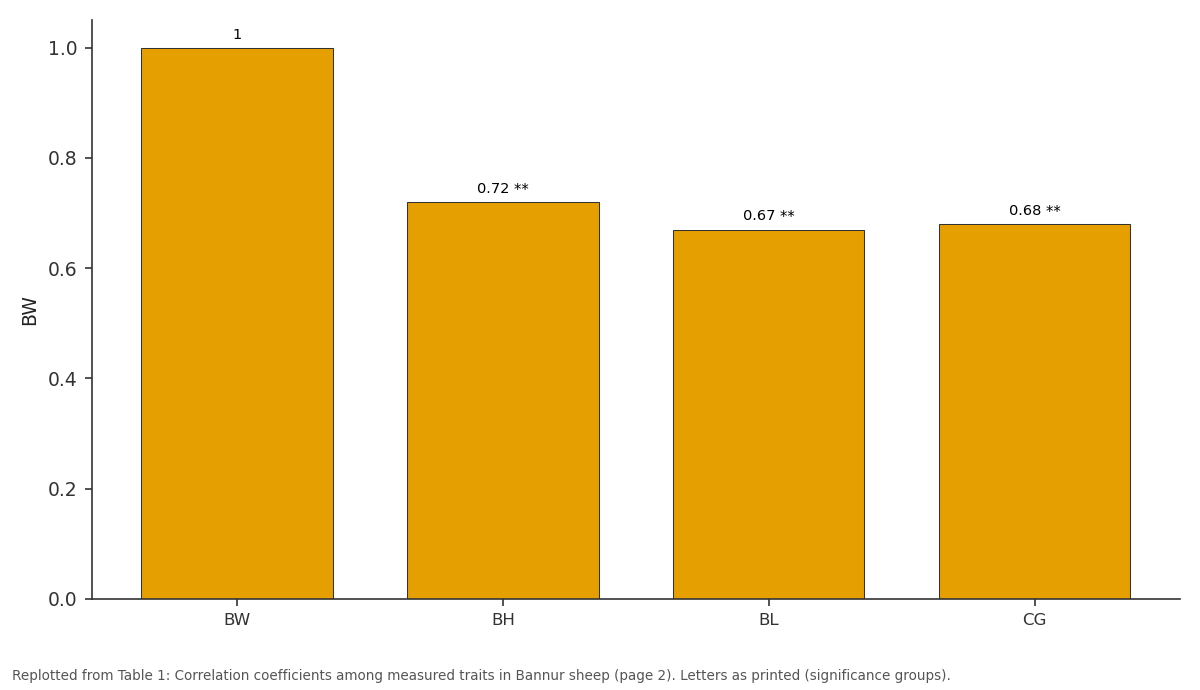
BW: BW vs BH vs BL vs CG
Replotted from Table 1 (page 2) of the original paper. Every bar is the paper's own table value.
View source evidence ↗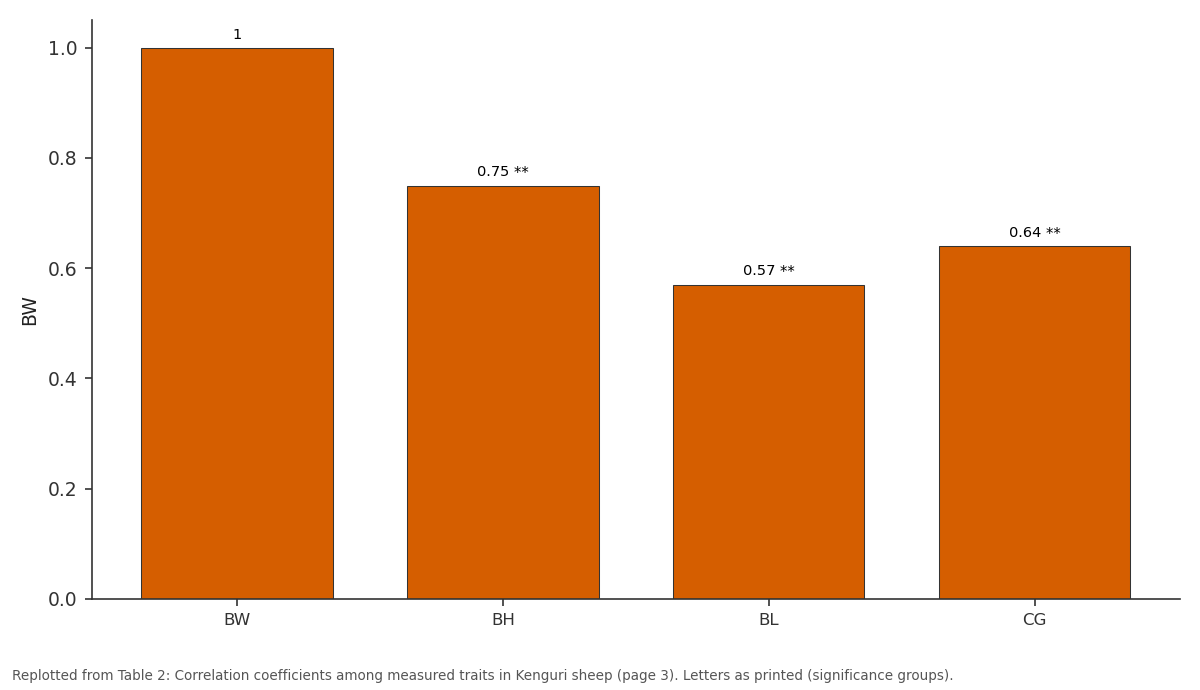
BW: BW vs BH vs BL vs CG
Replotted from Table 2 (page 3) of the original paper. Every bar is the paper's own table value.
View source evidence ↗Figures & tables
From the original paper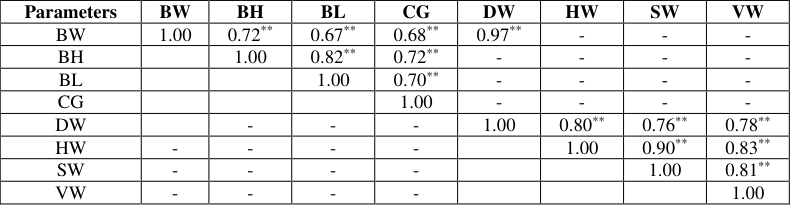 Table 1
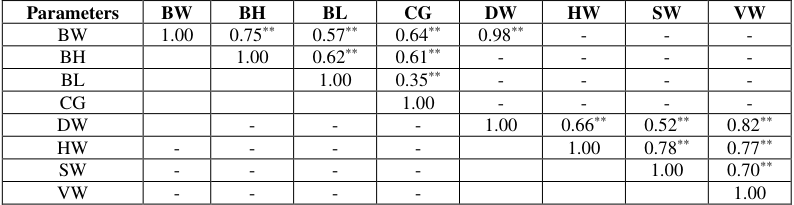 Table 2
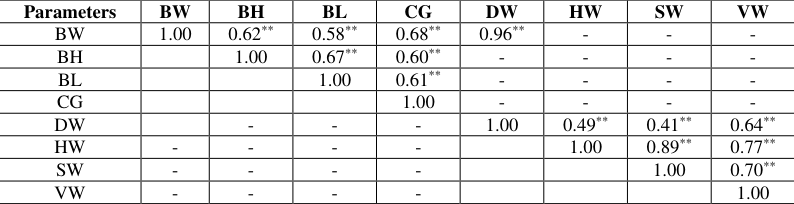 Table 3
Introduction
Karnataka is having good genetic resource of sheep with a population of 9.58 million (Livestock census, 2012) [13] . These animals are produced and maintained by small and landless farmers for their livelihood through meat, milk, skin and wool products. Majority of the sheep belongs to southern India are utilized as dual purpose. Recognised sheep breeds of Karnataka known for meat production are Mandya and Kenguri. Also, non-recognised breeds have been found. One such breed is Yalaga, a taller sheep breed with a good morphological character indicative of good mutton production, as studied by Dayanand, (2013) [7] . The native tract of Yalaga is Bagalkote district with a good population size in state. Similarly, Kenguri also a taller breed of northern Karnataka, famous for its mutton and found in the districts of Raichur, Koppal, Yadgir and Kalaburagi. The population was found to be 4.3 lakh in the country (Livestock census, 2012) [13] . Bannur is an established and well known mutton sheep breed of Karnataka. It is a short breed, located in Mandya and Mysuru districts. Increased production is one of the primary goals in sheep production, and growth is also a major concern to livestock farmers. However, 80% of the small ruminant population in Karnataka is maintained at the small holder level, where the production system is largely extensive with its array of constraints (Akpa et al., 2006) [1] . A quantitative measure for animal conformation is desirable, as it will enable reliable genetic parameters for traits to be estimated and permits its inclusion in breeding programme (Ibe, 1989) [10] . Also, the relationship between scale weight and easily measured linear body traits will be useful for predicting body weight in situations where weighing facilities are not available as is the case in many districts of Karnataka. Besides, body measurements are important in prediction of carcass weight and determination of certain body conformation traits that can be taken into consideration in selecting animals for genetic improvement and animal production. Earliest attempts to standardized sheep biometrics with regards to Madras Red sheep was done by Ganasekale and Rathnasabapathy (1973) [9] .
Growth which is the sum total of increase in size of different structural body components (Ibe and Nwakalor, 1987) [11] is measured from the gain in both body weight and linear body measurements (Spencer and Eckert, 1988) [19] . This paper therefore, evaluate the relationship among pre-slaughter traits like, body weight, body height, body length and chest girth and carcass traits like dressed weight, head weight, skin weight and visceral organs weight in Yalaga sheep compared to Kenguri and Bannur.
Materials and Methods
Materials and Methods
Location and Animals
The present study was conducted at Karnataka Meat and Poultry Marketing Corporation (KAMPCO), Bruhath Bengaluru Mahanagar Palike, Bengaluru and various mutton shops found at Bengaluru, where the farmers brought their animals Bannur, Kenguri and Yalaga for slaughter.
Data collection and Statistical analysis
Data for the present study was collected from 60 male animals each of Yalaga, Kenguri and Bannur, with the age group of 6-9 month. For our investigation, pre-slaughter traits viz. body weight (BW), body height (BH), body length (BL) and chest girth (CG) and carcass traits viz. dressed weight (DW), head weight (HW), skin weight (SW) and visceral organs weight (VW) were recorded. The age of the animal was estimated from its dentition pattern and varied from 6 to 8 milk teeth. The BW (The fasted live weight, in kilograms) was recorded using a weighing scale and remaining three traits like BH (The height from the bottom of the front foot to the highest point of the shoulder between the withers, in centimetres), BL (The horizontal distance from the point of shoulder to the pin bone, in centimetres) and CG (The circumference of the body immediately behind the shoulder blades in a vertical plane, perpendicular to the long axis of the body, in centimetres) were recorded with a measuring tape after making the animal to stand squarely on an even ground. Carcass traits were measured after the sacrifice of animals. The jugular vein was severed with a sharp knife for sheep sacrifice; head was removed at occipito atlantal joint after complete discharge of blood. De-skinning was done and visceral organs (heart, kidney, lungs, trachea, liver and gut) were separated from the carcass. The remaining muscle and bone portion of the carcass was dressed weight. The weight of head, skin and visceral organs of carcass was measured in kilograms using digital weighing machine. The relationship among pre-slaughter and carcass traits in three breeds were tested using correlation coefficient module of SAS.9.3
Results and Discussion
The statistical analysis showed the positive and significant (p< 0.05) correlation among the pre-slaughter and carcass traits in Bannur, Kenguri and Yalaga sheep breeds. The correlation coefficients among various pre-slaughter and carcass traits are presented in the Table 1 through 3, respectively. In the present study, Bannur showed higher values of correlation coefficient among pre-slaughter and carcass characters compared to Kenguri and Yalaga, except for BW with BH, which was found to be lower than Kenguri. The correlation coefficients varied between 0.41 to 0.98. Interestingly, all three sheep breeds showed positive and significantly (p< 0.05) high correlation of BW with DW as 0.97, 0.98 and 0.96 in Bannur, Kenguri and Yalaga, respectively. In Bannur, the correlation coefficient of BW with BH, BL and CG was found to be 0.72, 0.67 and 0.68, respectively. Similarly, for carcass traits like DW with HW, SW and VW was found to be 0.80, 0.76 and 0.78, respectively. The correlation coefficients of pre-slaughter traits in Kenguri for BW with BH, BL and CG were found to be 0.75, 0.57 and 0.64, respectively. Similarly, for carcass traits like DW with HW, SW and VW was found to be 0.66, 0.52 and 0.82, respectively. However, Yalaga showed the correlation coefficients of 0.62, 0.58 and 0.68 for BH, BL and CG, respectively with BW. Interestingly, low correlation coefficients values were found for carcass traits of DW with HW, SW and VW as 0.49, 0.41 and 0.64, respectively compared to Kenguri and Bannur. Similar to our study, positive and significantly (p< 0.01) lower correlation coefficient of 0.65 was found for BW with BH in Gaddi (Basu et al. 1967) [4] , 0.69 in Bikaneri (Bhasin et al. 1968) [6] , 0.57 in Rampur Bushair (Basu and Negi, 1968) [3] , 0.17 in Magra (Malik et al. 1970) [15] , 0.30 in Sonadi (Arora et al. 1977) [2] , 0.47 in Gaddi (Mahajan and Bohra, 1977) [14] and 0.58 in Bandur (Siddalinga, 2001) [16] . However, higher correlation coefficient of 0.78 was found in Magra 0.78 (Gajbhiye and Johar, 1985) [8] , 0.76 in Nali (Kandasamy and Gupta, 1983) [12,8] , 0.81 in Bikaneri (Singh and Singh, 1974), 0.75 in Bikaneri 0.75 (Singh et al. 1972), 0.83 in Madras Red (Vimal et al. 2002) compared to our findings. Higher values of correlation coefficients was found for BW respectively with BL and CG as 0.85, 0.70 in Rampur Bushair (Basu and Negi, 1968) [3] , 0.82, 0.85 in Bikaneri (Singh and Singh, 1974), 0.68, 0.71 in Gaddi (Mahajan and Bohra, 1977) [14] , 0.82, 0.76 in Nali and 0.81, 0.82 in Chokla (Kandasamy and Gupta, 1983) [12,8] , 0.74, 0.86 in Magra (Gajbhiye and Johar, 1985) [8] , respectively. Interestingly, lower values of correlation coefficient was found as 0.66, 0.68 in Bandur (Siddalinga, 2001) [16] , respectively compared to our findings. Reports in correlation coefficient among the carcass traits in sheep breeds of Karnataka is not available to compare our results and we are first to report this.
| Parameters | BW | BH | BL | CG | DW | HW | SW | VW |
|---|---|---|---|---|---|---|---|---|
| BW | 1.00 | 0.72** | 0.67** | 0.68** | 0.97** | - | - | - |
| BH | 1.00 | 0.82** | 0.72** | - | - | - | - | |
| BL | 1.00 | 0.70** | - | - | - | - | ||
| CG | 1.00 | - | - | - | - | |||
| DW | - | - | - | 1.00 | 0.80** | 0.76** | 0.78** | |
| HW | - | - | - | - | 1.00 | 0.90** | 0.83** | |
| SW | - | - | - | - | 1.00 | 0.81** | ||
| VW | - | - | - | - | 1.00 |
Table text extracted from the original PDF; superscript letters are shown inline. The original table image is below.
View original table image
Conclusion
Present study was conducted to ascertain the relationship among pre-slaughter and carcass traits in Yalaga compared to Kenguri and Bannur sheep breeds, and the correlation coefficient varied between 0.41 -0.98. Statistical analysis has a positive and significant (p< 0.05) correlation among both pre-slaughter and carcass traits in three sheep breeds studied. However, Bannur showed positive and significantly (p< 0.05) higher correlation coefficients in both pre-slaughter and carcass traits, except for BW with BH, where it showed lower values than Kenguri. Interestingly, BW showed highly positive and significant (p< 0.05) correlation with DW in all the three breeds of sheep.
Acknowledgement
AcknowledgementWe are grateful to the Dean of Veterinary College, Bidar, Karnataka, for providing necessary facilities and we are also thankful to the Dr Kanthraj, Assistant Director, KEMPCO, BBMP, Bengaluru for permitting me to make a note of various parameters for our study.
Figures and tables from the paper
| Parameters | BW | BH | BL | CG | DW | HW | SW | VW |
|---|---|---|---|---|---|---|---|---|
| BW | 1.00 | 0.75** | 0.57** | 0.64** | 0.98** | - | - | - |
| BH | 1.00 | 0.62** | 0.61** | - | - | - | - | |
| BL | 1.00 | 0.35** | - | - | - | - | ||
| CG | 1.00 | - | - | - | - | |||
| DW | - | - | - | 1.00 | 0.66** | 0.52** | 0.82** | |
| HW | - | - | - | - | 1.00 | 0.78** | 0.77** | |
| SW | - | - | - | - | 1.00 | 0.70** | ||
| VW | - | - | - | - | 1.00 |
Table text extracted from the original PDF; superscript letters are shown inline. The original table image is below.
View original table image
| Parameters | BW | BH | BL | CG | DW | HW | SW | VW |
|---|---|---|---|---|---|---|---|---|
| BW | 1.00 | 0.62** | 0.58** | 0.68** | 0.96** | - | - | - |
| BH | 1.00 | 0.67** | 0.60** | - | - | - | - | |
| BL | 1.00 | 0.61** | - | - | - | - | ||
| CG | 1.00 | - | - | - | - | |||
| DW | - | - | - | 1.00 | 0.49** | 0.41** | 0.64** | |
| HW | - | - | - | - | 1.00 | 0.89** | 0.77** | |
| SW | - | - | - | - | 1.00 | 0.70** | ||
| VW | - | - | - | - | 1.00 |
Table text extracted from the original PDF; superscript letters are shown inline. The original table image is below.
View original table image
References
20 in the original paper- Akpa GN, Alphonsus C, Duru S. The relationship between body growth parameters and testicular and horn development in Yankasa rams. Small Rumin. Res. 2006; 2(2):56-61.
- Arora CL, Acharya RM, Sangolli BV, Nagaraja MS. Characterization of Sonadi breed in Rajasthan and future prospects for its improvement. Indian J Anim. Sci. 1977; 47:120-125.
- Basu TAK, Negi GC. A study of phenotypic biometry of indigenous Rampur Bushair sheep. Indian Vet. J. 1968; 38:258-260.
- Basu TAK, Mahajan JM, Singh ON. Study on body weight and confirmation of Gaddi and Romney Marsh sheep. Indian Vet. J. 1967; 44:589-596.
- Basu TAK, Nivsarkar AE, Singh RN. Studies on some pre and post slaughter parameters in Malpura lambs. Phenotypic biometry and dressing percentage. Indian Vet. J. 1980; 57:473-478.
- Bhasin NR, Desai RN, Kapri BD. Studies on body size in relation to clean fleece yield in Bikaneri sheep. Indian Vet. J. 1968; 38:632-643.
- Dayanand KC. Morphological characterization of Yalaga sheep. M.V.Sc thesis, Karnataka Veterinary Animal and Fisheries Sciences University, Bidar, Karnataka, India, 2013.
- Gajbhiya PU, Johar KS. Predicting body weight on the basis of body measurements in Magra sheep. Indian J Anim. Sci. 1985; 55(7):604-606.
- Ganasekale D, Rathnasabapathy V. Sheep breeds of Tamil Nadu. Cheiron. 1973; 2:146-55.
- Ibe SN. Measurement of Size and Conformation in Commercial Broilers. Poultry Sci. 1989; 56:461-467.
- Ibe SN, Nwakalor LN. Growth Pattern and conformation in Broilers, influence of genotype and management on isometry of growth. Poultry Sci. 1987; 46:1247-1251.
- Kandasamy N, Gupta DC. Studies on physical measurements, live weight and fleece weight in native and crossbred sheep in a semi-arid zone of India. Tropical Agriculture (Trinidad). 1983; 60:92-94.
- Livestock Census, 19 th Animal census report, Department of Animal Husbandry, Dairying and Fisheries. GOI, 2012.
- Mahajan JM, Bohra SDJ. Some biometrical investigations on the Gaddi hill breed of sheep. Indian J Anim. Sci. 1977; 11:44-46.
- Malik BS, Kunzru ON, Dwaraknath PK. Relationship of birth weight and certain body measurements at birth with yearling body weight of Magra lambs. Indian Vet. J. 1970; 47:749-752.
- Siddalinga MHK. Evaluation of Bandur sheep in Mandya District of Karnataka for economic traits. M.V.Sc thesis, University of Agricultural Sciences, Bangalore, Karnataka, India, 2001.
- Singh BB, Singh MR. Relative importance of body measurements for body weight and wool yield of Bikaneri lambs. Indian J Anim. Health. 1974; 13:37-40.
- Singh BP, Singh BB, Singh MR. Relationship of wool yield with age, weight and body measurements of Bikaneri sheep. Indian J Anim. Sci. 1972; 42:218-220
- Spencer WP, Eckert IB. Estimation of live weight and carcass weight in Gambian N'Dama cattle. World Anim. Revie. 1988; 65:18-23.
- Vimal S, Kumar RT, Nathan SR, Meenakshisundaram S, Gajendran K. Prediction of body weight from body measurements in Madras Red sheep. Indian J Anim. Sci. 2002; 72(1):180-181.