
Research article · 2019 · Full text
International Journal of Veterinary Sciences and Animal HusbandryDairy producer’s attitudes toward implementing calf management practices on smallholder and large commercial dairy herds in Kenyan Rift valley
Volume 4(5) · Pages 35–39
Research areasLivestock Management and Performance ImprovementAgricultural Innovations and PracticesLivestock Farming and Management
Abstract
Author-writtenPracticing best calf management practices in housing, feeding and health are important for growing the future replacement stock. This is important for sustainability of the dairy herd where a significant proportion of the national dairy herds are smallholders with poorer calf performance than is in large commercial herds. Kenya’s national dairy herds comprise over 75% smallholders, some affiliated to cooperatives offering regular extension advises on best calf management practices to their members. This study tested the hypothesis that producer attitudes reflect calf management practices that are implemented in large commercial and smallholder herds. The hypothesis was tested with a sample of large commercial dairy herds and smallholder herds affiliated to cooperative societies. Producer attitudes and management practices in calf housing, feeding and health were captured regarding standard management practices on a five point scale of agreement. The responses were analyzed to reveal the underlying differences between the herds using non-parametric chi square test and Mann-Whitney U test statistics. Compared to large commercial dairy producers, smallholders expressed more negative (p
Summary
Source-checkedPlain-language reading of the full paper, prepared with AI and checked against the text. Each point links to the authors' own words.
Why it matters
- Proper calf management in housing, feeding, and health is essential for developing future replacement stock for dairy herds. View evidence ↗
- In Kenya, smallholders make up more than 75% of the national dairy herd, with some receiving extension advice through cooperatives. View evidence ↗
- Smallholder herds often show poorer calf performance compared to large commercial herds, which impacts the overall sustainability of the dairy sector. View evidence ↗
The question
- The study aimed to test whether the attitudes of dairy producers reflect the actual calf management practices implemented in smallholder and large commercial herds. View evidence ↗
What they did
- The research was conducted in Nakuru County, characterized by a bimodal rainfall pattern (1800mm in long rains and 500mm in short rains). View evidence ↗
- The study sampled 20 farms using a 1:4 ratio of large commercial to smallholder dairy farms. View evidence ↗
- Farm owners completed structured questionnaires using a five-point Likert scale to report their attitudes and implementation of standard housing, feeding, and health practices. View evidence ↗
- Data analysis was performed using non-parametric chi-square tests and Mann-Whitney U test statistics to compare smallholder and large commercial producers. View evidence ↗
What they found
- Smallholders had significantly more negative attitudes (p<0.05) than large commercial producers regarding recommended housing, feeding, and health practices. View evidence ↗
- Smallholders implemented recommended housing, feeding, and health practices significantly more poorly (p<0.05) than large commercial producers. View evidence ↗
- There were no significant differences (p>0.05) between the two groups regarding attitudes toward pen ventilation, calf grouping, and treatment. View evidence ↗
What it means
- The authors conclude that smallholder dairy producers require a change in attitude to successfully implement recommended calf management practices. View evidence ↗
- The authors recommend implementing these management practices to improve calf welfare and the overall dairy sector. View evidence ↗
Visual summary
1 visualsIllustrations explain the paper; they do not show study data.
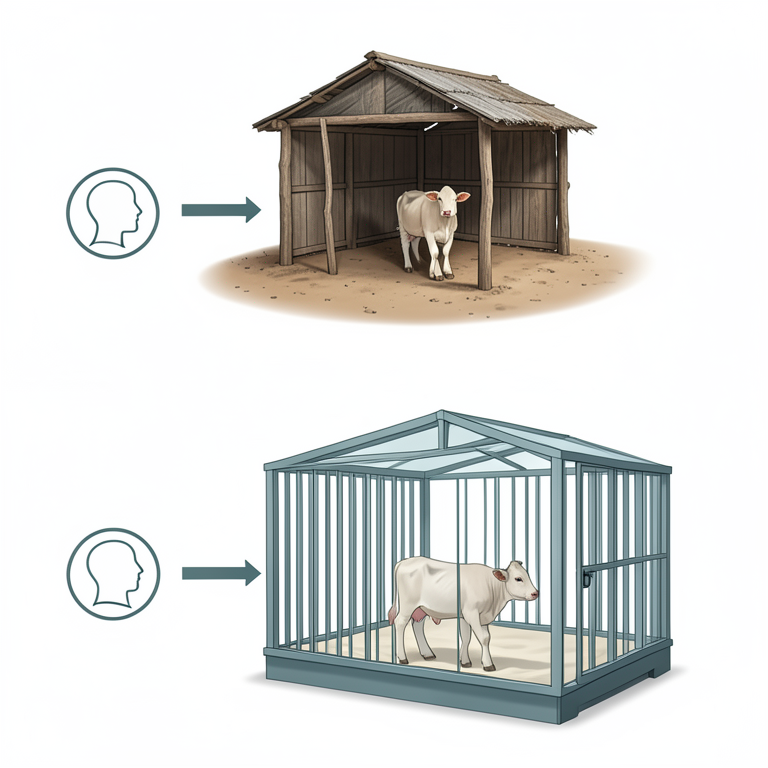
Attitude-Practice Link
AI-generated conceptual illustration (Holstein-Friesian calves in Kenyan dairy farm settings). It explains the idea and does not show study data.
View source evidence ↗Figures & tables
From the original paper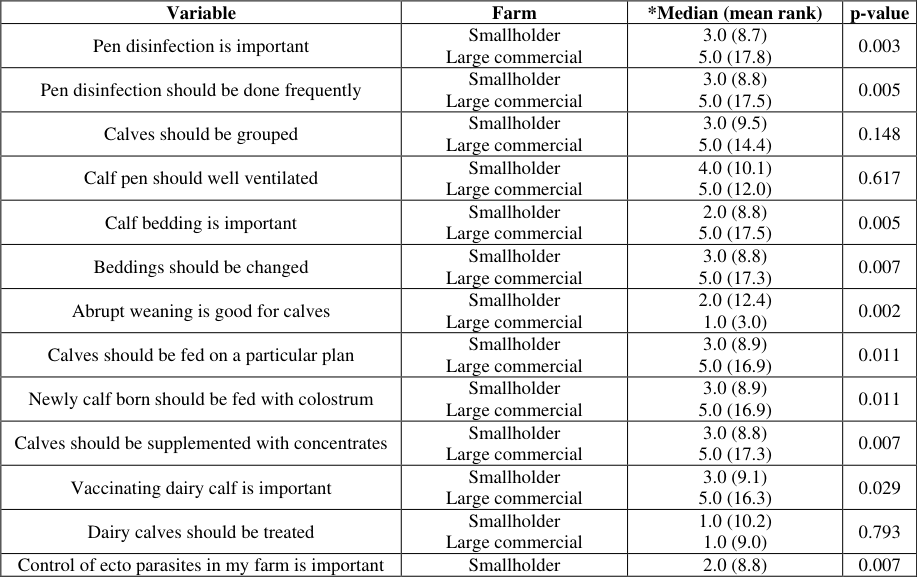 Table 1
 Table 2
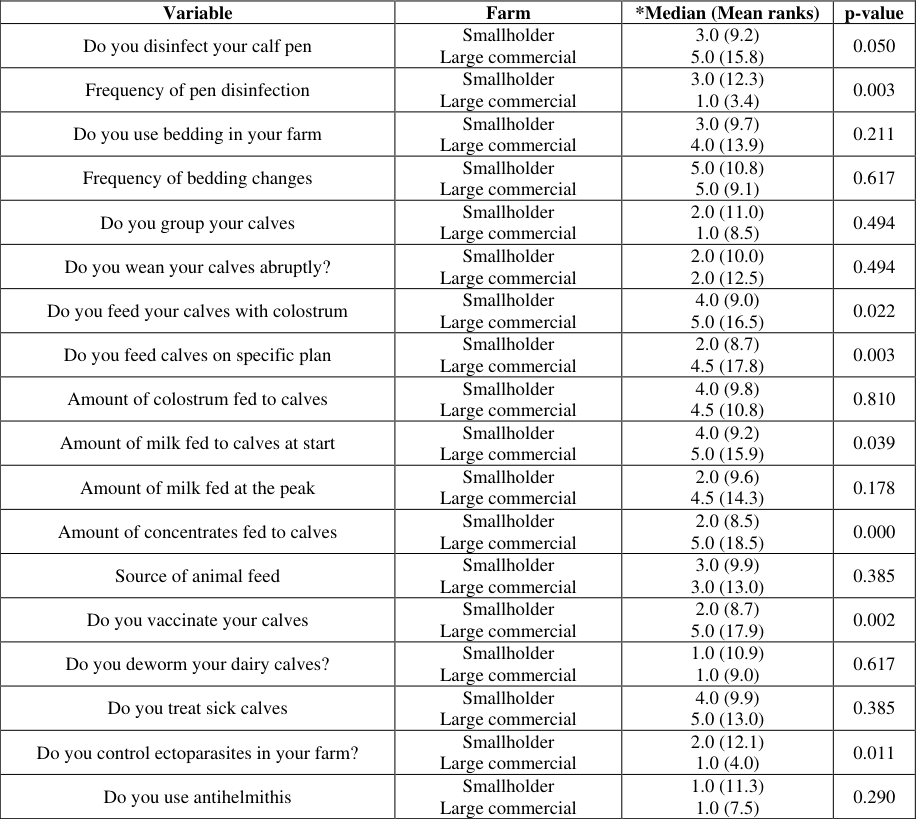 Table 2
Introduction
Practicing best calf management practices in housing, feeding and health is important for rearing the future replacement stock. This is important for sustainability of the dairy herd where a significant proportion of the national dairy herd attain poorer calf performance. Kenya has such dairy herd in which smallholder's comprise75% of the national herd and with poorer calf performance than in the fewer remainder medium and large commercial herds [3] . Good calf management practices enhance calf survivability and performance and subsequently, quality replacement stock for the future herd [17] . Important calf management is in housing, feeding and health. Calf housing should be well ventilated, partitioned into individual pens which are regularly disinfected, cleaned and the bedding are kept dry to provide calf comfort, good welfare and ease early disease detection of diseases. This way, good housing contributes to improved calf performances [5] . Good calf feeding practices begin with colostrum feeding, essential for passive immunity to calf. Colostrum feeding is followed with milk feeding, which has to be warm, hygienic and in enough quantity corresponding to calf body weight to support sufficient growth. Supplemental concentrate is necessary after weaning to sustain high growth rates [16,4] .
Poor calf health is associated with calf mortalities from pneumonia, diarrhea and septicemia diseases. Poor calf health slow growth rate and limits daily body weight gain [7] . Routine disease management such as control of ecto-parasites, vaccination and treatment adhered reduces mortality rates and cost of antibiotics [14,6] .
Materials and methods
Materials and methods
Ethical approval
The study was approved by National Commission for Science, Technology and Innovation Informed consent: The study was discussed with owners of the animals who were to be recruited and thereafter they signed written consent. They were free to make the decision to join the study or withdraw.
Study site and sampling procedure
The study was done in Nakuru County which has a bimodal rainfall pattern with 1800mm rainfall during the long rains between March, April, May and June and 500mm rainfall during short rains between October and November. The county is generally warm and temperate with an average temperature of 17.5 o C (Egerton University Meteorological Station 2018). A sample 20 in the ratio of 1:4 (large commercial: smallholder dairy) farms was obtained. This corresponds to the national herd in which smallholders are over 75%. The farms were randomly selected in four different locations where both large commercial farms and cooperative smallholder dairy farms were accessible. The smallholder herds were affiliated to four dairy farmer cooperatives.
Data collection and analysis
Data was collected on producer attitude and calf management practices on housing, feeding and health using structured questionnaire administered to farm owners. A set of statements describing standard management practices were put to farmers to which they responded with a five point Likert scale: 1=strongly disagree, 2=disagree, 3=undecided, 4=agree and 5= strongly agree. These ordinal scale measures captured farmer attitudes to calf standard practices and if are implemented in the herd. The responses were subjected to statistical significance testing between smallholder and large commercial producers using non parametric chi square test and mean rank test with Mann-Whitney U test statistics.
Results
Results
Producer attitudes
Table 1 shows the attitudes of smallholders and large commercial dairy producers towards best practices recommended for calf housing, feeding and health management. Compared to large commercial producers, smallholders expressed more negative (p<0.05) attitude towards practicing recommended housing (pen disinfection, crowding, bedding), feeding (colostrum and concentrate supplementation) and health (vaccination, deworming and ecto parasite control) management. However, attitudes towards pen ventilation, calf grouping and treatment were not different (p>0.05) between large commercial and smallholder herds.
| Variable | Farm | *Median (mean rank) | p-value |
|---|---|---|---|
| Pen disinfection is important | Smallholder Large commercial | 3.0 (8.7) 5.0 (17.8) | 0.003 |
| Pen disinfection should be done frequently | Smallholder Large commercial | 3.0 (8.8) 5.0 (17.5) | 0.005 |
| Calves should be grouped | Smallholder Large commercial | 3.0 (9.5) 5.0 (14.4) | 0.148 |
| Calf pen should well ventilated | Smallholder Large commercial | 4.0 (10.1) 5.0 (12.0) | 0.617 |
| Calf bedding is important | Smallholder Large commercial | 2.0 (8.8) 5.0 (17.5) | 0.005 |
| Beddings should be changed | Smallholder Large commercial | 3.0 (8.8) 5.0 (17.3) | 0.007 |
| Abrupt weaning is good for calves | Smallholder Large commercial | 2.0 (12.4) 1.0 (3.0) | 0.002 |
| Calves should be fed on a particular plan | Smallholder Large commercial | 3.0 (8.9) 5.0 (16.9) | 0.011 |
| Newly calf born should be fed with colostrum | Smallholder Large commercial | 3.0 (8.9) 5.0 (16.9) | 0.011 |
| Calves should be supplemented with concentrates | Smallholder Large commercial | 3.0 (8.8) 5.0 (17.3) | 0.007 |
| Vaccinating dairy calf is important | Smallholder Large commercial | 3.0 (9.1) 5.0 (16.3) | 0.029 |
| Dairy calves should be treated | Smallholder Large commercial | 1.0 (10.2) 1.0 (9.0) | 0.793 |
| Control of ecto parasites in my farm is important | Smallholder | 2.0 (8.8) | 0.007 |
Table text extracted from the original PDF; superscript letters are shown inline. The original table image is below.
View original table image
Producer management practices
Table 2 shows implementation of the recommended calf management practices by smallholder and large commercial dairy producers. Compared to large commercial dairy producers, smallholders were poorer (p<0.05) in implementing recommended calf housing practices (pen disinfection), feeding practices (colostrums and milk feeding, concentrate supplementation and weaning procedure), and health practices (vaccination and ecto parasite control). However, they concurred on bedding and deworming practices. However the result showed some concurrences (p>0.05) in housing practices (use and frequency of bedding changes, grouping of calves), feeding practices (weaning procedures, feeding of colostrum, milk allowances at the peak and source of animal feed) and health practices (deworming, treatment of sick calves and use of antihelminthics).
Discussion
Compared to large commercial producers, smallholders were more (p<0.05) negatively in attitudes, with the negative attitudes they were poorer (p<0.05) in implementing the recommended calf management practices. Smallholder considered disinfection of calf housing as less important. This encourages an environment favorable for multiplication of diseases pathogens which hinders calf performance [5] . This is in agreement with [18] who observed relationship between pen disinfection and calf performance. With regard to calf housing specifications, the recommended pen spacing should be observed however, the smallholder's pen was not corresponding to the standard spacing of 95 by 135cm as pointed out by [8,1] . Farmers should maintain the recommended pen spacing, the larger the size of the pen the more the lying behavior and vice versa this behavior is influenced by pen area per calf, type of floor, type of bedding, and weather conditions. Well ventilated calf pen helps in reducing the incidences of respiratory diseases due to minimization of air borne pathogen load [5] . There was no variation attitude between producers in providing ventilation to calf pen. This facilitates in enabling early detection of disease infections and treatment of sick calves. A well ventilated pen reduces pathogen loads in the calf pen [10] . The calves kept in a separate pen promotes calf performance as it avoids risks for direct contacts and risks of disease transmission via feeding and drink troughs [11] . Single housing is in agreement with the reports by [18] which indicates that majority of the dairy farmers are practicing individual pen. Individual calf pen is important in ensuring calf performance since it provides isolation of calves, minimizes stress, reduces competition for feed hence improved performance. Calf housing should be clean, dry and well ventilated, properly spaced this serves for good management. Basing on these facts, the research found both smallholder and large commercial dairy farmer were providing individual calf pen. However there was significance difference on how the farmer practiced bedding together with frequencies of bedding changes. The large commercial was in agreement with the dos' of the newborn calf management strategies by providing with bedding in the individual pen and changing the beddings should frequently. The habit of not changing the calf bedding compromises with dairy calf health consequently calf performance in that wetness can interfere with thermoregulation hence negative impact on dairy calves [14] .
By providing good housing to the calf, it helps in controlling heat stress which has direct relationship with the feed intake and so influencing growth. Housing was significantly different between smallholder and large commercial dairy herds whereby some of the smallholders were keeping their calves in enclosed houses and or kitchen. Housing practice management system needs to be adjusted according to heat or cold weather to enable calves withstands critical temperatures for better performance [10] . Properly designed and managed calf housing helps in providing thermal comfort zone. This is achieved through minimal extreme climatic due to reduced thematic stress because there is direct relationship between the type of housing and respiratory disease [15] . Attitudes and feeding management practices of the newly calf with colostrum, concentrates and feeding plans greatly affects calf performances [12] . Feeding of colostrum ensured calf health and survival welfare [19] also improvement in milk feeding, amount and kind of feed fed to the calves promotes early weight gain [9] . This is in agreement with [4] who said that feeding multiple time daily or increased feeding promotes increase in average daily gain in daily heifers. Feeding colostrum is important in providing the mucosal barriers for preventing disease pathogen this is due to the fact serum immunoglobulin GI (IgGI) is associated with the amount of colostrum fed to calves and timing of colostrum ingestion.
Where colostum is not enough, artificial colostrum should be provided to ensure levels of IgGI because reduced level of IgGI leads to increased mortality, lower daily weight gains together with lower milk produced during the first lactation [10] . Dairy calves need to be fed with concentrates to ensure its maximum energy. This practice was not fully practices by the smallholder herd are which could compromise calf performance by reducing average weight daily gains. Starch fermentation in the rumen and growth for calves pre weaned is related to the starter intake so ensuring more concentrates is taken, liquid feeding should be reduced this will maintain weight gains [2] . For sustainability of the herd controlling of disease for the dairy calves is inevitable because it ensures calf survivability. Furthermore disease control is less expensive to disease treatment. The result from the research showed weaker implementation of biosecurity measures in smallholder as opposed to large commercial dairy farmers. Calf performance is in line with controlling of disease incidences since dairy calf disease hinders daily body weight gain. Implementation of the biosecurity measures such as vaccination, deworming and controlling of the ectoparasites will ensure calf performance, this was not the case for the smallholder herds.
Vaccination is very important aspect for dairy calves however this seems to be less important for smallholders. These findings are in agreement with previous research showed that dairy producer considered vaccination harmful to calves health [13] . The outcome of this attitude is compromising calf's health consequently performance the dairy sector. Prevention reduces calf risks, prevents enteric diseases and minimizes treatment cost in so doing improves calf performance.
Conclusion
Smallholder dairy producers implement calf housing, feeding and health management practices more poorly than the large commercial producers. In housing, smallholders are poorer in implementing pen disinfection and in feeding they are poorer in implementing recommended colostrums and milk feeding, concentrate supplementation and weaning procedures.
Besides, smallholders more poorly implement recommended health practices, especially vaccination and ecto parasite control. Smallholder dairy producers implement calf housing, feeding and health management practices more poorly than the large commercial producers. In housing, smallholders are poorer in implementing pen disinfection and in feeding they are poorer in implementing recommended colostrums and milk feeding, concentrate supplementation and weaning procedures. Besides, smallholders more poorly implement recommended health practices, especially vaccination and ecto parasite control.
Recommendations
Smallholder dairy producers need change of attitude towards implementing recommended calf management practices. Implementation of dairy calf management practices will improve the calf welfare consequently dairy sector.
Acknowledgement
AcknowledgementsThe authors acknowledge the World Bank through CESAAM (Center for Excellence for Sustainable Agriculture and Agribusiness Management) for funding, Egerton University and Tanzania Livestock Research Institute (TALIRI) for facilitation of this research.
References
19 in the original paper- Algers BB, Broom DM, Canali E, Hartung J, Smulders F, Van Reenen CJ et al. Scientific opinion on the risk of poor welfare in intensive calf farming systems -An update of the scientific veterinary committee report on the welfare of calves. EFSA Journal. 2006; 366:1-36.
- Chapman CE, Erickson PS, Quigley JD, Hill TM, Bateman II HG, Suarez-Mena FX et al. Effect of milk replacer program on calf performance and digestion of nutrients with age of the dairy calf. Journal of Dairy Science. 2016; 99:2740-2747.
- Corné JR, Bebe BO, Jan van der Lee, Catherine K, Charles T. Sustainable intensification pathways for dairy farming in Kenya: a case study for PRO Intens Africa WP2, Deliverable. 2016; 2(3):997. http://dx.doi.org/10.18174/391018 or at www.wur.nl/livestock-research (under Wageningen Livestock Research publications).
- Hill TM, Suarez-Mena FX, Pas HG, Bateman II, Aldrich JM, Schlotterbeck RL. Effect of daily feeding frequency on performance of 2 to 4 months old weaned dairy calves. The Professional Animal Scientist. 2015; 31:383386.
- Jorgensen MW, Janni K, Adams-Progar A, Chester-Jones H, Salfer JA, Endres MI. Housing and management characteristics of calf automated feeding systems in the Upper Midwest United States. Journal of Dairy Science. 2017; 100:1-11.
- Julie F, Marie de Passille J, Cecilie Marie M, Bøe KE, Grøndahl AM, Annabelle B et al. The effect of nursing on the cow calf bond. Applied Animal Behaviour Science. 2015; 163:50-57.
- Justyna ŻB, Bauer E, Kania-Gierdziewicz J, Wrońska A. The Main Causes of Calf Mortality in dairy herds in Poland. Journal of Agricultural Science and Technology. 2015; 5:363-369.
- Kathambi EK, Van Leeuwen JA, Gitau GK, McKenna SL. A cross-sectional study of the welfare of calves raised in smallholder dairy farms in Meru, Kenya. Veterinary World, EISSN, 2018, 2231-0916.
- Kehoe SI, Dechow CD, Heinrichs AJ. Effects of weaning age and milk feeding frequency on dairy calf growth, health and rumen parameters. Livestock Science. 2007; 110:267-272.
- Lindsey EH, Sonia JM. Stress, immunity, and the management of calves. Journal of Dairy Science. 2016; 99:1-18.
- Marce´ C, Guatteo R, Bareille N, Fourichon C. Dairy calf housing systems across Europe and risk for calf infectious diseases. The Animal Consortium. 2010; 4:1588-1596.
- Menjo DK, Bebe BO, Okeyo AM, Ojango JMK. Survival of Holstein-Friesian heifers on commercial dairy herds in Kenya. Applied Animal Husbandry Rural Development. 2009; 2:14-17.
- Pempek JA, Schuenemann GM, Holder E, Habing GG. A comparison of practices and producer attitudes among conventional and organic herds. Journal of Dairy Science. 2017; 100:8310-8321.
- Peña G, Risco C, Kunihiro E, Thatcher MJ, Pinedo PJ. Effect of housing type on health and performance of pre weaned dairy calves during summer in Florida. Journal of Dairy Science. 2016; 99:1-8.
- Roland L, Drillich M, Klein-Jöbstl D, Iwersen IM. Influence of climatic conditions on the development, performance and health of calves. Journal of Dairy Science. 2016; 99:1-15.
- Schäff CT, Gruse J, Maciej J, Pfuhl R, Zitnan R, Rajskyand M et al. Effects of feeding unlimited amounts of milk replacer for the first 5 weeks of age on rumen, small intestinal growth and development in dairy calves. Journal of Dairy Science. 2018; 101:1-11.
- Urie NJ, Lombard JE, Shivley CB, Kopral CA, Adams AE, Earleywine TJ et al. Pre weaned heifer management on US dairy operations: Part V. Factors associated with morbidity and mortality in pre weaned dairy heifer calves. Journal of Dairy Science. 2018; 101:1-16.
- USDA. Dairy, Part III: Reference of Dairy Cattle Health and Management Practices in the United States. National Animal Health Monitoring System, Fort Collins, Company, 2008.
- Vasseur E, Borderas F, Cue RI, Lefebvre D, Pellerin D, Rushen J et al. A survey of dairy calf management practices in Canada that affects animal welfare. Journal of Dairy Science. 2010; 93:1307-1315.