
Research article · 2019 · Full text
International Journal of Veterinary Sciences and Animal HusbandryEstimation of body weight and dressed weight in different sheep breeds of Karnataka
Volume 4(6) · Pages 10–14
Research areasLivestock Management and Performance ImprovementGenetic and phenotypic traits in livestock
Abstract
Author-writtenAnimal biometry can succour in a great extent to predict the body weight in livestock when accurate scales for measuring mass is in accessible at most of the rural establishments. Under rural conditions however, where scales and records may be absent, it may be difficult to know the weight of sheep. Various body measurements are of value in judging the quantity characteristics of meat and also are helpful in developing of suitable selection criteria (Islam et al. 1991). Procedures for estimating weight of small ruminants in such conditions include the use of weight visual appraisal, and use of body linear measurements among others, all these measurements give estimates of the animals live weight and in turn can find out the dressed weight, which will be a difficult task but the farmer get monitory benefits. This study was designed to estimate body weight and dressed weight from various body measurements in Yalaga, Kenguri and Bannur sheep reared under rural extensive production system. Animals were brought from native tract to slaughter house. Data were recorded from 60 male sheep in each breed of 6-9 months age to investigate the relationship between body weight and dressed weight with body measurements such as body height, body length and chest girth. The statistical analysis revealed the body height and chest girth are the traits showing significant results for prediction of body weight and dressed weight in Yalaga, Kenguri and Bannur, except for body weight in Kenguri where only the body height showing significant results for body weight and dressed weight. The R2 value ranges from 0.46 to 0.72, and highest R2 value were found in Kenguri between body weight and body height (0.72; p<0.01).The analysis was done by Multiple Regression Analysis and equations were developed based on high R2 and low AIC and Cp criterion.
Summary
Source-checkedPlain-language reading of the full paper, prepared with AI and checked against the text. Each point links to the authors' own words.
Why it matters
- Animal biometry is useful for predicting livestock body weight in rural areas where accurate weighing scales are often unavailable. View evidence ↗
- Body measurements help in assessing meat quantity characteristics and developing selection criteria for livestock. View evidence ↗
- Estimating live weight through body measurements allows for the determination of dressed weight, which provides financial benefits to farmers. View evidence ↗
The question
- The study aimed to estimate the body weight and dressed weight of Yalaga, Kenguri, and Bannur sheep breeds using various body measurements. View evidence ↗
What they did
- The researchers collected data from 60 male sheep per breed, aged 6-9 months, measuring body height, body length, and chest girth. View evidence ↗
- Dressed weight was defined as the remaining muscle and bone portion of the carcass after removing the head and visceral organs, measured in kilograms using a 100kg electronic balance. View evidence ↗
- Multiple Linear Regression Analysis was performed using the SAS-9.3 generalized linear model procedure to predict body and dressed weights. View evidence ↗
What they found
- The mean body weight was significantly lower in Bannur sheep (19.90±0.58 kg) compared to Kenguri (24.40±0.61 kg) and Yalaga (25.23±0.54 kg) sheep. View evidence ↗
- Chest girth was significantly lower in Kenguri sheep (66.76±0.60 cm) than in Bannur (69.61±0.60 cm) and Yalaga (70.44±0.67 cm) sheep. View evidence ↗
- Body height and chest girth were significant predictors for both body and dressed weight in Yalaga and Bannur breeds, while only body height was significant for body weight in Kenguri sheep. View evidence ↗
- Body length did not significantly influence the prediction of either body weight or dressed weight across all three sheep breeds. View evidence ↗
What it means
- The authors conclude that chest girth and body height are the most significant traits for identifying body and dressed weight in the studied sheep breeds. View evidence ↗
Visual summary
3 visualsIllustrations explain the paper; charts are replotted from the paper's own table values.
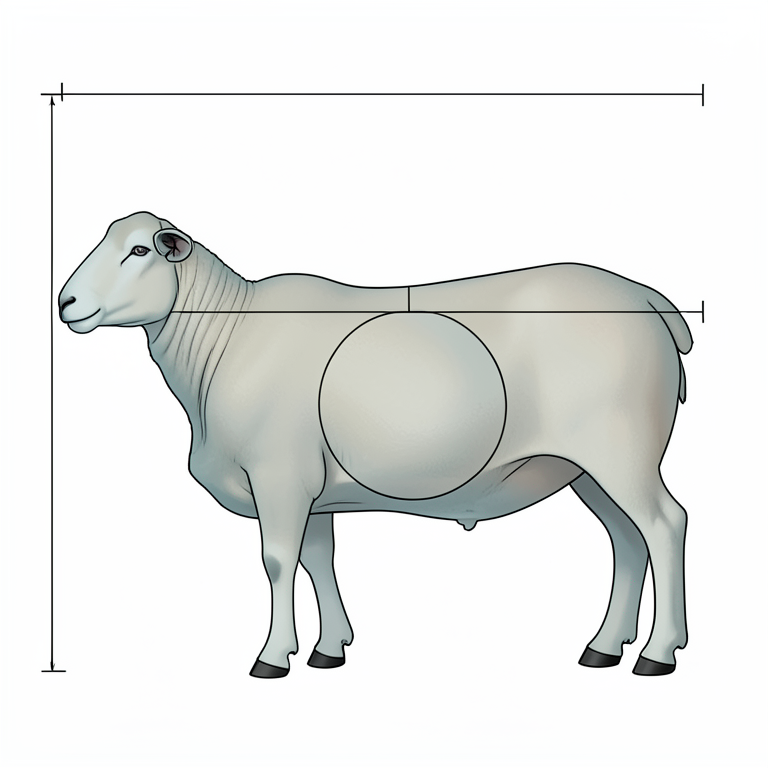
Body Measurement Points
AI-generated conceptual illustration (sheep). It explains the idea and does not show study data.
View source evidence ↗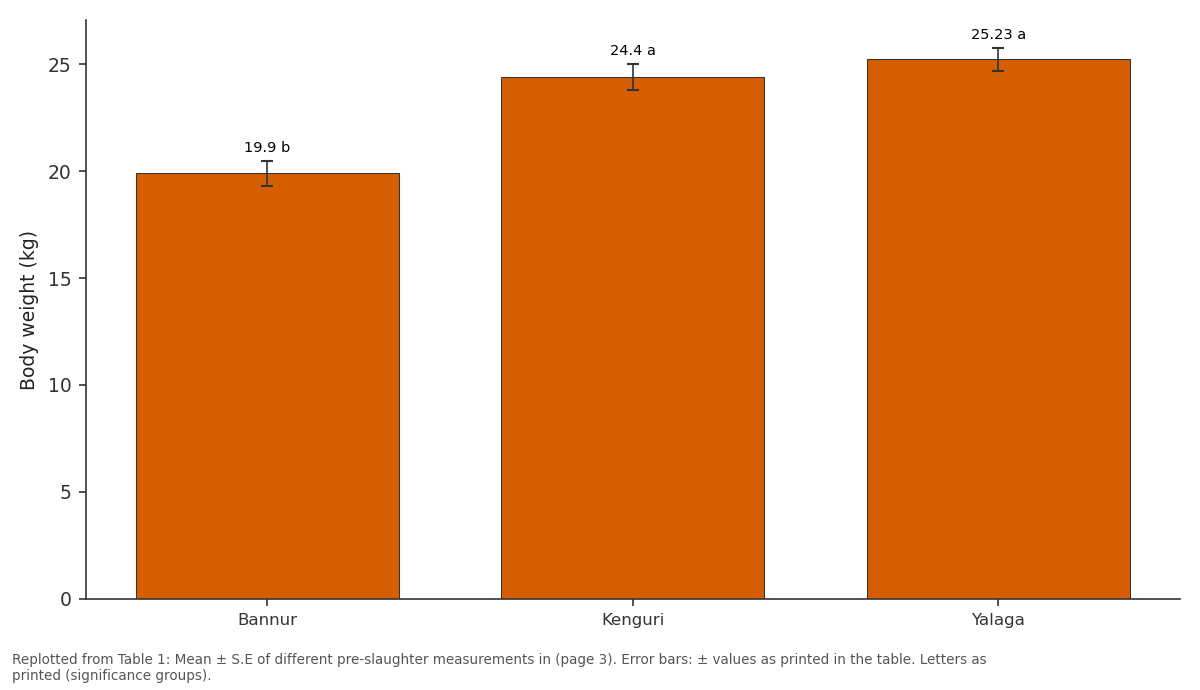
Body weight (kg): Bannur vs Kenguri vs Yalaga
Replotted from Table 1 (page 3) of the original paper. Every bar is the paper's own table value.
View source evidence ↗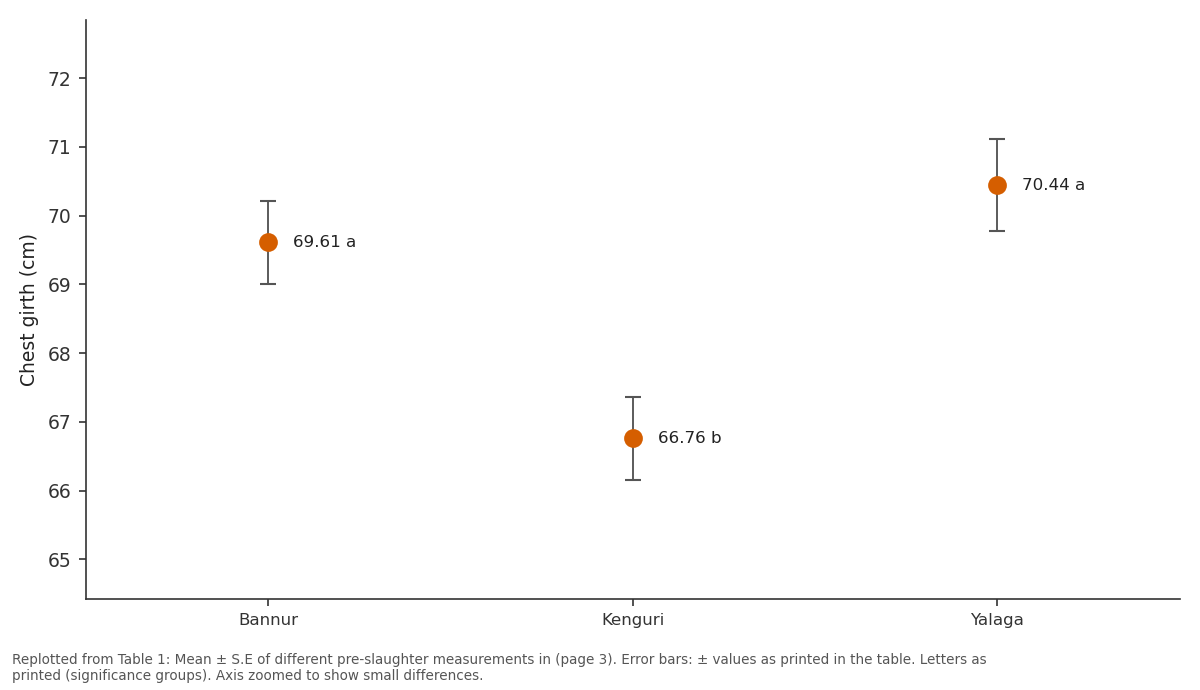
Chest girth (cm): Bannur vs Kenguri vs Yalaga
Replotted from Table 1 (page 3) of the original paper. Every bar is the paper's own table value.
View source evidence ↗Figures & tables
From the original paper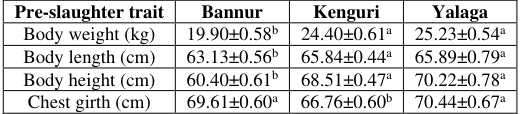 Table 1
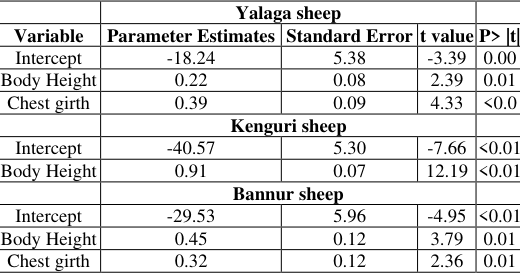 Table 2
 Table 3
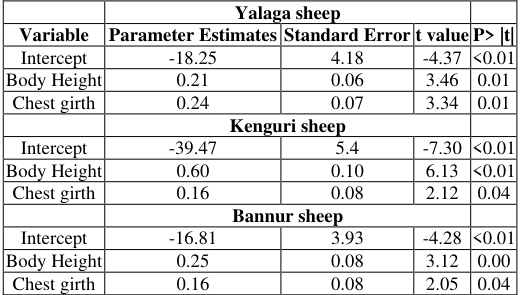 Table 4
 Table 5
Introduction
Sheep meat production is indispensable to meet protein needs of people throughout the world. Most scientific studies in relation to growth, one of the critical characteristics in sheep production, have been conducted to increase meat production per sheep. Information on body weight with several body measurements is necessary not only to monitor the growth of the sheep but also to estimate genetic correlations between body weight, dressed weight and body measurements. Besides, genetic and non-genetic components for the growth parameters must be estimated for improving better selection strategies relating to growth and development of sheep. Body weight is measured not only to evaluate carcass yield (Afolayan et al., 2006) [2] and condition of the animal as a selection criterion. Knowing the live body weight of small ruminants is important for a number of reasons, such as for breeding, correct feeding, health (Slippers et al., 2000) [40] and an indicator of breed standards (Pesmen and Yardimci, 2008) [33] , provides great convenience for the prediction of body weight without weigh bridges (Afolayan et al., 2006; Adeyinka, and Mohammed, 2006; Yakubu, 2009) [2,1] . Body measurements have been used to predict the body weight in small ruminant's studies in particular sheep and goat (Prasad et al., 1990; Aziz and Sharaby, 1993; Enevoldsen and Kristensen, 1997; Valdez et al., 1997; Atta and El Khidir, 2004 [43,28,27,8,34,16,46,40,15,25,35,33,27,2,7,45] . In recent years, there have been a great number of studies on the prediction of body weight from various body measurements taken at different growth periods of sheep (Afolayan et al., 2006; Kunene et al., 2009; Cam et al., 2010a) [15,21,6] and goat (Gul et al., 2005 [25,35,7] . Attempts have been made to arrive at a most probable body weight prediction equation for certain breeds of small ruminants (Das et al. 1990, Mishra et al. 1987) [8,24] for the study. In these studies, Generally, Pearson correlation and regression coefficients have been used to determine the bivariate relationships between body weight, dressed weight and various body measurements. For analysing multiple relationships among all traits, use of Multiple Regression Analysis (MRA) is the simple way to predict body and dressed weight using these body measurements. The present study involves the development of prediction equations for body weight (BW) and dressed weight (DW) based on body measurements like body height (BH), body length (BL) and chest girth (CG) in Yalaga, Kenguri and Bannur breeds of sheep. Yalaga, a tall non-descript breed of sheep found in the Bagalkote district of Karnataka. It is also known as the Belagi Kuri or Bili Kuri, having good morphometric traits with body weight (54.78±0.96kg), body height (86.29±0.49cm), body length (83.44±0.68cm) and chest girth (92.32±0.77cm) at the adult age group and had meat potentials (Dayanand, 2013) [9] . Kenguri is a proven mutton breed of Northern Karnataka found in the districts of Raichur, Koppal and Yadgir. Good morphological characters with body weight (52.6±0.86kg), body height (81.5±0.43cm), body length (74.7±0.45cm) and chest girth (89.4±0.54cm; Jain et al., 2013) at adult age were found with a population of 4.3 lakh in the country (Livestock census, 2012) [23] . Bannur, Southern mutton breed of Karnataka, a short and stocky breed with the morphological traits like body weight as 37.21±0.85kg, body length as 60.17±0.49cm, body height as 53.8±0.56cm and chest girth as 68.1±0.63 at adult age group which was found in the Mandya, Mysuru, Chamrajnagar and Bengaluru rural districts (Jain et al., 2014).
Materials and Methods
Materials and Methods
Location and Animals
The present study was conducted at Karnataka Meat and Poultry Marketing Corporation (KAMPCO), Bruhath Bengaluru Mahanagar Palike, Bengaluru and various mutton shops found at Bengaluru, where the farmers brought their animals Bannur, Kenguri and Yalaga for slaughter.
Data collection and Statistical analysis
Data for the present study was collected from 60 male animals each of Yalaga, Kenguri and Bannur, with the age group of 6-9 month. For our investigation, pre-slaughter traits such as body length (from point of shoulder to point of tuber ischii), body height (from the base of the fore-hoof to highest point of the withers), chest girth (around the thoracic cavity just behind the elbow joint) were taken by metal tape in centimetres (cm), and body weight was taken by the electronic weighing balance of 100kg capacity. Sheep age was estimated from its dentition pattern and varied from 6 to 8 milk teeth (FAO, 2012). Dressed weight was measured after the sacrifice of animals. The jugular vein was severed with a sharp knife for sheep sacrifice; head was removed at occipito-atlantal joint after complete discharge of blood. De-skinning was done and visceral organs (heart, kidney, lungs, trachea, liver and gut) were separated from the carcass. The remaining muscle and bone portion of the carcass was dressed weight, which will be taken in kilograms (kg) by electronic weighing balance of 100kg capacity. The linear relationship between bodyweight and dressed weight with body measurements was estimated using Pearson correlation coefficients. The dependent variable can be predicted by using regression model, based on lower Conceptual predictive criterion (Cp) and Akaike information criterion (AIC) and the high coefficient of determination (R 2 ) value to choose the best fit model. To predict the dressed weight (or carcass weight) and body weight from body measurements, linear-regression analysis was done by using Multiple Linear Regression Analysis by using SAS-9. The significance control for each regression coefficient was performed using a t-test statistic. The appropriateness of the multiple regression analysis was decided by the coefficient of determination (R 2 ), Conceptual predictive and Akaike information criterion.
Results and Discussion
The mean weight with standard error of Yalaga, Kenguri and Bannur sheep breeds were presented in the Table 1. The average body measurements were similar in Yalaga and Kenguri, except for chest girth and found significantly (p< 0.01) higher compared to Bannur except chest girth where it was showing non-significant difference with Yalaga sheep. The best fit models to predict the body weight were constructed using body measurements as dependent variables. Only those traits were significantly contributed to better fit were included in the model. Using these variables the predicted equations for the body weight and dressed weight in each sheep breed was given in [15] , Nellore ram 94.29% (Narasimha, 2002) [48] , Ganjam sheep 68% (6 months), 74% (9 months) and 72% (12-months; Nayak et al., 2008) [30] , Bannur sheep 90.18% (Nagraja et al., 1996) and in Zulu sheep 71% (Kunene et al., 2009) [21] . FAO have used height at withers as a prime indicator (Wilson, 1995) [49] . Atta and El Khadir (2004) [3] also reported an increased coefficient of determination based on curvilinear functions when estimating the live weight using heart girth of 2-8-month-old Nilotic sheep. Lawrence and Fowler (1997) [22] reported that the relationship between live weight (LW) and heart girth is curvilinear for animals growing over a wide weight range. Goe et al., (2001) [14] suggested that higher order polynomial equations are more appropriate for predicting the weight of growing animals. Although the use of wither height (WH) produced fairly good estimates (R 2 = 0.64-0.67) of LW for the sheep with milk set of teeth, these results indicate that more parameters would need to be added to WH to obtain a higher R 2 . Thiruvenkandan (2005) [44] obtained higher R 2 when he used WH and HG compared to the use of WH or HG alone to compute LW equation of 1-12months old Kanni-Adu goats in India.
| Pre-slaughter trait | Bannur | Kenguri | Yalaga |
|---|---|---|---|
| Body weight (kg) | 19.90±0.58b | 24.40±0.61a | 25.23±0.54a |
| Body length (cm) | 63.13±0.56b | 65.84±0.44a | 65.89±0.79a |
| Body height (cm) | 60.40±0.61b | 68.51±0.47a | 70.22±0.78a |
| Chest girth (cm) | 69.61±0.60a | 66.76±0.60b | 70.44±0.67a |
Table text extracted from the original PDF; superscript letters are shown inline. The original table image is below.
View original table image
As that of the body weight, dressed weight can also be predicted from body measurements based on the best fit model, which shows higher R [48] , Ganjam (Nayak et al., 2008) [30] , Zulu (Kunene et al., 2009) [21] , Muzaffarnagari (Bhadula et al., 1979) [15] , Karayaka (Cam et al., 2010b) [7] and Bannur sheep (Nagraja et al., 1996).
Conclusion
The study concludes that, similar body measurements were found in Yalaga and Kenguri and were found significantly (p< 0.01) higher than Bannur sheep except for chest girth
where it is non-significantly differ. However, only BH and CG showed significant (p< 0.01) results for prediction of body weight and dressed weight in both Yalaga and Bannur, but in Kenguri only BH showed significant results. At the same time, body length was non-significantly influencing the prediction of BW and DW in all three breeds of sheep viz. Yalaga, Kenguri and Bannur
Acknowledgement
AcknowledgementWe are grateful to the Dean of Veterinary College, Bidar, Karnataka, for providing necessary facilities and we are also thankful to the Dr Kanthraj, Assistant Director, KEMPCO, BBMP, Bengaluru for permitting me to make a note of various parameters for our study.
Figures and tables from the paper
| — | Yalaga sheep | — | — | — |
|---|---|---|---|---|
| Variable | Parameter Estimates | Standard Error | t value | P> |t| |
| Intercept | -18.24 | 5.38 | -3.39 | 0.00 |
| Body Height | 0.22 | 0.08 | 2.39 | 0.01 |
| Chest girth | 0.39 | 0.09 | 4.33 | <0.0 |
| Kenguri sheep | ||||
| Intercept | -40.57 | 5.30 | -7.66 | <0.01 |
| Body Height | 0.91 | 0.07 | 12.19 | <0.01 |
| Bannur sheep | ||||
| Intercept | -29.53 | 5.96 | -4.95 | <0.01 |
| Body Height | 0.45 | 0.12 | 3.79 | 0.01 |
| Chest girth | 0.32 | 0.12 | 2.36 | 0.01 |
Table text extracted from the original PDF; superscript letters are shown inline. The original table image is below.
View original table image
| Trait | Breed | Equation | R2 |
|---|---|---|---|
| Body weight | Bannur | BW= -29.53+ 0.45 (BH)+0.32 (CG) | 0.56 |
| Kenguri | BW= -40.57 + 0.91 (BH) | 0.72 | |
| Yalaga | BW= -18.24 + 0.22 (BH) +0.39 (CG) | 0.54 |
Table text extracted from the original PDF; superscript letters are shown inline. The original table image is below.
View original table image
| — | Yalaga sheep | — | — | — |
|---|---|---|---|---|
| Variable | Parameter Estimates | Standard Error | t value | P> |t| |
| Intercept | -18.25 | 4.18 | -4.37 | <0.01 |
| Body Height | 0.21 | 0.06 | 3.46 | 0.01 |
| Chest girth | 0.24 | 0.07 | 3.34 | 0.01 |
| Kenguri sheep | ||||
| Intercept | -39.47 | 5.4 | -7.30 | <0.01 |
| Body Height | 0.60 | 0.10 | 6.13 | <0.01 |
| Chest girth | 0.16 | 0.08 | 2.12 | 0.04 |
| Bannur sheep | ||||
| Intercept | -16.81 | 3.93 | -4.28 | <0.01 |
| Body Height | 0.25 | 0.08 | 3.12 | 0.00 |
| Chest girth | 0.16 | 0.08 | 2.05 | 0.04 |
Table text extracted from the original PDF; superscript letters are shown inline. The original table image is below.
View original table image
| Trait | Breed | Equation | R2 |
|---|---|---|---|
| Dressed weight | Bannur | DW= -16.81 + 0.25 (BH) + 0.16 (CG) | 0.46 |
| Kenguri | DW= - 39.47 + 0.60 (BH) +0.16 (CG) | 0.62 | |
| Yalaga | DW= -18.25 + 0.21 (BH) + 0.24 (CG) | 0.50 |
Table text extracted from the original PDF; superscript letters are shown inline. The original table image is below.
View original table image
References
49 in the original paper- Adeyinka IA, Mohammed ID. Relationship of live weight and linear body measurement in two breeds of goat of Northern Nigeria. Journal of Animal and Veterinary Advances. 2006; 5:891-893.
- Afolayan RA, Adeyinka IA, Lakpini CAM. The estimation of live weight from body measurements in Yankasa sheep. Czech Journal of Animal Science. 2006; 51:343-348.
- Atta M, El Khadir OA. Use of heart girth, wither height and scapula-ischial length for prediction of live weight of Nilotic sheep. Small Ruminants Research. 2004; 55:233237.
- Aziz MA, Sharaby MA. Collinearity as a problem in predicting body weight from body dimensions of Najdi sheep in Saudi Arabia. Small Ruminants Research. 1993; 12(2):117-124.
- Bhadula SK, Bhat PN, Garg RC. Prediction of body weight from body measurements in sheep. Indian Journal of Animal Science. 1979; 49(10):775-777.
- Das N, Joshi HB, Bisht GS. Prediction of body weight from body measurements in Barbari and Jamnapari goats reared under intensive management system. Indian Veterinary Journal. 1990; 67(4):347-351.
- Dayanand KC. Morphological characterization of Yalaga sheep. M.V.Sc. Thesis submitted to Karnataka Veterinary Animal and Fisheries Sciences University, Bidar, Karnataka, India, 2013.
- Edea Z, Haile A, Tibbo M, Sharma AK, Solkner J, Wurzingere M. Relationship of live body weight and other linear body measurements in two sheep breeds of Ethiopia, Climate change, livestock and people: Challenges, opportunities, and the way forward. in Proceedings of the 17 th Annual Conference of the Ethiopian Society for Animals, 2009, 105-112.
- Enevoldsen C, Kristensen T. Estimation of body weight from body size measurements and body condition scores in dairy cows. Journal of Dairy Science. 1997; 80(9):1988-1995.
- Food and Agriculture Organization, Rome, Italy. Phenotypic characterization of Animal Genetic Resources. Ed n 11 th , 2012, 95-106.
- Getachew T, Haile A, Tibb M, Sharma AK, Solkner J, Wurzingere M et al. Use of linear body measurements for performance recording and genetic evaluation of Menz and Afar sheep breeds under village condition, Climate change, livestock and people: Challenges, opportunities, and the way forward. Pages 113-122 Proceedings of the 17 th Annual Conference of the Ethiopian Society for Animals (ESAP) held in Addis Ababa, Ethiopia, 2009, 24-26.
- Goe MR, Alldrege JR, Light D. Use of heart girth to predict body weight of working oxen in the Ethopian highlands. Livestock Production Science. 2001; 69:187195.
- Gul S, Gorgulu O, Keskin M, Bicer O, Sari A. Some production equations of live weight from diffrent body measurements in Shami (Damascus) goats. Journal of Animal and Veterinary Advances. 2005; 4(5):532-534.
- Hassan A, Ciroma A. Bodyweight measurements relationship in Nigerian Red Sokoto goats. Department of Animal Science, Usmanu Danfodiyo University, Sokoto, Nigeria, 1990. http://www.fao.org/wairdocs/ilri/x5520b/x5520b1d.htm.
- Iqbal ZM. Relationship between live body weight and body measurements in Kajli sheep, M. Phil Thesis, Department of Livestock Production. University of Veterinary and Animal Sciences. Lahore, Pakistan, 2010, 20-40.
- Islam MR, Saadullah M, Howlider AR, Huq MA. Estimation of live weight and dressed carcass weight from different body measurements in goats. Indian Journal of Animal Science. 1991; 61:460-461.
- Khan H, Muhammad F, Ahmad R, Nawaz G, Rahimullah, Zubair M. Relationship of body weight with linear body measurements in goat. Journal of Agriculture and Biological Sciences. 2006; 1(3):51-54.
- Kunene N, Fossey A. A survey on livestock production in some traditional areas of Northern Kwazulu Natal in South Africa. Livestock Research Rural Development, 2006, 18(8). www.cipav.org.co/Irrd18/8/kune18113.html.
- Kunenea NW, Nesamvunib AE, Nsahlaic IV. Determination of prediction equations for estimating body weight of Zulu (Nguni) sheep. Small Ruminant Research. 2009; 84:41-46.
- Lawrence TL, Fowler VR. Growth of Farm Animals. CAB. International, Wallingford, Oxon, UK, 1997, 330.
- Livestock Census. 19 th Animal census report, Department of Animal Husbandry, Dairying and Fisheries. Government of India, 2012.
- Mishra RC, Mohant SC, Mishra M. Estimation of live and dressed weights of sheep from body measurements: A note. Indian Journal of Animal Production. 1987; 3:3739.
- Moaeen-ud-Din, Ahmad MN, Iqbal A, Abdullah M. Evaluation of diffirent formulas for weight estimation in Beetal, Teddi and crossbred (Beetal x Teddi) goats. The Journal of Animal and Plant Science. 2006; 16:3-4.
- Mohammad MT, Rafeeq M, Bajwa MA, Awan MA, Abbas F, Waheed A et al. Prediction of body weight from body measurements using regression tree (RT) method for indigenous sheep breeds in Balochistan. Pakistan Journal of Animal and Plant Science. 2012; 22(1):20-24.
- Mohammed ID, Amin JD. Estimating body weight from morphometric measurements of Sahel (Borno White) goats. Small Ruminants Research. 1997; 24(1):1-5.
- Mukherjee DK, Singh SK, Mishra HR. Phenotypic correlations of body weight with body measurements in grey Bengal goats. Indian Journal of Animal Science. 1981; 51:682-694.
- Musa AM, Idam NZ, Elamin KM. Heart Girth Reflect Live Body Weight in Sudanese Shogur Sheep under Field Conditions. World Veterinary Journal. 2012; 2(4):54-56.
- Nayak S, Sahu G, Mohapatra AK. Study on management practices, phenotypic and reproductive characteristics of Ganjam sheep under range conditions of Orissa. SAARC Journal of Agriculture. 2008; 6(2):93-106.
- Oke UK, Ogbonnaya EO. Application of Physical Body Traits in the Assessment of Breed and Performance of WAD Sheep in a Humid Tropical Environment. Livestock Research for Rural Development, 2011, 23(24).
- Otoikhian CSO, Otoikhian AM, Akporhuarho OP, Isidahoman C. Correlation of body weight and some body measurement parameters in Quda sheep under extensive management system. African Journal of Genetics and Agriculture. 2008; 4(3):129-133.
- Pesmen G, Yardimci M. Estimating the live weight using some body measurements in Saanen goats. Archiva Zootechnica. 2008; 11(4):30-40.
- Prasad RDD, Madhava Rao T, Charyulu EK, Munirathnam D. Note on the prediction of body weights based on body measurements in Nellore sheep. Cheiron. 1990; 19(6):275-277.
- Rahman F. Prediction of carcass weight from the body characteristics of black Goats. International Journal of Agriculture and Biology. 2007; 9(3):431-434.
- Ravimurugan T, Thiruvenkadan AK, Sudhakar K, Panneerselvam S, Elango A. The Estimation of Body Weight from Body Measurements in Kilakarsal Sheep of Tamil Nadu India. Iranian Journal of Applied and Animal Sciences. 2013; 3(2):357-360.
- Riva J, Rizzi R, Marelli S, Cavalchini LG. Body measurements in Bergamasca sheep. Small Ruminants Research. 2004; 55(1):221-227.
- Shirzeyli SH, Lavvaf A, Asadi A. Estimation of body weight from body measurements in four breeds of Iranian sheep. Songklanakarin. Journal of Science and Technology. 2013; 35(5):507-511.
- Singh PN, Mishra AK. Prediction of body weight using conformation traits in Barbari goats. Indian Journal of small Ruminants. 2004; 10(2):173.
- Slippers SC, Letty BA, De Villiers JF. Prediction of the body weight of Nguni goats. South African Journal of Animal Science. 2000; 30(1):127-128.
- Sowande OS, Sobola OS. Body measurements of West African dwarf sheep as parameters for estimation of live weight. Tropical Animal Health Production. 2008; 40(6):433-439.
- Tadesse A, Gebremariam T. Application of Linear Body Measurements for Live Body Weight Estimation of Highland Sheep in Tigray Region, North-Ethiopia. Journal of the Dry Lands. 2010; 3(2):203-207.
- Tandon HS. Relationship of body weight with body measurements in Beetal goat. Indian Journal of Dairy Science. 1965; 18:1987-1990.
- Thiruvenkandan AK. Determination of best-fitted regression model for estimation of bodyweight in KanniAdu kids under farmer's management system. Livestock Rural Development. 2005; 17(7):365-367.
- Tsegaye D, Belay B, Haile A. Linear Body Measurements as Predictor of Body Weight in Hararghe Highland Goats under Farmers Environment Ethiopia. Global Veterinaria. 2013; 11(5):649-656.
- Ulaganathan V, Krishnappa K, Shanmugasundaram S. Prediction of body weight from linear body measurements in local goats. Indian Journal of Animal Genetics Breed. 1992; 14(2):31-32.
- Valdez CA, Tupas DGA, Matias JB. Determination of body weight in sheep using external body measurements. Philippine Journal of Veterinary Medicine. 1997; 34:2531.
- Vimal Selvaraj, Ramesh Kumar T, Senthil Nathaw R, Meenakshisundaram S, Gajendraw K. Prediction of body weight from body measurements in Madras Red sheep. Indian Journal of Animal Sciences. 2002; 72(2):180-181.
- Wilson TR. Livestock Production Systems: The Tropical Agriculturalist. Macmillan Education. Nairobi, Kenya, 1995.
- Yakubu A. Fixing collinearity instability in the estimation of body weight from morphobiometrical traits of West African dwarf goats. Trakia Journal of Science. 2009; 7:61-66.
- Younas U, Abdullah M, Bhatti JA, Pasha TN, Ahmad N, Nasir M et al. Inter-relationship of body weight with linear body measurements in Hissardale sheep at different stages of life. Journal of Animal and Plant Science. 2013; 23(1):40-44.
Cited by 6
From OpenAlex, OpenCitations and reference lists read by Scinovex
- Non-Intrusive Fish Weight Estimation in Turbid Water Using Deep Learning and Regression Models ↗
Naruephorn Tengtrairat, Wai Lok Woo, Phetcharat Parathai, Damrongsak Rinchumphu, Chatchawan Chaichana · Sensors · 2022
Underwater fish monitoring is the one of the most challenging problems for efficiently feeding and harvesting fish, while still being environmentally friendly. The proposed 2D computer vision method is aimed at non-intrusively estimating the weight of Tilapia fish in turbid water environments. Additionally, the proposed method avoids the issue of using high-cost stereo cameras and instead uses only a low-cost…
❝ 40PDF - Weighing live sheep using computer vision techniques and regression machine learning ↗
Diego André Sant’Ana, Marcio Carneiro Brito Pache, José Augusto Correa Martins, Wellington Pereira Soares, Sebastião Lucas Neves de Melo, Vanir Garcia et al. · Machine Learning with Applications · 2021
This research arose from the need to aggregate computer vision technology and machine learning in sheep weight control and facilitate the weighing process of animals in farms. The experiment was conducted to collect the images of the animals and their weights, and later, the annotations of the images were made, generating a mask image dataset. We selected the attribute extraction…
❝ 40PDF - Samsun ili koyun işletmelerinde üreme performansı ve et üretim potansiyeli ↗
Mehmet Ali Güntay, Mehmet Akif Çam · ANADOLU JOURNAL OF AGRICULTURAL SCIENCES · 2024
Bu çalışmada Samsun ilindeki 3508 küçükbaş hayvancılık işletmesindeki koyunların kuzulama oranı (KO), ikizlik oranı (İO), kuzu verimi (KV) ve koç altı koyun başına kuzu sayısı (doğumda sürü kuzu üretimi; DSKÜ) gibi üreme performansı kriterlerinin ve koyun eti üretim potansiyelinin belirlenmesi amaçlanmıştır. Çalışma, 2019-2020 yıllarında Samsun ilinin merkez ve ilçelerindeki 86 üretici ile yüz yüze anket yapılarak yürütülmüştür. Ankete alınan işletmeler,…
❝ 2PDF - Application of Biometric Traits for Predicting Weaning Weight of Dorper Sheep using Path Analysis ↗
International Journal of Veterinary Science · 2021
The current study was conducted to examine the relationship between weaning weight and biometric traits viz; heart girth (HG), rump height (RH), body length (BL), withers height (WH) and sternum height (SH) and, also to determine direct and indirect influence of biometric traits on weaning weight (WW) of Dorper sheep. Dorper sheep lambs (females=23, males=16) were used. Pearson’s correlation and…
❝ 2PDF - Genetics of some reproduction traits in some sheep breeds from India: A review ↗
Mubashir Ali Rather, Ambreen Hamadani, Syed Shanaz, Safeer Alam, Aadil Ayaz, Mir Shabir et al. · Journal of Entomology and Zoology Studies · 2020
Sheep farming is a major source of income for small and marginal farmers of the country besides providing nutritional security during crises. Sheep constitute an important AnGR (Animal Genetic Resource) of the country. For any sheep improvement program, reproductive traits are essential. However, compared with production traits such as growth and wool traits, reproduction traits have received very little emphasis
- Morphometric measurement of hog plum leaf beetle Podontia 14-punctata (Chrysomelidae: Coleoptera) ↗
Akata Rani, Fatematuzzjohora, Abdul Ahad · Acta Entomology and Zoology · 2021
The objective of this article is to find out the morphometric measurement of Hog Plum Leaf Beetle Podontia 14-punctata (Chrysomelidae: Coleoptera). The result showed that the mean length and breadth of the 1st, 2nd, 3rd, 4th instars larvae were 1.93, 10.02, 12.0, 20.42 mm and 0.99, 1.48, 3.41, 6.55 mm respectively and the weight were 4.367, 24.695, 75.282, 315.7 mg…
❝ 0PDF