
Research article · 2019 · Full text
International Journal of Biology SciencesAssessment on the diversity of mosquitoes found in dumpsites of Gashua metropolis, bade local government area, Yobe state, north-Esatern, Nigeria
Volume 1(2) · Pages 19–24 · DOI: 10.33545/26649926.2019.v1.i2a.12 ↗
Research areasMosquito-borne diseases and control
Abstract
Author-writtenThe study on the assessment on the diversity of mosquitoes found in dumpsites of Gashua metropolis was carried out from the period of May to August, 2019. A total of one hundred and fifteen (115) mosquito larvae and one hundred and sixty two (162) adult mosquitoes from five different sites were identified. For the mosquito larvae, Culex species has a total percentage of 66.96%, Anopheles species has 26.09% and Aedesspecies has the least percentage of 6.95%. However the male and female mosquito’s species were also identified from the adult’s samples collected and culex male has a percentage of 16.67%, Culex female has a percentage of 38.27%, anopheles female has a percentage of 29.01% and anopheles male species has the least percentage of 16.05%. However, out of the total samples of mosquito’s larvae and adults collected, Culex species has the highest percentage in all the sampling sites and Aedes species has the least percentage, this shows that dominating mosquito species found in Gashua metropolis are the Culex mosquito species.
Summary
Source-checkedPlain-language reading of the full paper, prepared with AI and checked against the text. Each point links to the authors' own words.
Why it matters
- Waste dumps are considered potential environments where disease vectors can survive and multiply. View evidence ↗
- Mosquitoes serve as vectors for various human pathogens, including bacteria, viruses, protozoa, and helminthes. View evidence ↗
- Different mosquito genera transmit specific diseases: Anopheles transmits malaria and filariasis, Aedes transmits yellow fever and dengue, and Culex transmits filarial worms causing elephantiasis. View evidence ↗
The question
- The study aimed to assess the diversity of mosquitoes found in the dumpsites of Gashua metropolis between May and August 2019. View evidence ↗
What they did
- The researchers identified 115 mosquito larvae and 162 adult mosquitoes collected from five different sites. View evidence ↗
- Larvae were collected from the sites using a dipper with a telescoping handle. View evidence ↗
- Mosquitoes were identified to the species level using microscopy and established taxonomic keys. View evidence ↗
What they found
- Among the larvae, Culex species were the most common at 66.96%, followed by Anopheles at 26.09%, and Aedes at 6.95%. View evidence ↗
- Among adult mosquitoes, female Culex had the highest overall occurrence at 38.27%, while male Anopheles had the lowest at 16.05%. View evidence ↗
- Culex species dominated all sampling sites for both larvae and adults, while Aedes species were the least frequent. View evidence ↗
- Culex species recorded the highest percentages across all five sites, peaking at 15.65% in Katuzu. View evidence ↗
- The analysis found no association between precipitation levels and the abundance of mosquitoes. View evidence ↗
What it means
- The authors conclude that unsanitary environments like waste dumps contribute to the survival of pathogens and impact urban public health. View evidence ↗
- The authors state a need for further exploration of the relationship between waste and malaria to develop better intervention strategies. View evidence ↗
Visual summary
3 visualsIllustrations explain the paper; charts are replotted from the paper's own table values.
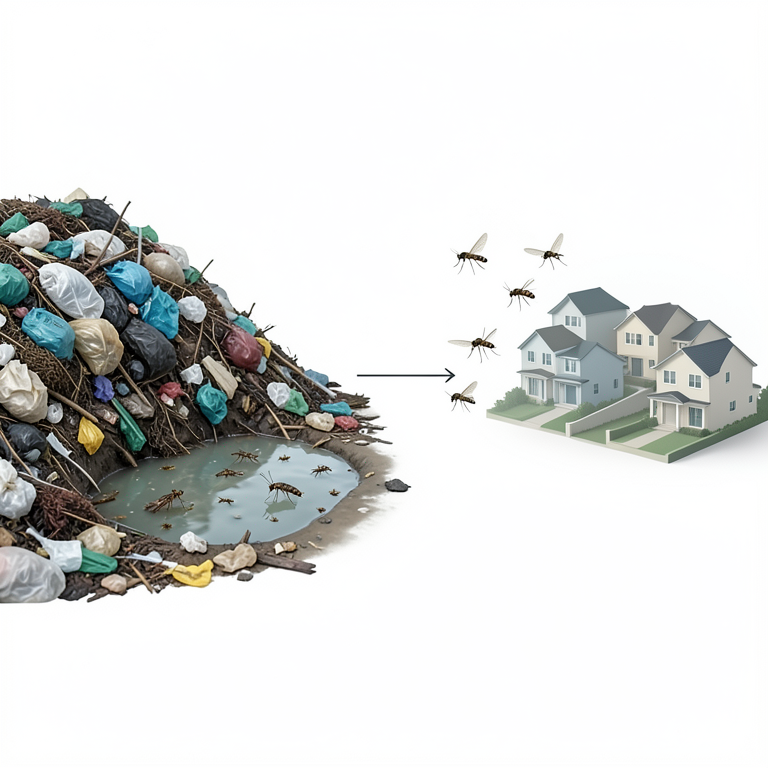
Waste-Vector Cycle
AI-generated conceptual illustration (Anopheles and Culex mosquitoes in a municipal waste dumpsite). It explains the idea and does not show study data.
View source evidence ↗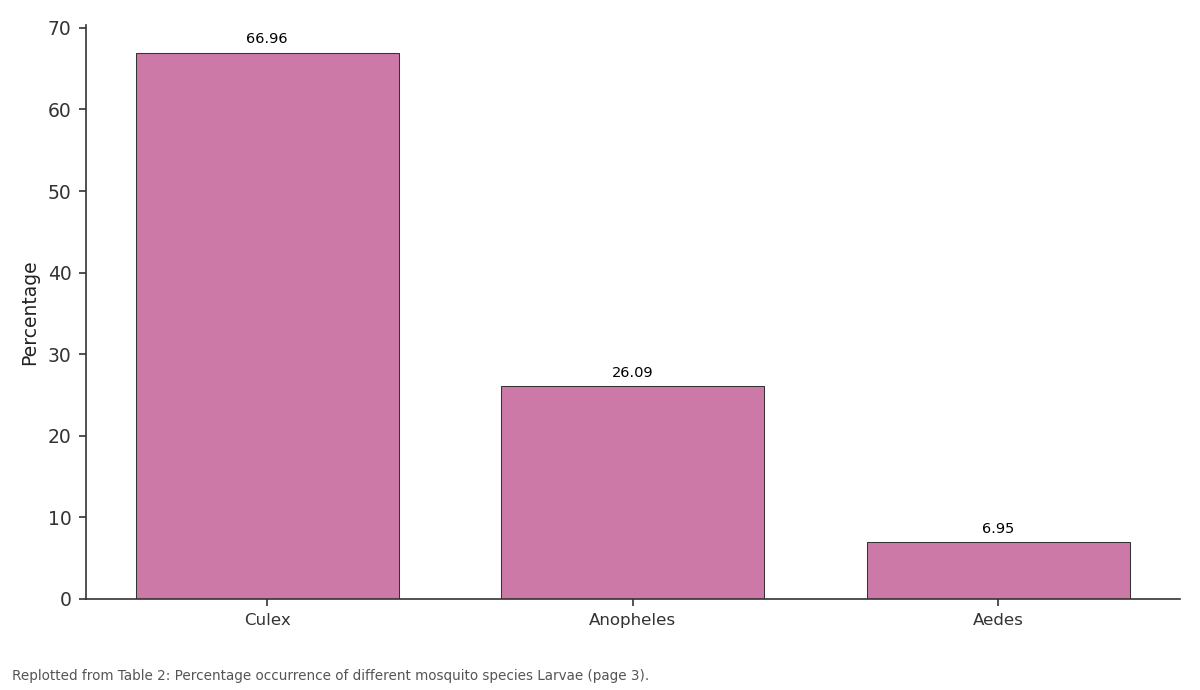
Percentage: Culex vs Anopheles vs Aedes
Replotted from Table 2 (page 3) of the original paper. Every bar is the paper's own table value.
View source evidence ↗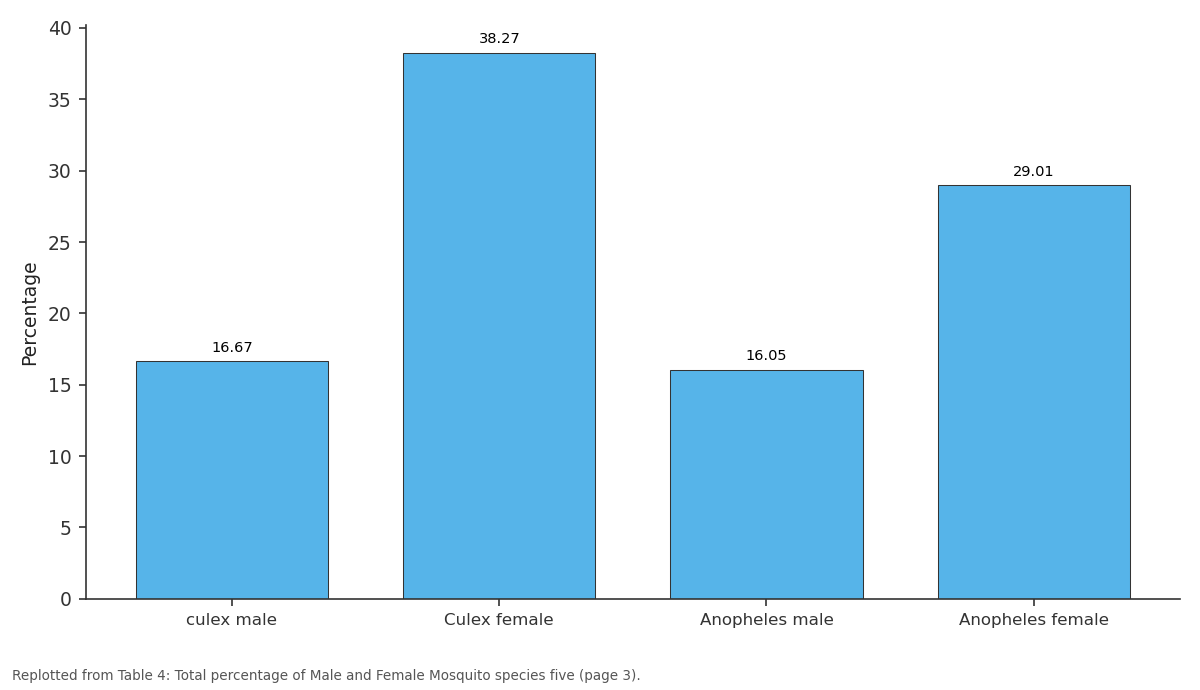
Percentage: culex male vs Culex female vs Anopheles male vs Anopheles female
Replotted from Table 4 (page 3) of the original paper. Every bar is the paper's own table value.
View source evidence ↗Figures & tables
From the original paper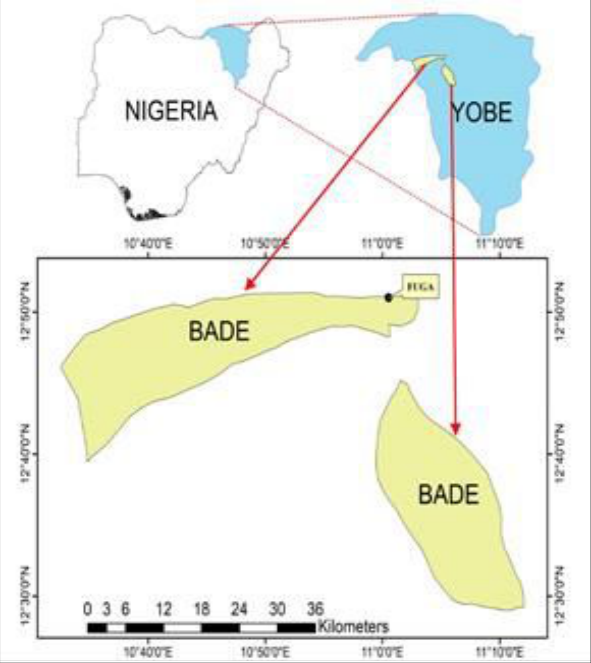 Figure 1
 Table 2
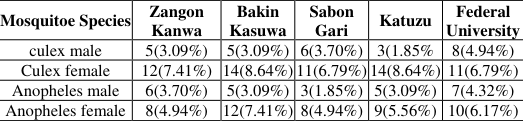 Table 3
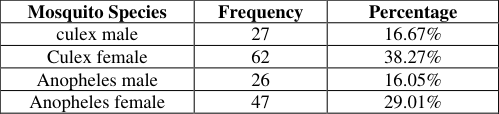 Table 4
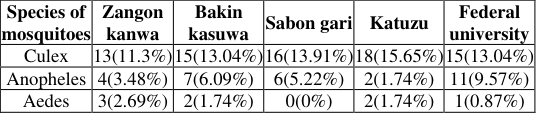 Table 1
Introduction
The continued function and survival of any human society is dependent, for a large extent on its adaptability and resilience to environmental events (Young and Berlaut, 2006). As globalization accelerates the rate and spatial scale of human environment interacting, the distinction between natural and man-made disasters becomes blurred (Pezzzoli and Turkey, 2007) [32] . The human environment interaction had led to the modification of landscapes in a process called urbanization and thus has greatly impacted on the health of the environment and not humanization. Some authorities argue that exposure to different sources of pollution can aggravate health problem especially among the most vulnerable group (Gren et al., 2001; Wang et al., 2006 and Blatia, 2009) [41] . Others specifically posit that waste dumps could provide conditions in which disease vectors could persist and reproduce (Weidong et al., 2006; Sogoba et al., 2007) although this depends o waste constituent, environmental conditions, age of the dumps and waste management practices (Tony, 1978; Swan et al., 2002) [39] . Mosquitoes are viscous biters and their bite constitute biting nuisance, allergic reactions, slain irritations, scratching restlessness and sleepless nights (Amusan, et al., 2005; Onyido et al., 2009) [3,26] . Some bite during the day while others bite at the night or at both night and day periods. Through their blood sucking habits, they act as vectors of a variety of human pathogens including viruses, bacteria, protozoa and helminthes diseases. They transmit to man such deadly disease as malaria, yellow fever, filariasis, dengue and various forms of viral encephalitis (Ulapai and Ajolau, 2003), the anopheles mosquitoes especially, Anopheles gambiae, transmit malaria and filariasis. The aedes mosquito particularly Aedes aegypti, albopictus, Ae africaplus, Ae luteocephalis and Ae. simponi transmit yellow fever, dengue, haemarlagi fever and various forms of viral encephalitis. The Culex mosquito particularly culex quingufasciatus are very important transmitters of filarial worms especially Wuchereria which causes elephantiasis. They also transmit various forms of viral encephalitis (Onyido et al., 2009) [27] . Mosquitoes also bite livestock and transmit some disease of veterinary importance like fowl pee disease of poultry, myxomatos of rabbits, sift valley fever of sheep, encephalitiees of horses and heat worm disease of dogs (Service, 1980) [33] . All these medical and somatic disease cause high death toll on both human and animal populations and lead to poor socio economic development of many countries. Mosquitoes which are strong fliers with long, stylet shaped proboscis for piercing the skin of their hosts and sucking bood are majorly responsible for causing malaria infection, hunting for their hosts both indoors and outdoors (Gordon and Lavoipiene 1976). This disease is caused by the bite of an infected female Anopheles mosquitoes which transmit the lasmodium sporozoite into the human blodstrea, fromthere it travelsl to othe liver, where it grows and multiplies from a period of 8 days to seven months and even years (Afolabi, 2006) [22] . DOI: https://doi.org/10.33545/26649926.2019.v1.i2a.12 , 1998). Worldwide there are over 500 species of anopheles mosquitoes, but fewer than 50 are considered competent malaria vectors. Many vector species are polymorphic. In some cases, sharply contrasting forms are found in different geographic areas or in differing ecological circumstances and one population may be of much greater importance as a malaria vector than its subtle differing neighbour. A number of studies have investigated that incidence of malaria all over the world (Gerritsen et al., 2008) [9] it is estimated that the annual death resulting from this disease is between 1. [37,13,22] . Much attention was focused on the pregnant women and children due to their high vulnerability and exposure to conditions that cause malaria, added to the increasing resistance of malaria parasite to modern drugs (Hemingway, 1999; Jumbo et al., 2001 and Orasanya et al., 2007) [12,15,28] . Malaria is holoendemic in Nigeria as high intensity transmission occurs all year round, with rates of transmission higher in the wet season than in the dry season, and with more victims in the southern than in the Northern part. (Okogun, 2003) [24] , there is limited evidence from the results of all these studies to suggest that the breeding and multiplication of mosquitoes on solid waste dumps can lead to increase in the incidence of malaria.
Materials and Methods
Materials and Methods
Study
Study
Collection of sample
Mosquito larvae were captured using a dipper with telescoping handle by dipping the dipper in the located area. The larvae were placed in a container that was labeled base on the located areas of sample collection and taken to the laboratory for further processing.
Processing, Examination and Identification of Mosquitoes species
The study sample (Mosquitoes) were processed by making a protective larvae cage in the laboratory and placing the containers inside under favourable environmental condition where the larvae were fed and control in order to grow.
The study was done by carrying out a wet preparation of the sample under X10 or X40 lens objective of the microscope. Illumination by transmitted light was adjusted so that the glands will show up clearly against the background. A shute's needle was held in the left hand and placed flat across the thorax. Very gentle pressure was exerted which caused the two trilobed salivary glands to pop out from the end of the neck. It may also be accompanied by fat globules, some muscle fibres and other tissues. When the glands were located under X10 objective lens of the microscope, it was freed from the debris and pulled to the edge of the slide. A drop of saline solution was added and a cover slip was gently placed on it.
The glands were pressed down on the cover slip with a dissecting needle. The ruptured gland was then examined under X40 objective lens of the microscope for the sickleshaped motile sporozoites. The Mosquitoes were identified microscopically with the aid of published keys by Hopkin (1952). Similarly, the taxonomic keys of (Gillies and De Meillon, 1968; Gillies and Coetzee, 1987) were used to identify the various mosquitoes to species level. The identification was based on gross external morphological features, appearance of the antennae, palps, proboscis, thorax, terminal abdominal segments, wings, colour of hind legs and striations on the body.
Results
Results
Mosquitoes examined
From the sample collected, One hundred and fifteen (115) mosquito larvae were obtained from five sites: zangon Kanwa, Katuzu, federal university Gashua, Sabon Gari and Bakin Kasuwa. And 162 adult mosquitoes were also obtained from the sites.
Percentage occurence of different Mosquitoes species
From the five (5) sampling sites, in Zangon Kanwa, culex spp had the highest percentage of 11.30% while Aedes spp had the lowest percentage of 2.69%. From bakin kasuwa, culex recorded the highest percentage of 13.04% while Aedes had the lowest of 1.74%. The highest percentage of 13.91% in sabon gari was recorded by culex spp while Aedes spp was not found in this sites from katuzu and federal university Gashua, cukex recorded the highest percentage of 15.65% and 13.04% respectively, while Aedes recorded the lowest in both sites.
Total
From the result in table 2, the highest percentage of larvae from the overall sampling sites was recorded by culex spp 66.96% while Aedes had the lowest percentage of 6.95% Percentage of occurrence of male and female mosquito's species From the five (5) sampling sites, in zangon James the culex female app has the highest percentage of 7.41% while culex male has the lowest percentage of 3.09%. From bakin kasuwa culex female has the highest percentage of 8.64% while anopheles and culex males has the lowest percentage of 3.09% each. Also, in sabon gari culex female has the highest percentage of 6.79% while male anopheles has the lowest percentage of 1.85%. In katuzu, the female culex has the highest percentage of 8.64% while the male culex has the lowest percentage of 1.85%. In federal university Gashua, female culex has the highest percentage of 6.79% while the male anopheles has the lowest percentage of 4.32%. From the result in table 4. The highest percentage of male and female mosquito's species from overall sampling sites was recorded by female culex species with 38.27%. While anopheles male had the lowest percentage of 16.05%.
| Mosquito Species | Frequency | Percentage |
|---|---|---|
| culex male | 27 | 16.67% |
| Culex female | 62 | 38.27% |
| Anopheles male | 26 | 16.05% |
| Anopheles female | 47 | 29.01% |
Table text extracted from the original PDF; superscript letters are shown inline. The original table image is below.
View original table image
| Species of Mosquitoes | Frequency | Percentage |
|---|---|---|
| Culex | 77 | 66.96% |
| Anopheles | 30 | 26.09% |
| Aedes | 8 | 6.95% |
Table text extracted from the original PDF; superscript letters are shown inline. The original table image is below.
View original table image
Conclusion
The study is one of the evidence that support the argument that exposure to unsanitary environment such as waste dumps, can contribute to urban public health and survival of pathogen of related diseases. It is of public health concern because most of the species of mosquitoes encountered have been incriminated in the transmission of one form of disease or the other. The case study is nonetheless, a clear demonstration that accumulation of solid wastes in proximity to residential areas constitutes a pathway of many vector based diseases including malaria. There is great need to further explore the waste-malaria padigm in environmental health studies with the view to developing new strategies for intervention and prevention of this disease. Ultimately, the promotion of the urban cleanliness and effective management of municipal wastes may be the most sustainable strategies to "Roll Back Malaria" in Nigerian urban areas in the years ahead. Most efforts of government towards the controlling of the vector of malaria are yet yield a positive results, and to achieve this, a detailed ecological knowledge of these mosquitoes will be of great assistance especially at the local levels.
Recommendations
Gashua town is an endermic zone for the spread of mosquitoes and therefore the following recommendations are proposed: a. Identifying the sibling species of the mosquitoes b. Carefully locating and identifying their breeding sites c. Regular and frequent sanitation exercises such as clearing of bushy environments, and proper waste disposal should be encouraged. d. Adequate fundings to all levels of government for proper mosquito control. e. Ecological knowledge and behaviour of the vectors of malaria would greatly assist in their total eradication. This is because the source from which malaria vectors disperse may change seasonally within the year as breeding sites dry out or are created (Carter and coluzzi, 2013). This information calls for all stake holders involved in the concerted effort of malaria vector control to pay particular attention to the indigenes of Gashua in Bade L. G. A in order to come up with measures that will ensure little risk of exposure to malaria infection. f. Mass awareness of personal hygiene should be created via the media (Radio. IV. Bill boards, Newspaper, etc).
Figures and tables from the paper
| Mosquitoe Species | Zangon Kanwa | Bakin Kasuwa | Sabon Gari | Katuzu | Federal University |
|---|---|---|---|---|---|
| culex male | 5(3.09%) | 5(3.09%) | 6(3.70%) | 3(1.85% | 8(4.94%) |
| Culex female | 12(7.41%) | 14(8.64%) | 11(6.79%) | 14(8.64%) | 11(6.79%) |
| Anopheles male | 6(3.70%) | 5(3.09%) | 3(1.85%) | 5(3.09%) | 7(4.32%) |
| Anopheles female | 8(4.94%) | 12(7.41%) | 8(4.94%) | 9(5.56%) | 10(6.17%) |
Table text extracted from the original PDF; superscript letters are shown inline. The original table image is below.
View original table image
| Species of mosquitoes | Zangon kanwa | Bakin kasuwa | Sabon gari | Katuzu | Federal university |
|---|---|---|---|---|---|
| Culex | 13(11.3%) | 15(13.04%) | 16(13.91%) | 18(15.65%) | 15(13.04%) |
| Anopheles | 4(3.48%) | 7(6.09%) | 6(5.22%) | 2(1.74%) | 11(9.57%) |
| Aedes | 3(2.69%) | 2(1.74%) | 0(0%) | 2(1.74%) | 1(0.87%) |
Table text extracted from the original PDF; superscript letters are shown inline. The original table image is below.
View original table image
References
37 in the original paper- Abubakar AD. Survey of mosquito abundance and breeding habitat in yabo local government area of sokoto state Nigeria, 2010.
- Afolabi B. why malaria is more deadly in Nigeria. Pharmanews. 2006; 28(5):1-6.
- Amusan AAS, Mafiana CF, Idowu Olantunde GO. Sampling mosquito with CDC light-traps In rice field and plantation communities in ogun state Nigeria. Tanzania health res bull. 2005; 7:111-6.
- Awolola TS, Ibrahim K, Okorie T, Koekemoer LL, Hunt Coetzee M. Species composition and biting activities of anthropophilic anopheles mosquitoes and their role in malaria transmission in a holoendemic area of southwestern Nigeria. Afr Entomol. 2003; 11(2):227-32.
- Beier JC, Vanderberg JP. Sporogonic Development in mosquito in malaria: parasite Biology, Pathogenesis, and protection, Edited by Sherman, I. W., ASM press, Washigton DC, 1998, pp49-61.
- Bensensky NI. Complexities in the analysis of cryptic taxa within the genus anopheles, parasitologia. 1999; 41:97-100.
- Bradshaw WE, holzapfel CM. genetic shft in photoperiodic response correlated with global warming. Proceeding of the national academy of sciences. 2001; 98(25):14509-14511.
- Bruce-chwatt II. Essential malariology. Williams Heinemann med books Etd, London, uk, 1980.
- Gerritsen AA, Kruger P, leoff MFS, Grobuse MP. Malaria incidence in Limpopo province, South Africa 1998-2007. Malaria journal, 2008, 7:el67.
- Goma LKH. The mosquito: Hutchinson & co. ltd. London, 1966.
- Gordon RM, lavoipirre MMJ. Entomology for students of medicine 4 th printing, Blackwell scientific publication, Oxford, 1976, 353p.
- Hemingway J. Insecticide resistance in malaria vectors: a new approach to an old subject. parasitologia. 1999; 41:515-518.
- Ikhisemoge T. Health encyclopedia: diseases and conditions; a seminar on new trends of malaria management in Nigeria, pharmanews, 2006.
- Johansson EW, Renshaw M, Wardlaw T. malaria and children progress intervention. New york. United Nations children's fund (UNICEF) Report, 2009.
- Jumbo GTA, Mbaawuaga EM, Anongu SU, Egar DZ, Peters EJ. The burden of malaria among under-five children. Findings from markurdi city, north central Nigeria. 2001; I(3):140-144.
- Khan JS, Usman M, Abbass Y, Hussain M, Ali M. Knowledge, attitude and practice study on malaria. Gomal journal of medical sciences. 2010; 8(2):204-208.
- Killeen GF, Smith TA, Ferguson HM, Mshinda H, Abdulla S. Preventing childhood malaria in Africa by protecting adults from mosquitoes with insecticides treated nets PLOS med. 2007; 4(7):229.
- Kinunghi SM, Mashauri F, Nwanga JR, Nnko SE, kaatano GM, Malima R. et al. Knowledge, attitudes, and practices about malaria among communities: comparing epidemic and non-epidemic prone communities of muleba district, northwestern Tanzania. BMC public health, 2010.
- Lucas, gilles malaria: short textbook on public health medicine for the tropics. India, Arnold publication, 2002.
- Moorthy VS, Reed Z, smith PG. Measurement of malaria vaccine efficiency in phase 111 trials: reports of a WHO consultation vaccine. 2007; 25:5115-5123
- Moucchet carnevale P, Julvez M, Manguin J, Richardlenole SD, Sircoulon J. Biodiversite du paludismedans le monde. John libby eurotext, paris, france, 2004.
- Okogun GRA. Ecology; biology of anopheles mosquitoes and prevalence transmission intensity of malaria in midwest Nigeria, Doctoral dessartation in med. Parasitology. imo state uni, owerri, 2003, P272.
- Onyabe DY, Conn JE. Population genetics structures of the malaria mosquito anopheles arabiensis across Nigeria suggests range expansion. Molecular ecology. 2001; 10(11):2577-2501
- Orasanya OB, Honshen M, Sofola OT. Utilization of insecticide treated net by under-five children in Nigeria: assessing progress towards the Abuja targets. Malaria journal, 2007, 2:145.
- Oyewale IO, Ibidapo AC. Attitude to malaria, prevention, treatment and management strategies associated with the prevalence of malaria in a nigerian urban centre. African journal of biotechnology. 2007; 6(21):2424-2427.
- Paskewitz SM, Wesson DM, Collins FH. The internal transcribed spacer of ribosomal DNA in five members of anophelesgambie species complex. insect molecular biology. 1993; 2:247-257.
- Peterson CN, Day S, Wolfe BE, Ellison AM, Kolter R, Pringle A. et al. A Keystone predator controls bacterial diversity in the pitcher-plant (sarraceniapurpurea) microecosystem. Environmental microbiology. 2008; 10(9):2257-2266.
- Pezzoli K, Turkey R. The NIEHS Environmental health sciences data resources portal: place advance technology in service of vulnerable communities; environmental health perspectives. 2007; 115(4):564-571.
- Service MW. The ecology of the mosquitoes of the northern guinea savannah of Nigeria, Bull. Ent. Res. 1963; 54:601-32.
- Service MW. A guide in medical entomology (macmillan tropical and subtropical medical texts). Macmillan international college editions, London, basing stoke, 1980, 226.
- Sharma AK, Bhasin S, Chaturvedi S. Predictors of knowledge about malaria in india. Journal on vector borne disease. 2007; 44:189-1197.
- Singh OP, Nanda N, Dev V, Bali P, Sohail M, Mehrunnisa A. et al. Molecular evidence of misidentification of anopheles minimus as anopheles fluviatilis in Assam (india)., Acta Tropica. 2010; 113(3):241-244.
- Snow RW. Relation between severe malaria morbidity in children and level of plasmodium falciparum Transmisssion in africa. Lancet. 1997; 349:1650-1654.
- Thien LB. Mosquito pollution of habenaria obtusata (orchidaceae). American journal of botany. 1969; 56(2)232-237.
- Tony GO. The breeding site preference of mosquitoes in ibadan, Nigeria. Nigerian j. Entomol. 1978; 1(3):71-75.
- Van bortel W, Harbach RE, Trung HD, Roelants P, Backeljau T, Coosemans M. et al. Confirmation of anopheles varuna in vietnam, previously misidentified and mistargeted as the malaria vector anopheles minimus. American journal of tropical medicine & hygiene. 2001; 65(6):729-732.
- Wang S, Lengeler C, Smith TA, Vountson P, Cisse G, Tanner M. et al. Rapid urban malaria appraisal (RUMA).epidemiology of urban malaria in the municipality of youpougou (Abidjan). Malaria journal, 2006, 7:29.