
Research article · 2019 · Full text
International Journal of Statistics and Applied MathematicsThe predictive validity of public examinations in Mathematics on performance in university Algebra
Volume 4(6) · Pages 158–164
Research areasMathematics Education and ProgramsEducational Assessment and Pedagogy
Abstract
Author-writtenThis study investigated the extent public examinations (WASSCE, UTME & Post-UTME) predicted performance in university Algebra among undergraduate students of the department of computer science, Ignatius Ajuru University of Education, Port Harcourt. The ex-post facto and correlational designs were adopted. A total of 67 students took part in the study. All the year one computer science students in the 2012/2013 academic session who took FSC 114 (Algebra) in the first semester examinations were included in the study. The existing result of the students in WASSCE, UTME and Post-UTME examinations in Mathematics were collected using a detained Proforma. The regression analysis via SPSS software package was used for data analysis. The findings among others established that all three public examinations significantly predicted university Algebra performance of the students respectively. The WASSCE had the strongest predictive power when compared with UTME and Post-UTME. It was recommended among others that universities should uphold the use of these exmaminations for those seeking admission into Nigerian universities.
Summary
Source-checkedPlain-language reading of the full paper, prepared with AI and checked against the text. Each point links to the authors' own words.
Why it matters
- Mathematics is considered essential for progress in science and innovation because it provides the foundation for logical thinking and physical science theories. View evidence ↗
- Basic mathematical skills, such as the use of exponents and fractions, are key indicators of whether a student is likely to succeed as a science major. View evidence ↗
- Admission to Nigerian universities requires candidates to pass three public examinations: the WASSCE, UTME, and Post-UTME. View evidence ↗
The question
- The study aimed to determine if public mathematics examination scores can validly predict a student's performance in university-level Algebra. View evidence ↗
What they did
- The study included 67 first-year computer science students from Ignatius Ajuru University of Education who took the FSC 114 Algebra course in the 2012/2013 academic session. View evidence ↗
- WASSCE, UTME, and Post-UTME scores were used as predictor variables, while the students' performance in university Algebra served as the criterion variable. View evidence ↗
- Researchers used SPSS software to perform Pearson Product Moment Correlation and stepwise regression analysis on the data. View evidence ↗
What they found
- All three public examinations showed a significant positive correlation with university Algebra performance, with WASSCE (R=.676), UTME (R=.644), and Post-UTME (R=.506). View evidence ↗
- When taken together, the three predictor variables explained 50.8% of the variance in university Algebra scores (R=.713, R²=.508). View evidence ↗
- Stepwise regression analysis identified WASSCE as the primary predictor of student performance in university Algebra. View evidence ↗
- Post-UTME was found to be a weak predictor of Algebra achievement, as it did not enter the regression equation at the .05 significance level. View evidence ↗
- WASSCE alone accounted for 45.7% of the variance in Algebra performance, which increased to 50.3% when combined with UTME. View evidence ↗
What it means
- The authors conclude that WASSCE and UTME results should remain the primary requirements for university admission in Nigeria due to their predictive validity. View evidence ↗
- The authors note that since nearly half of the variance in performance was unexplained, future studies should include other latent and observable variables. View evidence ↗
Visual summary
1 visualsIllustrations explain the paper; they do not show study data.

Predictive Strength Comparison
AI-generated conceptual illustration (University students studying mathematics). It explains the idea and does not show study data.
View source evidence ↗Figures & tables
From the original paper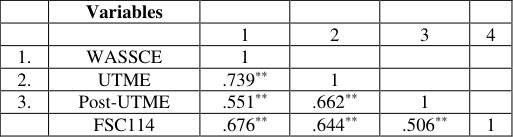 Table 1
 Table 2
 Table 3
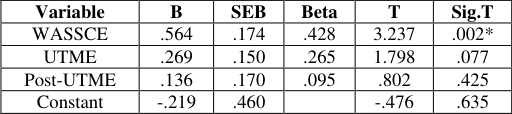 Table 4
Introduction
The teachers of science and even non-science instructors accept that no student can make progress in science and innovation without essential knowledge of Mathematics. This is so in light of the fact that Mathematics is concerned about logical thinking and is the centre of the significant theories of physical sciences. The distinctive component of Mathematics is its quantitative character. All science depends on investigations and all investigations depend on measurements and measurement is a branch of Mathematics (Lim & Gronlund 2000) [18] . Most investigators in the sciences are of the opinion that competence in Mathematics is essential for the study of most courses in universities. Research findings established that mathematical competence and skill have the ability to effectively predict success. Development of the cognitive abilities needed by students for success can be achieved in their first level college Mathematics for science majors. Thus, the possession of basic Mathematics skills, ability to use fractions, exponents, etc., best discriminates between those who were likely to succeed as science majors and those who would not. Therefore, the study of Mathematics should receive greater emphasis on all levels of education in Nigeria. The Mathematics curriculum in secondary school is vertically integrated, such that the complexity/difficulty of Mathematics problems solved increases as the students move to higher classes. Therefore, it becomes important for the learners to ensure that understand what is being taught at each level to get prepared for mathematics problems with a higher level of difficulties. In addition to this, it is also believed that the Mathematics students learned at the secondary and tertiary education serve to aim them in their future careers. For instance, mastery of industrial Mathematics enhances the practical calculations in the construction of metal, wood, building, drawing and electrical projects. Experiences in the foregoing areas are closer to the learners' practical environment than abstract aspects of general Mathematics. Therefore, general Mathematics can be used as a footing for the development of numerical abilities in the learners at higher levels (Curriculum Evaluation and Management Centre 2003) [6] . The knowledge of the validity of these secondary school Mathematics examinations scores from WASSCE, JAMB/UTME and Post UTME in predicting the University Algebra performance of the undergraduate students become very vital. The concept of predictive validity occurs when the criterion measures are obtained at a time after the tests. Examples of text with predictive validity are career or aptitude tests which are helpful in determining who is likely to succeed or fail in certain subjects or occupations (Cherry, 2019) [5] . The West African Senior Secondary Certificate (WASSCE), Unified Tertiary Matriculation Examination (UTME) and Post Unified Tertiary Matriculation Examinations (Post-UTME) conducted by WAEC, JAMB, and Universities respectively are three examinations every candidate must pass before securing admission into any university in Nigeria. The predictive validity of these examinations as the basis for success in examinations in the university is questionable. A study geared toward finding out whether the public examination results do reasonably predict the performance in university Algebra with particular reference to the Computer Science department at Ignatius Ajuru University of Education Port Harcourt is worthwhile and timely.
Literature review
Olutola, Olatoye, and Owolabi (2018) [19] explored the predictive validity of final continuous assessment (CA) scores of the students in biology and mathematics using their National Examination Council performance as the criterion measure. The findings were that the student performance in the final CA in Biology and Mathematics had significantly related to their National Examination Council Biology and Mathematics performance respectively. The National Examination Council (NECO) Mathematics and Biology were strongly predicted by the CA mathematics and Biology. The predictive validity of Mathematics and English mock examination results of the students in WASSCE has been studied (Omirin & Ale (2008) [20] . The finding revealed that mock Mathematics and English results significantly predicted the performance of the students in WASSCE. The English mock examination was a better predictor of performance in WASSCE than the Mathematics mock results. Agingu (2018) [4] investigated the validity of primary school examinations scores in the prediction of success at the secondary school level in Kenya. The findings established a strong positive relationship between the KCPE and KCSE scores where KCSE and KCPE are acronyms for the Kenya Certificate of Secondary Education and Kenya Certificate of Primary Education respectively. Faleye and Afolabi (2005) [11] attempted to determine the relationship between overall student performance in Junior Secondary Certificate Examination (JSCE) and their Senior Secondary Certificate Examinations (SSCE) performance in the Osun State of Nigeria. The findings were established that the JSCE scores poorly predicted the performance of the students in SSCE. Though, the JSCE Mathematics and English Language scores significantly predicted the SSCE performance of the students in Mathematics and English language than the rest of the subjects. Hinneh and Nenty (2016) [14] explored the extent to which the student performance in the core subjects on the Liberian Senior High School Certificate Examination (LSHSCE) influenced their performance in the WASSCE. The results were that the students differed significantly on their overall performance on WASSCE and LSHSCE when analysed according to school location and gender. The finding also showed that the general performance of the students in core science subjects taken on LSHSCE significantly predicted their WASSCE performance. The performance of the students in WASSCE Physics and Biology were significantly predicted by their performance LSHSCE in the same subject where the chemistry performance of the students on LSHSCE was a weak predictor of their performance in Chemistry on WASSCE. Oye and James (2018) [22] items of examinations on mathematics which were oganised by the NECO and West African Examination Council (WAEC) were examined in terms of item bias to ascertain the probability of success of the candidates of comparable abilities. The findings were that 70% of the items of the WAEC and 88% of the items of the NECO showed item bias. Salako, Adegoke, and Ogundipe (2017) [25] conducted a case study and compared the performance of students on WASSCE and NECO SSCE in Mathematics and Physics. The results of students who passed the examinations at credit level were used for data analysis. The findings showed that the successes on WAEC and NECO SSCE in Mathematics and Physics were not correlated; the two groups of students differed significantly in their mean scores. Kolawole and Ala (2013) [17] studied the predictive validity for the estimation of the relationship and effects of Continuous Assessment (CA) scores on the performance of students in NECO-SSCE as a case study. The key findings among others were that the Examination scores and Actual Aggregate Continuous Assessment (AACA) had a direct and significant influence on Final scores. The examination Score and Moderated Aggregate Continuous Assessment (MACA) also had a direct and significant effect on the final scores. The joint impact of AACA and Examination Scores, in addition to the combination of Examination score and MACA, had predicted the Final Grade of the students. Examination scores and AACA, as well as Examination score and MACA, had a positive and significant effect on the final scores of the students. The AACA and Examination score had a negative relationship with Final Grade as well as the combination of MACA and Examination scores. Jamalifar, Chalak, and Tabrizi (2014) [16] attempted to determine the relationship between general English courses taken at the Bachelor of Art programme and the general English performance in the Master of Art entrance examination in TEFL. Five courses were entered into the regression equation, but Grammar 1 had the strongest and significant unique contribution to the prediction of the University Entrance Examination (UEE) performance scores. The findings established that the general courses explained 67%of the variance in the UEE. Sarkodie, Korang, Asiedu, and Tattrah (2018) [26] predicted the CGPA of students in a dummy variable regression analysis, with the type of students, credit hours studied and joint impact of the type of student and credit hours as the predictors. The study found among others that the hours taken by a student are inversely related to performance. The maturity of the students reduces the CGPA and the joint effect of type of student (mature) and credit hours also had an adverse effect on the CGPA. Omodara (2010) [21] explored the predictive validity of the UME score on undergraduate student academic performance. The findings revealed a weak relationship between the UME score and undergraduate student academic performance. The UME was found to be a poor predictor of undergraduate student performance. An elaborate study was conducted by Ikiroma (2016) [15] attempted to predict the CGPA of undergraduate students using their academic entry requirements. The findings established that, when taken distinctively, SSCE, UTME, and Post-UTME had no significant relationship with the undergraduate student CGPA in the faculty of Education and Faculty of Arts/Humanities. The SSCE significantly predicted the undergraduate student CGPA in the Faculty of Engineering/Technology when taken alone, whereas when UTME and Post-UTME entered the equation separately, failed to predict the undergraduate student CGPA in the Faculty of Engineering/Technology. Additionally, when SSCE, UTME, and Post-UTME were considered separately, the result established that SSCE and UTME do not significantly predict the undergraduate student CGPA in the Faculty of Management Sciences whereas Post-UTME was found to be a significant predictor of the undergraduate student CGPA in the Faculty of Management Sciences. Furthermore, SSCE and UTME when taken separately were able to significantly predict the undergraduate student CGPA in the Faculty of Sciences whereas Post-UTME was found to be a weak predictor of the CGPA of the undergraduate students in the Faculty of Sciences. Dalha (2005) [7] attempted to find the impacts of student attitudes, teacher qualifications and Mathematics WAEC/NECO results on undergraduate student performance in Katsina State, Nigeria. The result showed that teacher qualification had an influence on the performance of the students. There was a significant predictive relationship between the WASSCE Mathematics results of the undergraduate students and their performances. Similarly, NECO Mathematics results of the students significantly predicted their performances. Gender had no influence on the performance of the students. Eze (2014) [10] determined the extent to which student final grades in four departments (Medical Rehabilitation Sciences, Medical Laboratory Sciences, Medical Radiography, and Radiological Sciences and Nursing Sciences) of the Faculty of Health Sciences and Technology University of Nigeria, Enugu Campus were used to predict the UTME scores. The key findings among others were that the UME score was a weak predictor of the final grades of the students in the Faculty of Health Science and Technology; in the department of Medical Radiography and Radiological Sciences, the UME scores had a significant relationship with the Final Cumulative Grade Point Average (FCGPA). The differences in the FCGPA and UME scores were in favour of the male students. The relationship between the FCGPA and UME scores of the male students was statistically significant. A recent study by Abubakar, Sakiyo, Waziri, and Joda (2019) [1] predicted the academic achievement of students in Nigerian Universities using the ordinary level results and JAMB qualification of undergraduate biology students. The findings revealed that WASSCE, SSCE, UTME, National Business, and Technical Certificate Examination (NBC/NTC) were weak predictors of Biology student academic achievement. Adeyemi (2010) [2] predicted the undergraduate student success in educational management in universities in Ondo and Ekiti States Nigeria using credit grades in Mathematics in SSCE. The findings revealed that credit grades in Mathematics had a significant relationship with the performance of the students in educational management as quantified using the Cumulative Grade Point Average (CGPA) in both states under exploration. The findings also lend credence to the conclusion that credit in Mathematics is vital for improved performance in Educational management in the universities. Emaikwu (2015) [9] predicted the validity of UTME on Post-UTME in Nigeria. It was found among others that the mean performance of the students in UTME and Post-UTME scores differed significantly when analysed using paired sample t-test. The relationship between UTME and Post-UTME scores was weak. Afu and Ukofia (2017) [3] predicted the undergraduate student success in first-year final departmental examinations in the University of Abuja from their performance in UTME and Post-UTME. The findings were that, in four departments, the relationship between UTME scores and CGPA for first-year final examination scores were low and negative (inverse). The Post-UTME and first-year final examination scores for the four departments under exploration when correlated had negative/low, positive/low and positive/moderate correlation coefficients. Popoola (2016) [23] explored the predictive validity of UME scores of students to their learning achievement at the Federal University of Technology, Yola. The findings among others established that there is a significant relationship between UME scores and GPA in the first year Ekwale (2018) [8] , predicted the student GCE Advanced level Biology scores from the Mock-GCE Advanced level Biology scores in Science High Schools, in Fako Division-Buea, Cameroon. The findings revealed that there is a significant correlation between Mock-GCE scores and GCE advanced Level Biology scores with the correlation coefficients varying across studied schools' investigation.
Problem specification
The predictive validity of WASSCE, UTME, and Post-UTME as the basis for success in examinations in the university is questionable. There have been, therefore; unrelenting calls from varying quarters for the reassessment of the current modes of selecting candidates for admission into diverse programmes in the Universities in Nigeria intended to establish the credibility of each of the admission criteria. It is worthy of note that the moves fuelled by the observed disparity between candidates' performance in public examinations and their later achievement in university degree examinations gave rise to post-UTME screening examinations. Researches on the predictive validity of public examinations on student future academic achievement in varying contexts are well established with some revealing low and/or negative relationship between these examination scores and student CGPA (Rothstein, 2004 [24,12,13,2,15,3,8,4,1] . The observed inconsistencies in the findings of the previous studies also call for a specific exploration of the predictive validity of these examinations on first-year university Algebra at Ignatius Ajuru University of Education, Port Harcourt.
Aim and Objectives
The aim of this study was to investigate the predictive validity of public examinations in Mathematics on performance in university Algebra. Specifically, the objectives of the study were to:
Results
Using a WASSCE, UTME and Post-UTME scores to predict university Algebra performance of students. Table 2 above shows the values of the parameters of the regression analysis between the predictor variables and performance in Algebra. The results of the analysis showed that predictor variables jointly predicted the performance of computer science undergraduate students in first-year Algebra. The predictor variables taken against the criterion variable yielded a coefficient of multiple correlations (R) of .713 and multiple correlations squared (R 2 ) of .508. The R 2 value translated into 50.8% of the observed variance in the in Algebra scores. The analysis also gave a standard error (SE)=.776 and an F-value of 21.707 significant at 0.05 level of significance. The dependent variable was student achievement in Algebra sr 2 is the square semi-partial correlation.
| Source | — | SS | df | MS | F | Sig. |
|---|---|---|---|---|---|---|
| R=.713 R2=.508 SE=.776 | Regression | 39.236 | 3 | 13.079 | 21.707 | .000 |
| Residual | 37.958 | 63 | .603 | |||
| Total | 77.194 | 66 |
Table text extracted from the original PDF; superscript letters are shown inline. The original table image is below.
View original table image
Table 3 shows the relative contributions of WASSCE and UTME to the observed variance in the criterion variable (Algebra score). The WASSCE, UTME and Post UTME were used in a stepwise multiple regression analysis to predict student performance in Algebra. Table 3 confirmed that WASSCE was the primary predictor of student performance in Algebra when compared with other predictor variables. It showed that WASSCE and UTME accounted for approximately 50% of the variance of achievement (R 2 =.503, Adjusted R 2 =.488). The Post-UTME did not enter the equation at .05 levels. Hence, revealing that it is a weak predictor of student academic achievement in Algebra. The forecast model contained only two of the three indicators and was got to in two steps with one variable expelled. With the sizeable relationships between the indicators, the novel change clarified by every one of the factors recorded by the squared semi-partial correlations was generally low. The WASSCE and UTME particularly represented around 9% and under 5% of the fluctuation in Algebra performance. Table 3 shows that the model was statistically significant (F (2, 64) =32.419, p < .05). Table 4 gives the predictor factors in the regression model, the Beta value and significant T values matching the factors regressed against the criterion variable. A look at Table 4 uncovers that the Beta values for WASSCE were found to be as profoundly significant (Beta=.428; t = 3.237, p<.01). From the results in Table 3, the value pulled by WASSCE was the highest when compared with the values pulled by UTME (Beta =.265; t = 1.798, p>.01) and Post-UTME (Beta=.095; t = .802, p>.01) respectively. This confirms the results in Table 3 where WASSCE was earlier revealed to be the strongest predictor of students' performance in university Algebra.
| Variable | B | SEB | Beta | T | Sig.T |
|---|---|---|---|---|---|
| WASSCE | .564 | .174 | .428 | 3.237 | .002* |
| UTME | .269 | .150 | .265 | 1.798 | .077 |
| Post-UTME | .136 | .170 | .095 | .802 | .425 |
| Constant | -.219 | .460 | -.476 | .635 |
Table text extracted from the original PDF; superscript letters are shown inline. The original table image is below.
View original table image
| — | Model | B | SE-B | Beta | Pearson r | sr2 | T | Sig. |
|---|---|---|---|---|---|---|---|---|
| R=.709 R2=.503 Adj.R2=.488 F=32.419 | Constant | -.193 | .458 | -.421 | .675 | |||
| WASSCE | .581 | .172 | .441 | .676 | .088 | 3.370 | .001 | |
| UTME | .323 | .133 | .318 | .644 | .046 | 2.431 | .018 |
Table text extracted from the original PDF; superscript letters are shown inline. The original table image is below.
View original table image
Discussion
The results in Table 2 indicated that 50.3% of the variance in performance in Algebra was accounted for the predictor variables being taken together. The relationship between students' performance in university Algebra and the predictor variables taken together were high as shown by the coefficient of multiple correlations (R =.713). Thus, the predictor variables investigated when taken together, could to some extent, predict performance in university Algebra among undergraduate-computer science students involved in this study. The F-value (21.71) as revealed in the ANOVA which was significant at the alpha level of .05 lend credence to the fact that the predictor capacity of the predictor variables of this study did not occur by chance even though a large proportion of the variance in university Algebra performance was unexplained by the current data. Consistent with the present finding was an earlier study by Dalha (2005) [7] who found among others a significant predictive relationship between the WASSCE Mathematics results of the undergraduate students and their performances. Similarly, NECO Mathematics results of the students significantly predicted their performances. Gender had no influence on the performance of the students. Inconsistent with the present finding is a recent study by Abubakar, Sakiyo, Waziri, and Joda (2019) [1] which attempted to predict the academic achievement of students in Nigerian Universities using the ordinary level results and JAMB qualification of the undergraduate biology students. The findings revealed that WASSCE, SSCE, UTME, National Business and Technical Certificate Examination (NBC/NTC) were weak predictors of Biology student academic achievement. Adeyemi (2010) [2] predicted the undergraduate student success in educational management in universities in Ondo and Ekiti States Nigeria using credit grades in Mathematics in SSCE. The findings revealed that credit grades in Mathematics had a significant relationship with the performance of the students in educational management as quantified using the Cumulative Grade Point Average (CGPA) in both states under exploration. Popoola (2016) [23] explored the predictive validity of UME scores of students to their learning achievement at the Federal University of Technology, Yola. The findings among others established that there is a significant relationship between UME scores and GPA in the first year. Ekwale (2018) [8] , predicted the student GCE Advanced level Biology scores from the Mock-GCE Advanced level Biology scores in Science High Schools, in Fako Division-Buea, Cameroon. The findings revealed that there is a significant correlation between Mock-GCE scores and GCE advanced Level Biology scores with the correlation coefficients varying across the schools under investigation. The results contained in Table 3 and Table 4 are quite enlightening and useful. All the predictor variables investigated were found to contribute differently to the prediction of performance in university Algebra. However, WASSCE, UTME, and Post-UTME contributed significantly to the observed variance in the criterion variable in that order. WASSCE accounted for 45.7% of the variance in performance in university Algebra, while WASSCE combined with UTME accounted for 50.3% of the variance in performance in university Algebra. This means that 49.7% of the variance in achievement is accounted for by other variables unexplained by the data. These findings suggest that a few other latent and observable variables that lie outside the scope of the present study should be included in a similar study to provide a more comprehensive conceptualization of the other variables determining the performance of students in university Algebra. The finding of this study is consistent with an earlier finding by Ikiroma (2016) [15] which found that SSCE and UTME, when taken separately, were able to significantly predict the undergraduate student CGPA in the Faculty of Sciences whereas Post-UTME was found to be a weak predictor of the CGPA of the undergraduate students in the Faculty of Sciences. Jamalifar, Chalak, and Tabrizi (2014) [16] found that Grammar 1 had the strongest and significant unique contribution to the prediction of the University Entrance Examination (UEE) performance scores. The findings established that the general courses explained 67% of the variance in the UEE. Emaikwu (2015) [9] predicted the validity of UTME on Post-UTME in Nigeria. It was found among others that the mean performance of the students in UTME and Post-UTME scores differed significantly when analysed using paired sample t-test. The relationship between UTME and Post-UTME scores was weak. Afu and Ukofia (2017) [3] predicted the undergraduate student success in firstyear final departmental examinations in the University of Abuja from their performance in UTME and Post-UTME. The findings among others were that, in four departments, the relationship between UTME scores and CGPA for the firstyear final examination scores were low and negative (inverse). The Post-UTME and first-year final examination scores for the four departments under exploration when correlated had negative/low, positive/low and positive/ moderate correlation coefficients.
Conclusion
The results of this study have revealed that out of the three independent variables correlated and regressed with the criterion measure of university Algebra scores, WASSCE was the strongest predictor of student performance in university Algebra. It had the strongest predictive power than the UTME and Post-UTME. The implication of the findings is that WASSCE and JAMB/Unified Tertiary Matriculation Exanimation (UTME) results should continue to be the key requisite qualifications for entry into Nigerian Universities. Therefore, Universities have been admitting the right candidates and these results have predictive validity. The public examination results do reasonably predict student performance in the university Algebra. The Universities may, therefore, jettison the use of Post-UTME as an additional requirement for the admission of students because of its weak predictive power in forecasting the future performance of undergraduate students in Mathematics.
Recommendations
Based on the findings of the present study it is recommended that: 1. Students take serious the study of their general Mathematics to have good results in WASSCE as this significantly impacts on their achievement in university Algebra 2. The WASSCE and UTME examinations should continue to stand as an entrance examinations to students seeking admission into the university. 3. Universities should not scrap the use of Post-UTME as an additional check examination for those seeking admission into Nigerian universities.
Figures and tables from the paper
| — | Variables | — | — | — | — |
|---|---|---|---|---|---|
| 1 | 2 | 3 | 4 | ||
| 1. | WASSCE | 1 | |||
| 2. | UTME | .739** | 1 | ||
| 3. | Post-UTME | .551** | .662** | 1 | |
| FSC114 | .676** | .644** | .506** | 1 |
Table text extracted from the original PDF; superscript letters are shown inline. The original table image is below.
View original table image
References
26 in the original paper- Abubakar BK, Sakiyo J, Waziri K, Joda FM. Entry qualifications as a predictor of undergraduate Biology students' academic achievement in Nigerian universities. International Journal of Education and Social Science Research. 2019; 2(4):142-149.
- Adeyemi TO. Credit in Mathematics in Senior Secondary Certificate Examinations as a Predictor of Success in Educational Management in Universities in Ekiti and Ondo States, Nigeria. Research Journal of Mathematics and Statistics. 2010; 2(1):14-22.
- Afu MO, Ukofia IBF. Predictive Validity of UTME and Post-UTME Scores on first Year Students' Performance in four Departments in University of Abuja. International Journal of Education and Evaluation. 2017; 3(4):26-35.
- Agingu EA. Validity of primary school examination as a predictor of secondary school examination score among public secondary school students in Kenya. International Journal of Research -Granthaalayah, 2018; 6(4):80-94. https://doi.org/10.5281/zenodo.1241461
- Cherry K. Why validity is important to psychological tests, 2019. Verywell https://www.verywellmind.com/what-is-validity-2795788
- Curriculum, Education and Management Centre A. Level Update, Monitoring a levels, 2003. Retrieved on 16 th August, 2013. from http://www.Cemeentre.org/recenttopics/alevel/update/def ault.asp
- Dalha N. Impact of students' attitudes, teachers' qualifications and Mathematics WAEC/NECO results on tertiary students' performance in Katsina State, Nigeria. A master degree dissertation, Ahmadu Bello University Zaria, 2005.
- Ekwale EA. The Predictive Validity of Mock GCE Advanced Level Biology Scores on GCE Advanced Level Biology Scores: A case study of Science High Schools in Fako Division-Buea, Cameroon. International Journal of Trend in Scientific Research and Development (IJTSRD). 2018; 3(1):113-125.
- Emaikwu SO. Predictive validity of unified tertiary matriculation examination (UTME) on post-unified tertiary matriculation examination scores (UTME) in Nigeria. Asia Pacific Journal of Research. 2015; 1(24):54-62.
- Eze EC. University Matriculation Examination as a predictor of students' final grades in the Faculty of Health Sciences and Technology of University of Nigeria, Nsukka. An M.Sc Dissertation, University of Nigeria, Enugu Campus, 2014.
- Faleye BA, Afolabi ERI. The Predictive Validity of Osun State Junior Secondary Certificate Examination. Electronic Journal of Research in Educational Psychology. 2005; 5-3(1):131-144.
- Gbore LO. Cognitive entry characteristics, study habits and self concept as predictors of academic performance of university undergraduates in South-West of Nigeria, Doctoral dissertation, University of Ado-Ekiti, Ado-Ekiti, 2006.
- Geiser S, Santelices MV. Validity of high school grades in predicting student success beyond the freshman year: High School record vs. Standardized test as indicators of four-year college outcomes, Research & Occasional paper series No. 6.07, center for studies in Higher Education, University of California, Berkeley, 2007.
- Hinneh JT, Nenty HJ. Analysis ofthe predictive validity of students' performance in core sciences on Liberian SHSCE with WASSCE as the criterion. IOSR Journal of Research & Method in Education (IOSR-JRME). 2016; 6(4)25-31. DOI: 10.9790/7388-0604042531
- Ikiroma B. Predictive validity of academic entry requirements into federal universities in Nigeria. Journal of Education Research and Behavioral Sciences. 2016; 5(2):31-40.
- Jamalifar G, Chalak A, Tabrizi HH. The predictive Validity of the M.A. Entrance Examination of TEFL. Procedia -Social and Behavioral Sciences. 2014; 136:313-317. Available online at www.sciencedirect.com
- Kolawole EB, Ala EA. Predictive validity of continuous assessment scores on students' performance in mathematics in some selected states in South-West Nigeria. Journal of Educational Research and Reviews. 2013; 1(4):42-48.
- Linn RL, Gronlund NE. Measurement and Assessment in Teaching, 8thedn. New Jersey: Prentice-Hall, 2000.
- Olutola AT, Olatoye RA, Owolabi HO. Predictive validity of students' final continuous assessment scores in mathematics and biology using their performance in national examination council as a criterion measure. Fudma Journal of Educational Foundations (FUJEF). 2018; 1(1):147-158.
- Omirin MS, Ale VM. Predictive validity of English and Mathematics Mock Examination results of senior secondary school student's performance in WASSCE in Ekiti-State, Nigeria. Pakistan Journal of Social Sciences. 2008; 5(2):139-141.
- Omodara MF. Assessment of the predictive validity of UME scores on academic performance of science university undergraduates. Multidisciplinary Journal of Research Development. 2010; 14(1):110-114.
- Oye BS, James AO. Examining the item bias of mathematics examinations constructed by WAEC AND NECO in Nigeria. International Journal of Quantitative and Qualitative Research Methods. 2018; 6(2):1-7.
- Popoola SF. Predictive validity of UME scores to students' academic achievement in Federal University of Technology, Yola. International Journal of Social Science and Humanities Research. 2016; 4(2):583-588.
- Rothstein J. College Performance predictions and the SAT. Journal of Econometrics. 2004; 9(121):297-317.
- Salako RJ, Adegoke BO, Ogundipe LO. Performance Appraisal of NECO and WAEC SSCE: An Empirical Evidences from Mathematics and Physics. International Journal of Innovative Social & Science Education Research. 2017; 5(3):1-10.
- Sarkodie EE, Korang T, Asiedu DK, Tattrah VD. Predictive validity of university entrance examinations, a case of college of technology education, university of education, Winneba, Ghana. International Journal of Research in Business Studies and Management. 2018; 5(4):9-13.