
Research article · 2019 · Full text
International Journal of Statistics and Applied MathematicsAnalysis of dengue disease by mathematical Model
Volume 4(6) · Pages 108–110
Research areasMathematical and Theoretical Epidemiology and Ecology ModelsCOVID-19 epidemiological studiesEvolution and Genetic Dynamics
Abstract
Author-writtenIn this paper the main purpose was to study the dynamics of dengue fever and its progression to the dengue haemorrhagic fever in order to understand the epidemic phenomenon and to suggest strategies for the control of the disease in general and the haemorrhagic form in particular. The nature of dengue epidemics is complex since it conjugates human, environmental, biological, geographical and socio-economic factors. Our model and simulations show that the strategy based on the prevention of dengue epidemic using vector control through environmental management or chemical methods remains insufficient since it only permits to delay the outbreak of the epidemic.
Summary
Source-checkedPlain-language reading of the full paper, prepared with AI and checked against the text. Each point links to the authors' own words.
Why it matters
- Dengue fever propagation is facilitated by several factors, including environmental deterioration, climate change, poverty, and uncontrolled urbanization. View evidence ↗
- The World Health Organization reports approximately 50 million annual cases of dengue globally, and this number is increasing. View evidence ↗
The question
- The study aims to analyze the dynamics of dengue fever and its progression to the haemorrhagic form to identify effective control strategies. View evidence ↗
What they did
- The authors used a SIR (Susceptible, Infective, Removed) mathematical model, omitting the 'exposed' compartment because the latent period was assumed to be non-crucial. View evidence ↗
- The research proposes a model featuring two different viruses that act at separate time intervals. View evidence ↗
- Simulations were performed using MATLAB routines to test various parameter values and control strategies. View evidence ↗
What they found
- Simulations indicate that vector control via chemical methods or environmental management is insufficient, as it only delays the epidemic outbreak. View evidence ↗
- Stability analysis shows that a population can be protected from epidemics if the proportion of immunized humans (p) satisfies the herd immunity principle: μh(R - 1) ≤ p. View evidence ↗
- The model suggests that the progression of dengue to the haemorrhagic form can be controlled using a partial vaccine targeted at individuals who were affected by the first epidemic. View evidence ↗
What it means
- The authors recommend a short-term strategy combining environmental prevention with partial vaccination to specifically prevent the haemorrhagic form of the disease. View evidence ↗
- The authors suggest that researchers should focus on developing vaccines for individual serotypes rather than attempting to create a single vaccine for all four serotypes simultaneously. View evidence ↗
- A global immunization strategy is considered unrealistic in the short term due to the difficulty of creating a vaccine that protects against all four dengue serotypes. View evidence ↗
Visual summary
1 visualsIllustrations explain the paper; they do not show study data.
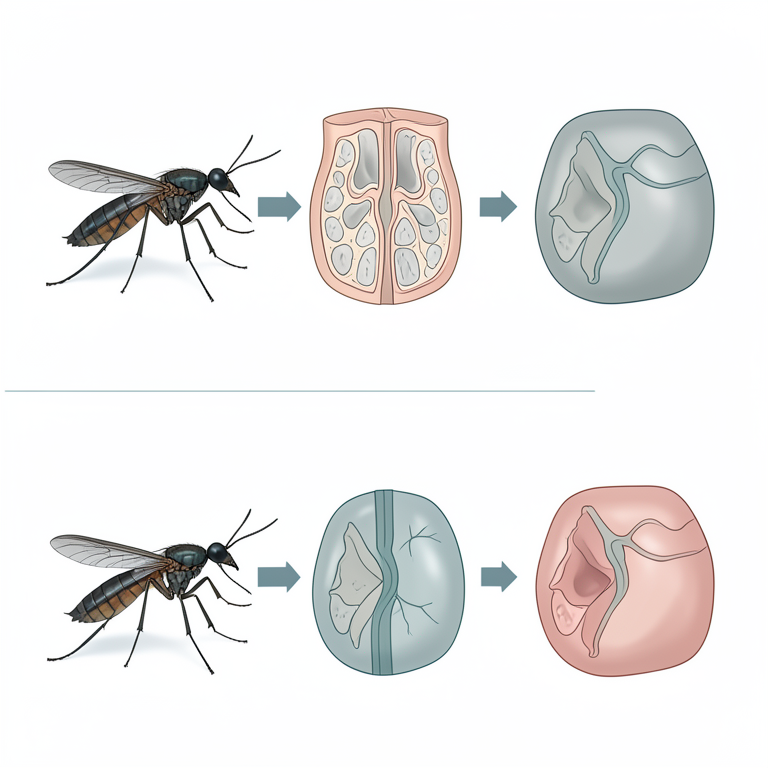
SIR Model Flow
AI-generated conceptual illustration (Aedes aegypti mosquitoes and human skin). It explains the idea and does not show study data.
View source evidence ↗Figures & tables
From the original paper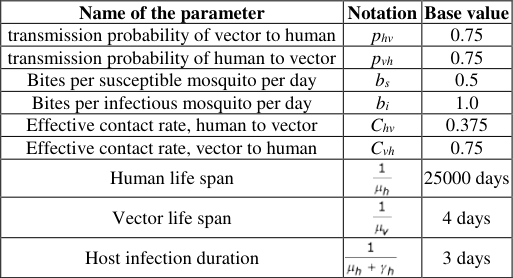 Table 1
Introduction
With medical research achievements in terms of vaccination, antibiotics and improvement of life conditions from the second half of the 20 th century, it was expected that infectious diseases were going to disappear. Consequently, in developed countries the efforts have been concentrated on illnesses as cancer. However, at the dawn of the new century, infectious diseases are still causing suffering and mortality in developing countries. Malaria, yellow fever, AIDS, Ebola and other names will have marked the memory of humanity forever. So far, the strategies of mosquito control by insecticides or similar techniques proved to be inefficient. Moreover, the deterioration of the environment, the climatic changes, the unsanitary habitat, the poverty and the uncontrolled urbanization are as many favorable factors to the infectious illness propagation in general and dengue fever in particular. During the last decades the global prevalence of the dengue progressed dramatically. The disease is now endemic in more than 100 countries of Africa and America. The Southeast of Asia and the Western Pacific are seriously affected by the illness. Before 1970, only nine countries had known epidemics of dengue haemorrhagic fever, but this number had increased more than fourfold in 1995 and about 2500 million of people are now exposed to the risk of the dengue fever. According to the present evaluations of the World Health Organization (WHO), about 50 million cases of dengue occur in the world every year, with an increasing tendency. In 1998, there were more than 616, 000 cases of dengue in America, of which 11, 000 cases of dengue haemorrhagic fever, that's twice the number of cases recorded in the same region during the year 1995. In 2001 there were 400, 000 cases of haemorrhagic fever in Southeast Asia, whereas, in Rio de Janeiro alone, 500, 000 people were struck by a dengue outbreak in 2002. The epidemic effect reached Florida and southern Texas [1][2][3] . During epidemics of the dengue fever the rate of the infectious among the susceptibles is often between 40 and 50% but it may reach 80-90% in favorable geographic and environmental conditions. Every year more then 500, 000 cases of dengue haemorrhagic require an hospitalization. Mathematical modelling became an interesting tool for the understanding of these illnesses and for the proposition of strategies. The formulation of the model and the possibility of a simulation with parameter estimation, allow tests for sensitivity and comparison of conjunctures [4] .
In the case of dengue fever, the mathematical models we have found in the literature propose compartmental dynamics with Susceptible, Exposed, Infective and Removed (immunised). In particular, SEIRS models [5] and SIR models [6] with only one virus or two viruses acting simultaneously [7] were considered. In the present paper, while pointing out that the idea of two viruses coexisting in the same epidemic is controversial [7] , a model with two different viruses acting at separated intervals of time is proposed. Our main purpose is to study the dynamics of dengue fever, while concentrating on its progression to the haemorrhagic form, in order to understand the epidemic phenomenon and to suggest strategies for the control of the disease. In search of clarity and simplicity, we assume that the latent period is not crucial for the susceptibleinfective interaction, hence we omit the compartment of exposed and consider a SIR model.
Parameters of the Model
We suppose that we dispose of a human population (respectively of mosquito population) of size Nh (resp. Nv) formed of Susceptibles Sh, of Infective Ih and of Removed Rh (resp. Sv and Iv). The model supposes a homogeneous mixing of human and mosquito population so that each bite has an equal probability of being taken from any particular human. While noting bs the average biting rate of susceptible vectors, phv the average transmission probability of an infectious human to a susceptible vector, the rate of exposure for vectors is given by: (phvIhbs)/Nh. It is admitted [6] that some infections increase the number of bites by the infected mosquitos in relation to the susceptible, therefore, we will assume that the rate of infected mosquito bites bi is greater than the one of the susceptible mosquitos bs. Noting pvh the average transmission probability of an infectious vector to human and Iv the infectious vector number, the rate of exposure for humans is given by: (pvhIvbi)/Nh so: The adequate contact rate of human to vectors is given by: Chv = Phvbs The adequate contact rate of vectors to human is given by: Cvh = pvhbi.
The man life span is taken equal to 25 000 days (68.5 years), and the one of the vector is of 4 days. Other parameters values are given in the following section.
Host infection duration 3 days
Up to now there is no vaccine against dengue viruses but research is going on and the eventuality of an immunization program is not excluded in the medium term. In this study we investigate the effect of such an immunization option and we also discuss the possibility of a partial vaccination against each serotype that will enable the control of the second epidemic and the evolution of dengue to dengue haemorrhagic fever.
In the case of first epidemic, the simplest assumption is that a random fraction, p, of susceptible humans can permanently be immunized against all the four serotypes. While for the second epidemic, a partial immunization is applied to the removed from the first epidemic. The dynamics of this disease in the host and vector populations is given by the following equations:
First epidemic
The model is governed by the following equations: Human population
Vector population
With the conditions Sh + Ih + Rh = Nh and Sv + Iv = Nv, so: Rh = Nh -Sh -Ih and Sv = Nv -Iv then the two previous systems become:
Equilibrium points
Let the set Ω given by: Ω = {(Sh,Ih,Iv)/0 ≤ Iv ≤ Nv; 0 ≤ Ih; 0 ≤ Sh, (1 + p/μh)Sh + Ih ≤ Nh}
Second epidemic
In the same way as in the previous section we suppose the onset of a second epidemic with another virus. But in this case, we may assume that a proportion of the population of susceptibles is globally immunized against the four serotypes or partially immunized against one, two or tree viruses. Consequently, we may concentrate only on the removed from the first epidemic who are exposed to the DHF by taking the new population . Therefore the model is given by the following equations:
Human population
Human population
Vector population
With the conditions and Sv + Iv = Nv so: et Sv = Nv -Iv then the two previous systems become:
Equilibrium points
Let the set Ω given by: With p' = p/μh
Results and Discussion
Assuming a vaccination program as an option that would enable a proportion p of susceptible humans to be globally immunized against the four serotypes, the stability analysis shows that the population may be protected from epidemics if p satisfies the principle of herd immunity: μh(R -1) ≤ p, where R is a function of the model parameters, defined as the number of new infected by an infective in interaction with susceptibles. Otherwise, there will be an endemic equilibrium and the disease will persist. But the problem is precisely in finding a vaccine against the four serotypes, which makes a strategy based on global immunization irrealistic in the short term. Meanwhile, a search leading to a partial vaccine against each serotype should be more feasible. In this direction, the proposed model shows that the evolution of dengue to dengue haemorrhagic fever can be controlled by a partial vaccine restricted to the people affected by the first epidemic. In order to illustrate the dynamics of each epidemic and to study different strategies, a simulation was carried out using MATLAB routines with different values of the parameters implied in each model. Mainly two directions can be envisaged to control the disease. The first may act on the number of mosquitoes and the second may consider the number of susceptible humans.
Conclusion
As mentioned in the introduction, Our main purpose was to study the dynamics of dengue disease and its progression to the dengue haemorrhagic fever in order to understand the epidemic phenomenon and to suggest strategies for the control of the disease in general and the haemorrhagic form in particular. This conclusion agrees with the experiences realized by EA. Newton and P. Reiter using insecticides [5] . On the other hand, although the model suggests the reduction of susceptibles via vaccination, such a strategy is unlikely to be applicable in the short term because it faces some hurdles due to the fact that a vaccine must protect against the four serotypes at the same time. However, we consider this option since its eventuality is not excluded in the medium and long term.
In the short term, an intermediate solution would be to combine as much as possible, the environmental prevention and a partial vaccination essentially to avoid the haemorrhagic form of the disease caused by different viruses. This suggestion may help health-care policy makers to tackle environment causes as preventive measures and researchers to investigate and concentrate on the search for a vaccine against each serotype rather than looking for a vaccine against the four serotypes at the same time.
Figures and tables from the paper
| Name of the parameter | Notation | Base value |
|---|---|---|
| transmission probability of vector to human | phv | 0.75 |
| transmission probability of human to vector | pvh | 0.75 |
| Bites per susceptible mosquito per day | bs | 0.5 |
| Bites per infectious mosquito per day | bi | 1.0 |
| Effective contact rate, human to vector | Chv | 0.375 |
| Effective contact rate, vector to human | Cvh | 0.75 |
| Human life span | 25000 days | |
| Vector life span | 4 days | |
| Host infection duration | 3 days |
Table text extracted from the original PDF; superscript letters are shown inline. The original table image is below.
View original table image
References
9 in the original paper- Derouich M. Modélisation et Simulation de modèles avec et sans structure d'âge: Application au diabète et à la fièvre dengue. PhD thesis Faculty of Sciences, Oujda Morocco, 2001.
- Sesser S. Plague proportion. The Asian Wall Street Journal August 30 Septembre, 1, 2002.
- Hethcote HW. The Mathematics of Infectious Diseases. SIAM review. 2000; 42:599-653. [Google Scholar]
- Newton EA, Reiter P. A model of the transmission of dengue fever with an evaluation of the impact of ultralow volume (ULV) Insecticide applications on dengue epidemics. Am J Trop Med Hyg. 1992; 47:709-720. [PubMed] [Google Scholar]
- Esteva L, Vargas C. Analysis of a dengue disease transmission model. Mathematical Biosciences. 1998; 150:131-151. DOI: 10.1016/S0025-5564(98)10003-2. [PubMed] [CrossRef] [Google Scholar]
- Feng Z, Hernàndez V. Competitive exclusion in a vectorhost model for the dengue fever. Journal of Mathematical Biology. 1997; 35:523-544. DOI: 10.1007/s002850050064. [PubMed] [CrossRef] [Google Scholar]
- Luenberger DG. Introduction to Dynamic systems, Models, and Applications. Theory, Models, and Applications, John Wiley & sons, 1997.
- Luenberger DG. Introduction to Applied Non linear systems and Chaos. S Wiggins, Springer, 1996.
- Dietz K. Transmission and control of arbovirus diseases. In: Ludwing D, editor. In Proceedings of the Society for Industrial and Applied Mathematics, Epidemiology: Philadelphia. Philadelphia, 1974, 104-106. [Google Scholar]