
Research article · 2019 · Full text
International Journal of Veterinary Sciences and Animal HusbandryThe influence of photoperiods on behaviour of quail under different housing systems
Volume 4(6) · Pages 35–39
Research areasAnimal Nutrition and Physiology
Abstract
Author-writtenThis experiment was conducted to investigate the effect of different day times on some maintenance behaviour of Japanese quail (Coturnix Coturnix Japonica). The experiment was carried out at faculty of Veterinary Medicine poultry farm, Zagazig University, Egypt. 120 quail of one day old chick were divided randomly into two equal group (60 birds of each) one group were housed at floor system and the other at cage system. From the obtained results the diurnal variation had a significant effect on feeding behaviour. The ingestive behaviour was increased with floor managed quail at early morning. There was a non-significant difference in walking time between different day times. The wall pecking time wasn't affected with the diurnal hours. We concluded that there was a positive correlation coefficient between the ingestive behaviour of quail and the different diurnal hours as it increase with early morning at floor housed quail. The crouching time was increased with mid-day at battery managed quail.
Summary
Source-checkedPlain-language reading of the full paper, prepared with AI and checked against the text. Each point links to the authors' own words.
Why it matters
- Circadian rhythms, controlled by an internal diurnal clock, are the primary factor influencing bird behavior. View evidence ↗
- Floor housing systems are generally considered superior to cage systems for satisfying a bird's motivation for activities like dust bathing. View evidence ↗
- Increased activity levels in the morning may be a result of reduced temperature stress. View evidence ↗
The question
- The study aimed to investigate how different times of the day affect the maintenance behavior of Japanese quail. View evidence ↗
What they did
- The two housing systems compared were floor pens with 10cm of sawdust and a multi-decked cage system. View evidence ↗
What they found
- Quail in the battery system exhibited their highest ingestive behavior in the late afternoon (P3), with a feeding time of 10.70±1.56 Sec/hr. View evidence ↗
- There was a positive correlation between ingestive behavior and diurnal hours, specifically increasing during early morning and mid-day. View evidence ↗
What it means
- The authors concluded that ingestive behavior peaks in the early morning for floor-managed quail and late afternoon for battery-managed quail, while crouching peaks at mid-day for battery-managed quail. View evidence ↗
Visual summary
3 visualsIllustrations explain the paper; charts are replotted from the paper's own table values.
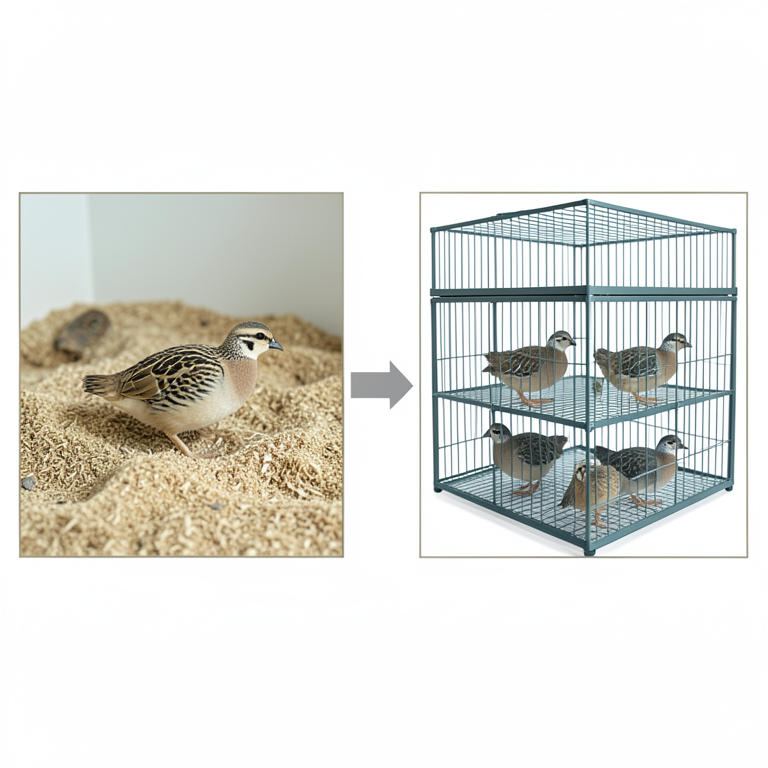
Experimental Setup Comparison
AI-generated conceptual illustration (Japanese quail in floor pens and wire cages). It explains the idea and does not show study data.
View source evidence ↗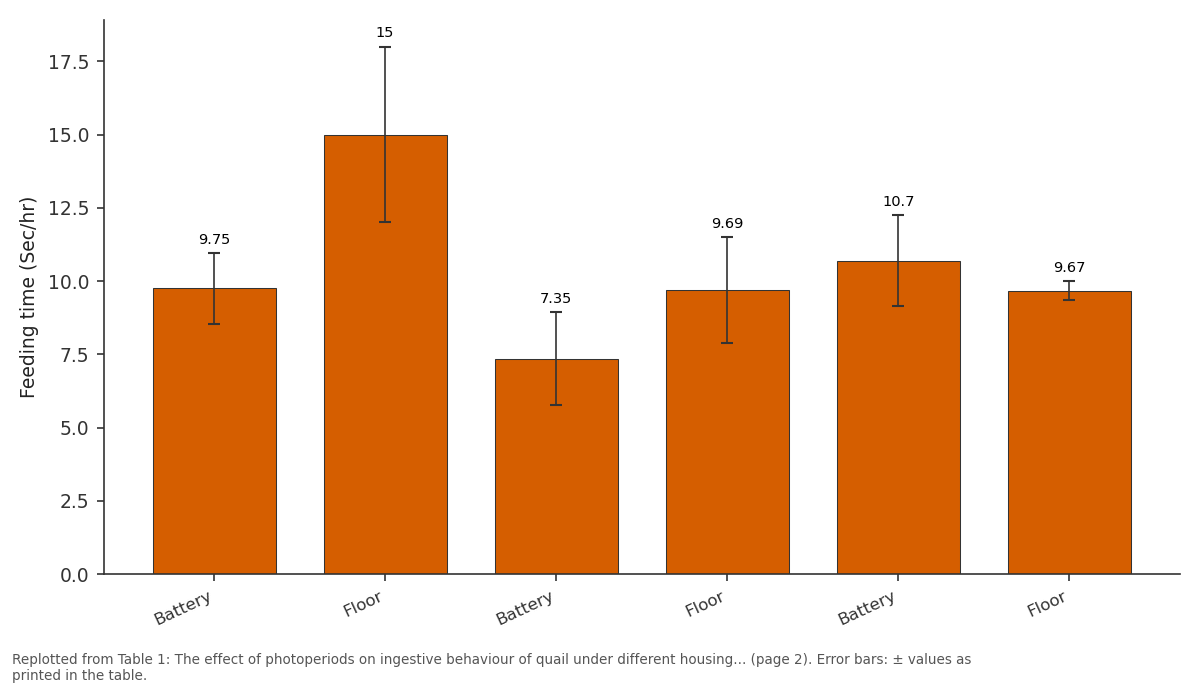
Feeding time (Sec/hr): Battery vs Floor vs Battery vs Floor vs Battery
Replotted from Table 1 (page 2) of the original paper. Every bar is the paper's own table value.
View source evidence ↗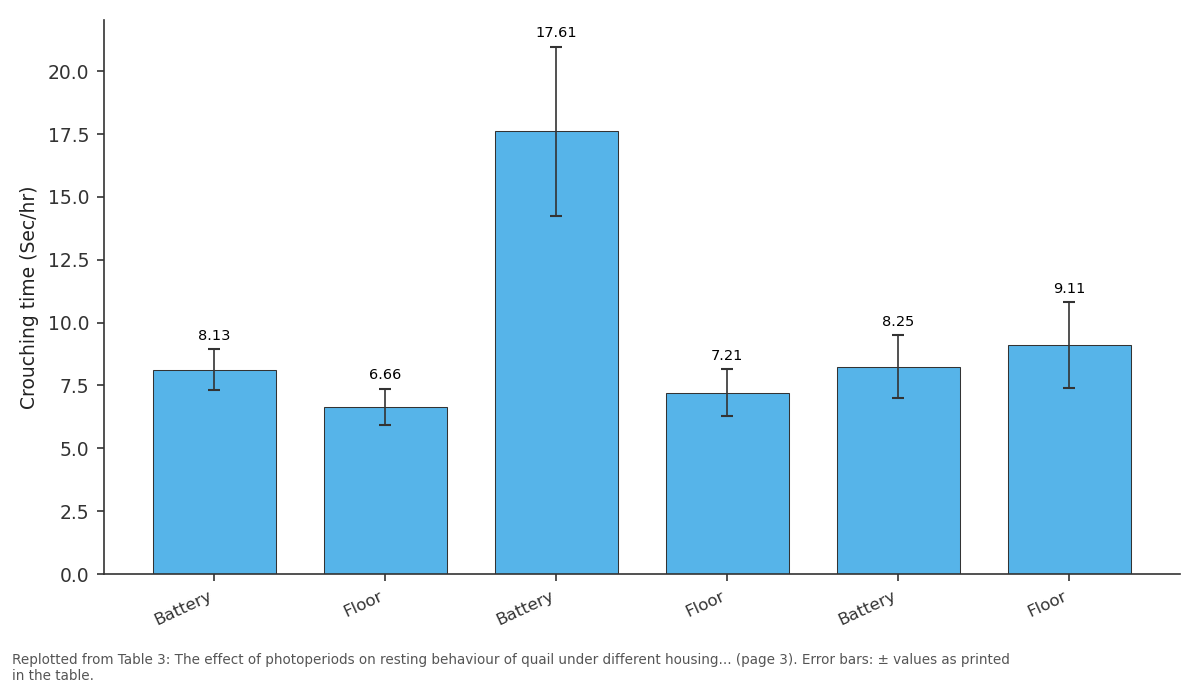
Crouching time (Sec/hr): Battery vs Floor vs Battery vs Floor vs Battery
Replotted from Table 3 (page 3) of the original paper. Every bar is the paper's own table value.
View source evidence ↗Figures & tables
From the original paper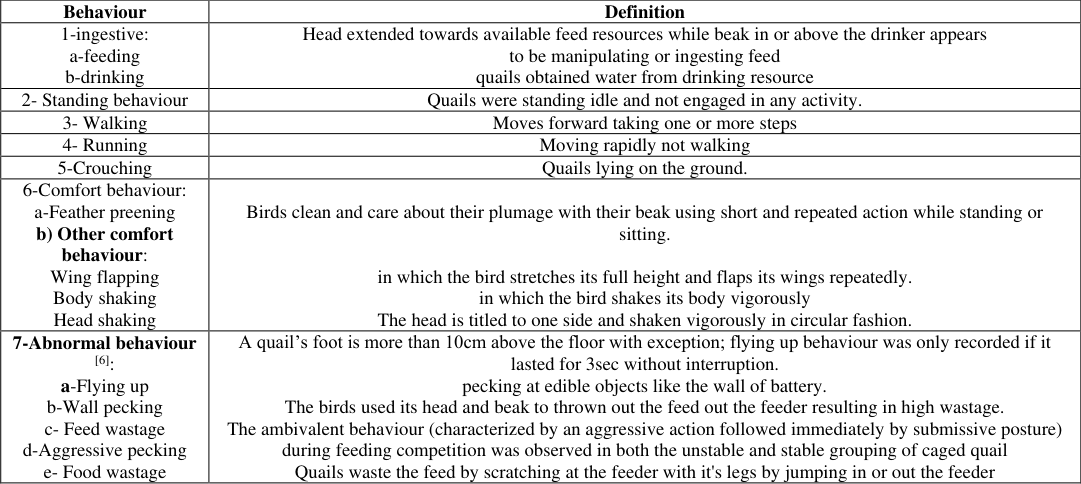 Table 1
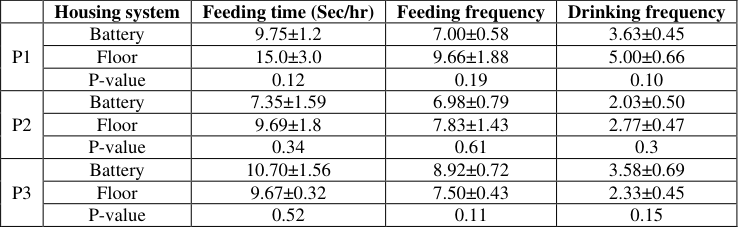 Table 1
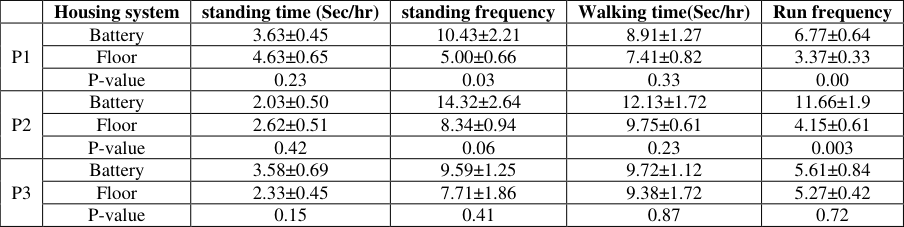 Table 2
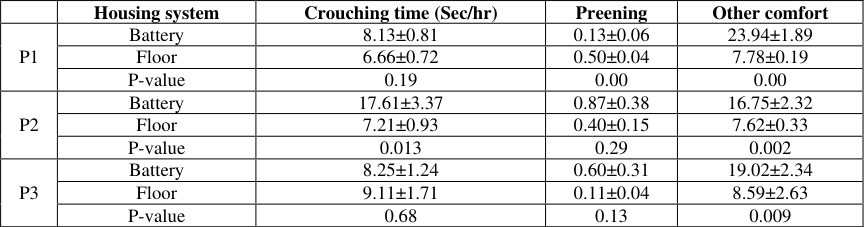 Table 3
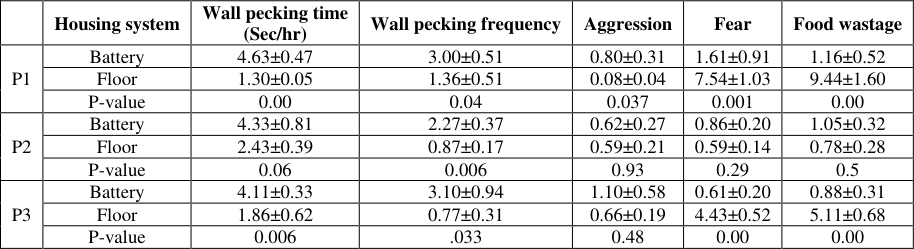 Table 4
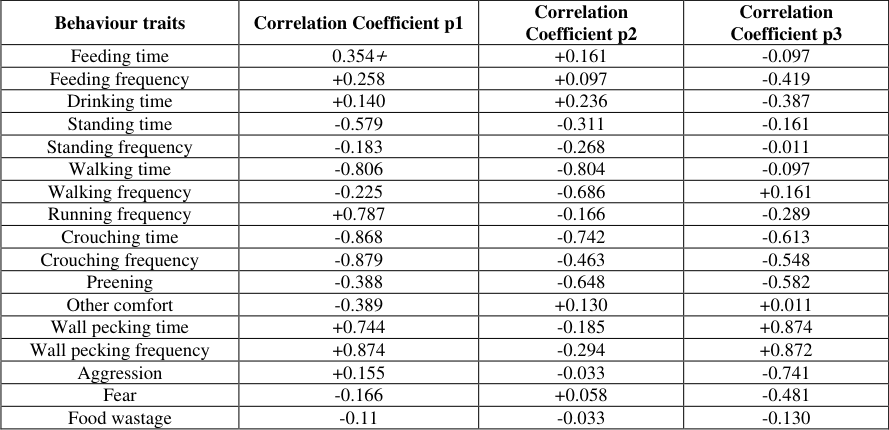 Table 5
Introduction
Circadian rhythms are the most important factor that affects the behaviour of the birds which controlled by mean of endogenous diurnal clock [1] . Floor housing system is better for satisfaction of the bird's motivation for activity, dust bathing and other important behavioural activities than cage [2] . The increase of activities in the morning may be due to decrease of temperature stress [3] . Measuring welfare of farm animals requires consideration of a variety of parameters and methods. The classical approach to use physiological parameters to assess welfare is considered more objective as they measure the real-time health status of an animal. Nevertheless, good welfare does not only include physical health of an individual but also the mental wellbeing [4] . In the Japanese quail, the eyes activity rhythm such that the interval of activity proceeds contain circadian oscillators that control circadian behaviour the time of injection cause arrhythmicity [5] .
Material and Methods
This work was carried out at the faculty of Veterinary medicine poultry farm, Zagazig University, Sharkia, Egypt. This experiment was conducted to investigate the effect of different day times on some maintenance behaviour of Japanese quail (Coturnix Coturnix Japonica).
Birds used and management
A total of 120 one-day old quail chicks were obtained from a commercial chick producer and were used in the experiment. They were randomly divided into two equal experimental groups each consisting of 3 replicates of 20 chicks each and were compared 3 periods of day early morning, mid-day and late afternoon on each housing system. In the first group, the chicks were reared in floor pens which covered with layer of saw dust (10cm depth), while the other group, chicks were reared in multi-decked cage system as welded wire with close mesh to provide secure footing avoiding leg damage and escape [6] . Food and water were available were available ad-libitum throughout the experiment where feed according to [7] as Yellow corn 56.10, Crude protein 24.9%, Soybean meal 32.73, Crude fiber 3.45%, Fish meal 5.50, Metabolized energy 3909 MJ/kg, Other feed additives 1.9, Calcium & Phosphorus 1.23%. The temperature was maintained at about 35 °C during the first week of brooding then decreased by about 3-5 °C weekly by till full feather (3-4 weeks). The birds were identified by different colored wing band on each group.
Medication
Two intervals source of vit. AD 3 E, Ca, ph in addition to anticoccidial drugs were administrated.
Observation technique
Behavioural observation was done by using a focal sample technique, videotaping [8] . The behavioural observation in both system floor and cage were recorded at 6 minutes interval through 12 hour observation period/week to represent different day times; P1(Early morning: 7-11h), P2 (Mid-day: 11-15h) and P3 (Late afternoon 15h-19h).
Behavioural patterns: [4] Table 1: The observed behavioural patterns were recorded as shown in
| — | Housing system | Feeding time (Sec/hr) | Feeding frequency | Drinking frequency |
|---|---|---|---|---|
| P1 | Battery | 9.75±1.2 | 7.00±0.58 | 3.63±0.45 |
| Floor | 15.0±3.0 | 9.66±1.88 | 5.00±0.66 | |
| P-value | 0.12 | 0.19 | 0.10 | |
| P2 | Battery | 7.35±1.59 | 6.98±0.79 | 2.03±0.50 |
| Floor | 9.69±1.8 | 7.83±1.43 | 2.77±0.47 | |
| P-value | 0.34 | 0.61 | 0.3 | |
| P3 | Battery | 10.70±1.56 | 8.92±0.72 | 3.58±0.69 |
| Floor | 9.67±0.32 | 7.50±0.43 | 2.33±0.45 | |
| P-value | 0.52 | 0.11 | 0.15 |
Table text extracted from the original PDF; superscript letters are shown inline. The original table image is below.
View original table image
Definition Behaviour
Head extended towards available feed resources while beak in or above the drinker appears to be manipulating or ingesting feed quails obtained water from drinking resource 1-ingestive: a-feeding b-drinking Quails were standing idle and not engaged in any activity.
2-Standing behaviour
Moves forward taking one or more steps 3-Walking Moving rapidly not walking 4-Running Quails lying on the ground.
5-Crouching
Birds clean and care about their plumage with their beak using short and repeated action while standing or sitting.
in which the bird stretches its full height and flaps its wings repeatedly. in which the bird shakes its body vigorously The head is titled to one side and shaken vigorously in circular fashion.
6-Comfort behaviour:
a-Feather preening b) Other comfort behaviour: Wing flapping Body shaking Head shaking A quail's foot is more than 10cm above the floor with exception; flying up behaviour was only recorded if it lasted for 3sec without interruption. pecking at edible objects like the wall of battery. The birds used its head and beak to thrown out the feed out the feeder resulting in high wastage. The ambivalent behaviour (characterized by an aggressive action followed immediately by submissive posture) during feeding competition was observed in both the unstable and stable grouping of caged quail Quails waste the feed by scratching at the feeder with it's legs by jumping in or out the feeder 7-Abnormal behaviour [6] : a-Flying up b-Wall pecking c-Feed wastage d-Aggressive pecking e-Food wastage
Results
Results
Discussion
The obtained results at Table (1) showed that the diurnal variation had a significant effect on feeding behaviour. The ingestive behaviour was increased with floor managed quail at early morning. While quail reared at battery system showed the highest level of ingestive behaviour at late afternoon. These results were similar to that obtained with [9,3,10] who mentioned that the ingestive behaviour was higher at morning than other times of photoperiods, this may be due to a decrease of heat stress. In contrast [1] found that the feeding time of ornamental birds was increased at mid-day than early morning and late afternoon, while [11] mentioned that the diurnal hours have weakly impact on the behaviour of birds. There were non-significant differences in standing time between different daytimes at both housing systems as shown in Table [2] While the standing frequency was increased with battery system at all day times especially at mid-day in compared with floor system. These results in agreement with [12] and disagree with [1,13] . There were non-significant differences in walking time between different day times, although the highest result was recorded at battery system at mid-day. Bird's activity varies over the times of day, which decreases with increased temperature, stocking density leading to decrease walking ability [14] . Concerning to the crouching time, it was increased with midday at battery managed quail than floor reared ones as shown in table (3) the highest level of crouching time recorded by quail reared at floor litter and at late afternoon. These results were similar to that obtained by [9,3,10,15,1] . The preening wasn't affected with different day times at both housing systems. While other comfort behaviour was increased with early morning at cage reared quails.
These results were consistent with [1] , while the results were argued with [9] who observed that preening and dust bathing were highest level with late evening. The most behavioural patterns of birds were greatly affected with circadian rhythms [16] Results in table (4) showed that diurnal hours had no significant effect on wall pecking behaviour, These results supported by [17,18,19] . While the results were incompatibled with [20,21,5] . The aggression wasn't affected by Cirdanian rhythms at both housing systems. While fear and food wastage were increased at morning was may be due to increase the activity of bird at this time of day. [11, 22, 23] found that The Circadian rythms have great impact on behaviour of birds at different environmental sites. Results in table (5) clarified that there was a positive Correlation coefficient between the ingestive behaviour of quail and the different diurnal hours as it increase with early morning and mid-day. These results were in line with [1] and were contraryed to [24] as who stated that the feeding behaviour occur few hours after light go on and late afternoon. [3] found that there was no correlation between circadian rythms and other behaviour of birds. There was a non-correlation between standing, walking, crouching, preening and day times. In spite of [25] showed differ. There were a negative correlation co-efficient with wall peck and mid-day, while there with other comfort and fear behaviour. While no correlation with day times and abnormal feed wastage behaviour.
Conclusion
We concluded that the ingestive behaviour was increased with floor managed quail at early morning while quail reared at battery system showed the highest level of ingestive behaviour at late afternoon. The crouching time was increased with mid-day at battery managed quail. There was a nonsignificant difference in standing time between the different daytimes.
Acknowledgement
AcknowledgmentsWe thank the staff at the Department of Veterinary Public Health, Faculty of Veterinary Medicine, Zagazig University, Egypt for providing materials used in this study. Also, we would like to thank the anonymous referees for their helpful comments on the manuscript.
Figures and tables from the paper
| — | Housing system | standing time (Sec/hr) | standing frequency | Walking time(Sec/hr) | Run frequency |
|---|---|---|---|---|---|
| P1 | Battery | 3.63±0.45 | 10.43±2.21 | 8.91±1.27 | 6.77±0.64 |
| Floor | 4.63±0.65 | 5.00±0.66 | 7.41±0.82 | 3.37±0.33 | |
| P-value | 0.23 | 0.03 | 0.33 | 0.00 | |
| P2 | Battery | 2.03±0.50 | 14.32±2.64 | 12.13±1.72 | 11.66±1.9 |
| Floor | 2.62±0.51 | 8.34±0.94 | 9.75±0.61 | 4.15±0.61 | |
| P-value | 0.42 | 0.06 | 0.23 | 0.003 | |
| P3 | Battery | 3.58±0.69 | 9.59±1.25 | 9.72±1.12 | 5.61±0.84 |
| Floor | 2.33±0.45 | 7.71±1.86 | 9.38±1.72 | 5.27±0.42 | |
| P-value | 0.15 | 0.41 | 0.87 | 0.72 |
Table text extracted from the original PDF; superscript letters are shown inline. The original table image is below.
View original table image
| — | Housing system | Crouching time (Sec/hr) | Preening | Other comfort |
|---|---|---|---|---|
| P1 | Battery | 8.13±0.81 | 0.13±0.06 | 23.94±1.89 |
| Floor | 6.66±0.72 | 0.50±0.04 | 7.78±0.19 | |
| P-value | 0.19 | 0.00 | 0.00 | |
| P2 | Battery | 17.61±3.37 | 0.87±0.38 | 16.75±2.32 |
| Floor | 7.21±0.93 | 0.40±0.15 | 7.62±0.33 | |
| P-value | 0.013 | 0.29 | 0.002 | |
| P3 | Battery | 8.25±1.24 | 0.60±0.31 | 19.02±2.34 |
| Floor | 9.11±1.71 | 0.11±0.04 | 8.59±2.63 | |
| P-value | 0.68 | 0.13 | 0.009 |
Table text extracted from the original PDF; superscript letters are shown inline. The original table image is below.
View original table image
| — | Housing system | Wall pecking time (Sec/hr) | Wall pecking frequency | Aggression | Fear | Food wastage |
|---|---|---|---|---|---|---|
| P1 | Battery | 4.63±0.47 | 3.00±0.51 | 0.80±0.31 | 1.61±0.91 | 1.16±0.52 |
| Floor | 1.30±0.05 | 1.36±0.51 | 0.08±0.04 | 7.54±1.03 | 9.44±1.60 | |
| P-value | 0.00 | 0.04 | 0.037 | 0.001 | 0.00 | |
| P2 | Battery | 4.33±0.81 | 2.27±0.37 | 0.62±0.27 | 0.86±0.20 | 1.05±0.32 |
| Floor | 2.43±0.39 | 0.87±0.17 | 0.59±0.21 | 0.59±0.14 | 0.78±0.28 | |
| P-value | 0.06 | 0.006 | 0.93 | 0.29 | 0.5 | |
| P3 | Battery | 4.11±0.33 | 3.10±0.94 | 1.10±0.58 | 0.61±0.20 | 0.88±0.31 |
| Floor | 1.86±0.62 | 0.77±0.31 | 0.66±0.19 | 4.43±0.52 | 5.11±0.68 | |
| P-value | 0.006 | .033 | 0.48 | 0.00 | 0.00 |
Table text extracted from the original PDF; superscript letters are shown inline. The original table image is below.
View original table image
| Behaviour traits | Correlation Coefficient p1 | Correlation Coefficient p2 | Correlation Coefficient p3 |
|---|---|---|---|
| Feeding time | 0.354+ | +0.161 | -0.097 |
| Feeding frequency | +0.258 | +0.097 | -0.419 |
| Drinking time | +0.140 | +0.236 | -0.387 |
| Standing time | -0.579 | -0.311 | -0.161 |
| Standing frequency | -0.183 | -0.268 | -0.011 |
| Walking time | -0.806 | -0.804 | -0.097 |
| Walking frequency | -0.225 | -0.686 | +0.161 |
| Running frequency | +0.787 | -0.166 | -0.289 |
| Crouching time | -0.868 | -0.742 | -0.613 |
| Crouching frequency | -0.879 | -0.463 | -0.548 |
| Preening | -0.388 | -0.648 | -0.582 |
| Other comfort | -0.389 | +0.130 | +0.011 |
| Wall pecking time | +0.744 | -0.185 | +0.874 |
| Wall pecking frequency | +0.874 | -0.294 | +0.872 |
| Aggression | +0.155 | -0.033 | -0.741 |
| Fear | -0.166 | +0.058 | -0.481 |
| Food wastage | -0.11 | -0.033 | -0.130 |
Table text extracted from the original PDF; superscript letters are shown inline. The original table image is below.
View original table image
References
25 in the original paper- Abdel-Hamid El. Sh. Behaviour and management guide of some ornamental birds in relation to diurnal hours. Int J Adv Res. 2017; 5(2):2084-2090.
- Fouad MA, Razek AHA, Badawy SM. Broilers welfare and economics under two management alternatives on commercial scale. Int J Poul Sci. 2008; 7:1167-1173. 11. Hocking PM, Maxwell MH, Rob.
- Amado M, Diego B, Vanner B, Carla T, Concepta M, Francisco E. Behaviour of captive Ostrich chicks from 10 days to 5 months of age. R Bras Zootec. 2011; 40(7):1613-1618.
- Dawkins M. Using behaviour to assess animal welfare. Animal welfare potters bar then wheath ampstead. 2004; 13:S3-S8.
- Chabot CC, Menaker M. Effects of physiological cycles of infused birds, Brain Res. 1993; 620:297-300.
- Abdel-Hamid El. Sh. Effect of managerial systems on behaviour and performance of quail. Master thesis. Faculty of veterinary Medicine, Zagazig University. Egypt, 2009.
- AOAC Official methods of analysis. Association official analytical chemists, Gaithersburg, USA, 2002.
- Gebhardt-Henrich SG, Steiger A. Effect of aviary and box sizes on body mass and behaviour of domesticated budgerigars. Animal welfare. 2006; 15:353-358.
- Mohammed HH. The Potential Effect of Circadian Rhythms and Lighting Duration on Behaviour and Growth Performance of Quails under Egyptian Condition. Zagazig Veterinary Journal Research Article 2017; 45(S1):31-36, DOI: 10.21608/zvjz.2017.29238.
- Wirminghus J, Downs C, Perrin M, Symes C. Abundance and activity patterns of the cape parrot in two a fromontane forests in South Africa. African Zool. 2001; 36(1):71-77.
- Lincolin G, Clarke I, Hut R, Hazlerigg D. Characterizing a mammalian circannual pace marker. Science. 2006; 314:1941-1944.
- Lee YP, Chen TL. Daytime behavioural patterns of slowgrowing chickens in deep-litter pens with perches. British Poultry Science. 2007; 48(2):113-120.
- Snyder NFR, Enkerlin-Hoeflich EC, Cruz-Nieto MA. Thick billed parrot, Rhynchopsitta Pachyrhncha. In the bird of North America, ed., D.B. Gill and A-poolPhiladelphia American ornithologists Union and Academy of Natural sciences of Philadelphian, 1999.
- Nielsen BL, Litherland M, Nøddegaard F. Effects of qualitative and quantitative feed restriction on the activity of broiler chickens. Appl. Anim. Behav. Sci. 2003; 83:309-323 doi: http://dx.doi.org/10.1016/S01681591(03)00137-0.
- Ayala-Guerro F. Sleep patterns in the parakeet melopsittacus undulates. Physiology and behaviour, 1989.
- Kondo N, Sekijima Kondo T, Takamatsu J, Ohtsu T. Circannual control of hibernation by HP complex in the brain. Cell. 2006; 125:161-172.
- Kundu A, Senani S, Ahlawat SPS, Rai RB, Yadav SP, Chalterjee RN et al. Japanese quail under cage and deeplitter system of rearing in Andman and Nicobar Island. (Indian, J. poultry. Sci. 2003; 38(1):63-66.
- Khurshid A, Farooq M, Durrani FR, Sarbiland K, Manzoor A. Hatching performance of Japanese quails livestock research for rural development. 2004; 16(1):15.
- Appleby MC, Mench JA, Hughes BO. Poultry behaviour and welfare. Walking ford, England CABI publishing, 2004, 46.
- Bertin A, Richard-Yaris MA. Mothers fear of human affect the emotional reactivity of young in domestic Japanese quail. Applied Animal Behaviour. 2004; 89:215-231.
- Cassone VM. Effects of melatonin on vertebrate circadian systems, Robertson, The avian pineal, a vertebrate model system of the TINS. 1990; (13):457464.
- Newton I. The ecology of bird migration London, UK. Academic press, 2007.
- Jones SG, Vya Zovskiy VV, Cirelli C, Tononi G, Bence RM. Homestatic regulation of sleep in the whitecrowned sparrow (Zonotrichia Leucophrysgambelii). BMC Newosci. 2008; 9:47-60.
- Jensen P. The ethology of domestic animals and edition part. 2009; 9:121-24
- Anthony JB. Photoperiod effects on broiler performance and behaviour. A thesis of Master degree. Athens, Georgia, 2010.
Cited by 1
From OpenAlex, OpenCitations and reference lists read by Scinovex
- How the diurnal hours affects maintenance behavior in Japanese quail concerning rearing modification systems ↗
Shereen El. Abdel-Hamid, Azhar F. Abdel Fattah · Journal of Animal Behaviour and Biometeorology · 2020
This study was carried out to investigate the impact of times of day on the behavior of Japanese quail concerning managerial modifications systems. A total of 120 one-day-old quail chicks were used in this study. 60 chicks were housed in cage systems; distributed into 3 subgroups (20 birds on each), a normal cage group, a cage with cover as wire…
❝ 2PDF