
Research article · 2019 · Full text
International Journal of Veterinary Sciences and Animal HusbandryTrypanosomiasis in equines: A brief discussion
Volume 4(6) · Pages 40–44
Research areasTrypanosoma species research and implications
Abstract
Author-writtenTrypanosomiasis causes by vector born haemoprotozoa in all mammals including human beings. In equines most common forms are Surra, Mal-de-caderus, Nagana, Dourine etc. It is a vector borne disease transmitted mechanically by various species of biting flies from the blood of infected animals. Surra is transmitted by tabanus and Stomoxys species. It is mostly prevalent during the monsoons and rainy season due to increase in the number of biting flies. The parasites are commonly observed in the swelling of oedematous lesion but less frequently seen in the blood. Diagnosis is based upon history of prevalence of infection, biting flies, clinical signs and symptoms. Laboratory examination of blood and body fluids by direct examination, chemical test, inoculation test and serological test helps in detection of disease. Treatment of the affected animals are done by preventive and curative measures. Chemotherapeutic agents like Diminazene aceturate (DA), Suramine, Quinapyramine, Isometanedium chloride and melarosomine dihydrochloride (Cymelarsan) are used. As vectors are the major transmitting agents thus control of vectors and changing in animal husbandry practice is best preventive measures for this zoonotic disease.
Summary
Source-checkedPlain-language reading of the full paper, prepared with AI and checked against the text. Each point links to the authors' own words.
Why it matters
- Trypanosomiasis is an infectious disease caused by Trypanosoma parasites that affect the blood and tissues of humans and other mammals. View evidence ↗
- The disease is a significant concern due to the economic losses it causes across Asia, Africa, Latin America, and the Middle East. View evidence ↗
- Controlling the disease in horses is difficult because of limited diagnostics, a lack of vaccines, and drugs that cannot treat neurological stages of infection. View evidence ↗
The question
- The authors aim to discuss the various forms of Trypanosoma species that cause disease in horses. View evidence ↗
What they did
- The discussion focuses on several species, including T. evansi (Surra), T. equinum (Mal-de-caderus), T. equiperdum (Dourine), and species like T. vivax and T. brucei that cause Nagana. View evidence ↗
What they found
- Transmission varies by disease: Surra and Mal-de-caderus are spread by biting flies, Nagana is linked to Tsetse flies, and Dourine is transmitted sexually. View evidence ↗
- Surra has an incubation period of 1 to 8 weeks and presents with fever, anemia, emaciation, and ulcerative lesions. View evidence ↗
- Nagana in horses is characterized by depression, a rectal temperature of 104°F, increased heart rate, tachypnea, and severe anemia. View evidence ↗
- Dourine has an 8-12 week incubation period and progresses through three stages: edema, the 'dollar stage' (plaques ≥ 3 cm), and paralysis of the hind legs. View evidence ↗
- Direct examination of fresh blood smears is considered the confirmatory method for diagnosing the infection. View evidence ↗
- Treatment options include Diminazene aceturate (3.5mg/kg), Quinapyramine methyl-sulphate (8mg/kg), and Melarosomine dihydrochloride (0.25-0.5mg/kg). View evidence ↗
- There is currently no vaccine available because the parasites rapidly change their surface glycoproteins to evade the host's immune system. View evidence ↗
What it means
- The authors conclude that because vectors are the primary means of transmission, controlling these vectors is the most effective way to prevent the disease. View evidence ↗
- The authors note a lack of specific diagnostic methods, emphasizing that early treatment is critical for animal survival. View evidence ↗
Visual summary
1 visualsIllustrations explain the paper; they do not show study data.
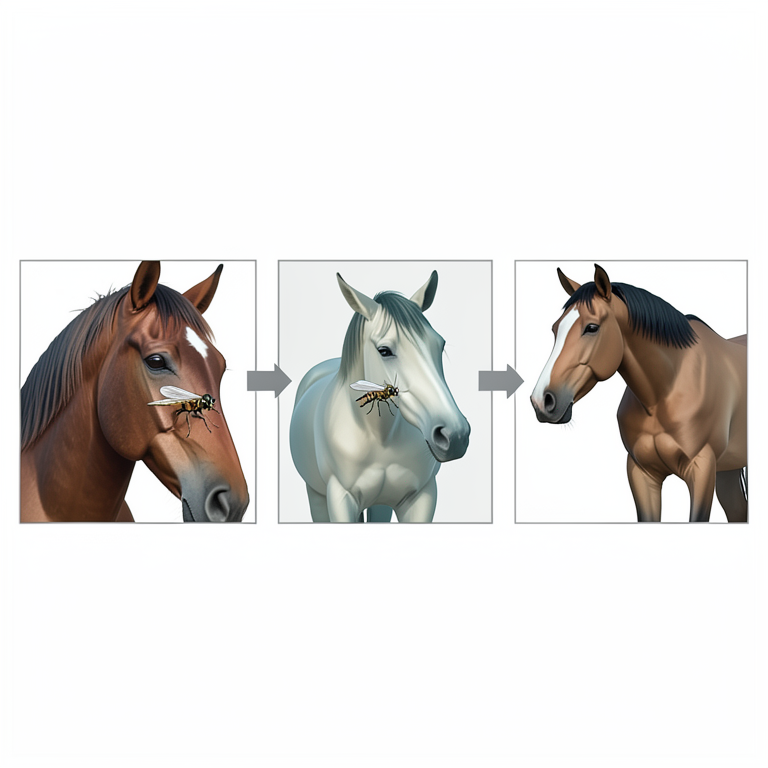
Transmission Pathways of Equine Trypanosomiasis
AI-generated conceptual illustration (horses and biting flies). It explains the idea and does not show study data.
View source evidence ↗Figures & tables
From the original paper Table 1
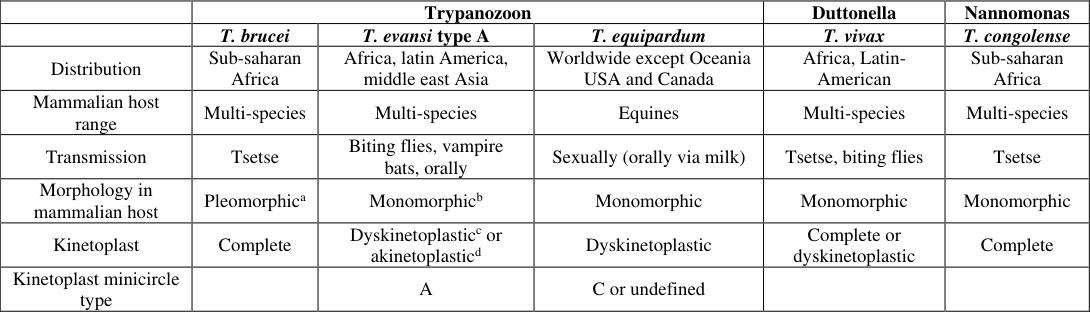 Table 2
Introduction
Trypanosomiasis is an infectious disease caused by several species of the genus Trypanosoma, a blood and tissue parasite found in mammals including human beings. The biting insects are the main transmitter of the disease in which biological transformation takes place (Desquesnes et al., 2013) [1] . Here, we are going to mainly discuss about the diseases of horse caused by different forms of Trypanosoma species. In equines the most common forms causing disease are Trypanosoma evansi, causative agent of "Surra"; T. equinum, causative agent of "Mal-decaderus"; T. equiperdum causative agent of "Dourine". The other species affecting horses are T. vivax, T. congolense, T. dimorphon, T. brucei etc. (Mondal, 2012) [4] which cause "Nagana" in horses. The disease causes important economic losses in Africa, the Middle East, Asia and Latin America. In world Trypanosoma evansi was the first pathogenic mammalian Trypanosome to be discovered (Hoare, 1972) [9] in the blood of Indian equines and dromedaries in 1880 by Griffith Evans (Desquesnes et al., 2013) [1] . Major obstacles to the local and global control of equine trypanosomiasis are the lack of vaccines, the inability of drugs to cure the neurological stage of the infections, the inconsistent case definitions and the limitations of current diagnostics.
Taxonomy and Morphology
Taxonomical classification of parasite Trypanosoma is described in table 1 Table 1: (Mondal, 2012) [4] Order [9] with prevalence in almost all over the country, where environment for breeding of fly vectors is most suitable (Bhatia et al., 2006) [14] . Occurrence of Trypanosomiasis depends upon the climatic and ecological condition which determine the distribution and abundance of the insect vectors of Trypanosomes involved. It is mostly prevalent during the monsoons and rainy season due to increase in the number of biting flies. Dourine transmitted during coitus; it is not influenced by environmental factors. Hence can occur anytime and anywhere. Dourine was present in North America and Canada until 1920s and in the Northern Europe and Balkans until 1940s. The recent outbreak of Dourine in Southern Europe underlined the need for constant vigilance and surveillance. The range of potential biting fly vectors of T. evansi is not known but where large number of biting fly population exist it might be possible that T. evansi gets introduced in imported livestock and get spread thereafter. Incidence of trypanosomiasis outbreak have been reported to be increased in camels after the advent of Indra Gandhi Canal and irrigation of vast tracts of arid land in Western Rajasthan (Pathak and Khanna, 1995) [10] . Again, the incidence of trypanosomiasis in bovines was found to be directly proportional to onset of monsoon to post monsoon in Panjab (Soodan et al., 1995) [11] , Andhra Pradesh (Prasad et al., 1997) [12] , West Bengal (Ray et al., 1992) [13] , Bihar (Sinha et al., 2006) [14] , Chhattisgarh (Agarwal et al., 2003) [16] and Jammu (Raina et al., 2000) [15] .
| Order | Kinetoplastida |
|---|---|
| Family | Trypanosomatidae |
| Genus | Trypanosoma |
| Species | T. evansi, T. equinum, T. equiperdum, T. vivax, T. congolense, T. brucei, T. dimorphon |
Table text extracted from the original PDF; superscript letters are shown inline. The original table image is below.
View original table image
Transmission
It is a vector borne disease transmitted mechanically by various species of biting flies from the blood of infected animals. Surra is transmitted by tabanus and Stomoxys species. Mal-de-caderus is transmitted by biting flies in a mechanical way. Dourine is transmitted through sexual intercourse where unrestricted and unsupervised mating is allowed. Nagana is influenced by degree of contact between horses and various types of Tsetse flies. Trypanosoma equiperdum is transmitted sexually, and T. evansi is transmitted mechanically by blood-sucking flies, vampire bats, and possibly sexually. Oral transmission of T. evansi via contaminated meat or carcasses.
Forms of trypanosomiasis in Equines
Surra: It mainly occurs in horse and camel, and known "surra" in Asia and Africa means "rotten". It is also prevalent in cattle and dog. Incubation period is 1-4 weeks and may exceed up to 8 weeks. The disease shows symptoms like fever, anemia, emaciation, urticarial plaques and ulcerative lesion in the mucocutaneous junction. The animals on affection also shows dullness, weakness due to anorexia and subsequent weight loss, there are petechial haemorrhages and oedema in ventral parts, udder or scrotum and sheath, low milk and meat yield, poor traction power, increased abortion and death. In horses the disease is chronic in nature and lasts for 2-3 years commonly known as 'Tebersa'. Generally, it occurs in all age groups but mainly starts just after weaning.
Mal-de-caderus:
The clinical signs shown in this case are conjunctivitis, eye lesions, keratitis, recumbency, fever etc. Nervous symptoms like periodic convulsions are also seen in some cases. Stumbling of fore-legs and dragging of hind legs is also seen. There may be signs of oedema in legs, brisket, abdomen, udder, testicles and sheath.
Nagana: Nagana is a Zulu word which means 'in low or depressed spirit'. The clinical songs of Nagana in horses is characterized by lethargic or depressed condition of animal, pyerexia (104°F rectal temperature), increase heart rate, tachypnea, severe anaemia with weakness and signs of ataxia.
Small oedamatous nodule on the skin mainly on flank region. Mucous membrane become pallor due to haemolysis. Nagana mainly caused by T. brucei brucei in horses resulting in death within 2 weeks to 3 months. Among the inflected animals 20% of horses infected with T. brucei may develop keratitis and corneal opacity (Sandy Love, Tim S. Mair, 2012) [7] .
Dourine: Meaning of Dourine is 'unclean'. Incubaion period is 8-12 weeks and this develops through three phages. First is 'stage of oedema' these shows visible symptoms like urethral or vaginal discharge, oedema of vagina and prepuce and the oedema extend until the belly. Second phage is 'dollar stage' circular urticarial plaques having 3 cm or more diameters are present beneath the skin mainly on flank region which is known as Dollar spots. Third phase is 'stage of paralysis' characterised by incoordination and unilateral paralysis of hind legs.
Postmortem lesion
Marked anaemia, emaciation, spleenomegaly, enlargement of lymph nodes is seen. Petechiae may be observed on the serous surface and in the parenchyma of liver and kidneys. In T. equiperdum infection the carcass appears emaciated with muscular atrophy, oedematous infiltration of the perineal tissue and abdominal wall may be seen. Serous infiltration may be present along with large nerved trunk. The parasites are commonly observed in the swelling of oedematous lesion but less frequently seen in the blood.
Diagnosis
Diagnosis is based upon history of prevalence of infection, biting flies, clinical signs and symptoms. Laboratory examination of blood and body fluids by direct examination, chemical test, inoculation test and serological test helps in detection of disease. [20] It is done by demonstration of organism in fresh blood smear collected from infected animal. It is the confirmatory way of diagnosis. In acute infection organisms are readily detectable on freshly stained blood slides but in chronic cases thick and thin blood smear collected from lymphoid fluid should be studied because parasitaemia is low in chronic cases. In allergic test, 0.1 ml antigen which consist of acetone dried trypanosomes with normal saline (1: 4000) also used for diagnosis of infection. 1ml of the antigen is injected intradermally on the side of neck in suspected animal. In positive cases there was no painful oedematous swelling on the side.
Direct Examination: (Tewari et al., 2013)
Direct Examination: (Tewari et al., 2013)
Chemical Test
Chemical Test
Treatment
There are four major groups of drugs which are used for treatment of Trypanosomiasis in horses. These drugs are divided into two categories i.e 'curative' drugs and ' preventive' drugs. Curative drugs are used to kill parasites but they cannot kill 100% of parasites. Preventive drugs are having chemoprophylaxis activity which helps to kill the parasites and also prevent the new parasites infection. Diaminazine aceturate: Diminazene aceturate (DA) is an aromatic diamidineIt is a curative drug mainly used for T. evansi @ 3.5mg/kg body weight deep intramuscularly given. Its use in horses and dogs is limited due to poor efficacy and tolerance in these species. Quinapyramine: Quinapyramine methyl-sulphate is used @ 8 mg/ kg body weight by subcutaneous injection. Quinapyramine sulphate and Quinapyramine chloride (Triquin) combination used as curative/preventive drug in horses given subcutaneously. Suramin: Is and uteric compound and 10% solution in sterile distilled water is given @ 4g/ 45kg body weight in 3 divided doses over a period of 3 weeks, intravenously. A combination of 8.9gm suramin and 10 gm Quinapyramine is also used. Isometanidium chloride: It acts as both curative as well as Preventive drugs and belongs to the phenanthridine family, as well as homidium chloride or bromide. As a curative it is given @ 0.5 mg/kg body weight and as a preventive @ 1 mg/kg body weight through deep intramuscularly or subcutaneously. Diaminazine aceturate-and Isometanidium chloride is used alternatively to induce 'senative effect' that means if one drug resistance develop another drug helps to prevent the infection. Melarosomine dihydrochloride: The latest trypanocidal drug is melarosomine dihydrochloride (Cymelarsan), first available in 1992 for commercial use (Desquesnes, M. et al, 2013) [1] . In case of horse it is given @ 0.25-0.5 mg/kg body weight via deep intramuscular injection.
Alternative approaches in treatment: Currently, in vivo and in vitro trypanocidal activity of free and nano encapsulated curcumin against Trypanosoma evansi is evaluated and found significant positive result to reduce parasitemia on adult male wistar rats. Treatment with essential oil of achyrocline satureioides in rats infected with Trypanosoma evansi revealed that essential oil did not eliminate the parasites from the bloodstream, but it reduced the number of trypanosomes, mainly by its nano encapsulated form so, association of this natural product with a trypanocidal drug may enhance its curative effect. Study on pre-clinical mouse model indicated that Heat shock protein 90 (Hsp90) from protozoan parasites may as a potential drug target of trypanosomiasis.
Alchornedine a new guanidine alkaloid from the leaves of Alchornea glandulosa was found effective against trypanosomiasis. In vitro trypanocidal activity of macela (Achyrocline satureioides) extracts against Trypanosoma evansi was also evaluated (Baldissera et al., 2014b) [19] .
Zoonotic aspect
Trypanosome has a wide range of zoonotic importance. Trypanosoma brucei spp., the causative agents of human sleeping sickness. In 2005, a human case of trypanosomosis caused by T. evansi was reported in a farmer from the Chandrapur district in the Maharashtra State, India. In this case, the man had fluctuating trypanosome parasitaemia associated with febrile episodes for several months and treated successfully with suramin. Immunosuppressed individuals living in the regions where T. evansi is endemic are under risk.
Prevention and Control
Trypanosomiasiasis is one of the important disease of horses which causes high mortality. As it is a vector-borne disease so control of vector is most important. Vector is controlled by different types of insecticides and fly repellents. Various type of trap is used to catch the flies i.e. Nzi trap, vavoua trap etc. Identification and isolation of infected animal from healthy animals. Protection of animals by using mosquito net in the stable and smoke released to protect the horses from biting of flies. As vampire bat is also transmit the infection 'Japanese net' is used to catch the vampire. T. equiperdum is sexually transmitted so mating should be allowed with infection free animal or semen should be collected from healthy animal for artificial insemination. For Trypanosomiasis no vaccine is available as the organisms change their surface glycoprotein rapidly to prevent immune response. Another reason is that the parasite undermining the host's capacity to mount an efficient immune response and to maintain its immunological memory termed as immunodeficiency to the host (Pays et al., 2004) [18] . Although a solitary report, wherein formalin inactivated T. evansi (2×10⁶ count) were administered in mice and found protective against homologous challenge (Tewari et al., 2009) [17] . Immunization with T. evansi recombinant beta-tubulin, induced some protection against T. evansi, T. equiperdum and T. brucei infection in mice.
Conclusion
Trypanosoma is an important blood protozoa causes worldwide losses in equine population and also has economic impact. Vectors are main transmitting agent of this zoonotic parasite. Thus control of vectors is the best method to prevent this parasitic hazards. Although there is the lack of specific diagnostic methods, but early treatment with most effective drugs can save the animals.
Figures and tables from the paper
References
22 in the original paper- Desquesnes M, Holzmuller P, Lai DH, Dargantes A, Lun ZR, Jittaplapong S. Trypanosoma evansi and surra: a review and perspectives on origin, history, distribution, taxonomy, morphology, hosts and pathogenic effects. Bio Med research international. 2013, 194176.
- Luckins AG. Equine trypanosomiasis. Centre for Tropical Veterinary Medicine. Royal school of Veterinary studies. University of Edinburgh. Eastern bush, Scotlan, 1996.
- Bhatia BB, Pathak KML, Juyal PD. Text book of Veterinary Parasitology 3 rd revised edition, 2012.
- Wernery U, Zachaniah R, Mumford JA, Luckins T. Preliminary evaluation of Diagnostic Tests using horses experimentally infected with Trypanosoma evansi, 2000.
- Clausen PH, Chuluan S, Sodnomdarjae R, Matthias G, Nocckler K, Stack KZ et al. A field study to estimate the prevalence of Trypanosoma equipardum in mongolian horses, 2003.
- Sandy Love, Tim S Mair. Infectious Diseases and Parasitology. In Equine Medicine, Surgery and Reproduction (2 nd edition), 2012.
- Büscher P, Gonzatti MI, Hébert L, Inoue N, Pascucci I, Schnaufer A et al. Equine trypanosomosis: enigmas and diagnostic challenges, Büscher et al. Parasites Vectors, 2019; 12:234 https://doi.org/10.1186/s13071019-3484-x
- Hoare CA. The Trypanosome of Mammals: A Zoological Monograph. Blackwell Scientific Publications. Oxford. UK. 1972, 749.
- Pathak KML, Khanna ND. Trypanosomosis in camel (Camelus dromedarius) with particular reference to Indian subcontinent: A review. Int. J Anim. Sci., 1995; 10:157-162.
- Soodan JS, Khahra SS, Juyal PD. Efficacy of capillary tube agglutination test (CAT) and get diffusion (GD) test for detection of experimental Trypanosoma evansi infection in donkeys. Indian Vet. J. 1995; 72:806-810.
- Prasad D, Babu RM, Rao AVN. Incidence of trypanosomiasis in buffaloes. Indian Vet. J. 1997; 74:887-888.
- Ray D, Biswas G, Sen GP. Trypanosoma infection in cattle and buffalo. Indian J. Anim. Sci. 1992; 62:42-42.
- Sinha BS, Verma SP, Mallick KP, Samantaray S, Kumar B, Kumar RP. Study on epidemiological aspects of bovine trypanosomosis in some districts of Bihar. J. Vet. Parasitol. 2006; 20:69-71.
- Raina R, Raina AK, Bhadwal MS. Outbreak of surra in buffaloes and ponies. Indian J Vet. Med. 2000; 20:32-32.
- Agrawal R, Singh R, Kumar M, Upadhyay AK. Epidemiological features of bovine trypanosomiosis and babesiosis in durg district of Chhattisgarh state. Indian Vet. J. 2003; 80:314-317.
- Tewari AK, Rao JR, Mishra AK. Protective potentiality of killed Trypanosoma evansi in mice. Indian Vet. J., 2009; 86:892-893.
- Pays E, Vanhamme L, Perez Morga D. Antigenic variation in Trypanosoma brucei: Facts, challenges and mysteries. Curr. Opin. Microbiol. 2004; 7:369-374.
- Tewari AK, Saravanan BC, Sudan V, Maharana BR, Sudhakar NR. Trypanosomosis caused by T. evansi: An insight. Livestock Management Product Technology and Health, 2013, 409-411.
- Holland WG, Claes F, Thanh NG, Tam PT, Verloo D et al., A comparative evaluation of parasitological tests and a PCR for Trypanosoma evansi diagnosis in experimentally infected water buffaloes. Vet. Parasitol., 2001; 97:23-33.
- Desquesnes M, Davila AMR. Applications of PCR-based tools for detection and identification of animal trypanosomes: A review and perspectives. Vet Parasitol. 2002; 109:213-231.
- Parashar R, Shanker D, Sudan V, Jaiswal AK. PCRbased diagnosis of surratargeting mini-chromosomal satellite DNA for unraveling the cryptic epizootiology of bubaline trypanosomosis. Indian J Anim. Sci., 2015; 85:43-45.
- Jaiswal AK, Sudan V, Verma AK. Insight into Trypanosomiasis in Animals: Various Approaches for its Diagnosis, Treatment and Control: A Review. Asian J Anim. Sci. 2015; 9(5):172-186.
Cited by 3
From OpenAlex, OpenCitations and reference lists read by Scinovex
- EFFICACY OF QUINAPYRAMINE SULPHATE, ISOMETAMEDIUM CHLORIDE AND DIMINAZENE ACETURATE FOR TREATMENT OF SURRA ↗
M Amjad, M.H. Saleem, M.Z. Iqbal, Amna Hassan, Abdul Jabbar, M Ashraf et al. · The Journal of Animal and Plant Sciences · 2021
Trypanosomiasis (Surra) is a parasitic and zoonotic disease caused by Trypanosoama evansi, transmitted by insect vectors Tabanus and Stomoxys mechanically. The aim of the present study was to determine the therapeutic efficacy of various trypanosidal drugs against trypanosomiasis in Thoroughbred horses. Horses having clinical signs of trypanosomiasis were diagnosed through blood smear through a microscope were selected for this study.…
❝ 3PDF - The diversity of trypanosomatids in Culicoides biting midges in the Eastern Baltic region ↗
Margarita Kazak, Kristina Valavičiūtė-Pocienė, Rita Žiegytė, Vaidas Palinauskas, Rasa Bernotienė · Medical and Veterinary Entomology · 2025
Culicoides (Diptera, Ceratopogonidae) biting midges serve as vectors of viruses, bacteria, filaria, and protozoans, such as dixenous avian blood parasites (Trypanosomatidae). Additionally, these insects can harbour insect-specific flagellates-monoxenous trypanosomatids-which are generally considered harmless commensals; however, in certain cases, they can increase mortality or reduce the fitness of their insect hosts. Recent studies indicate that the prevalence of trypanosomatids in wild-caught…
❝ 1 - Blood Transfusion as an Adjunct Therapy in a Foal Affected with Trypanosomiasis ↗
Balusupati Indhu Teja, Jothi J, A Sangeetha, Balakrishna A, Satish Kumar K · Indian Journal of Veterinary Medicine · 2024
Trypanosomiasis is an infectious haemo protozoan disease that affects various domestic, pet, and wild animals. A 9-month-old foal was presented to the Veterinary Clinical Complex of the College of Veterinary Science, Rajendranagar, Hyderabad with a complaint of reduced appetite, red color urine, and rapid loss of weight for a week. Upon physical examination pale conjunctival and buccal mucous membranes were…
❝ 0PDF