
Research article · 2019 · Full text
International Journal of Advanced Biochemistry ResearchStudy of serum calcium and serum uric acid in preeclampsia cases in and around Chitradurga
Volume 3(1) · Pages 31–36 · DOI: 10.33545/26174693.2019.v3.i1a.30 ↗
Research areasPregnancy and preeclampsia studiesLiver Disease Diagnosis and Treatment
Abstract
Author-writtenPre-eclampsia is defined as development of hypertension and proteinuria (> 300mg urinary protein in 24hrs urine) after 20th week gestation. The present study aims to find correlation and usefulness of serum total calcium and uric acid level in preeclampsia. The study was conducted in Basaveshwara Medical College & Hospital from January 2014 to September 2014. Serum Calcium, Uric acid and 24 hours Urinary proteins were estimated. There was a significant decrease in Serum total calcium and increase in serum uric acid in cases of preeclampsia as compare to control group. There was a negative Correlation of serum total calcium and Positive correlation of Serum Uric acid with 24 hour Proteinuria, Systolic & Diastolic Blood Pressure. The study concluded that there was significant hypocalcaemia and hyperuricaemia associated with Preeclampsia. They have greater diagnostic and prognostic value and can be used as screening tests for early prediction of preeclampsia.
Summary
Source-checkedPlain-language reading of the full paper, prepared with AI and checked against the text. Each point links to the authors' own words.
Why it matters
- Preeclampsia is a major global cause of maternal and perinatal illness and death, affecting an estimated 4% to 18% of pregnancies in developing countries. View evidence ↗
- Dietary calcium deficiency may complicate preeclampsia because low serum calcium can trigger parathyroid hormone, leading to vessel contraction and hypertension. View evidence ↗
- High levels of uric acid (hyperuricaemia) are considered a biochemical feature of preeclampsia, likely caused by reduced uric acid clearance and tubular retention of urate. View evidence ↗
The question
- The study aimed to determine the association between preeclampsia and levels of serum total calcium and uric acid, and to evaluate their usefulness as biomarkers. View evidence ↗
What they did
- The researchers conducted a case-control study comparing 50 women with preeclampsia to 50 normal pregnant women. View evidence ↗
- The case group consisted of 50 primigravida women aged 18-35 years with preeclampsia after 20 weeks of gestation and no prior history of hypertension or organ dysfunction. View evidence ↗
- Statistical analysis included Pearson's correlation to study parameters, with a p-value of less than 0.05 defined as statistically significant. View evidence ↗
What they found
- Women with preeclampsia had significantly lower mean serum total calcium (8.37 mg/dl) compared to the control group (9.43 mg/dl). View evidence ↗
- Mean serum uric acid was significantly higher in women with preeclampsia (7.04 mg/dl) than in the control group (4.61 mg/dl). View evidence ↗
- The study found an odds ratio of 6.52, suggesting that women with hypocalcaemia are approximately 6 times more likely to develop preeclampsia. View evidence ↗
- An odds ratio of 9.33 indicates that women with hyperuricaemia are approximately 9 times more likely to develop preeclampsia. View evidence ↗
What it means
- The authors concluded that hypocalcaemia and hyperuricaemia are significantly associated with preeclampsia, and their levels correlate with the severity of the disease. View evidence ↗
- The authors recommend using serum total calcium and uric acid as inexpensive screening tests for the early prediction and prognosis of preeclampsia. View evidence ↗
- A stated limitation of the study is that it did not account for the dietary intake of calcium. View evidence ↗
Figures & tables
From the original paper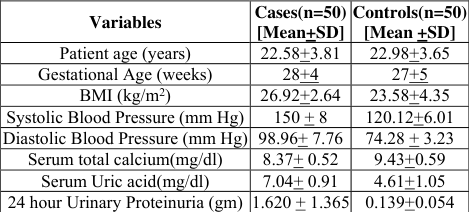 Table 1
 Table 2
 Table 3
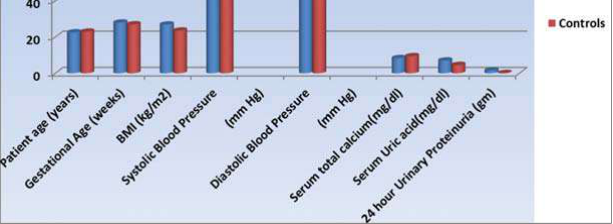 Figure 1
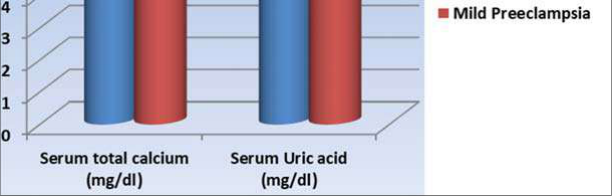 Figure 2
 Table 5
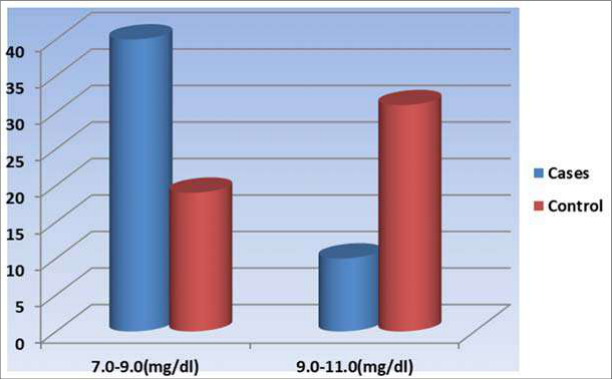 Figure 4
Introduction
Pregnancy is both desired and demanding for every woman of reproductive age.It is essentially a period that a woman's body undergoes adaptive physiological changes to accommodate fetal growth. One of the potential complications during this period is Preeclampsia. Pre-eclampsia is defined as the development of hypertension and proteinuria (> 300mg urinary protein in 24hrs urine) after 20 th -week gestation. Hypertension is defined as a blood pressure greater than 140/90mm Hg or a rise in blood pressure of 30/15 mm Hg from the baseline confirmed by two measurements 6 hours apart. It is a hypertension disorder of unknown etiology characterized by proteinuria, coagulation abnormalities and different systemic manifestations [1] . Pre-eclampsia is a leading cause of maternal and perinatal morbidity and mortality worldwide [2] . The incidence of preeclampsia in developing nations is estimated to be 4-18% of total pregnancies. 9% of maternal mortalities in Asia and Africa are said to be due to hypertensive disorders in pregnancy [3] . Pre-eclampsia occurs in about 5-7% of pregnancies. It is known to affect the function of various organs involving metabolism. Early diagnosis and treatment help to reduce it to a minimum and therefore the importance of identifying the women at risk. The most important feature in toxemia of pregnancy is hypertension which is supposed to be due to the vasospastic phenomenon in kidney, uterus, placenta and brain. Calcium plays an important role in muscle contraction and regulation of water balance in cells. It has been found that the lowering of serum total calcium and the increase in the concentration of cellular calcium may lead to elevation of blood pressure in preeclamptic pregnant females. Low calcium stimulates the parathyroid hormone which increases the intracellular calcium level leading to smooth vessel contraction and hypertension so dietary deficiency of calcium ions has been shown to have a harmful effect on the pregnant mother and growing fetus and possibly complicate preeclampsia [4] . Calcium supplementation has been reported to half the risk of development of preeclampsia [5] . Uric acid is an end product of purine degradation catalyzed by the enzyme xanthine oxidase. Hyperuricaemia is thought to be a biochemical feature of preeclampsia caused by early tubular retention of urate and disproportionate fall in uric acid clearance [6] . The increase in uric acid level appears to coincide with the increase in the blood pressure and precede the development of proteinuria. The serum level of uric acid rises as preeclampsia progresses; a level >5.5 mg/dl is a strong indicator of the disease and a level >7.8 mg/dl is associated with significant maternal morbidity and fetal morbidity including small-for-Gestational-age (SGA) infants and fetal death [7,8] . The degree of uric acid elevation correlates with the severity of proteinuria and renal pathological changes. Uric acid levels have been used for early diagnosis of pre-eclampsia [9,10] The aim of the study was (1) To find the association between preeclampsia and serum total calcium. (2) To find the association between preeclampsia and serum uric acid.
(3) To determine the usefulness of serum total calcium and serum uric acid as a biomarker in preeclampsia. Patients who did not give consent. Approval for the study was obtained from the Ethical Committee of the Hospital. Signed consent forms were also obtained from all participants before enrolling in the study. Demographic and general information such as age, number of pregnancy and gestational age were recorded.
Materials and Methods
Materials and Methods
Blood sample collection and processing
Blood samples were collected from the anticubital vein without stasis. 2 ml blood dispensed into the plain bulb. Serum samples were allowed to clot, afterwards serum was separated immediately by centrifugation at 3000 rpm for 5 minutes. The separated samples free from hemolysis were transferred into aliquots, labeled appropriately and analyzed in the Biochemistry laboratory for the estimation of serum uric acid and serum total calcium.
Estimation of Serum total calcium
Serum total calcium was determined by the Arsenazo method in a fully auto analyzer Erba 200 machine.
Estimation of Serum Uric acid
Serum Uric acid was determined by the Uricase enzymatic method in a fully auto analyzer Erba 200 machine.
Urine sample collection and processing
All patients underwent 24-hour urine collection as the gold standard for diagnosis of Preeclampsia, 24 hours urine was collected in all patients with assistance of nursing staff, Each container was marked with patient's name, number of container and collection time.
Estimation of 24 hours Urinary Protein
The urinary protein level was determined by the Pyrogallol method in the semi auto analyzer Erba Chem 5 Plus machine.
Statistical analysis
The results were documented, entered and analyzed through Excel 2007. Results are reported as mean + standard deviation. Mean and standard deviation was calculated for age, gestation age, 24-hour proteinuria, serum total calcium and serum uric acid. Chi square test and odds ratio were calculated for serum total calcium and serum uric acid levels in both groups. Pearson's correlation (r) was used to study the correlation between the study parameters. Probability value (p) < 0.05 was considered as statistically significant. 2 shows that mean serum total calcium is significantly lower in severepre eclampsia as compare to mild eclampsia and serum uric acid is significantly higher in severe pre eclampsia as compare to mild eclampsia. 3and figure 3 shows the distribution of serum calcium in cases and controls which show highest number of patients having hypocalcaemia belongs to pre eclampsia group. Table 4 and figure 4 shows the distribution of serum uric acid in cases and controls which show highest number of patients having hyperuricaemia belongs to pre eclampsia group. [11,12] .
Results
In 50 cases of preeclampsia, 40 women (80%) had mean serum total calcium in between 7-9 mg/dl and the rest of 10 women (20 %) had mean serum total calcium in between 9-11 mg/dl. In normal pregnant women (controls), 19 women (38%) had mean serum total calcium in between 7-9 mg/dl, rest of 31 (62%) women had mean serum total calcium in between 9-11 Mg/dl. The odds ratio is 6.52 in our study which indicates that women with hypocalcaemia are 6 times more likely to develop preeclampsia [Table 3]. In our study, there was a significant negative correlation between Serum total calcium and systolic blood pressure, diastolic blood pressure and 24 hour proteinuria (correlation coefficient is -0.46,-0.43 and -0.51 respectively).which suggests that strong association between deficiency of calcium and progression of preeclampsia. our findings are similar to [13,14,15,16,17] [Table 5]. Calcium metabolism is under immense dynamism during pregnancy. Expectant mothers need to store about 30-50 gm of calcium during the course of pregnancy, of which 25 gm is needed by the fetus. Eighty percent of the total fetal calcium is deposited during the third trimester. The transport of ionized calcium from mother to the fetus increases about 50 mg/day at 20 weeks of gestation to a maximum of about 350 mg/day at 35 weeks of gestation [18] . The protective effect of calcium on blood pressure can be explained in part by the influence of calcitrophic hormones on intracellular calcium. Unavailability of this element due to deficiency or decreased concentration may be a predisposing factor in the development of pre-eclampsia or a contributory factor in its pathogenesis. The limitation of this study was that the dietary intake of calcium was not taken into consideration. In cases of preeclampsia, mean serum uric acid was 8.15 mg/dl in severe preeclampsia and 6.69 mg/dl in mild , Williams et al concluded that uric acid levels are significantly elevated in women with gestational hypertension and preeclampsia as compared to normotensive pregnant women which is similar to our study [20] . In our study, there was a significant positive correlation of between serum uric acid and systolic blood pressure, diastolic blood pressure and 24-hour proteinuria (correlation coefficient is 0.76,0.53 and 0.56 respectively) [Table 5]. During pregnancy maternal serum uric acid levels initially fall, with a subsequent rise to pre-pregnancy levels near term [21] . In the third trimester, there is a rise in uric acid which may be related to an increase in fetal uric acid production or a decrease in uric acid clearance [22] . Elevated serum uric acid levels due to decreased renal urate excretion are frequently found in women with preeclampsia. Besides the reduced clearance, hyperuricaemia in pre-eclampsia may be due to increased uric acid production caused by trophoblast breakdown, cytokine release and ischemia [23] . Uric acid can promote endothelial dysfunction, damage and inflammation, which leads to oxidation. So, pre-eclampsia, which is characterized by widespread endothelial dysfunction and inflammation, might be propagated by uric acid [24] .
| Parameters | 24 Hour Proteinuria | Systolic BP | Diastolic BP | p Value |
|---|---|---|---|---|
| Serum total Calcium | -0.51 | -0.46 | -0.43 | <0.05 |
| Serum Uric Acid | 0.56 | 0.76 | 0.53 | <0.05 |
Table text extracted from the original PDF; superscript letters are shown inline. The original table image is below.
View original table image
| Serum calcium | Cases | Control | Total |
|---|---|---|---|
| 7.0-9.0(mg/dl) | 40 | 19 | 59 |
| 9.0-11.0(mg/dl) | 10 | 31 | 43 |
Table text extracted from the original PDF; superscript letters are shown inline. The original table image is below.
View original table image
Conclusion
The study concluded that there is significant association of hypocalcaemia and hyperuricaemia in Preeclampsia and their levels vary with severity of disease progression. Hyperuricaemia is one of the earliest and consistent observations of preeclamptic patients.Hypocalcaemia may have a role in etiology of preeclampsia and dietary interventions with calcium reduce the risk of preeclampsia. This study helps in to establish preventive strategy for preeclampsia by calcium supplementations. The estimations of serum total calcium and uric acidhave greater diagnostic and prognostic value in preeclampsia. Their estimations are relatively cheap and can be used as a screening test for early prediction of preeclampsia.
Acknowledgement
AcknowledgmentThe authors are very much grateful to the management, senior staff members and technical staff members for support and encouragement for carrying out this study.
Figures and tables from the paper
| Variables | Cases(n=50) [Mean+SD] | Controls(n=50) [Mean +SD] |
|---|---|---|
| Patient age (years) | 22.58+3.81 | 22.98+3.65 |
| Gestational Age (weeks) | 28+4 | 27+5 |
| BMI (kg/m2) | 26.92+2.64 | 23.58+4.35 |
| Systolic Blood Pressure (mm Hg) | 150 + 8 | 120.12+6.01 |
| Diastolic Blood Pressure (mm Hg) | 98.96+ 7.76 | 74.28 + 3.23 |
| Serum total calcium(mg/dl) | 8.37+ 0.52 | 9.43+0.59 |
| Serum Uric acid(mg/dl) | 7.04+ 0.91 | 4.61+1.05 |
| 24 hour Urinary Proteinuria (gm) | 1.620 + 1.365 | 0.139+0.054 |
Table text extracted from the original PDF; superscript letters are shown inline. The original table image is below.
View original table image
| Biochemical Parameter | Severe Pre eclampsia (n=12) [Mean + SD] | Mild Pre eclampsia (n=38) [Mean + SD] |
|---|---|---|
| Serum total calcium (mg/dl) | 7.77+0.30 | 8.56+0.41 |
| Serum Uric acid (mg/dl) | 8.15+0.52 | 6.69+0.70 |
Table text extracted from the original PDF; superscript letters are shown inline. The original table image is below.
View original table image
References
24 in the original paper- Dutta DC, Konar H. In. DC Dutta's Textbook of Obstetrics, edited by H Konar, 8Th Edition, (JAYPEE The Health Service Publisher, New Delhi, 2013, 219240.
- Portelinha A, Belo L, Cerdeira AS, Braga J, Tejera E, Pinto F. et al. Lipid levels including oxidized LDL in women with history of preeclampsia. Hypertension in pregnancy. 2010; 29(1):93-100.
- Villar J, Betran A, Gulmezoglu M. Epidemiological basis for the planning of maternal health services. WHO/RHR. 2001; 111:298-302.
- Raman L, Shatrugna V. Nutrition during pregnancy and lactation. In: Mahtab SB, Prahlad RN, Vinodini R, editors. Textbook of Human Nutrition. New Delhi: IBH, 2002, 509.
- Kanagal DV, Rajesh A, Rao K, Devi UH, Shetty H, Kumari S. et al. Levels of serum calcium and magnesium in pre-eclamptic and normal pregnancy: A study from Coastal India. Journal of clinical and diagnostic research: JCDR. 2014; 8(7):OC01.
- Boyle JA, Campbell S, Duncan AM, Greig WR, Buchanan WW. Serum uric acid levels in normal pregnancy with observations on the renal excretion of urate in pregnancy. Journal of clinical pathology. 1966; 19(5):501-3.
- Sagen N, Haram K, Nilsen ST. Serum urate as a predictor of fetal outcome in severe pre eclampsia. Acta obstetricia et gynecologica Scandinavica. 1984; 63(1):71-5.
- Redman CW, Beilin LJ, Bonnar J, Wilkinson RH. Plasma-urate measurements in predicting fetal death in hypertensive pregnancy. Lancet. 1976; 1:1370-1373. [PubMed]
- Franklin H. Epstein S. Ananth Karumanch: Pregnancy and the Kidney. Nephrology Rounds. 2005; 3(9).
- Saleh F, Shukar-ud-Din S, Soomro N. Serum uric acid as predictor model for preeclampsia. Pak J Surg. 2010; 26(3):246-51.
- Sukonpan K, Phupong V. Serum calcium and serum magnesium in normal and preeclamptic pregnancy. Arch Gynecol Obstet. 2005; 273:12-16.
- Kisters K, Barenbroka M, Louwenb F, Hausberga M, Rahna KH, Koscha M. et al. Membrane, intracellular and plasma magnesium, and calcium concentrations in preeclampsia. Am J Hypertens. 2000; 13:765-769.
- Onyegbuk OA, Meludu SC, Dioka CE, Udigwe GO, Udo JN, Ezidigboh AN. et al. Comparison of serumlevels of calcium and magnesium among preeclamptic and normotensive pregnant women at Nnamdi Azikiwe Universityteaching hospital, Nnewi, Nigeria. Int Res Med Sci. 2014; 2(2):404-408.
- Sultana R, Singh KR Joshi V. Role of serum calcium levelin pregnancy induced hypertension Sch J App Med Sci. 2016:4(3B):771-773.
- Sirajwala HB, Sharma D, Agravatt AM, A study of serum totalcalcium and uric acid levels in preeclampsia Indian J BasicAppl Med Res. 2013; 3(1):50-56
- Akhtar S, Begum S, Ferdousi S. Calcium and zinc deficiency in preeclamptic women. Journal of Bangladesh Society of Physiologist. 2011; 6(2):94-9.
- Moholkar AP, Bankar MP, Fojari KN, Jadkar SP Serum Calcium and magnesium levels in preeclampsia IJPBS. 2014; 4(3)42-45.
- Forbes GB. Calcium accumulation by the human fetus. Pediatrics. 1976; 57(6):976-7.
- Lim KH, Friedman SA, Ecker JL, Kao L, Kilpatrick SJ. The clinical utility of serum uric acid measurements in hypertensive diseases of pregnancy. Am J Obstet Gynecol. 1998; 178(5):1067-71
- Williams KP, Galerneau F. The role of serum uric acid as aprognostic indicator of the severity of maternal and fetal complication in hypertensive pregnancy. Can J Obstet Gyncol. 2002; 24(8):628-32.
- Lind T, Godfrey KA, Otun H, Philips PR. Changes in serum uric acid concentrations during normal pregnancy. BJOG: An International Journal of Obstetrics & Gynaecology. 1984; 91(2):128-32.
- Dunlop W, Davison JM. The effect of normal pregnancy upon the renal handling of uric acid. BJOG: An International Journal of Obstetrics & Gynaecology. 1977; 84(1):13-21.
- Kang DH, Finch J, Nakagawa T, Karumanchi SA, Kanellis J, Granger J. et al. Uric acid, endothelial dysfunction and pre-eclampsia: searching for a pathogenetic link. Journal of hypertension. 2004; 22(2):229-35.
- Martin AC, Brown MA. Could uric acid have a pathogenic role in pre-eclampsia?. Nature reviews nephrology. 2010; 6(12):744.