
Research article · 2019 · Full text
International Journal of Veterinary Sciences and Animal HusbandryQuantification of fertility impairments due to foot and mouth disease outbreaks in large scale dairy farms in Nakuru, Kenya
Volume 4(5) · Pages 20–22
Research areasAnimal Disease Management and EpidemiologyVector-Borne Animal DiseasesT-cell and Retrovirus Studies
Abstract
Author-writtenFoot and Mouth Disease (FMD) is a contagious viral disease to which dairy cattle are highly susceptible. This study quantified the association of FMD outbreak with fertility impairments in large scale dairy farms with a history of FMD outbreaks in the recent past. 507 cows were recorded for the period of six weeks before, six weeks during and six weeks after foot and mouth disease outbreaks. Data were subjected to general linear model and means comparison. Results showed that abortion before foot and mouth disease outbreak was (0.19%), while during and after FMD was (2.77%, 0.99%). The retained placenta before FMD was significant (0.19%), but during the outbreak was (1.3%) and after the outbreak was (0.59%). The conception failure or the repeated insemination for the three periods: before, during and after foot and mouth disease outbreaks was (12.47%, 6.33%, and 4.95%).
Summary
Source-checkedPlain-language reading of the full paper, prepared with AI and checked against the text. Each point links to the authors' own words.
Why it matters
- Foot and Mouth Disease (FMD) is a contagious viral infection that affects cloven-hoofed ruminants, including dairy cattle. View evidence ↗
- FMD causes significant production losses in dairy cattle, including reduced milk yield, higher culling and calf mortality rates, and impaired fertility. View evidence ↗
- In countries where FMD is endemic, the primary economic impact is the reduction in production efficiency, which directly lowers the income of farmers. View evidence ↗
The question
- The study aimed to quantify how FMD outbreaks are associated with fertility impairments in large-scale dairy farms that have a recent history of the disease. View evidence ↗
What they did
- The research was conducted using data from three large-scale dairy farms in Nakuru County, Kenya, that maintained consistent daily records. View evidence ↗
- Data was retrospectively collected from farm records spanning the years 2008 to 2018. View evidence ↗
- To analyze the impact, data was divided into three six-week periods: before, during, and after each FMD outbreak. View evidence ↗
- The study measured three specific fertility impairments: abortion, retained placenta, and repeated insemination (conception failure). View evidence ↗
What they found
- Abortion rates increased from 0.19% before an outbreak to 2.77% during the outbreak, and remained higher at 0.99% after the outbreak. View evidence ↗
- The incidence of retained placenta rose from 0.19% before the outbreak to 1.3% during the outbreak, then decreased to 0.59% after. View evidence ↗
- Conception failure rates were reported as 12.47% before, 6.33% during, and 4.95% after FMD outbreaks. View evidence ↗
- The increase in abortion cases during and after FMD outbreaks was statistically significant compared to the period before the outbreak. View evidence ↗
- Retained placenta occurred at a statistically significant rate during FMD outbreaks, whereas rates before and after were not significant. View evidence ↗
- Conception failure rates before and during outbreaks were significantly different when compared to the period after the outbreak. View evidence ↗
- Among the breeds studied, only Friesian cattle showed significant results for retained placenta across all three periods (before, during, and after the outbreak). View evidence ↗
What it means
- The authors conclude that implementing appropriate bio-security measures is necessary to reduce production losses and accelerate recovery from FMD. View evidence ↗
Visual summary
1 visualsIllustrations explain the paper; they do not show study data.
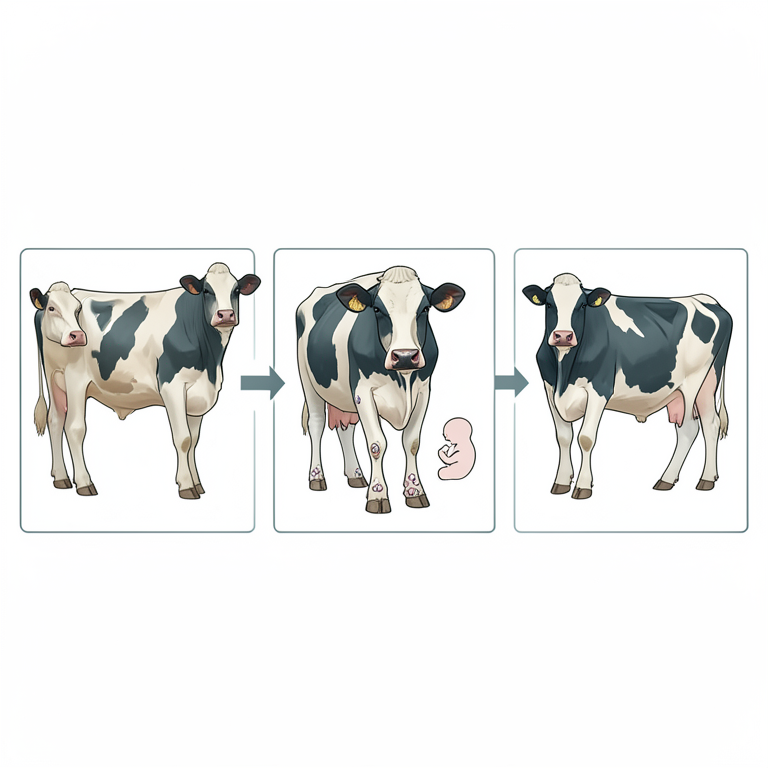
Timeline of Fertility Impairments
AI-generated conceptual illustration (Holstein Friesian dairy cows). It explains the idea and does not show study data.
View source evidence ↗Figures & tables
From the original paper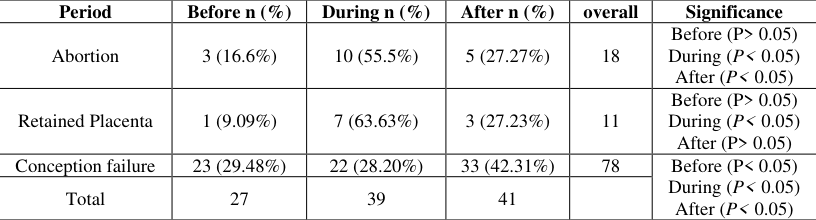 Table 1
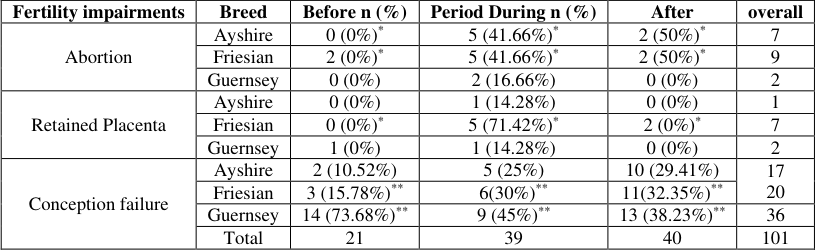 Table 2
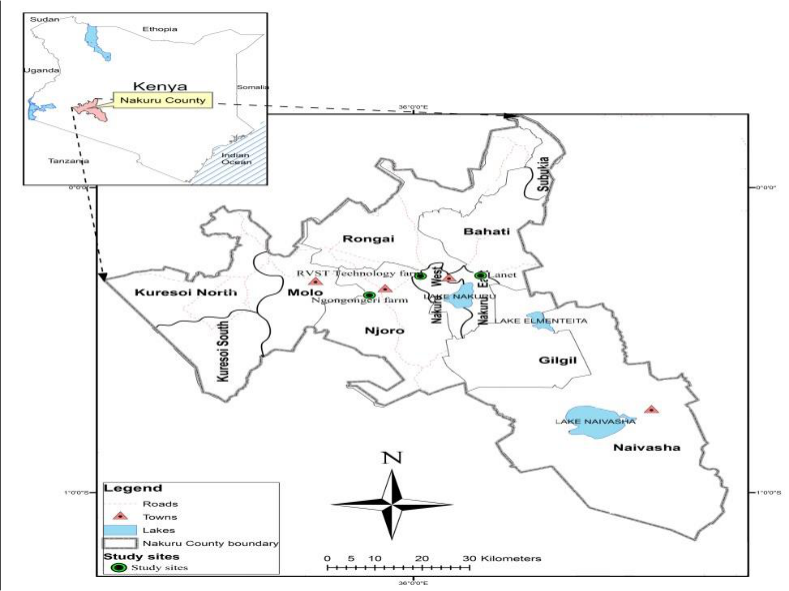 Figure 1
Introduction
Foot and Mouth Disease (FMD) is a contagious viral disease to which dairy cattle, clovenhoofed ruminants are susceptible [9] . The duration of FMD outbreak is generally three weeks to one month [6] . During this period, production loses variable, depending on the genetics, management of the livestock, and the systems inputs and outputs [2] . In dairy cattle the disease has associated production losses are related to drop in milk yield, culling, calf mortality, impaired fertility or increased susceptibility to mastitis [13] . The most direct economic impact of FMD in endemic countries is the loss or reduced efficiency of production, which lowers farmers' income [4] . The outbreak of FMD attracts trade bans [7,5] . The annual global impact of FMD previously has been estimated at US$11 billion [10] , moreover FMD outbreak has implications on the food nutrition and income security of the farming households and consumers as well with the threat of food supplies, security and safety [8,12] . The effects of foot and mouth disease on fertility performance are categorized as an invisible loss and is difficult to measure particularly in the less intensive system [1] , during the outbreak of FMD its effects can include: irregularity of oestrus in cattle (not seasonal), therefore extending calving interval, increase of abortion rate [11] . Retention of placenta is the inability of fetal membrane to be expelled from 8 to 48 hours, average 8 hours after parturition. The incidence of retained placenta varies from 4-18% of calving [14] .
Materials and Methods
The study was undertaken in Nakuru County within Kenya Highlands. It has an altitude of 1,800 m above sea level with temperatures ranging between 17.5 0 C and 22 0 C on average but can drop during cold season. Average annual rainfall in the area is up to 895 mm (en.climatedate.org).
Results
Three categories of fertility impairments (Abortion, retained placenta, conception failure) were quantified for the period of before, during and after foot and mouth disease outbreaks whereby abortion cases during and after FMD outbreak were significant (P< 0.05, P< 0.05) comparing to the period before foot and mouth disease outbreak which was not significant (P> 0.05) (Table 1). Retained placenta before and after foot and mouth disease outbreak were not significant (P> 0.05 P> 0.05), but during FMD outbreak it was significant (P< 0.050). Conception failure before and during foot and mouth disease outbreaks were highly significant (P< 0.05, P< 0.05) with regards to the period after FMD outbreak (P< 0.05).
| Period | Before n (%) | During n (%) | After n (%) | overall | Significance |
|---|---|---|---|---|---|
| Abortion | 3 (16.6%) | 10 (55.5%) | 5 (27.27%) | 18 | Before (P> 0.05) During (P< 0.05) After (P< 0.05) |
| Retained Placenta | 1 (9.09%) | 7 (63.63%) | 3 (27.23%) | 11 | Before (P> 0.05) During (P< 0.05) After (P> 0.05) |
| Conception failure | 23 (29.48%) | 22 (28.20%) | 33 (42.31%) | 78 | Before (P< 0.05) During (P< 0.05) After (P< 0.05) |
| Total | 27 | 39 | 41 |
Table text extracted from the original PDF; superscript letters are shown inline. The original table image is below.
View original table image
Discussion
Abortion, retained Placenta and insemination per conception (conception failure) were considered for fertility impairment for the three periods; before, during and after foot and mouth disease outbreaks. The reported abortion before FMD outbreak was low (0.19%), with the comparison of the period during FMD outbreaks which was higher (2.77%) and this because during foot and mouth disease the affected cows went under stress which caused the animal to loss appetite as well as the energy to move and access the feed [15,3] . After the recovery from foot and mouth disease outbreaks the system started to recover, therefore the recorded abortion was higher than before and lower than during FMD (0.99%). During the three periods Ayshire and Friesian were significant (P< 0.05), and Guernsey was not significant (P> 0.05). Retained Placenta before and during foot and mouth disease was not significant (P> 0.05), but during foot and mouth disease outbreak was highly significant (P< 0.05). Among the three breeds (Ayshire, Friesian, Guernsey), it was only Friesian was significant before, during and after foot and mouth disease outbreak (P< 0.05). Insemination per conception (conception failure), was high in the period after foot and mouth disease outbreak (12.47%), comparing to the two periods of before and during foot and mouth disease respectively (6.33%, 4.95). And the insemination per conception during foot and mouth disease was low because for the reason that the cows were not served during the FMD outbreak. The three breeds; Ayshire, Friesian and Guernsey were all significant (P< 0.05), but Friesian and Guernsey were highly significant (P = 0.0001).
Conclusion
To reduce the impact of foot and mouth disease the appropriate bio-security measures should be applied to reduce the production losses and to hasten recovery.
Figures and tables from the paper
| Fertility impairments | Breed | Before n (%) | Period During n (%) | After | overall |
|---|---|---|---|---|---|
| Abortion | Ayshire | 0 (0%)* | 5 (41.66%)* | 2 (50%)* | 7 |
| Friesian | 2 (0%)* | 5 (41.66%)* | 2 (50%)* | 9 | |
| Guernsey | 0 (0%) | 2 (16.66%) | 0 (0%) | 2 | |
| Retained Placenta | Ayshire | 0 (0%) | 1 (14.28%) | 0 (0%) | 1 |
| Friesian | 0 (0%)* | 5 (71.42%)* | 2 (0%)* | 7 | |
| Guernsey | 1 (0%) | 1 (14.28%) | 0 (0%) | 2 | |
| Conception failure | Ayshire | 2 (10.52%) | 5 (25%) | 10 (29.41%) | 17 20 |
| Friesian | 3 (15.78%)** | 6(30%)** | 11(32.35%)** | ||
| Guernsey | 14 (73.68%)** | 9 (45%)** | 13 (38.23%)** | 36 | |
| Total | 21 | 39 | 40 | 101 |
Table text extracted from the original PDF; superscript letters are shown inline. The original table image is below.
View original table image
References
15 in the original paper- Chaters G, Rushton J, Dulu TD, Lyons NA. Impact of foot-and-mouth disease on fertility performance in a large dairy herd in Kenya. Preventive Veterinary Medicine. 2018; 159:57-64.
- Derah N, Mokopasetso M. The control of foot and mouth disease in Botswana and Zimbabwe. Tropicultura. 2005; 95:3-5.
- De Rueda CB, Dekker A, Eblé PL, de Jong MC. Identification of factors associated with increased excretion of foot-and-mouth disease virus. Preventive veterinary medicine. 2014; 113:23-33.
- Forbes BR, Halderen A Van. Foot-and-Mouth Disease Economic Impact Assessment : What it means for New Zealand, 2014, 3.
- Hayama Y, Muroga N, Nishida T, Kobayashi S, Tsutsui T. Research in Veterinary Science Risk factors for local spread of foot-and-mouth disease, 2010 epidemic in Japan. Research in Veterinary Science. 2012; 93:631635.
- Mahul O, Durand B. Simulated economic consequences of foot-and-mouth disease epidemics and their public control in France. Preventive Veterniary Medicine. 2000; 47:23-38.
- Martínez-López B, Perez AM, De la Torre A, Rodriguez JMSV. Quantitative risk assessment of foot-and-mouth disease introduction into Spain via importation of live animals. Preventive Veterinary Medicine. 2008; 86:4356.
- Nogueira L, Marsh TL, Tozer PR, Peel D. Foot-and-mouth disease and the Mexican cattle industry. Agricultural Economics. 2011; 42:33-44.
- Pattnaik B, Subramaniam S, Sanyal A, Mohapatra JK, Dash BB, Ranja R et al. Foot-and-mouth Disease: Global Status and Future Road Map for Control and Prevention in India. Agricultural Research. 2012; 1:132-147.
- Pendell DL, Leatherman J, Schroeder TC, Alward GS. The economic impacts of a foot-and-mouth disease outbreak: a regional analysis. Journal of Agricultural and Applied Economics. 2007; 39:19-33.
- Şentürk B, Yalcin C. Production losses due to endemic foot-and-mouth disease in cattle in Turkey. Turkish Journal of Veterinary and Animal Sciences. 2008; 32:433-440.
- Stenfeld C, Eschbaumer M, Rekant SI, Pacheco JM, Smoliga GR, Hartwig EJ et al. The foot-and-mouth disease carrier state divergence in cattle. Virology, 2016; 28:13-2.
- Truong DB, Goutard FL, Bertagnoli S, Delabouglise A, Grosbois V, Peyre M. Benefit-cost analysis of Foot-andMouth Disease Vaccination at the Farm-level in south Vietnam. Frontiers in Veterinary Science. 2018, 26-33.
- Tucho TT, Ahmed WM. Economic and Reproductive Impacts of Retained Placenta in Dairy Cows. Journal of Reproduction and Infertility, 2017; 8:18-27.
- Zaher KS, Ahmed WM. Impact of foot and mouth disease on oxidative status and ovarian activity in Egyptian buffaloes. World Zoology. 2008; 3:1-7.
Cited by 2
From OpenAlex, OpenCitations and reference lists read by Scinovex
- Productivity, reproduction and economic losses due to foot-and-mouth disease (FMD) in Iranian Holstein cows ↗
M Bijari, Ali Sadeghi‐Sefidmazgi, Maryam Ansari‐Lari, Morteza Hosseini Ghaffari · Preventive Veterinary Medicine · 2025
❝ 4 - Epidemiological patterns and impacts of foot and mouth disease in ruminants: A retrospective analysis of 2006-2023 in Palestine ↗
Ibrahim Alzuheir · Al-mağallaẗ al-ʻirāqiyyaẗ li-l-ʻulūm al-bayṭariyyaẗ/Iraqi journal of veterinary sciences · 2024
This study presents a retrospective epidemiological analysis of foot and mouth disease (FMD) in ruminants in Palestine from 2006 to 2023. Data from the Palestinian Central Bureau of Statistics, the Annual Agricultural Census, and reports from the World Organization for Animal Health indicated the endemic nature of FMD in Palestine throughout the study period. The findings unveil FMD's consistent presence,…
❝ 0PDF