
Research article · 2019 · Full text
International Journal of Geography Geology and EnvironmentNew type of terrestrial mollusc of Archaica (Gastropoda, Pulmonata, Hygromiidae) from Central Asia
Volume 1(1) · Pages 01–02 · DOI: 10.22271/27067483.2019.v1.i1a.1 ↗
Research areasAquatic Invertebrate Ecology and BehaviorMollusks and Parasites StudiesAncient and Medieval Archaeology Studies
Abstract
Author-writtenA new species of land mollusk of the genus Archaica (Gastropoda, Pulmonata, Hygromiidae) from Central Asia A. Pazilov, Z. Kudratov, Z. Makhmudzhonov - New species - differs in relatively thin-walled slightly translucent shell, not more than 4.5 well convex, slowly growing turns.
Summary
Source-checkedPlain-language reading of the full paper, prepared with AI and checked against the text. Each point links to the authors' own words.
Why it matters
- The land snail population (malacofauna) of Central Asia is unevenly documented, with the mountains of the Fergana valley being particularly understudied. View evidence ↗
- The genus Archaica currently consists of six species, with new additions discovered over the last three decades. View evidence ↗
The question
- The study aims to describe and establish a new species of the genus Archaica discovered in the Fergana valley. View evidence ↗
What they did
- In April 2019, 25 mollusk specimens were collected from Mount Karatumshuk near the village of Khazratishoh in the Namangan region of Uzbekistan. View evidence ↗
- Anatomical examinations were performed on 9 specimens using manual dissection in 75% alcohol under an MBI-10 binocular microscope. View evidence ↗
- Shell measurements included height, large and small diameters, mouth height, and the number of revolutions, following the method established by A. Shileiko (1978). View evidence ↗
- Ten shells identified as Leukopenia hypophaea from the Samarkand State University Zoological Museum were used as comparative material. View evidence ↗
What they found
- The new species possesses 4 to 4.5 convex revolutions that increase slowly in size. View evidence ↗
- The new species is characterized by mucous glands with a 2 X 2 configuration. View evidence ↗
- Both the upper and inner stylophores of the new species are consistently spherical in shape. View evidence ↗
- The new species differs from other Archaica species anatomically by its spherical stylophores and 2 X 2 mucous glands, whereas others have pointed upper stylophores and 3 X 2 or 4 X 2 mucous glands. View evidence ↗
- The species has only been identified at its type location, inhabiting scree among semi-shrubs. View evidence ↗
What it means
- Based on the reproductive tract structure and shell characteristics, the authors conclude that the specimens represent a new species of the genus Archaica. View evidence ↗
Visual summary
2 visualsIllustrations explain the paper; charts are replotted from the paper's own table values.
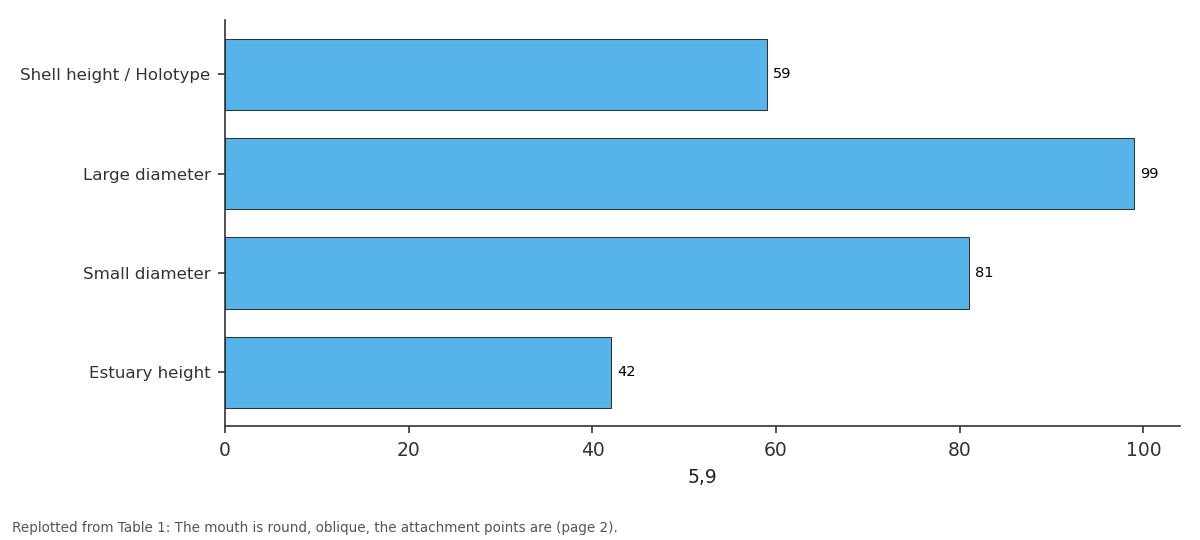
5,9: Shell height / Holotype vs Large diameter vs Small diameter vs Estuary height
Replotted from Table 1 (page 2) of the original paper. Every bar is the paper's own table value.
View source evidence ↗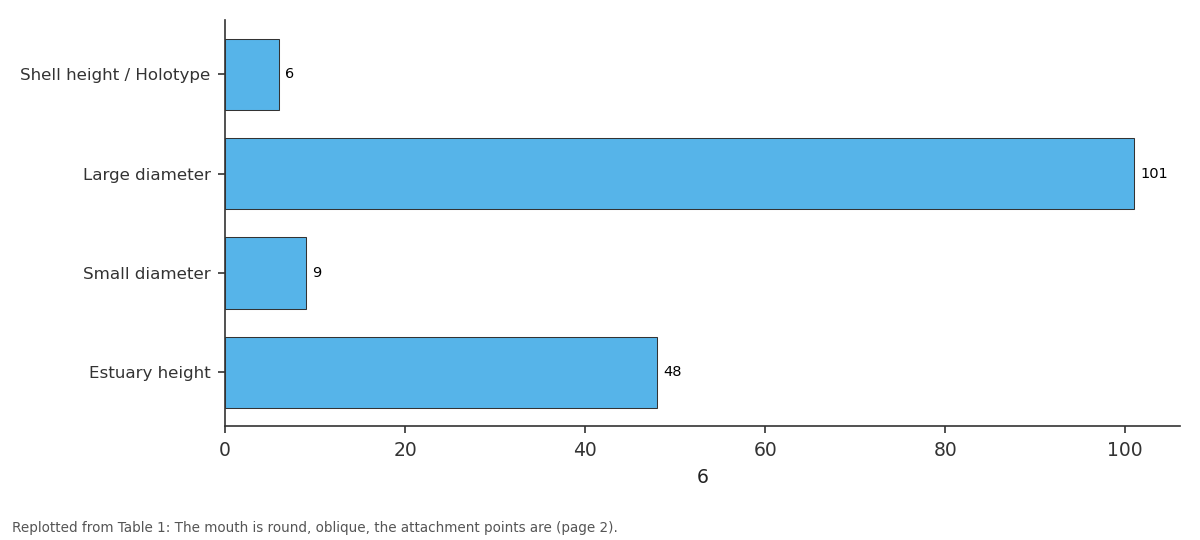
6: Shell height / Holotype vs Large diameter vs Small diameter vs Estuary height
Replotted from Table 1 (page 2) of the original paper. Every bar is the paper's own table value.
View source evidence ↗Figures & tables
From the original paper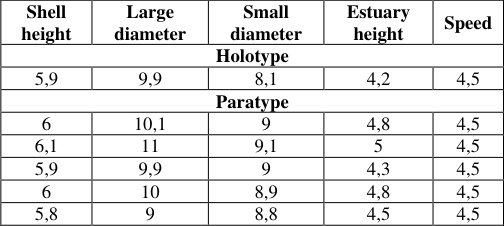 Table 1
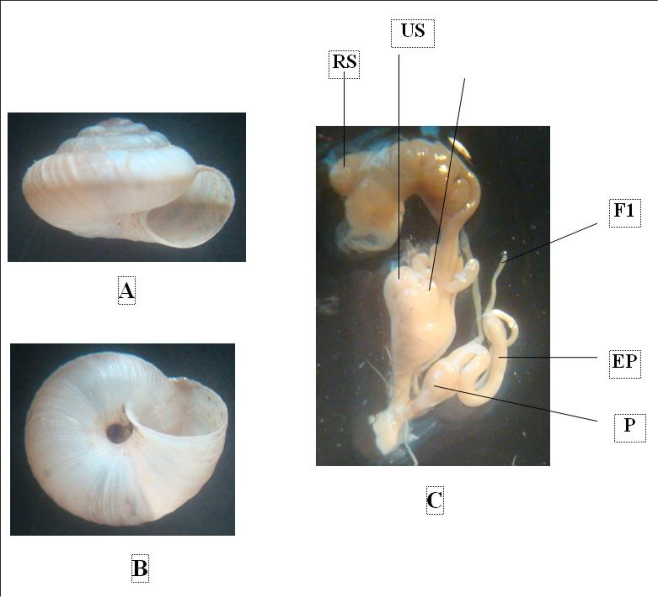 Figure 1
Introduction
As the genus Archaica, it was first established by A.A. Shileyk (1970) [1] with two genus Euarchaica and Archaica in one species. Upon further study of the mollusks of Central Asia, the genus was replenished by another under the genus Ugama (Shileiko, 1978). Currently, the genus Archaica has 6 species, and over the last thirty years it has been replenished with new species, Archaica (E.) suspecta from the mountain Yangyskyr, $.
Pkhan (right tributary of the Ala-Buka river), (Sileiko, Moiseyev, 1989) [3]; Archaica (U.) papanica from the neighborhood of Papan, r. Ak-Bura (Alai Range), (Pasilov, Shileiko, 1992). As we know, the terrestrial malacofauna of Central Asia has been studied very unevenly. The least known regions include the little-known mountains of the Fergana valley, systematic and focused study from the point of view of the mollusk fauna was not conducted at all.
In April 2019, one of the authors (A. Pazilov) conducted the collection of land mollusks in the Fergana valley of Mount Karatumshuk, near the village of Khazratishoh (Namangan region, Uzbekistan), which collected 25 copies. mollusks, the shells of which are very similar to the dwarf forms of Leukozonella hypophaea. The results of studying the structure of the reproductive tract of these animals turned out to be new species of the genus Archaica which is the subject of this article.
Material And Methods
25 copies from mountain Karatumshuk in ok r.s. Hazratishoh. Opened 9 copies. method of manual anatomy in 75% alcohol under binocular MBI-10. The shell was measured using the method A, Shileiko (1978): shell height (BP), large shell diameter (BDR), small shell diameter (MDR), mouth height (WU), revolutions number (PR).
For comparison, material from the Samarkand State University Zoological Museum has also been studied: 10 shells from three locations identified as Leukopenia hypophaea (Lindholm, 1927). Systematic part and discussion Superfamily Xanthonychoidea Pfeiffer in Strebel et Pfeiffer, 1880 Family Hygromiidae Tryon, 1886 Subfamily Archaicinae Sehileyko, 1978 Genus Archaic Sehileyko, 1978 Archaic haziratishaxika, Pazilov, Qudratov et Maxmudjonov, sp. nov. (Figs. 1, A, B, C) Locus typicus - Karatumshuk mountains, surroundings with. Hazratishoh (Namangan region) Material 25 copies of the typical location, 04/16/2019; anatomously 9 copies. The holotype and 15 paratypes are stored in the Zoological Museum of Gulistan State University. https://www.geojournal.net The shell is small, of varying degrees pressed, relatively thin-walled, slightly translucent, dome-shaped conic curl.
Revolutions 4-4.5 convex, slowly increasing. The last turn in the profile is rounded, smoothly lowered to the mouth. The color of the embryonic momentum is always brown, definitive horny, below the periphery grayish-horny, translucent. Fetal embryos are shiny, with strongly smoothed radial striations.
The sculpture of definitive revolutions in the form of irregular radial ribs, which are strongly weakened on the basal surface. Table 1: The mouth is round, oblique, the attachment points are wide apart, the edges are thin, sharp, the columellar edge is turned away, but does not close the expanded-cylindrical navel Dimensions (mm) Estuary Shell height Large diameter Small diameter height Speed Distal spermoviduct and oviduct straight. The mucous glands are 2 X 2. Stylofors are developed to varying degrees: the outer one is much larger, the apex is spherical in shape, the inner stylofor squeezes the wall of the vagina with the spherical outer stylofor slightly, but retains spherical shape.
| Shell height | Large diameter | Small diameter | Estuary height | Speed |
|---|---|---|---|---|
| Holotype | ||||
| 5,9 | 9,9 | 8,1 | 4,2 | 4,5 |
| Paratype | ||||
| 6 | 10,1 | 9 | 4,8 | 4,5 |
| 6,1 | 11 | 9,1 | 5 | 4,5 |
| 5,9 | 9,9 | 9 | 4,3 | 4,5 |
| 6 | 10 | 8,9 | 4,8 | 4,5 |
| 5,8 | 9 | 8,8 | 4,5 | 4,5 |
Table text extracted from the original PDF; superscript letters are shown inline. The original table image is below.
View original table image
The penis is small, spherical. Cylindrical epifallus forms a double bend. Flagellum 1.5 times short epiphallus. There is no membrane between the vas deferens, the epiphallus and the penis.
The duct of the seminal receptacle is short, ends with a spherical reservoir. Distribution and habitat. The species is known only from a typical location, where it lives in scree among semi-shrubs. Remarks.
The shell of the present species differs from the representative of the genus Archaic: with a small, relatively thin walled, slightly translucent shell, not more than 4.5 well convex, slowly increasing revolutions. The anatomical difference is that in the new species, the stylophores (upper and inner) are always spherical, the mucous glands are 2 X 2, while in other species of the genus, the upper stylophores are more or less distinctly pointed, the mucous glands are 3 X 2 or 4 X 2. Etymology. The name is formed from the name with.
Hazratishoh - typical location of the species. Holotype 5,9 9,9 8,1 4,2 4,5 Paratype 6 10,1 9 4,8 4,5 6,1 11 9,1 5 4,5 5,9 9,9 9 4,3 4,5 6 10 8,9 4,8 4,5 5,8 9 8,8 4,5 4,5 Fig 1: Archaica schileykoi sp. nov., holotype. A, B- sink; C-reproductive tract; P-penis; US- upper stylophors; VN - internal stylophors; F1 Flagellum; EP-epiphallus; RS- seminal receptacle. 4. Пазилов А, Шилейко АА. Еще один случай Reference 1. Шилейко АА. Объем, система и филогения группы нахождения конхологических двойников среди среднеазиатских Hygromiidae (Gastropoda, Pulmonata) // Ruthenica. 1992; 2:59-62. Pereforatella-Zenobiella-Chilanodon (Pulmonata, Helicidae)// Зоол.журн.-1970; 49(9):1306-1321. 2. Шилейко АА. Наземные моллюски надсемейства Hellicoidea // Фауна СССР. Моллюски. - Л.: Наука Ленинградское отделение, 1978; 3(6):384C. 3. Шилейко АА, Моисева СЕ. Новые и малоизвестные виды наземных моллюсков из Киргизии // Зоол.журн. – 1989; LXYIII(1):1303-1314.
References
0 in the original paperCited by 2
From OpenAlex, OpenCitations and reference lists read by Scinovex
- Biological peculiarities of Leucozonella retteri ↗
Zafar M. Makhmudjonov, Khayrullo B. Khakimov, Nilufar A. Mekhmonova, Shakhzoda R. Nasriddinova, Seytveli S. Abdurashitov · Baghdad Science Journal · 2023
The aim of the research is to study the biology, life cycles, distribution and structure of the reproductive organ of Leucozonella retteri in natural conditions. Zoological and malacological methods are used in the work. The collection of the material was carried out according to A.A. Shileiko method. According to the results of the conducted studies, the differences between Leucozonella retteri…
❝ 1PDF - Distribution of rare and endangered terrestrial mollusks in Central Uzbekistan ↗
Zafar M. Makhmudjonov, Abduvaeit P. Pazilov, Abdulla T. Karimqulov, Gaibnazarova Feruza Pardabaevna, Farrukh U. Umarov, J. Kh. Karshibaev et al. · Research Square · 2024
❝ 0PDF