
Research article · 2018 · Full text
International Journal of Advanced Biochemistry ResearchChemical composition of Lawsonia inermis cultivated under Sudanese conditions-existence of chemotypes species
Volume 2(2) · Pages 01–03 · DOI: 10.33545/26174693.2018.v2.i2a.13 ↗
Research areasBioactive Compounds and Antitumor AgentsMorinda citrifolia extract uses
Abstract
Author-writtenObjectives: The objectives of this study are to: (i) qualitatively and quantitatively assessing the chemical components of Lawsonia inermis Leaves from cultivated plants in two localities in Central Sudan, and (ii) to identify of their chemotypes by using GC/MS. Materials and Methods: The cultivated plant Lawsonia inermis L. in Ed-Damer and AL-Fetaehab regions were collected in October 2014 from Ed-Damer city, Nile River State (Ed-Damer sample) and Omdurman South, Khartoum State (AL-Fetaehab sample). All plant samples under study were separately extracted by ethanol (80%) at room temperature for 24 hours. After extraction it were filtered and then the removal of solvent was done. The qualitative and quantitative analysis of the samples were carried out by using GC/MS technique. Interpretation on mass spectrum GC-MS was conducted using the database of National Institute Standard and Technology (NIST).Results: The ethanol extract of leaves of L. inermis (AL-Fetaehab sample) showed that the D-allose (17.61%), lawsone (12.87%), beta-D-glucopyranoside, methyl (12.74%), phytol (10.78%), 1-isobutoxy-1-methoxypropane (9.18%), n-hexadecanoic acidin6.33%), 9,12,15-octadecatrienoic acid (Z,Z,Z) (4.44%), squalene (4.06%) and vitamin E (3.60%) as the major phytochemical constituents, whereas the ethanol extract of leaves of L. inermis (Ed-Damer sample) showed that the compounds: beta-D-glucopyranoside, methyl (36.10%), phytol (10.85%), 9,12,15-Octadecatrienoic acid, Z,Z,Z (7.31%), squalene (7.20%), vitamin E (6.82%) and lawsone (6.79%) as the major phytochemical constituents.Conclusion: According to the chemical composition of Lawsonia inermis, it can be classified as (i) lawsone (naphtha Quinone) Chemotype (AL-Fetaehab sample) and (ii) ethyl alpha-d-glucopyranoside (Phenolic glucoside) Chemotype (Ed-Damer sample).
Summary
Source-checkedPlain-language reading of the full paper, prepared with AI and checked against the text. Each point links to the authors' own words.
Why it matters
- Lawsonia inermis, commonly known as Henna, is a plant from the Lythraceae family used as a natural red coloring agent. View evidence ↗
- The plant is a valuable source of natural products that can be used to develop industrial products and medicines for various diseases. View evidence ↗
- Lawsone, a major component of Henna, exhibits antiviral, antibacterial, antifungal, and antineoplastic activities, including the ability to inhibit tumor cell growth. View evidence ↗
The question
- The study aimed to qualitatively and quantitatively assess the chemical components of Lawsonia inermis leaves from two Central Sudan localities and identify their chemotypes using GC/MS. View evidence ↗
What they did
- Plant samples were collected in October 2014 from two regions: Ed-Damer (Nile River State) and AL-Fetaehab (Omdurman South, Khartoum State). View evidence ↗
- The plant samples were extracted using 80% ethanol at room temperature for a duration of 24 hours. View evidence ↗
- Qualitative and quantitative analyses were performed using a Shimadzu GC/MS – QP2010-Ultra model. View evidence ↗
- The mass spectrum results were interpreted using the National Institute Standard and Technology (NIST) database, which contains over 62,000 patterns. View evidence ↗
What they found
- In the AL-Fetaehab sample, the primary constituents were D-allose (17.61%), lawsone (12.87%), methyl beta-D-glucopyranoside (12.74%), and phytol (10.78%). View evidence ↗
- In the Ed-Damer sample, the major constituents were methyl beta-D-glucopyranoside (36.10%), phytol (10.85%), and 9,12,15-Octadecatrienoic acid, Z,Z,Z (7.31%). View evidence ↗
- The AL-Fetaehab sample contained the highest lawsone content at 12.87%. View evidence ↗
- Lidocaine (0.15%) was detected in the Ed-Damer sample, while no alkaloids were found in the AL-Fetaehab sample. View evidence ↗
- Ten fatty acid compounds were identified in both samples, making up 24.43% of the Ed-Damer extract and 21.89% of the AL-Fetaehab extract. View evidence ↗
What it means
- The authors concluded that L. inermis can be classified into two chemotypes: the lawsone (naphthaquinone) chemotype (AL-Fetaehab sample) and the ethyl alpha-d-glucopyranoside (phenolic glucoside) chemotype (Ed-Damer sample). View evidence ↗
Visual summary
1 visualsIllustrations explain the paper; charts are replotted from the paper's own table values.
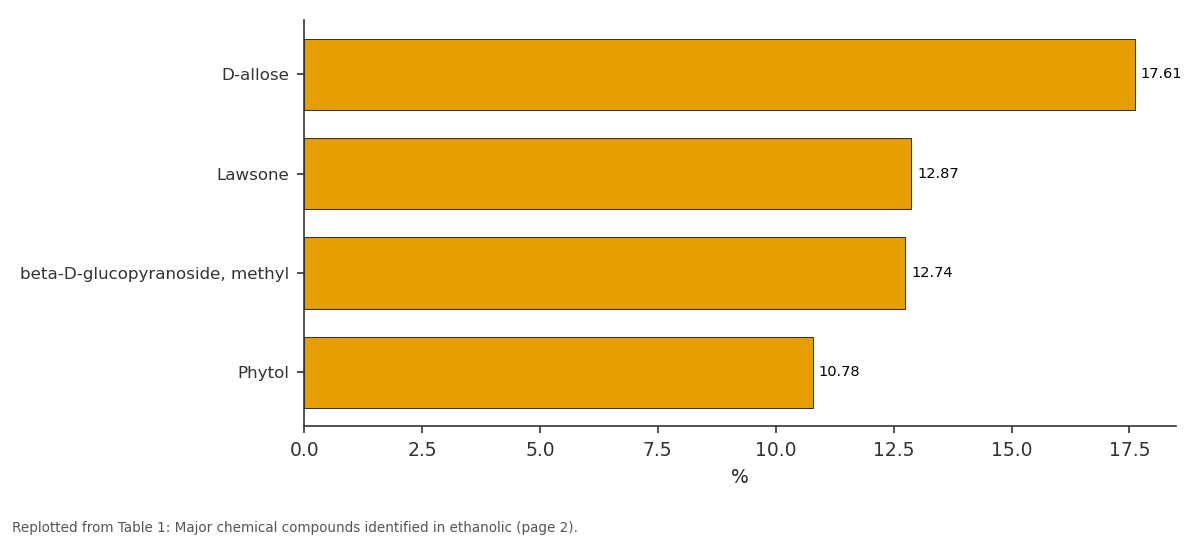
%: D-allose vs Lawsone vs beta-D-glucopyranoside... vs Phytol
Replotted from Table 1 (page 2) of the original paper. Every bar is the paper's own table value.
View source evidence ↗Figures & tables
From the original paper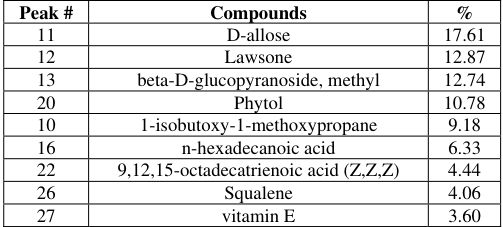 Table 1
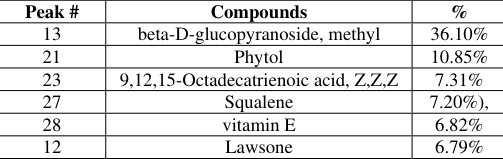 Table 2
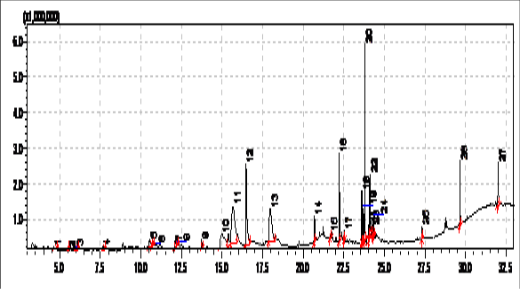 Figure 1
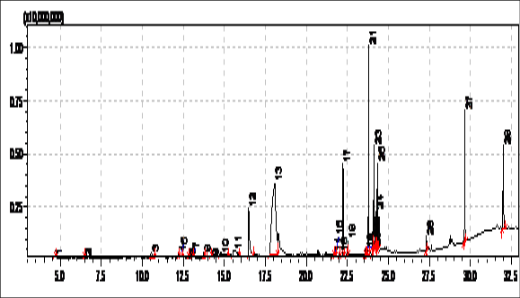 Figure 2
Introduction
Lawsonia inermis L. (Family: Lythraceae) is a natural red colouring agent, commonly named "Henna" and is cultivated in the savannah region. Leaves are commonly used as cosmetics for staining skin, hair and wool (Gallo et al., 2008; Takeda and Fatope, 1988) [1,2] . It considered as a valuable source of unique natural products for development of medicines against various diseases and also for the development of industrial products (Chaudhary et al., 2010) [3] . Lawsone, a major colorant component extracted from Lawsonia inermis (Henna), naphthaquinone-type dye. This compound is well known from its cosmetic use to dye hair, nails and skin while it is been used to colour textiles including leather, wool and silk (Endrini 2002) [4] . Lawsone found to possess antibacterial, antifungal, antiviral and antineoplastic activities. They could also inhibit tumor cell growth (Endrini et al., 2002) [4] . Henna (Lawsonia inermis L.) has been known as the natural source of dye, besides having medicinal properties. Henna powder is made into paste in water and used for skin decorations and hair dyeing. The use of henna in Sudan goes back to the ancient times as a soothing agent and also for dyeing material. The objectives of this study are to: (i) qualitatively and quantitatively assessing the chemical components of Lawsonia inermis Leaves from cultivated plants in two localities in Central Sudan, and (ii) identification of their chemotypes using GC/MS.
Materials and Methods
Materials and Methods
Plant Material
The cultivated plant Lawsonia inermis L. in Ed-Damer and AL-Fetaehab regions were collected in October 2014 from Ed-Damer city, Nile River State and Omdurman South, Khartoum State. The plant materials were taxonomically identified by one author, Prof. HH EL-Kamali, Department of Botany, Faculty of Science and Technology, Omdurman Islamic University.
Sample preparation
Each plant sample was carefully dried in the Botany laboratory at Omdurman Islamic University at room temperature. The plant materials were then grounded to fine powder with a mechanical Miller and the powder was kept in glass container at room temperature.
Plant Extraction
All plant samples under study were separately extracted by ethanol (80%) at room temperature for 24 hours. After extraction it were filtered and then the removal of solvent was done.
Chromatography Mass Spectrometer (GC/MS) conditions
The qualitative and quantitative analysis of the samples were carried out by using GC/MS technique model (GC/MS -QP2010-Ultra) from Japan (Shimadzu Company) with serial number 020525101565SA) and capillary column (Rtx-5ms-30mx0.25mm x0.25 um). The sample was injected by using split mode, instrument operating in EI mode at 70 eV. Helium as the carrier gas passed with flow rate 1.69 ml/min. The temperature program was started from 50 C with rate 7C/min to 18C then the rate was changed to 10C/min reaching 300C as final temperature degree, with 2 minutes as hold time, the injection port temperature was 300C, the ion source temperature was 200 C and the interface temperature was 250C. The sample was analyzed by using scan mode in the range of m/z 40-500 charges to ratio and the total run time was 30 minutes.
Identification of components
Interpretation on mass spectrum GC-MS was conducted using the database of National Institute Standard and Technology (NIST) having more than 62000 patterns. The spectrum of the unknown component was compared with the spectrum of the known components stored in the NIST library. The name, molecular weight and structure of the components of the test materials were ascertained.
Results and Discussion
Results and Discussion
GC/MS analysis of Lawsonia inermis (AL-Fetaehab sample)
GC/MS chromatogram of ethanol extract of leaves of L. inermis (AL-Fetaehab sample) (Figure 1) showed the presence of 27 compounds. The Table 1 shows the compounds: D-allose (17.61%), lawsone (12.87%), beta-Dglucopyranoside, methyl (12.74%), phytol (10.78%), 1isobutoxy-1-methoxypropane (9.18%), n-hexadecanoic acid (6.33%), 9,12,15-octadecatrienoic acid (Z,Z,Z) (4.44%), squalene (4.06%) and vitamin E (3.60%) as the major phytochemical constituents.
| Peak # | Compounds | % |
|---|---|---|
| 11 | D-allose | 17.61 |
| 12 | Lawsone | 12.87 |
| 13 | beta-D-glucopyranoside, methyl | 12.74 |
| 20 | Phytol | 10.78 |
| 10 | 1-isobutoxy-1-methoxypropane | 9.18 |
| 16 | n-hexadecanoic acid | 6.33 |
| 22 | 9,12,15-octadecatrienoic acid (Z,Z,Z) | 4.44 |
| 26 | Squalene | 4.06 |
| 27 | vitamin E | 3.60 |
Table text extracted from the original PDF; superscript letters are shown inline. The original table image is below.
View original table image
GC/MS analysis of Lawsonia inermis (Ed-Damer sample)
GC/MS chromatogram of ethanol extract of leaves of L. inermis (Ed-Damer sample) (Figure 2) showed the presence of 28 compounds. The Table 2 shows the compounds: beta-D-glucopyranoside, methyl (36.10%), phytol (10.85%), 9,12,15-Octadecatrienoic acid, Z,Z,Z (7.31%), squalene (7.20%), vitamin E (6.82%) and lawsone (6.79%) as the major phytochemical constituents. In previous reports on the chemical content of Lawsonia inermis from around the world (Hema et al. [5] ., 2010, Wagini et al. [6] ., 2014, Kidanemarium et al. [7] ., 2013, Mahkam et al. [8] ., 2014, Upadhyay et al. [9] ., 2010, Charoensup et al. [10] ., 2017 and Bakkali et al. [11] ., 1997), were found in the range between 0.004 and 19.19%. In our results the lawsone content were in average 13.23%. According to the chemical composition of Lawsonia inermis, it can be classified as lawsone (Naphthaquinone) chemotype (AL-Fetaehab sample) and ethyl alpha-dglucopyranoside (Phenolic glucoside) chemotype (Ed-Damer sample).
| Peak # | Compounds | % |
|---|---|---|
| 13 | beta-D-glucopyranoside, methyl | 36.10% |
| 21 | Phytol | 10.85% |
| 23 | 9,12,15-Octadecatrienoic acid, Z,Z,Z | 7.31% |
| 27 | Squalene | 7.20%), |
| 28 | vitamin E | 6.82% |
| 12 | Lawsone | 6.79% |
Table text extracted from the original PDF; superscript letters are shown inline. The original table image is below.
View original table image
References
11 in the original paper- Gallo FR, Multari G, Giambenedetti M, Federici E. Chemical fingerprinting of Lawsonia inermis using HPLC, HPTLC and densiumetry. Phytochemical Analysis. 2008; 19(6):479-575.
- Takeda Y, Fatope MO. New phenolic glucosides from Lawsonia inermis. J Nat. Prod. 1988; 51:725-729.
- Chaudary G, Goyal S, Poonia P. Lawsonia inermis L. A Phyto pharmacological review. International Journal of Pharmaceutical Sciences and Drug Research. 2010; 2(2):91-98.
- Endrini S, Rahmat A, Ismail P, Hin TY. Anticarcinogenic properties and antioxidant activity of henna (Lawsonia inermis). Journal of Medical Sciences. 2002; 2(4):194-197.
- Hema R, Kumaravel S, Gomathi S. Gas Chromatography -Mass Spectroscopic analysis of Lawsonia inermis leaves. New York Science Journal. 2010; 3(12):99-101.
- Wagini NH, Soliman AS, Abbas MS, Hanafy YA, Badawy EM. Phytochemical analysis of Nigerian and Egyptian henna (Lawsonia inermis L.) leaves using TLC, FTIR and GC/MS. Plant. 2014; 2(3):27-32.
- Kidanemarium TK, Tesema TK, Asressu KH, Boru AD. Chemical investigation of Lawsonia inermis leaves from Afar region, Ethiopia. Oriental Journal of Chemistry. 2013; 29(3):1129-1134.
- Mahkam M, Nabati M, Kafshboran HR. Isolation, identification and characterization of lawsone from henna powder with soxhlet technique. Iranian Chemical Communication. 1914; 2(1):34-38.
- Upadhyay B, Dhaker AK, Singh KP, Kumar A. Phytochemical analysis and influence of edaphic factors on lawsone content of Lawsonia inermis L. Journal of Phytology. 2010; 2(6):47-54.
- Charoensup R, Duangyod T, Palanuvej M, Ruangrugsi N. Pharmacognostic specifications and lawsone content of Lawsonia leaves. Pharmacognosy Research. 2017; 9(1):60-64.
- Bakkali AT, EL-Jaziri M, Foriers A. et al., Lawsone accumulation in normal and transformed cultures of henna, Lawsonia inermis. Plant Cell, Tissue and Organ Culture. 1997; 51(2):83-87.
Cited by 5
From OpenAlex, OpenCitations and reference lists read by Scinovex
- Using nanoemulsions of the essential oils of a selection of medicinal plants from Jazan, Saudi Arabia, as a green larvicidal against Culex pipiens ↗
Hesham A. Mahran · PLoS ONE · 2022
Researchers are increasingly looking to plants as sources of novel ingredients active against vector-borne diseases. Medicinal plant extracts and their metabolites are an attractive source for such products. This study investigated the insecticidal activity of five essential oils extracted from the most common medicinal herbs in Jazan province, Kingdom of Saudi Arabia. Extracted oils and nanoemulsions synthesized from those oils…
❝ 21PDF - Two new C-glycosidic ellagitannins and accompanying tannins from Lawsonia inermis leaves and their cytotoxic effects ↗
Mohamed A. A. Orabi, Hiroshi Sakagami, Naoki Umemura, Hamad S. Alyami, Tsutomu Hatano · Fitoterapia · 2021
❝ 10 - Back to nature: henna extracts from nanotech to environmental biotechnology – a review ↗
Desouky A M Abd-El-Haleem · Biotechnologia · 2023
), which thrives in subtropical and tropical climates. One of its many and long-standing uses is in cosmetics as a pigment to color hair and nails. Additionally, it serves as a disinfectant against microbiological infections and has traditional applications in the textile industry, specifically for coloring wool and nylon. The dried leaves of henna contain a significant amount of lawsone,…
❝ 5PDF - Potential Application of Lawsonia inermis L. (Lythraceae) Aqueous Extract as an Objectively Quantifiable Assay for Assessment of Viability of Protoscolices from Hydatid Cysts ↗
Elsayed E. Elowni, Ghada Hassan Abdelnabi, Mohamed Fadl Ahmad, Reem M. Badawi · OALib · 2020
Cystic echinococcosis, also known as hydatidosis, is a serious zoonotic disease.Protoscolices (PSCs) in hydatid cysts are the infective form of the tapeworm Echinococcus granulosus senso lato, an intestinal parasite of canines, particularly dogs.The cysts develop in a wide range of domestic and wild ungulates as intermediate hosts and humans as an aberrant host following incidental ingestion of parasite eggs.Canine hosts…
❝ 2PDF - Chemical and Enantiomeric Profiling, Chemotype Classification and Antibacterial Activity of a Phytone-Rich Essential Oil from Lawsonia inermis Leaves ↗
Rayhana Olubukola Davies-Sani, Alkali Hamza Sani, Moses Sunday Owolabi, Akintayo Lanre Ogundajo, William N. Setzer, Prabodh Satyal et al. · Elicit Journal of Science Research · 2025
Purpose: This study examines the chemical composition, enantiomeric distribution, and antibacterial activity of Lawsonia inermis leaf essential oil to identify its chemotypic features and clarify links between composition and bioactivity. Methodology: Essential oil was obtained from L. inermis leaves via hydro-distillation. Chemical characterization was performed using GC–MS, while chiral GC–MS was used to determine the enantiomeric distribution of selected terpenoids.…
❝ 0PDF