
Research article · 2019 · Full text
International Journal of Geography Geology and EnvironmentA comparative analysis of health and healthcare facilities in MAU, Azamgarh and Varanasi district of Uttar Pradesh
Volume 1(1) · Pages 23–27 · DOI: 10.22271/27067483.2019.v1.i1a.5 ↗
Research areasHealthcare Systems and ReformsGlobal Maternal and Child HealthGlobal Health and Epidemiology
Abstract
Author-writtenIndia is among one of those countries where the health of the people is deprived, and the healthcare facilities are inadequate and insufficient. These problems can be only solved when the micro-level planning and its implementation will be done on local level. Though India has a large and organised healthcare system, divided into primary, secondary and tertiary levels but still the situation of health and healthcare facilities is crucial. Annual Health Survey Report 2012-13 conducted the survey across 282 districts of 9 states and ranked them according to their performance in health and healthcare facilities. The present study has been carried out to know the situation of health and healthcare facilities in Mau, Azamgarh and Varanasi district of Uttar Pradesh. Mau has been taken into primary consideration and has been compared with the other two districts. These three district shows some similarities in their socioeconomic characteristics. The data of 10 health and healthcare facilities have been obtained from the AHS 2012-13 and compared by their ranking and the index. The data shows that Mau is deprived in all the fields of health and healthcare facilities taken by the Annual Health Survey except one as compare to the Azamgarh and Varanasi.
Summary
Source-checkedPlain-language reading of the full paper, prepared with AI and checked against the text. Each point links to the authors' own words.
Why it matters
- India faces significant challenges with inadequate and insufficient healthcare facilities, leaving many people deprived of necessary health services. View evidence ↗
- The authors argue that solving these systemic healthcare issues requires micro-level planning and implementation at the local level. View evidence ↗
The question
- The study aims to evaluate and compare the status of health and healthcare facilities in the Mau, Azamgarh, and Varanasi districts of Uttar Pradesh. View evidence ↗
What they did
- The researchers selected Mau, Azamgarh, and Varanasi districts in Eastern Uttar Pradesh because of their similar socioeconomic, social, and cultural backgrounds. View evidence ↗
- The analysis relied on secondary data, primarily from the Annual Health Survey (AHS) Report 2012-13, supplemented by the 2011 Census of India and the National Family Health Survey 2015-16. View evidence ↗
- The study compared the three districts across 10 different health and healthcare facility indicators using rankings and indices from the AHS 2012-13. View evidence ↗
What they found
- Mau had the lowest rate of full Antenatal Care (ANC) check-ups at 4.9% (ranked 36th among the 100 lowest districts), compared to Azamgarh's 5.4% and Varanasi's >7.6%. View evidence ↗
- Mau also showed the worst full immunization rates at 53.8% (ranked 65th among the lowest), while Azamgarh and Varanasi performed better. View evidence ↗
- Mau had the highest neonatal mortality rate among the three districts, with 58 deaths per 1,000 live births (ranked 17th among the 100 highest). View evidence ↗
- Mau performed better than the other two districts in controlling under-five mortality, recording 86 deaths per 1,000 live births compared to 89 in Azamgarh and 90 in Varanasi. View evidence ↗
What it means
- The authors conclude that Mau is the worst performing district among the three, underperforming in eight out of ten health indicators and only excelling in under-five mortality control. View evidence ↗
Visual summary
2 visualsIllustrations explain the paper; charts are replotted from the paper's own table values.
Comparative Health Performance Summary
AI-generated conceptual illustration (Healthcare facilities and medical infrastructure in three distinct rural Indian districts). It explains the idea and does not show study data.
View source evidence ↗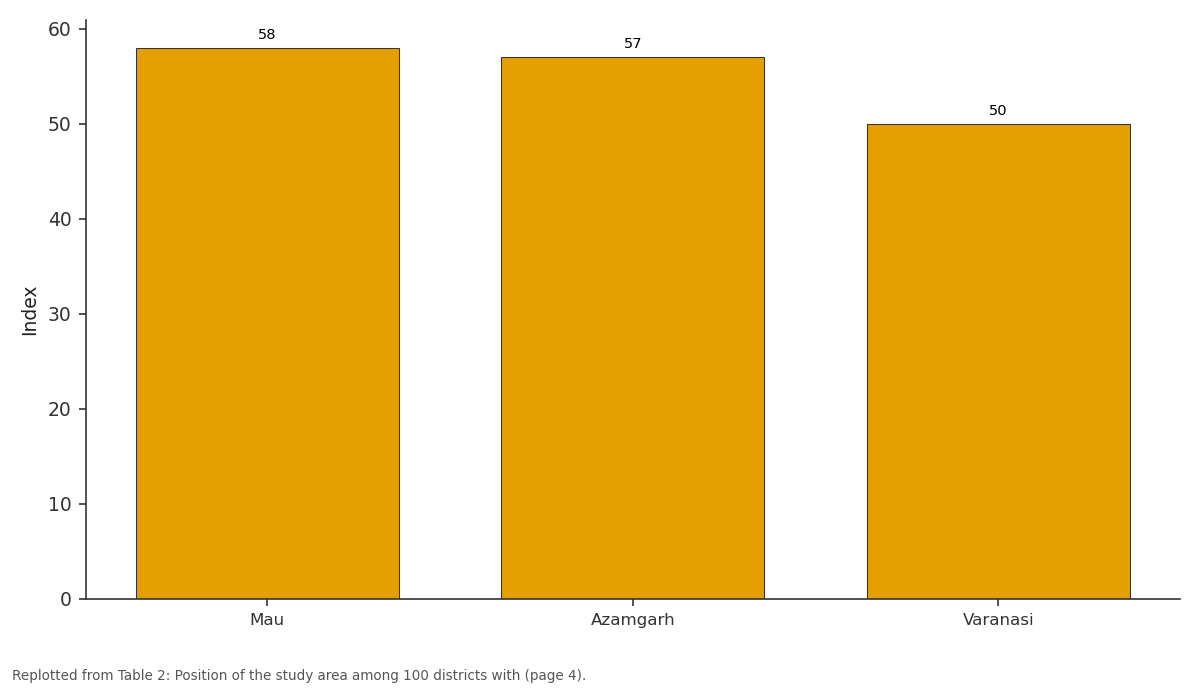
Index: Mau vs Azamgarh vs Varanasi
Replotted from Table 2 (page 4) of the original paper. Every bar is the paper's own table value.
View source evidence ↗Figures & tables
From the original paper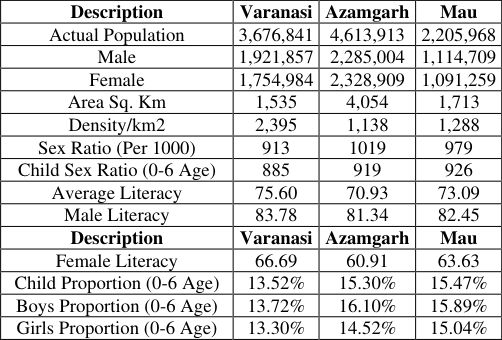 Table 1
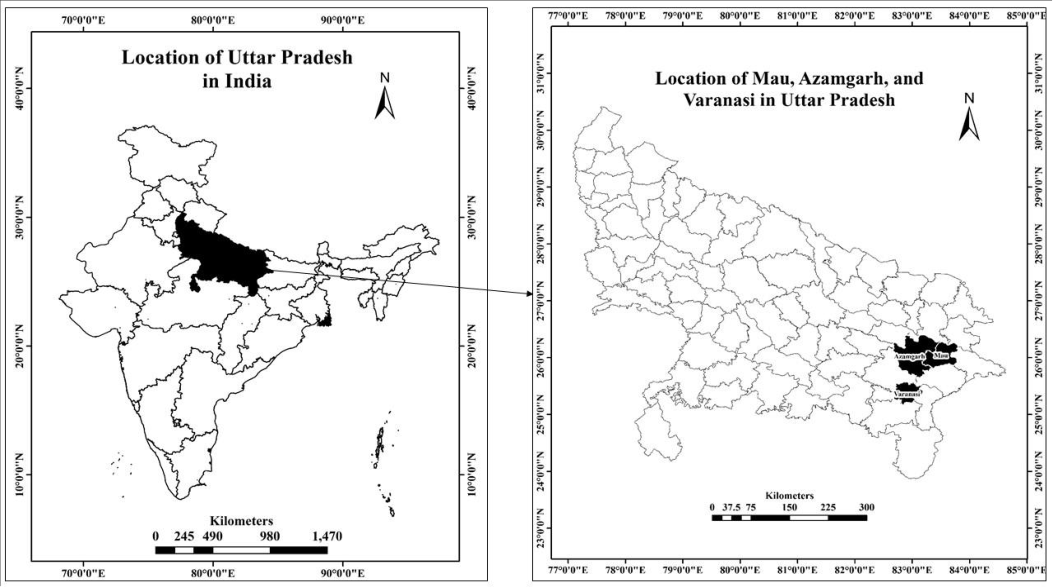 Figure 1
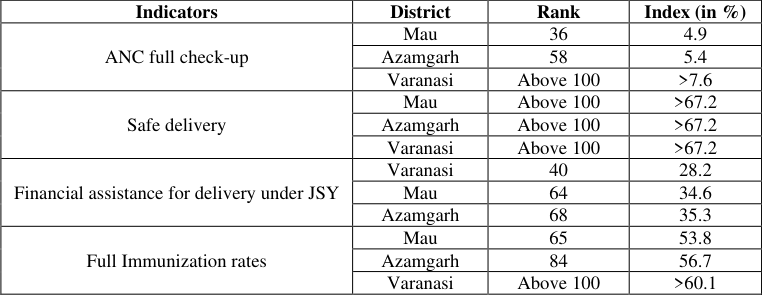 Table 1
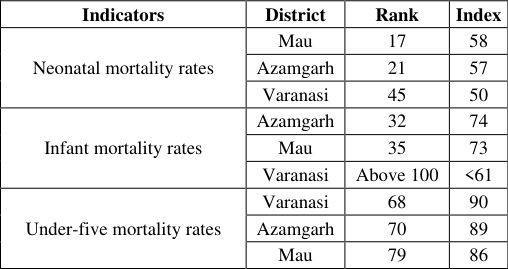 Table 2
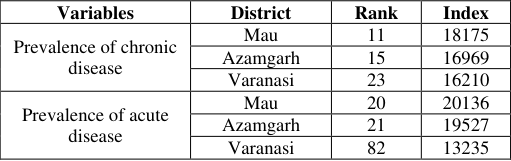 Table 3
 Table 4
Introduction
India is one of the countries in the world where the health facilities for people are inadequate and insufficient. The health care facilities and infrastructure related to health care are of low level in the country. The effective, active and efficient public health system in India is need of the hour. The health care system of India has gone through various changes historically and is dominated by neglected public health services and provisioning of medical facilities (Gupta 2005) [1] . At the time of Britishers the government health facilities were only confined to the Britishers, the facilities for Indian people were zero. However some stress were given to the preventions of contagious diseases such as cholera, but the remaining health problems were not addressed effectively (Gupta 2005) [1] . After the report of Bhore Committee in 1946 the health care system were prioritized and the health care system started to financed by the government of India (Chokshi et al. 2016) [2] . The first National Health Policy (NHP) of India was created in the 1983 with the aim to establish a system of primary care facilities and referral system. In the 2002 update of NHP, the focus was given to the improvement of the reach of the system and incorporating private and public clinics into the healthcare system (Chokshi et al. 2016) [2] . The recent scheme of government on health which is universal health coverage scheme focuses on the access of adequate health facilities to every citizen of the country without any financial hardships (Mathew 2014) [3] . India has extensive and organised health care facilities which have been divided into primary, secondary and tertiary levels. The Primary Health Centres (PHCs) and sub-centres are working at primary level. Community Health Centres (CHCs) and smaller Sub-District hospitals are at the secondary level. Medical Colleges and District Government Hospitals are providing health facilities at the top level [2] . However, the major drawbacks are in their own respective fields. These drawbacks include low quality care, corruption, unhappiness with the system, a lack of accountability, unethical care, overcrowding of clinics, poor cooperation between public and private spheres, barriers of access to services and medicines, lack of public health knowledge, and low affordability (Planning Commission and Jeffrey et al. 2007) [4,5] .
To change in this situation and improve the quality of health facilities in the country, there is a need to study the problems individually and separately for different areas at small and micro level. In present time India is amongst those countries which are worst performer in the world in tackling the health problems of the citizens. Twenty per cent of all maternal deaths and 25% of all child deaths in the world occur in India. 34 out of 1000 children are dead by the time they reach the age of 5 (Balarajan et al. 2007) [6] . About 58 per cent of Indians is immunized in urban areas compared to only 39% in rural areas. A communicable disease is the cause of death for 53% of all deaths in India (Balarajan et al. 2007) [6] .
Study area
The area which has been taken for this study are the three most important district of Eastern Uttar Pradesh which are Mau, Azamgarh and Varanasi. These districts have been selected for the study because they possess various similarities in their social, cultural and economic background. For a glance of the study area some attributes are given in the below table in which some are related to the indicators of this study. Objectives To compare the health facilities of the Mau district to its surrounding districts. To know the current situation of health care facilities of the district as compared to its surrounding districts. To find out the causes of the health problem in the district and proper solution to these health problems. [7] studied to compare the knowledge, attitude and practices among antenatal care facilities utilizing and non-utilizing women, aged 15-49 years. They collected the data through a cross-sectional survey and calculated the odds ratios and 95% confidence intervals. The P-value was obtained by chi-square test. The results show that pallor was significantly lower, and tetanus toxoid coverage was higher among women utilizing antenatal care. The knowledge about danger signals in pregnancy and realization of the importance of eating a healthy diet during pregnancy was significantly higher among women utilizing antenatal care [7] . Gupta (2005) [1] has traced the health services in India from the colonial period to post-independence and the current health care services. She has highlighted various issues in the health care sector arises after the post-independence. Finally she has discussed the current situation of the health care sector and concluded that India has resources and the people at the various level which helps in the connectivity of the services. This can improve health care sector with tremendous improvement, but the only problem is implementation of the schemes and access of the services by the people [1] . Reddy and Sivaramakrishnan (2006) [8] have discussed various health services and the development of health facilities. They have talked about the Unresolved Health Challenges in Public Health which are the massive need of qualified public health, need for the public health education as recommended by the Bhore Committee (1946), and Mudaliar Committee (1961) reports. They have also talked about the emergence of the PHFI. The interview of Researchers, policy-makers, teachers and health practitioners in the government and NGO sectors shows that they have lack of knowledge. There is a dearth of public health professionals in the government, and there is a vast difference in the quality of existing public health professionals. Also there is lack of employment opportunities in the government services [8] . Hammer et al. (2007) [5] studied about the causes of Government Failure in Public Health Services and said that high absenteeism, low quality in clinical care, low satisfaction levels with care and rampant corruption plague public health services in India has led to mistrust of the system. They also said that rapid growth of private services, weak voice and low accountability is the main obstacle in the effective delivery of health services to the people [5] .
Database and Methodology
Database and Methodology
Research discussion
The data about ten health indicators have been taken from the Annual Health Survey 2012-13, which says that it is a report on vital health indicators. The government schemes and facilities have been made for all these health indicators, so it will help to know the current situation of the success of government scheme and its implementation in the field in a better way. The AHS 2012 was conducted across 282 districts of nine states of India, but it gives only top or bottom 100 lists of districts in any indicator, so if the district has top 100 then its exact ranking is not given in the report. Above table shows the data about three health indicators and one financial scheme in the health sector. In ANC full check-up Mau is at worst with only 4.9% among the three districts and ranks 36 among the 100 lowest performing district, Azamgarh with 5.4% ranks 58 whereas Varanasi is performing well with more than 7.6% and ranks above 100. All the 3 three districts have shown good results in the safe delivery with more than 67.2% and secured the rank more than 100. However, in financial assistance for delivery under JSY they are among the lowest 100, Varanasi raked 40 with only 28.2 %, Mau performed better than Varanasi in JSY assistance with 34.6% but lesser than the Azamgarh which has secured 68 ranks among 100 lowest districts. Again in full immunisation rates, Mau performed worst among the three districts with only 53.8% of full immunization and ranked 65 among the lowest-performing district. Azamgarh and Varanasi had done better than Mau and ranked 84 and above 100 respectively. Antenatal care (ANC) is the medical attention given to women during pregnancy. It comprises visiting the obstetrician, receiving supplementary nutrients required during pregnancy, detecting potential complications during delivery and assessing the health of the unborn child and expectant mother. (AHSR-2012-13). The deliveries conducted by doctor/ nurse/auxiliary nurse midwife (ANM)/lady health visitor (LHV) can be categorized as safe deliveries both institutional deliveries and home deliveries (AHSR-2012-13). Immunization is a process by which resistance to a particular disease is developed through vaccination. Fully immunized child refers to infants who receive within 11-23 months BCG (Bacillus Calmette-Guerin) vaccination against tuberculosis, three doses of DPT (Diphtheria, Poliomyelitis and Tetanus), minimum three doses of the polio vaccine and one dose of measles vaccine. (AHSR-2012-13). Janani Suraksha Yojana (JSY) is a centrally sponsored scheme which aims to increase the coverage of institutional deliveries in the country. Under the scheme, pregnant women receive cash assistance to give birth in a medical institution. (AHSR-2012-13). The above table shows that again Mau is the worst performing district among the three in controlling neonatal mortality rates and ranks 17 in 100 districts of highest neonatal mortality rates with 58 deaths per 1000 live births. Whereas Azamgarh ranked 21 with 57 deaths and Varanasi with 50 deaths per 1000 live births ranked 45 among 100 districts. In controlling infant mortality rate Mau has performed better than Azamgarh and ranked 35 with 73 deaths per 1000 live births however Azamgarh ranked 32 among 100 districts with 74 deaths and Varanasi ranked above 100 with less than 61 deaths per 1000 live births. Mau has performed better from the other two districts in controlling Under-five mortality rates and ranked 79 with 86 deaths per 1000 live births whereas Varanasi and Azamgarh ranked 68 and 70 with 90 and 89 deaths respectively among the 100 districts with highest mortality rates.
Neonatal death: is defined as a death during the first 28 days of life and neonatal mortality rate (NMR) as the probability of dying in the first month of life expressed as per 1,000 live births.
Infant mortality: is the death of a child less than one year of age. Infant mortality rate (IMR) is the probability of death of children below one year of age expressed as per 1,000 live births.
Under-five mortality: refers to the death of infants and children under the age of five. Under-five mortality rate (UFMR) is calculated as the probability of dying between birth and exactly five years of age, again expressed per 1,000 live births. From the above table, it is crystal clear that Mau is worst performing district among the three and has highest prevalence of chronic and acute diseases per 100,000 populations. It ranked 11 with 18175 per 100,000 persons having one or the other chronic disease. Azamgarh and Varanasi ranked 15 and 23 with 16969 and 16210 per 100,000 persons respectively suffering from acute disease. In the prevalence of acute diseases again Mau ranked highest among the three and ranked 20 among the 100 districts with 20136 per 100,000 persons having acute disease. Azamgarh and Varanasi have performed better with 19527 and 13235 per 100,000 persons having acute diseases and ranked 21 and 82 respectively among the 100 districts. Acute illness: Acute illness is defined as a disease that has an abrupt onset and is generally short-lived. Chronic illness: Chronic illness is a human health condition that is persistent and lasts longer than usual. In most cases, it cannot be cured completely.
Findings and Conclusion
In ANC full check-up, Full Immunization rates, control of neonatal mortality rates, and prevalence of chronic and acute diseases Mau are below the Azamgarh and Varanasi. In Financial assistance for delivery under JSY and control over Infant mortality rates, Mau has shown better results than Azamgarh but has to go long mile to match Varanasi. Only in controlling of Under-five mortality rates it has performed better than Azamgarh and Varanasi. Mau has shown worst result in Maternal and Child Health Derivation Index with 0.543 and ranked 201 among 282 districts of the five stats. Only in one area (controlling of Under-five mortality) out of ten areas of health and healthcare facilities Mau has performed better than the Azamgarh and Varanasi. In one area (Safe delivery) it is equal to the other two districts. Remaining eight fields of health and healthcare facilities, Mau has performed below Azamgarh and Varanasi.
Suggestions
One single most important thing which can improve the health of people with drastic rate is awareness. There is a need to run the awareness camps on local and small level to aware the people about various health problems and their solution. Awareness about various government schemes and their benefits will help in improving the health of the people. Because there are so many government schemes, but it has been observed that people are unaware of these schemes and are unable to avail these schemes. Opening of more and more primary health care centres and clinics in small towns and villages will help to reduce the burden in government hospitals and medical colleges. There is a need to develop pleasant cooperation between public and private spheres of health to remove barriers of access to services and medicines.
Figures and tables from the paper
| Description | Varanasi | Azamgarh | Mau |
|---|---|---|---|
| Actual Population | 3,676,841 | 4,613,913 | 2,205,968 |
| Male | 1,921,857 | 2,285,004 | 1,114,709 |
| Female | 1,754,984 | 2,328,909 | 1,091,259 |
| Area Sq. Km | 1,535 | 4,054 | 1,713 |
| Density/km2 | 2,395 | 1,138 | 1,288 |
| Sex Ratio (Per 1000) | 913 | 1019 | 979 |
| Child Sex Ratio (0-6 Age) | 885 | 919 | 926 |
| Average Literacy | 75.60 | 70.93 | 73.09 |
| Male Literacy | 83.78 | 81.34 | 82.45 |
| Description | Varanasi | Azamgarh | Mau |
| Female Literacy | 66.69 | 60.91 | 63.63 |
| Child Proportion (0-6 Age) | 13.52% | 15.30% | 15.47% |
| Boys Proportion (0-6 Age) | 13.72% | 16.10% | 15.89% |
| Girls Proportion (0-6 Age) | 13.30% | 14.52% | 15.04% |
Table text extracted from the original PDF; superscript letters are shown inline. The original table image is below.
View original table image
| Indicators | District | Rank | Index (in %) |
|---|---|---|---|
| ANC full check-up | Mau | 36 | 4.9 |
| Azamgarh | 58 | 5.4 | |
| Varanasi | Above 100 | >7.6 | |
| Safe delivery | Mau | Above 100 | >67.2 |
| Azamgarh | Above 100 | >67.2 | |
| Varanasi | Above 100 | >67.2 | |
| Financial assistance for delivery under JSY | Varanasi | 40 | 28.2 |
| Mau | 64 | 34.6 | |
| Azamgarh | 68 | 35.3 | |
| Full Immunization rates | Mau | 65 | 53.8 |
| Azamgarh | 84 | 56.7 | |
| Varanasi | Above 100 | >60.1 |
Table text extracted from the original PDF; superscript letters are shown inline. The original table image is below.
View original table image
| Indicators | District | Rank | Index |
|---|---|---|---|
| Neonatal mortality rates | Mau | 17 | 58 |
| Azamgarh | 21 | 57 | |
| Varanasi | 45 | 50 | |
| Infant mortality rates | Azamgarh | 32 | 74 |
| Mau | 35 | 73 | |
| Varanasi | Above 100 | <61 | |
| Under-five mortality rates | Varanasi | 68 | 90 |
| Azamgarh | 70 | 89 | |
| Mau | 79 | 86 |
Table text extracted from the original PDF; superscript letters are shown inline. The original table image is below.
View original table image
| Variables | District | Rank | Index |
|---|---|---|---|
| Prevalence of chronic disease | Mau | 11 | 18175 |
| Azamgarh | 15 | 16969 | |
| Varanasi | 23 | 16210 | |
| Prevalence of acute disease | Mau | 20 | 20136 |
| Azamgarh | 21 | 19527 | |
| Varanasi | 82 | 13235 |
Table text extracted from the original PDF; superscript letters are shown inline. The original table image is below.
View original table image
| District | Rank | Index |
|---|---|---|
| Mau | 201 | 0.543 |
| Azamgarh | 171 | 0.516 |
| Varanasi | 142 | 0.492 |
Table text extracted from the original PDF; superscript letters are shown inline. The original table image is below.
View original table image
References
9 in the original paper- Gupta M Das. Public Health in India: Dangerous Neglect. Economic and Political Weekly. 2005; 40(49):5159-5165.
- Chokshi M, Patil B, Khanna R, Neogi SB, Sharma J, Paul VK, Zodpey S. Health systems in India. Journal of Perinatology. 2016; 36(3):9-12.
- Mathew G. Commentary: Viewpoint: Re-instating a "public health" system under universal health care in India. Journal of Public Health Policy. 2014; 6(1):1523.
- Jeffrey Hammer YA, SS. Understanding Government Failure in Public Health Services. Economic and Political Weekly. 2007; 42(40):4049-4057.
- Balarajan Y, Selvaraj S, Subramanian SV. Health care and equity in India. Lancet. 2011; 377(9764):505-515.
- Alam AY, Qureshi AA, Adil MM, Ali H. Comparative study of Knowledge, Attitude and Practices among Antenatal Care Facilities utilizing and non-utilizing women. 2005; 55(2):52-56.
- Reddy KS, Sivaramakrishnan K. Unmet National Health Needs: Visions of Public Health Foundation of India. Economic and Political Weekly. 2006; 41(37):3927-3933.
- Chokshi M, Patil B, Khanna R, Neogi SB, Sharma J, Paul VK, Zodpey S. Health Systems in India. Journal of Perinatology. 2016; 36(3):9-12.
- Ahmad S. Mau Shahar Hunro Waran. Faheem Book Depot, 2009.