
Research article · 2018 · Full text
International Journal of Veterinary Sciences and Animal HusbandryInsect pests infesting korarima (Aframomum corrorima) (Braun) P.C.M. Jansen in southwestern part of Ethiopia
Volume 3(2) · Pages 10–13
Research areasBiological Control of Invasive SpeciesAquatic Ecosystems and Biodiversity
Abstract
Author-writtenSurvey was conducted to study the distribution, infestation and damaging level of insect pests of korarima (Aframomum corrorima) indigenous spice of Ethiopia during 2013/2014 cropping seasons in Southwestern parts of Ethiopia. Insect pests were observed and identified at their sites in the surveyed areas. In addition, samples of insect pests and infected plant parts were collected and insect images were taken. The samples were diagnosed in Tepi National Spice Research Center laboratory. A total of fourteen species of insect pests from six orders were recorded as korarima insect pest with different infestation rate and damage level. Green stink bug (Acrosternum. spp), korarima flower thrips (Sciothrips. spp) mottled tortoise beetle (Chelymorpha. spp) and cardamom white fly (Dialeurodes. spp) were widely distributed and recorded relatively with high infestation rate from all surveyed areas while black leaf beetle (Chrysochus. spp), brown spotted grasshopper (Cyrtacanthacris. spp), spice grasshopper (Catantops. spp) were considered as intermediate due to medium infestation and damage level. The remaining insect pests showed very low infestation rate and damage level. They are grouped under minor insect pests. Therefore, it is important to design control options for these major insect pests to ensure plant health and pest action under economic threshold level.
Summary
Source-checkedPlain-language reading of the full paper, prepared with AI and checked against the text. Each point links to the authors' own words.
Why it matters
- Korarima is a spice indigenous to Ethiopia and is a common component of the national diet. View evidence ↗
- The dried capsules of the plant are used for both medicinal purposes and as food seasoning. View evidence ↗
- Over recent decades, there has been a decline in the biodiversity, production areas, and yields of korarima in southern Ethiopia. View evidence ↗
The question
- The study aimed to survey the insect pests damaging korarima in southwestern Ethiopia to provide a basis for developing control options. View evidence ↗
What they did
- The survey was conducted during the 2013/2014 cropping seasons in the southwestern regions of Ethiopia. View evidence ↗
- At each survey site, researchers randomly selected fifteen plants to assess insect presence, infestation, and damage levels. View evidence ↗
- Damage levels were categorized as very low (≤5%), low (6-10%), medium (11-20%), high (21-50%), or very high (>50%). View evidence ↗
What they found
- The survey identified fourteen species of insect pests belonging to six different orders. View evidence ↗
- The green stink bug showed high infestation rates in several areas, peaking at 38.8% in Andracha. View evidence ↗
- In the Bita district of the Kafa zone, korarima flower thrips caused a 27.7% infestation rate and a 21.4% damage level. View evidence ↗
- Mottled tortoise beetles were found across all areas, with the highest infestation rates occurring in Godere (24.2%) and Chena (20.7%). View evidence ↗
- Black leaf beetles, brown spotted grasshoppers, and spice grasshoppers were identified as intermediate pests with medium to high population densities. View evidence ↗
- Seven species, including termites and leaf hoppers, were classified as minor pests due to very low to low infestation and damage levels. View evidence ↗
What it means
- The authors conclude that management options should prioritize major pests, and regular surveys are necessary as minor pests may become major threats in the future. View evidence ↗
- The authors recommend that farmers be made aware of these pests and adopt appropriate cultural practices. View evidence ↗
Visual summary
2 visualsIllustrations explain the paper; charts are replotted from the paper's own table values.
Hierarchy of Korarima Pests
AI-generated conceptual illustration (Korarima plants (Aframomum corrorima) and various insect pests including stink bugs, thrips, leaf beetles, grasshoppers,). It explains the idea and does not show study data.
View source evidence ↗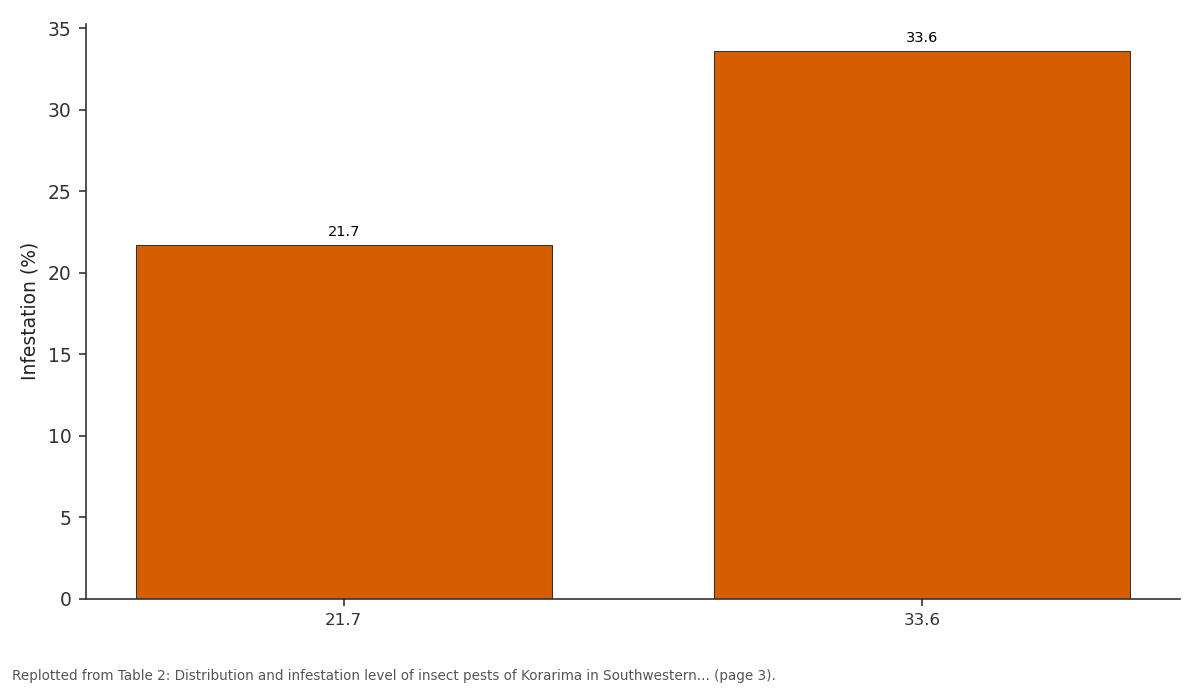
Infestation (%): 21.7 vs 33.6
Replotted from Table 2 (page 3) of the original paper. Every bar is the paper's own table value.
View source evidence ↗Figures & tables
From the original paper Table 1
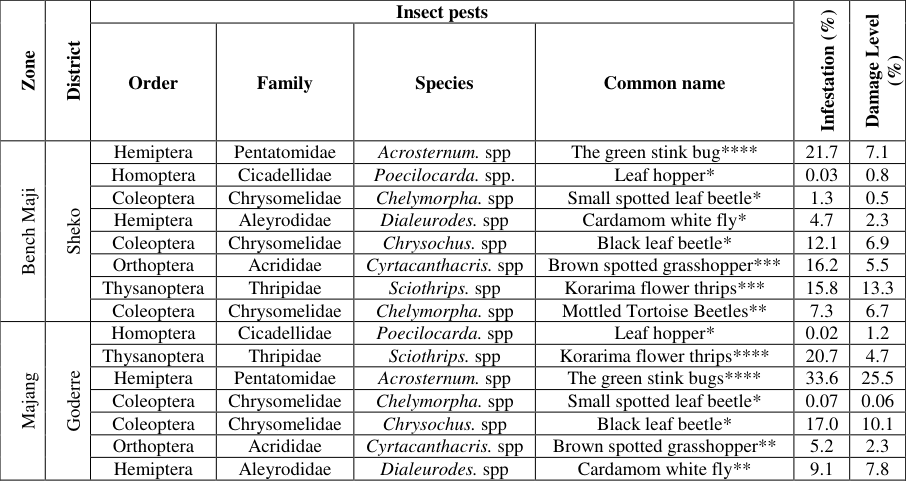 Table 2
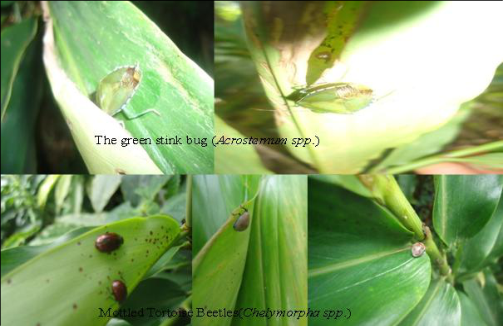 Figure 1
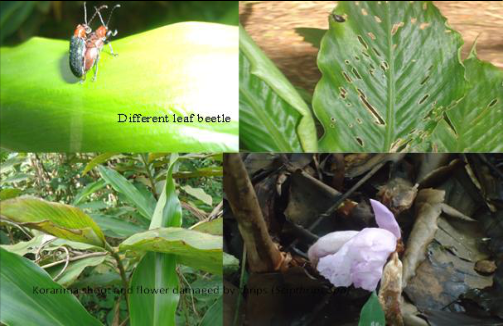 Figure 1
Introduction
Korarima (A. corrorima) is indigenous to Ethiopia and well known in every Ethiopian diet. The dried pods sold in almost every Ethiopian market and are quite expensive compared to other spices (Jansen 1981, Eyob et al. 2007) [5] . Dried capsules of korarima have diverse use from consumption as food seasoning to medicinal values. Some documents also indicate that korarima capsule was used as a bartering medium among the Ethiopian people before time immemorial. It mostly found in south and southwestern party of the country. The spice preferring shady locations and rich, moist, well-drained soil and recently well performed in South west part of Ethiopia particularly in Kafa, Gamo-Gofa, Bench-Mahag, Majangs zones (Eyob et al. 2007) [5] . Ethiopia exported dried pods of korarima to Sudan, Egypt, Arabia, Iran, India, and the Scandinavian markets (Jansen 1981, Lock 1997). The great potential of this plant has however, encountered different production problems. In the last few decades, yields, areas of production and biodiversity have declined both from farmer's field and natural forest of southern Ethiopia (EARO, 2000) [3] . In Ethiopia, korarima (A. corrorima) production is declining mainly due to destruction of plant's natural habitats (Jansen 1981, Eyob et al. 2007) [5] and other limiting factors such as non-improved variety, non-adapted agronomic practices and lose caused due to biotic and a biotic stress are very important (Edossa, 1998; Girma et al. 2008) [4,9] . Information on pest in a specific agro-ecosystem is vital to understand the pest status that helps the planner to design pest management options. However, such information on korarima (A. corrorima) insect pests in Ethiopia still not documented at all. Therefore, the current study aims to survey insect pest damaging korarima (A. corrorima) in south western of Ethiopia to initiate control options.
Materials and Method
Survey was conducted during during the 2013/2014 cropping season from (South Nations and Nationality and Peoples Regional State (SNNPRS) and Gambella Regional State of Ethiopia at flowering and maturity growth stages of Korarima. Field size covered by Korarima was obtained from zonal agricultural office to determine representative samples. At each site, a group of fifteen plants were selected randomly and accessed repeatedly for insect presence, infestation and damage level. Initial observation on damage symptoms on the leaves, flowers and capsules were noted by visual examination at their site. Moreover, insect pests were collected from selected sites for further identification. A pocket lens (10X), insect collecting nets, Camel brush, glass vials and polythene bags were used for collection of insect pests for their proper identification. Some pests were identified in the field using identification keys and some of them were brought to Tepi National Spice Research Center for detail study, using pertinent literature and internet search. Some specimens have been maintained to be identified at a later date. The insect damage scale was assigned according to Seif and Hillocks (1999) [13] that states very low (≤5%), 1ow (6-10%), medium (11-20%), high (21-50%) and very high (>50%) levels. Infestation and damage level from attacked plant leaf/parts were calculated by using the following formula. Infestation per cent = Number of affected sampled leaves/total number of sampled leaves x hundred (100). And Damage level = Area of plant tissue affected/total area of plant (tissue) x hundred (100). [2] Results and Discussion Korarima (A. corrorima) insect pests Fourteen species of insect pest from six orders were recorded. Among identified korarima insect pest, the green stink bug (Acrosternum. spp), korarima flower thrips (Sciothrips. spp) mottled tortoise beetle (Chelymorpha. spp) and cardamom white fly (Dialeurodes. spp) were widely distributed and recorded with high infestation rate across the surveyed areas (Table 2). The green stink bug (Acrosternum. spp) highest infestation rate was occurred at Sheko (21.7%), Godere (33.6%), Andracha (38.8%), Chena (30.7%) and Bita (24.1%) woredas. The damage level of all surveyed areas ranged very low to medium (0.3-18.7%) except in Godere (25.5%) district (Table 2). The adults & nymphs were observed sucking sap from plant leaves and apical shoots which resulted leave discoloration. According to McPherson and McPherson (2000), there are diversity of stinkbugs species which are economically important to agricultural crops. This finding is similar with what we recorded on present survey. High infestation rate (27.7%) and damage level (21.4%) were recorded due to korarima flower thrips attack on korarima plant in Kafa zone at Bita district. Similarly this pest caused high infestation rate in Godere (20.7%) district (Table 2). The thrips were found sucking the inner content sap inside the apical shoot, flower petals and capsule of the korarima plants. Similar to cardamom plant, the thrips damaged the surface of the korerimacapsules and sucked the plant contents. The injured capsules resulted in malformed and discolorations of the capsule. This type of effect on the capsules highly influence the capsule appearance and finally the quality (Girma et al. 2008) [9] . Among the insect pests recorded, cardamom white fly was widely distributed in most of surveyed areas though very low to medium infestation rate and damage level. In Chena district this pest caused (29.9%) infestation rate and (23.4%) damage level. Cardamom white fly also caused 22.1% infestation rate and 15.0% damage level in Bita district (Table 2). Whiteflies are found sucking the korarima plant which resulted in yellowing symptom and contaminated waste substance mostly under lower surface of the leaves. Thrips and white fly were recorded with high infestation rate and damage level from cardamom plant and korarima from all surveyed areas. The occurrence of these pests on both crops may probably due to the crops are found under the same family. Anon (1977) [1] , confirmed that Order Zingiberales (formerly known as Scitamineae) to which currently the family Zingiberaceae belongs has several wild spices among which Genus Elettaria (small cardamom) and Aframomum (large cardamoms) are two economically important seed spices widely distributed throughout tropics. These spices are much related in chemical constitute and morphological characteristics and their conducive environment for cultivation. Literature from different authors indicate that the existence of economically important insect pests on cardamom plant (Gopakumar and Chandrasekar, 2002) [8] , (Selvakumaran and Kumaresan, 1993) [14] and (Singh et al. 1995) [15] are similar to that of korarima. From current findings we recorded thrips and white fly attacking both plants (cardamom and korarima) in all surveyed areas. This phenomenon may be occurred due to the crops similarity in plant constitutes. (Finch, 1986 and De Wilde, 1976) [7,6] also states that even though some insect herbivores specialize on one host in their life, many insect pests have more than one host range in certain ecosystem to sustain their life. Mottled tortoise beetle were widely distributed in all surveyed areas though the infestation rate and damage levels were very low to medium with the exception at Godere and Chena the infestation rate were 24.2% and 20.7%, respectively. The adult beetles were found feeding on the leaves and pseudostems which resulted in circular holes and stem damage. The second category that occurred medium to high population density includes pests black leaf beetle (Chrysochus spp), brown spotted grasshopper (Cyrtacanthacris. spp), Spice grasshopper (Catantops spp).These pests are the second most important pests recorded whereas seven species were recorded from very low to low infestation rate and damage levels .These include: leaf-footed plant bug (Leptoglossus. spp), leaf hopper (Poecilocarda. spp), termite (Macrotermes. spp), green grasshopper (Catantops. spp), small spotted leaf beetle (Chelymorpha. spp), plant bug (Neurocolpus. spp.)
| Zone | District | Insect pests | — | — | — | Infestation (%) | Damage Level (%) |
|---|---|---|---|---|---|---|---|
| Order | Family | Species | Common name | ||||
| Bench Maji | Sheko | Hemiptera | Pentatomidae | Acrosternum. spp | The green stink bug**** | 21.7 | 7.1 |
| Homoptera | Cicadellidae | Poecilocarda. spp. | Leaf hopper* | 0.03 | 0.8 | ||
| Coleoptera | Chrysomelidae | Chelymorpha. spp | Small spotted leaf beetle* | 1.3 | 0.5 | ||
| Hemiptera | Aleyrodidae | Dialeurodes. spp | Cardamom white fly* | 4.7 | 2.3 | ||
| Coleoptera | Chrysomelidae | Chrysochus. spp | Black leaf beetle* | 12.1 | 6.9 | ||
| Orthoptera | Acrididae | Cyrtacanthacris. spp | Brown spotted grasshopper*** | 16.2 | 5.5 | ||
| Thysanoptera | Thripidae | Sciothrips. spp | Korarima flower thrips*** | 15.8 | 13.3 | ||
| Coleoptera | Chrysomelidae | Chelymorpha. spp | Mottled Tortoise Beetles** | 7.3 | 6.7 | ||
| Majang | Goderre | Homoptera | Cicadellidae | Poecilocarda. spp | Leaf hopper* | 0.02 | 1.2 |
| Thysanoptera | Thripidae | Sciothrips. spp | Korarima flower thrips**** | 20.7 | 4.7 | ||
| Hemiptera | Pentatomidae | Acrosternum. spp | The green stink bugs**** | 33.6 | 25.5 | ||
| Coleoptera | Chrysomelidae | Chelymorpha. spp | Small spotted leaf beetle* | 0.07 | 0.06 | ||
| Coleoptera | Chrysomelidae | Chrysochus. spp | Black leaf beetle* | 17.0 | 10.1 | ||
| Orthoptera | Acrididae | Cyrtacanthacris. spp | Brown spotted grasshopper** | 5.2 | 2.3 | ||
| Hemiptera | Aleyrodidae | Dialeurodes. spp | Cardamom white fly** | 9.1 | 7.8 |
Table text extracted from the original PDF; superscript letters are shown inline. The original table image is below.
View original table image
Conclusions
The survey provided some clue to understand distribution, infestation and importance of insect pests on korarima in southwestern Ethiopia. From this survey, it can be concluded that the insects which were the most distributed and recorded with high infestation rate and damaging level could be categorized as major insect pests. These pests are green stink bug (Acrosternum spp.), korarima flower thrips (Sciothrips spp), mottled tortoise beetle (Chelymorpha spp) and cardamom white fly (Dialeurodes. spp). Black leaf beetle (Chrysochusspp), brown spotted grasshopper (Cyrtacanthacris spp), spice grasshopper (Catantops spp) also caused considerable infestation rate and damage level in the most surveyed areas. They categorized as intermediate pests because they were the second most important insect pests in the surveyed areas. Leaf-footed plant bug (Leptoglossusspp), leaf hopper (Poecilocardaspp), termite (Macrotermesspp), green grasshopper (Catantopsspp), small spotted leaf beetle (Chelymorphaspp), plant bug (Neurocolpus spp.) are minor pests occurred in some of surveyed areas. Currently, insect pests recorded as major insect pests need emphasis for development of suitable management option while regular survey is important to access potential insect pest because there is the probability of current minor pest become major insect pest in the future. Farmers need awareness about these pests and follow appropriate cultural practice.
Acknowledgement
Author expresses sincere thanks to Kafa zonal agricultural office for their informatio during insect record. We acknowledge Ato Muluken Asfaw (technical assistant) for his support during data collection. The study was financially supported by the Ethiopian Institute of Agricultural Research (EIAR).
Figures and tables from the paper
| Regions | Zones | Geographic Location | — | Altitude (masl) | Temperature (0C) | Rainfall (mm) |
|---|---|---|---|---|---|---|
| Longitude (N) | Latitude (E) | |||||
| Snnpr | Benchmaji | 34.88 to 36.14 | 5.33-7.21 | 500 to 2500 | 15.1-27 | 400-2000 |
| Gam bella | Mejenger | 7.20 | 35.10 | 2400-522 | 15 and 25 | 1400 and 2200 |
| Snnpr | Sheka | 35.24 to 37.90 | 7.12-7.89 | 1001-3000 | 15.1-27.5 | 1201-1800 |
| Snnpr | Bonga/Kafa | - | - | 500 to 3500 | 10.1 to 27.5 | 1001 to 2200 |
Table text extracted from the original PDF; superscript letters are shown inline. The original table image is below.
View original table image
References
12 in the original paper- ANON. Zingiberaceae. In Encyclopaedia Britannica Macropaedia, 15th edn. 1977; 19:1150.
- Central statistical agency (CSA) summary and statistical report of the population and Housing, 2007.
- EARO. Utilization of crop technologies, Addis Ababa, Ethiopia, 2000.
- Edossa E. Spices, Research Achievements and experiences, Research Report No. 33, Institute of Agricultural Research, Addis Ababa, Ethiopia, 1998.
- Eyob S, Appelgren M, Rohloff J, Tsegaye A, Messele G Chemical composition and physical properties of essential oils from fresh plant parts of korarima (Aframomum corrorima) cultivated in the highland of southern Ethiopia. J Essent Oil Res. 2007; 19:372-375.
- De Wilde J. The olfactory component in hostplantselection in the adult Colorado beetle (Leptinotarsadecemlineata Say). Symposia Biologica Hungarica. 1976; 16:291-300.
- Finch S. Assessing hostplant finding by insects. In Insectplant interactions (ed. J.R. Miller and T.A. Miller), Springer, New York, 1986, 23-63.
- Gopakumar B, Chandrasekar SS. Insectpests of cardamom incardamom: The genus Elettaria (Ed) P.N. CRC, 2002, 180-200.
- McPherson J, McPherson R, Stinkbugs of economic importance in America north of Mexico. CRC Press Boca Raton, EARO National research strategy for spices, medicinal and other essential oil bearing plants, 2000, 253.
- Seif AA, Hillocks RJ. Some factors affecting infection of Citrus by Phaeoramularia angolensis. Blackwell Wissenschafts-Verlog. Berlin ISSN, 1999, 0931-1785
- Selvakumaran S, Kumaresan D. Studies onbio-ecology, damage potentialand control of the whitefly, Dialeurodescardamomi Davidand Subr. (Aleyrodidade: homoptera) on smallcardamom. Final reportICARScheme. Indian cardamomresearch institute, Spices Board, My ladumpara, India, 1993, 40.
- Singh J, Sudharshan MR, Tamilselvan M. Seasonal population fluctuationon cardamom thrips, (sciothrips cardamom Ramk) J Appl. Zoo. Res. 1995; 6:101-104.
Cited by 1
From OpenAlex, OpenCitations and reference lists read by Scinovex
- Cultivation and postharvest handling practices affecting yield and quality of major spices crops in Ethiopia: A review ↗
Tsegaye Shimelis Hordofa, Tasisa Temesgen Tolossa · Cogent Food & Agriculture · 2020
Developing agricultural production and productivity is the most important strategy in fostering critical capital shortage and enhancing economic growth and poverty reduction in Ethiopia. Spices, being a cash crop, have an immense potential for countries economic development through improving smallholder farmers, creation and expansion of employment opportunities and distribution of income and foreign exchange earnings. The diverse agro ecology, abundant…
❝ 27PDF