
Research article · 2018 · Full text
International Journal of Veterinary Sciences and Animal HusbandrySurgical management of deep lacerated tongue in a red kandhari cow calf
Volume 3(2) · Pages 14–15
Research areasSurgical Sutures and AdhesivesOral and Maxillofacial PathologyOral and gingival health research
Abstract
Author-writtenA 6 month old calf was presented with protruded tongue, blood tinged excessive salivation having deep lacerated wound at the lateral side of the anterior part of the tongue. The cause of injury might be some sharp object. The diagnosis was done by history and clinical examination. Pre surgical treatment was done to stabilize the animal and the cut portion was surgically corrected under influence of sedation with Xylaxine hydrochloride @ 0.1 mg/kg BW IM and local infiltration of 2% lignocaine hydrochloride. The mouth gag was applied and cotton bandage was tied at the base of tongue as tourniquet and to hold and pull the tongue and sutured by absorbable suture material. Sub-cuticular suture and simple interrupted suture techniques were used during surgery. Post-operatively, antibiotics and analgesic were given and advised owner offering for soft feed. Animal recovered quickly as healing of the oral cavity was very rapid.
Summary
Source-checkedPlain-language reading of the full paper, prepared with AI and checked against the text. Each point links to the authors' own words.
Why it matters
- Tongue lacerations in cattle are typically caused by sharp objects such as nails, wires, needles, thorns, or sharp teeth. View evidence ↗
- Tongue lacerations can lead to excessive saliva loss because the injury interferes with the animal's ability to swallow. View evidence ↗
The question
- The study aims to describe the surgical management of a deep tongue laceration in a cow calf caused by consuming sugarcane tops. View evidence ↗
What they did
- The subject was a two-month-old cow calf presented at TVCC, COVAS, Parbhani, exhibiting blood-tinged salivation, tongue protrusion to the right, and an inability to drink milk. View evidence ↗
- Sedation was achieved using Xylazine Hydrochloride at 0.1 mg/kg and Atropine Sulphate at 0.04 mg/kg BW administered intravenously. View evidence ↗
- Local anesthesia was administered by depositing 10 ml of 2% Lignocaine hydrochloride at the injury site. View evidence ↗
- A cotton bandage was used as a tourniquet at the torus lingual (base of the tongue) to retract the organ and control bleeding. View evidence ↗
- The wound was closed using Catgut No.1 suture material in a simple interrupted pattern on both the dorsal and ventral surfaces of the tongue. View evidence ↗
- Post-operative care included 1 liter/day of Ringer's Solution, 1 liter/day of 5% Dextrose solution, daily mouth cleaning with 0.1% Potassium permanganate, and boroglycerine application. View evidence ↗
- The calf received a 5-day course of intramuscular injections including Amoxicillin Cloxacillin (10 mg/kg BW), Meloxicam (0.5 mg/kg BW), Tribivet (2 ml), and Anhistamin (0.2 mg/kg BW). View evidence ↗
What they found
- Following the surgical procedure and post-operative care, the calf recovered without complications and regained the ability to consume milk. View evidence ↗
- The surgical management of the deep laceration resulted in rapid healing, which the authors attribute to the high vascularity of the tongue. View evidence ↗
What it means
- The authors conclude that the calf recovered completely and recommend that this simple surgical technique can be adopted for field-level use. View evidence ↗
Visual summary
1 visualsIllustrations explain the paper; they do not show study data.
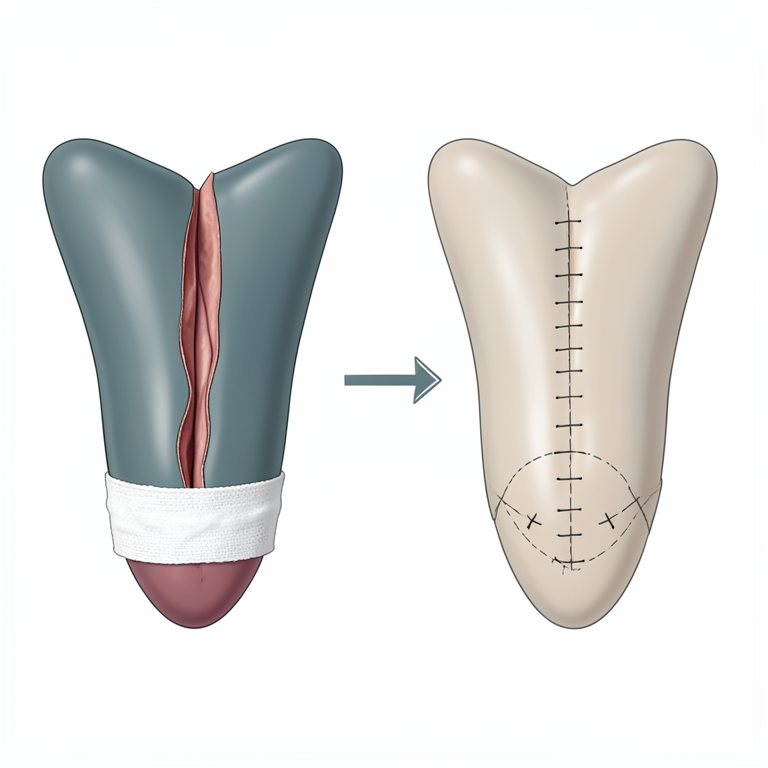
Surgical Procedure Concept
AI-generated conceptual illustration (Red Kandhari cow calf tongue). It explains the idea and does not show study data.
View source evidence ↗Figures & tables
From the original paper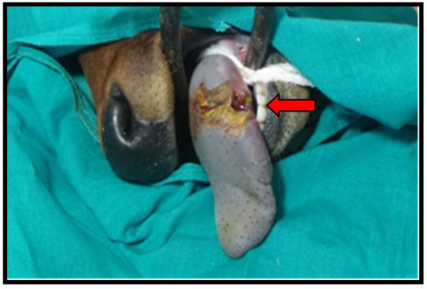 Figure 1
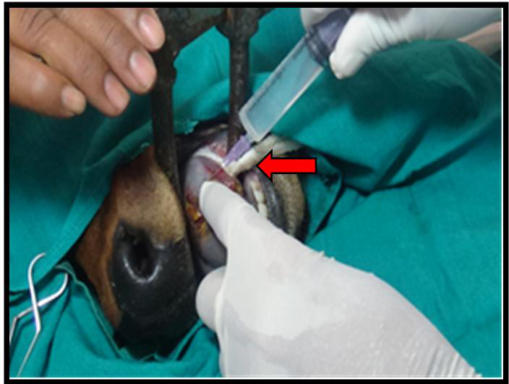 Figure 2
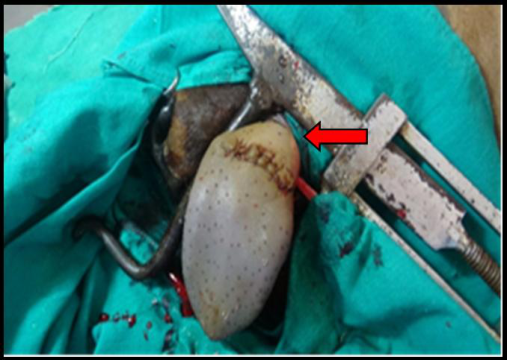 Figure 3
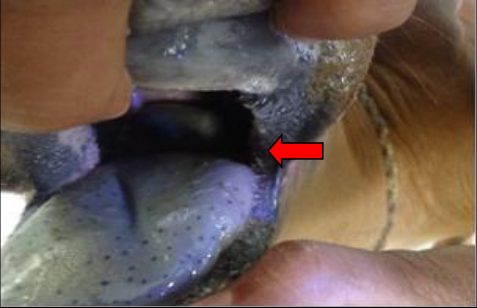 Figure 4
Introduction
Laceration of the tongue usually occurs in bovine due to injury caused by sharp objects like thorns, nails, wires, needles or sharp teeth. Laceration of tongue may be superficial,deep,or involve loss of portion of organ (O’Connor,1994) [1].The present article deals with surgical management of deeply lacerated tongue of a non descript cow calf due to sugarcane top consumption. Case history and observations Two month old Cow calf was presented at TVCC, COVAS, Parbhani, with the history of sudden onset of blood tinched salivation, protrusion of tongue towards right side, inability to consume milk and was dull. The physiological parameters like heart rate,respiration rate and rectal temperature were found in normal range with mild dehydration.
Oral cavity on examination showed excessive salivation mixed with blood and the tongue was lacerated into unequal parts from middle of the tongue to base at which a part was attached to the base of the tongue at torus linguale (Fig-1). Fig 1: Deep lacerated tongue VET 2018; 3(2): 14-15 Dr. VD Aher Professor & head, Department of Veterinary Surgery and Radiology, College of Veterinary and Animal Science, Parbhani, Maharashtra, India GP Dhage Assistant Professor, Department of Veterinary Surgery and Radiology, College of Veterinary and Animal Science, Parbhani, Maharashtra, India Pradeep R Balage MVSc Scholars, Department of Veterinary Surgery and Radiology, College of Veterinary and Animal Science, Parbhani, Maharashtra, India Lokhande DS MVSc Scholars, Department of Veterinary Surgery and Radiology, College of Veterinary and Animal Science, Parbhani, Maharashtra, India Correspondence Pradeep R Balage MVSc Scholars, Department of Veterinary Surgery and Radiology, College of Veterinary and Animal Science, Parbhani, Maharashtra, India Treatment The calf was prepared for aseptic lingual surgery. Mild sedation was achieved with administration of Xylazine Hydrochloride @ 0.1 mg/kg also Inj.
Atropine Sulphate @ 0.04 mg/kg BW I/V was given. The animal was restrained and local anaesthesia was achieved by depositing 10 ml of 2% Lignocaine hydrochloride at the site (Fig-2). After applying mouth gag, Fig 2: Local infiltration with 2% lignocaine Fig 4: After recovery.
Discussion
Most lacerations heal without surgical intervention by using daily mouth lavage and systemic antibiotics and by feeding a soft diet, however in severe cases that involve body of the tongue are best managed surgically. Laceration of the tongue can result in complete or partial severance of the organ with the severed portion protruding from the oral cavity. Excessive loss of saliva is common because of interference with swallowing (Radostits, et al. 2005) [2] Deep laceration of the tongue was successfully managed surgically resulting in rapid healing of the tongue was observed due to good vascularity (Thyagi, et al. 1993) [3]. In this case torniquate helped in controlling of bleeding as well as for easy protrusion of the tounge also anasthesia was prolonged in the local area.
Calf recovered completely without any complications this simple technique can be adopted at field level.
Acknowledgement
Authors would like to thank Dr. Bhagyashree K bhadane for her technical support. Reference 1. O’Connor JJ.
Dollar’s Veterinary Surgery Edn.4th CBS publishers and distributors Delhi, 1985, 557. 2. Radostits M, Arundel JH, Gay C. A Text book of the diseases of cattle, sheep, pigs, goats & horses, 205, 187 3. Thyagi RPS, Jitsingh.
Text book of Ruminant surgery, Hissar. 1983, 18. 4. Dixon PM, Gerard MP. Oral cavity and salivary glands. In: Equine surgery, Auer JA, 2006. 5.
Stick JA. 3rd Eds. WB Saunders.ElsevierInc. 338-339 6. Duchrame NG. Surgery of the bovine digestive system.
In: farm animal surgery, Fubini, S. L. and Duchrane N.G. (eds) 1sted,Elsevier (USA) St. Louis, Missouri, 2004, 164 -165. 7. Dwivedi DK, Gupta AK, Kushwaha RB, Gupta P, Sharma A.
Surgical repair of traumatic laceration of tongue in a pony.Indian Journal of Veterinary Surgery. 2013; 34(2):148-148. 8. Patel JB, Patel PB, Avasthi HA. Surgical Management of Tongue trauma in Mare.Intas Polivet. 2013; 14(1):167- 168. Fig 3: After suturing of the wound Torniquate was applied at the base of the tongue at torus lingual with the help of cotton bandage and retracted outside.
The wound was thoroughly washed with 0.1% Potassium permanganate solution and all the blood clots were removed. The lacerated wound was sutured with Catgut No.1 by applying simple interrupted pattern on dorsal and ventral surface of tongue seprated (Fig-3). Post-operatively the animal was administered with Ringer’s Solution 1 lit/day and Dextrose solution 5%, 1lit/day, daily cleaning of mouth with 0.1% Potassium permanganate solution and application of boroglycerine at the suture site. Inj.
Amoxicillin Cloxacillin @10 mg/kg BW I/M, Meloxicam @0.5 mg/kg BW I/M, Tribivet 2 ml I/M and Inj. Anhistamin @ 0.2 mg/kg BW I/M regularly for 5 days were given and maintained only on milk and the calf recovered uneventfully and able to consume milk (Fig-4).
References
0 in the original paperCited by 1
From OpenAlex, OpenCitations and reference lists read by Scinovex
- Experimental and clinical evaluation of a new intra-lingual suture pattern for management of lingual wounds in farm animals ↗
A.M. Seddek, Mohammed Elrashidy, Sayed Fathi El-Hawari · SVU- International Journal of Veterinary Sciences · 2021
A pre-clinical experimental study is used to evaluate a new intralingual suture pattern, for treating farm animal’s tongue-wounds. Experimental section was performed on 36 fresh goat’s tongue-samples, to compare the new suture pattern with the traditionally used two patterns (double rows simple interrupted pattern; and tension relieve vertical mattress with deep row simple interrupted pattern that is followed by superficial…
❝ 1PDF