
Research article · 2019 · Full text
International Journal of Statistics and Applied MathematicsThe relationships of partial derivatives, continuity and total differentials of multivariate functions
Volume 4(4) · Pages 40–42
Research areasAdvanced Algorithms and Applications
Abstract
Author-writtenOn the basis of discussion of the properties of Multivariate functions, this article puts forward the relationships of partial derivatives, continuity and total differentials of multivariate functions.
Summary
Source-checkedPlain-language reading of the full paper, prepared with AI and checked against the text. Each point links to the authors' own words.
Why it matters
- In univariate functions, differentiability implies continuity, providing a baseline for comparing these properties in multivariate functions. View evidence ↗
The question
- The paper investigates whether the existence of partial derivatives in multivariate functions guarantees continuity, similar to the univariate case. View evidence ↗
What they did
- The author analyzes the relationships between partial derivatives, continuity, and total differentials by examining the properties of multivariate functions. View evidence ↗
- The study specifically uses functions of two variables to demonstrate and prove these mathematical relationships. View evidence ↗
What they found
- Continuity at a point does not guarantee the existence of partial derivatives, as shown by the function f(x, y) = |x| + |y| at (0,0). View evidence ↗
- Differentiability is guaranteed if the partial derivatives exist and are continuous at a given point. View evidence ↗
- Differentiability at a point necessarily implies that the function is continuous at that point. View evidence ↗
- Continuity at a point is not a sufficient condition for the function to be differentiable at that point. View evidence ↗
What it means
- The author concludes that continuity is neither necessary nor sufficient for partial derivatives to exist, and that while continuous partial derivatives guarantee differentiability, differentiability itself is a sufficient but not necessary condition for continuity. View evidence ↗
Visual summary
1 visualsIllustrations explain the paper; they do not show study data.
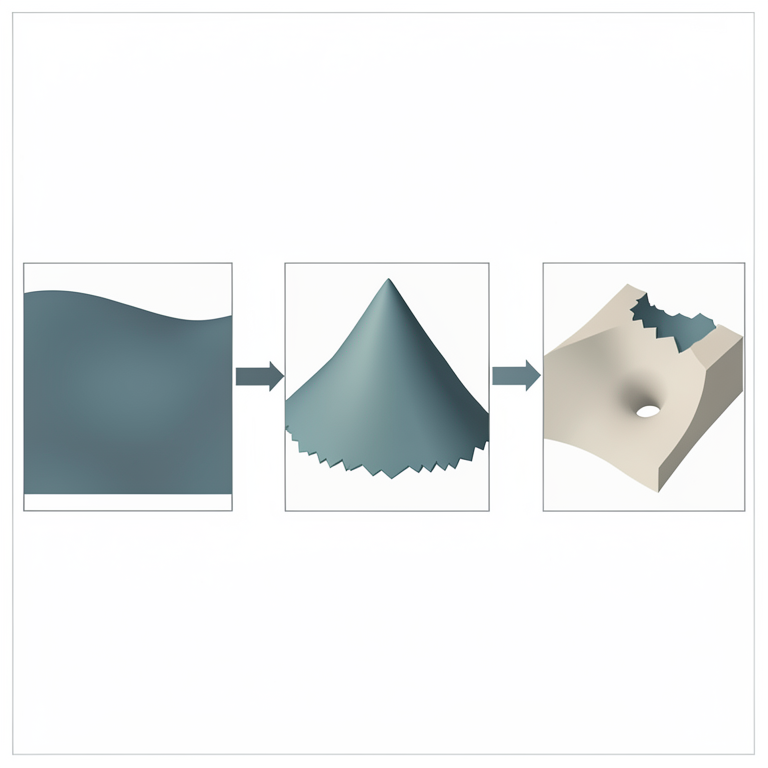
Logical Relationship Map
AI-generated conceptual illustration (Three-dimensional mathematical surfaces representing multivariate functions). It explains the idea and does not show study data.
View source evidence ↗Introduction
It is well known that if a univariate function is differentiable, then it is continuous [1] . Is this situation the same when the function is multivariate? Namely, if the partial derivatives of a multivariate function exist, is the function continuous? The answer is negative. Here we will explain it with the function of two variables in detail.
The relationships of partial derivatives and continuity
If a function of two variables is continuous at a point, the partial derivatives of this point does not necessarily exist. Example 1 [2] . Let𝑓(𝑥, 𝑦) = |𝑥| + |𝑦|, then it is continuous at(0,0), and its partial derivatives at this point do not exist.
Similarly 𝑓 𝑦 (0,0) does not exist. ∴ 𝑓(𝑥, 𝑦) is continuous at(0,0), but its partial derivatives at this point do not exist.
If the partial derivatives of a function of two variables exist at a point, this function is not necessarily continuous at this point.
Example 2 [3] . Let𝑓(𝑥, 𝑦) = { 0, 𝑥 = 0 𝑜𝑟 𝑦 = 0 1, 𝑜𝑡ℎ𝑒𝑟𝑠 , Then its partial derivatives exist at(0,0), it is not continuous at this point.
is not continuous at(0,0). ∴The partial derivatives of 𝑓(𝑥, 𝑦) exist at (0,0), the function is not continuous at this point.
The relationships of partial derivatives and total differential
If the partial derivatives of a function of two variables exist at a point, the function is not necessarily differentiable at this point. Firstly, the function with total differential is defined to be differentiable [3][4] .
Example 3 [3] . Let𝑓(𝑥, 𝑦) = { 𝑥 2 𝑦 𝑥 2 +𝑦 2 , 𝑥 2 + 𝑦 2 = 0 0, 𝑥 2 + 𝑦 2 ≠ 0 , Then its partial derivatives exist at point (0,0), it is not differentiable at this point.
So its partial derivatives exist at point(0,0).
When (𝑥, 𝑦) approaches (0,0) by the path 𝑦 = 𝑘𝑥
Obviously, the limit varies according to the value of 𝑘, so it does not exist. Which means that 𝑓(𝑥, 𝑦) is not differentiable at (0,0).
If the partial derivatives of a function of two variables exist and they are continuous at a point, then the function is differentiable at this point. This conclusion can be proved easily [3] . At a certain point, if a function of two variables is differentiable, and its partial derivatives exist, but they are not necessarily continuous.
Example 4 [3] . Let𝑓(𝑥, 𝑦) = { (𝑥 2 + 𝑦 2 ) 𝑠𝑖𝑛 1 𝑥 2 +𝑦 2 , 𝑥 2 + 𝑦 2 ≠ 0 0 , 𝑥 2 + 𝑦 2 = 0 , then its partial derivatives exist, but they are not necessarily continuous.
∴ 𝑓(𝑥, 𝑦) is not differentiable at(0,0) And consider the situation when 𝑥 2 + 𝑦 2 ≠ 0 does not exist, so 𝑓 𝑥 (𝑥, 𝑦) does not continuous at(0,0).
Similarly 𝑓 𝑦 (𝑥, 𝑦) does not continuous at (0,0).
The relationships of total differential and continuity
1. If a function of two variables is differentiable at a point, it is must continuous at this point.
It is easy to be proved based on the definition of total differential. 2. If a function of two variables is continuous at a point, it is not necessarily differentiable at this point.
It is obvious according to example 1. It has been proved that the partial derivatives of this function at (0,0) do not exist, so it is not differentiable at this point.
Conclusion
In summary, the relationships of partial derivatives, continuity and total differentials of multivariate function can be concluded as follows:
For multivariate functions at a certain point, (1) The continuity is the unnecessary and insufficient condition of the existence of the partial derivatives;
(2) The existence of the partial derivatives is the necessary and insufficient condition of the differentiability.
(3) The continuity of the partial derivatives is the unnecessary and sufficient condition of the differentiability; (4) The differentiability is the unnecessary and sufficient condition of the continuity.