
Research article · 2018 · Full text
International Journal of Advanced Biochemistry ResearchSynthesis of cinnamyl alcohol acetate in a static lipase bioreactor at room temperature
Volume 2(1) · Pages 11–15 · DOI: 10.33545/26174693.2018.v2.i1a.9 ↗
Research areasEnzyme Catalysis and ImmobilizationMicrobial Metabolic Engineering and BioproductionAnalytical Chemistry and Chromatography
Abstract
Author-writtenTo make the synthesis of cinnamyl acetate not only green but also low energy consumption, absorbent cotton was taken as an immobilized material to prepare the immobilized Pseudomonas fluorescens lipase in a column glass bottle and obtain a simple immobilized lipase bioreactor, and employed in catalysis of vinyl acetate reacting to cinnamyl alcohol. It is interesting that, even at room temperature and under static state, the bioreactor still behaves a good catalytic activity, and the proper addition of acylation reagents or solvents in the bioreactor can increase the reaction conversion. The best reaction system is composed of 3 mL vinyl acetate and 1.34 g cinnamyl alcohol. After 24 h, the molar conversion can reach 80.0%, and after 48 h, it can reach 91%. Obviously, the immobilized lipase bioreactor has an obviously catalytic effect of low energy consumption, and has potential value for further development and application in industry.
Summary
Source-checkedPlain-language reading of the full paper, prepared with AI and checked against the text. Each point links to the authors' own words.
Why it matters
- Cinnamyl acetate is a flavor used in the food, pharmaceutical, and cosmetic industries, with a global annual consumption of approximately 100 tons. View evidence ↗
- Traditional chemical synthesis of cinnamyl acetate often suffers from low conversion, long reaction times, high energy consumption (high temperature and pressure), and significant by-product formation. View evidence ↗
- Enzymatic synthesis is considered a greener alternative because enzymes offer high selectivity and operate under mild reaction conditions. View evidence ↗
The question
- The study aimed to create a low-energy, green synthesis method for cinnamyl acetate by using a simple bioreactor consisting of Pseudomonas fluorescens lipase (PFL) immobilized on absorbent cotton. View evidence ↗
What they did
- The bioreactor was prepared by dissolving 10 mg of PFL enzyme powder in distilled water and absorbing it into 10 mg of absorbent cotton within a 10 mL column glass bottle. View evidence ↗
- The standard reaction involved adding 2 mL of vinyl acetate and 1.34 g of cinnamyl alcohol (a 2.17:1 molar ratio) to the bioreactor. View evidence ↗
- Reaction progress was monitored using gas chromatography (GC) with specific temperature ramps and nitrogen as the carrier gas. View evidence ↗
What they found
- Catalysis at room temperature (25°C) is feasible, with a conversion rate only 14.5% lower than the conversion achieved at 40°C (69.3% vs 54.8%). View evidence ↗
- Adding n-hexane as a solvent increased conversion (up to 64.5% for 2 mL vinyl acetate and 74.7% for 3 mL vinyl acetate), though this effect was less significant than simply increasing the vinyl acetate amount. View evidence ↗
- The bioreactor demonstrated high stability, with enzyme activity decreasing by only 2.1% after five days of reuse, representing a decay rate of approximately 0.02% per hour. View evidence ↗
What it means
- The authors conclude that the absorbent cotton-PFL bioreactor is an effective, stable, and low-energy method for synthesizing cinnamyl acetate at room temperature. View evidence ↗
- The production of acetaldehyde as a by-product may competitively inhibit lipase activity, limiting the maximum achievable conversion. View evidence ↗
Visual summary
1 visualsIllustrations explain the paper; they do not show study data.
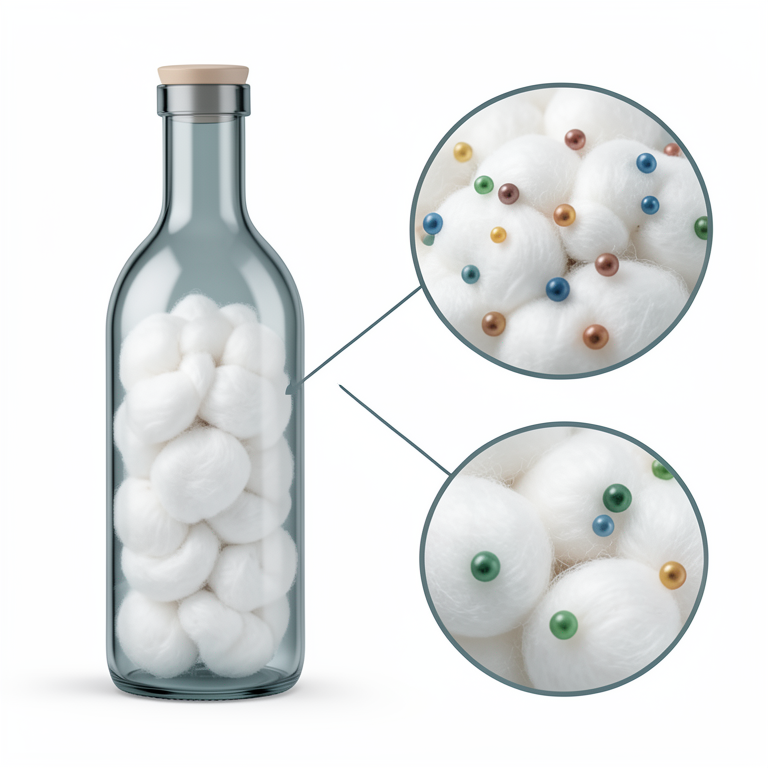
Bioreactor Structure
AI-generated conceptual illustration (a column glass bottle containing absorbent cotton fibers and lipase enzyme molecules). It explains the idea and does not show study data.
View source evidence ↗Figures & tables
From the original paper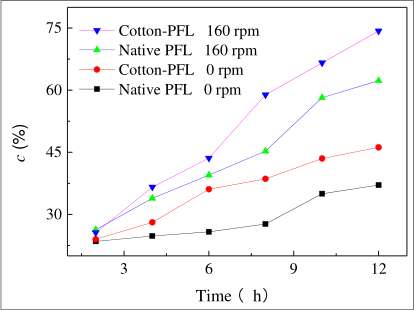 Figure 1
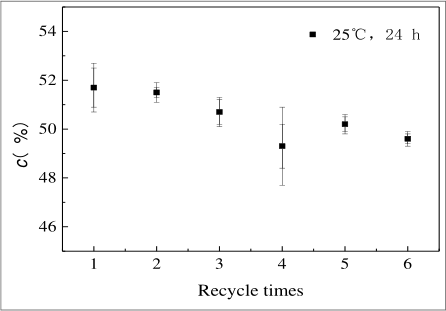 Figure 3
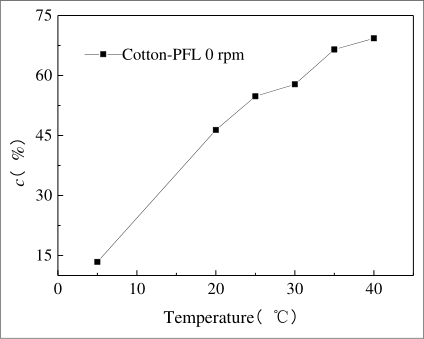 Figure 2
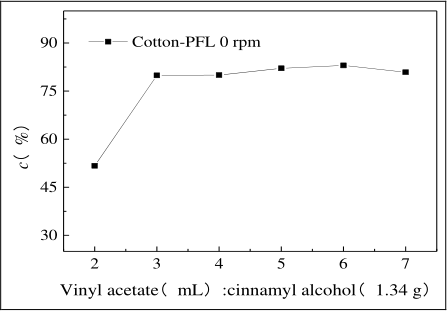 Figure 4
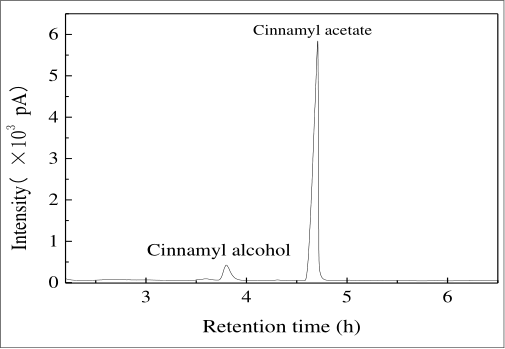 Figure 6
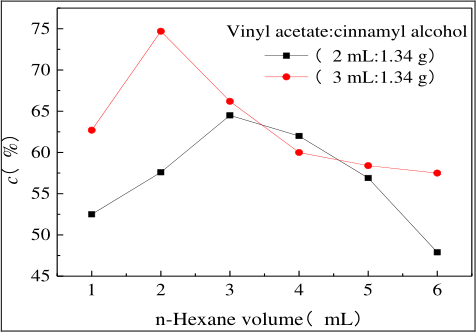 Figure 5
Introduction
Cinnamon acetate, as a flavor, is widely used in cosmetics [1] , pharmaceuticals [2] and food industry [3] , etc. and its consumption in the world is about 100 tons annually [4] . For the preparation of this ester, a small part is extracted from natural raw materials and the majority is synthesized by catalysis of chemical catalysts [5,6] . However, the current chemical synthesis process is usually difficult to abandon some unfavorable factors, such as low conversion, long reaction time, much by-products, high downstream processing costs, and high temperature and high pressure energy consumption conditions, etc. [7] . To avoid these disadvantages, it is imagined that bio-enzymes were taken as catalysts to synthesize ester flavors, because enzymes have catalytic selectivity and mild reaction conditions [8] . Thus the enzymatic synthesis of cinnamyl acetate is an alternative green way. Lipases are commonly employed because most of them can catalyze synthesis of esters under approximately anhydrous conditions [9] , which is very conducive to the preparation of ester compounds. They are usually prepared into immobilized lipases so as to improve the catalytic activity and stability of them, and also facilitate the separation of the enzyme from the reaction solutions [10] . If they are further fabricated into immobilized enzyme bioreactors [11] , it is more convenient for the enzymatic synthesis of aromatic esters. Based on this idea, a simple immobilized enzyme bioreactor was designed and prepared by immobilizing Pseudomonas fluorescens lipase (PFL) on absorbent cotton fibers in a column glass bottle and then carefully stretching fibers until fluffy, to form a simple immobilized enzyme bioreactor together with the bottle. Interestingly, cinnamyl acetate could be availably synthesized in the bioreactor even if at room temperature and under static condition.
Materials and methods
Materials and methods
Materials and reagents
Lipase PFL is purchased from Hangzhou Chuang Ke Biological Technology Co., Ltd. (20 U/mg). Cinnamyl alcohol (p> 98%) is purchased from Shanghai Yuanye Biological Technology Co., Ltd. Absorbent cotton, vinyl acetate and other chemical reagents all are analytical pure and purchased from the market.
Main apparatus
Gas chromatograph (GC, Yimeng A90, Shanghai YiMeng Electronic Technology Co., Ltd., Shanghai), equipped with hydrogen flame detector and capillary column (SE-30 30 m × 0.32 mm × 0.33 μm). Constant temperature shaker (HZQ-Q, Harbin Donglian Electronic Technology Development Co., Ltd., Harbin) and constant temperature incubator (BSC-150 Hangzhou Connor Technology Co., Ltd., Hangzhou) are used as apparatus for enzyme immobilization and catalytic reaction.
Experimental Methods
Experimental Methods
Absorbent cotton treatment
10 g of absorbent cotton was put into a 250 mL beaker, and subsequently anhydrous ethanol was added to the beaker to cause cotton completely immersed. Then the beaker was sealed and kept standing at room temperature for 24 h. Thereafter the soaked absorbent cotton was taken out and rinsed twice with anhydrous ethanol alcohol, and placed in a clean beaker, which was sealed with gauze to dry cotton for use in future. Before use, the dry absorbent cotton was pulled into fluffy state by tweezers.
Preparation of absorbent cotton-PFL bioreactor
In a 10 mL column glass bottle, 10 mg PFL enzyme powder and 200 L distilled water were added, and the enzyme was completely dissolved in water by gently shaking. Then, 10 mg absorbent cotton was added to absorb enzyme solution. Thereafter, the glass bottle was put into a constant temperature shaker at 37℃ and 160 rpm, and kept mouth open for more than 7 h. Then the immobilized enzyme, absorbent cotton-PFL, was obtained and also carefully pulled into a fluffy state before use. This immobilized enzyme, together with the column glass bottle, formed a simple absorbent cotton-PFL bioreactor.
Enzymatic synthesis of cinnamyl acetate
2 mL vinyl acetate and 1.34 g cinnamyl alcohol (2.17:1, mol:mol) were added to a 10 mL column glass bottle containing absorbent cotton-PFL or PFL enzyme powder, respectively. The lid was covered and sealed with a piece of sealing film, and placed in a constant temperature shaker to catalyze the reaction at 37℃ and 160 rpm. The PFL in each system was 10 mg. In addition, the same two reaction systems were gotten ready for catalysis in a stationary incubator at 37℃. Every one of above reaction systems was sampled and analyzed every 2 h.
Effect of temperature on catalysis in bioreactor
In six absorbent cotton-PFL bioreactors, 2 mL vinyl acetate and 1.34 g cinnamyl alcohol were added, and covered and sealed with sealing film. They were placed in a constant temperature incubator. Under the static condition, the reaction was catalyzed for 24 h at different temperatures, and sampled for GC analysis.
Repeated catalytic reaction in bioreactor
2 mL vinyl acetate and 1.34 g cinnamyl alcohol were added to the absorbent cotton-PFL bioreactor, covered and sealed with a piece of sealing film. The absorbent cotton-PFL reactor was placed in a constant temperature incubator and kept at 25℃ for 24 h, and then sampled for GC analysis. Thereafter, the reaction solution is poured out, and the bioreactor was washed three times with a small amount of nhexane and kept with mouth open for 5 minutes to volatilize n-hexane. Again, 2 mL vinyl acetate and 2.34 g cinnamyl alcohol were added to the bioreactor. The bioreactor was covered and sealed with a piece of sealing film, and then placed in a constant temperature incubator and kept at 25℃ for 24 h, and then sampled for GC analysis. So, the operations were cycled for total 6 times.
Effect of substrate ratio on catalysis
In six absorbent cotton-PFL bioreactors, 1.34 g cinnamyl alcohol and 2-7 mL vinyl acetate were added, respectively. The bioreactor was sealed with sealing film and placed in a static constant temperature incubator in which the reaction was catalyzed for 24 h at room temperature and sampled for GC analysis.
Effect of solvents on catalysis
In 6 absorbent cotton-PFL bioreactors, 2 mL vinyl acetate and 1.34 g cinnamyl alcohol were added, respectively. In addition, different volumes of n-hexane were added to the six systems in order. The bioreactors were covered, sealed with a piece of sealing film, and placed in a constant temperature incubator to catalyze reaction at room temperature for 24 hours, and sampled for GC analysis. In addition, vinyl acetate in the reaction systems as above was changed into 3 mL and were catalyzed to react with cinnamyl alcohol at room temperature for 24 h, and sampled for GC analysis.
Chromatographic analysis of samples
2 μL of reaction solution was taken, diluted with 1 mL nhexane and filtered with 0.25 μm filter membrane for GC analysis. The chromatographic conditions were set as follow: nitrogen (0.4 MPa, split ratio 1:1), 130℃, retention 1 min, 20℃/min, 210℃, retention 5 min, 60℃ /min, 280℃, retention 2 min. The injection and detection temperatures were 280℃ and 300℃ respectively. According to the peak area of cinnamyl alcohol and cinnamyl acetate, the molar conversions of substrates were calculated [12] . The retention times of cinnamyl alcohol and cinnamyl acetate were 3.8 min and 4.7 min, respectively.
Results and analysis 3.1 Enzymatic reaction under shaking and static conditions
Absorbent cotton fibers have natural fluffy characteristic, which are still fine after PFL immobilized on them by physical absorption. Thus cotton fibers cause PFL dispersed well, and result in that enzyme molecules easily contact with reaction liquid so as to effectively catalyze reaction, even in a static state. To verify the idea, PFL powder and absorbent cotton-PFL were employed to catalyze transesterification of vinyl acetate and cinnamyl alcohol under ether shaking or static condition, at 37℃, which is a temperature commonly suitable for common enzyme catalysis [13] . The results are that, in a static column glass bottle, absorbent cotton-PFL can transform substrate about twice relative to native enzyme powder (Fig. 1). Under shaking condition, absorbent cotton-PFL transforms substrate slightly more than native PFL. To explore low-energy enzymatic reaction, it is necessary to further understand the catalytic characteristics of absorbent cotton-PFL bioreactor.
Effect of temperature on absorbent cotton-PFL bioreactor
In order to study the catalytic activity of absorbent cotton-PFL bioreactor at varous temperatures, six reaction systems were set up to catalyze the above-mentioned trans esterification reaction at different temperatures for 24 h. The molar conversion of reaction system was shown in Fig. 2. It can be seen that at lower temperature stage, with the temperature rising, the conversion increased significantly. After reaching 25℃, although the conversion continued to increase with temperature rising, but the increase was not as large as the increase in the range of 5-25℃. Obviously, it is feasible to conduct catalytic reaction at room temperature 25℃. Although the conversion of reaction in the reactor was not the highest at 25℃, it was only a small difference, 69.3% -54.8% = 14.5%, relative to the conversion at 40℃. This difference is expected to further reduce by improving the ability of the reactor to produce aromatic esters by changing the ratio of substrates, adding suitable solvents [14] and prolonging the reaction time, so as to achieve the green low-energy synthesis of aromatic esters.
Stability of catalysis for bioreactor
The activity stability of the reactor is the basis to ensure the effective conversion of substrates. For this reason, the absorbent cotton-PFL reactor is used to catalyze transesterification in a cyclic manner at 25 ℃ and in a static state for 24 h at a time. The results are shown in Fig. 3.
If the conversion rate (51.7%), after the first time of catalysis, is taken as the initial activity of enzyme under non-aqueous condition [15] , and the conversion rate (49.6%), after six times, is taken as the final enzyme activity. Then, after five days of reuses, the activity of bioreactortransforming substrate decreased only 51.7% -49.6% = 2.1%. The decay rate of enzyme activity can be calculated as (2.1%)/ (24 h × 5) = 0.0175%•h -1 ≈ 0.02%•h -1 . It can be seen that the activity of absorbent cotton-PFL in this reactor is relatively stable, this stability is attributed to that cotton fibers contain abundant hydroxyl groups that, similar to water molecules, can stabilize enzyme protein [16] . Based on this stability, the substrate conversion can be improved by prolonging reaction time.
Effect of substrate ratios on bioreactor
To improve the ability of the bioreactor to transform substrates at room temperature and in a static state, the ratio of substrates can be changed by increasing the amount of acylation reagents [17] . If cinnamyl alcohol unchanged in quantity, the dosage of vinyl acetate was gradually increased from 2 mL to 7 mL to observe the optimal dosage of acylation reagent. In different systems, the trans esterification reaction was for 24 h at 25℃ and under static condition. The result was that, when the vinyl acetate was 2 mL, the conversion rate was 51.7%, and when the vinyl acetate was 3 mL, the conversion rate significantly increased to 80% (Fig. 4). However, as the amount of acylation reagent continued to increase, the conversion of cinnamyl alcohol did not increase largely. This should be that excessive acylation reagent diluted cinnamyl alcohol and reduced the probability of substrates contacted with enzyme molecules and catalyzed by them. It can be seen that in this reactor, when the mass of cinnamyl alcohol is 1.34 g, the best dosage of the vinyl acetate is 3 mL.
Effect of n-hexane on reactor
In the reaction system consisted of vinyl acetate and cinnamyl alcohol, cinnamyl alcohol has some viscosity [18] , which may effect the transesterification ability of the bioreactor. Therefore, it is assumed that the viscosity of the system can be reduced by adding small molecular solvents and then the conversion of enzymatic reaction can be increased. In the absorbent cotton-PFL bioreactor, 2 mL (3 mL) vinyl acetate and 1.34 g cinnamyl alcohol were added, and various volumes of n-hexane were added, respectively. The conversions of reactions after 24 h at 25℃ and under static state, were shown in Fig. 5. When vinyl acetate was 2 mL and n-hexane was 3 mL, the conversion reached a maximum of 64.5%. When the amount of vinyl acetate was 3 mL and the amount of n-hexane was 2 mL, the conversion rate reached 74.7%. However, the addition of n-hexane to the reaction system did not further increase the conversion of the reaction, as compared with the effect achieved by directly increasing the amount of vinyl acetate (Fig. 4). It is obvious that the increase of vinyl acetate also played a role in reducing the viscosity of the reaction system.
Increasing conversion by prolonging reaction time
It was found that the optimum reaction system catalyzed by absorbent cotton-PFL was consisted of cinnamyl alcohol 1.34 g and vinyl acetate 3 mL. The reaction system was catalyzed by absorbent cotton-PFL for 24 h at 25 C and under static state, and the conversion reached 80.0%. Because of the stability of absorbent cotton-PFL, the conversion of reaction can be further improved by prolonging the time of reaction. When reaction time was prolonged to 48 h, the conversion of the reaction reached 91.0%, as shown in Fig. 6. According to the ability of substrate transformed in the bioreactor in the first 24 hours, the conversion of reaction after 48 h should be higher than 91.0%. The reason might be that, at a high conversion, more by-product acetaldehyde is produced, from acylation reagent vinyl acetate after it takes part in the transesterification. Enough of acetaldehyde usually has a competitive inhibitory effect on lipase activity [19] , which hinders the further increase of conversion. In the future, a new reaction system might be designed to eliminate the effect of acetaldehyde on the enzymatic reaction, and further improve the conversion in a reaction cycle as short as possible, for practical application.
Conclusion
The green low-energy consumption of reaction process is an ideal goal pursued by synthetic chemists. The greening of reaction process is gradually realized by enzymatic catalysis method because of the selectivity of enzymes, high catalytic efficiency and mild reaction conditions. If the method of enzymatic catalysis is improved by reasonable design, and the high efficiency of enzymatic reaction can be achieved, even at room temperature and under static condition. That is to say that the efficiently enzymatic reaction process can almost be carried out under the condition with almost no energy consumption. In this paper, taking the synthesizing edible flavor of cinnamyl acetate as an example, the absorbent cotton-PFL bioreactor was prepared by immobilizing PFL on absorbent cotton fibers in a column glass bottle, based on the lipase interfacial activity, in which absorbent cotton was instead of water molecules for the activation and stabilization of enzyme protein. When the bioreactor was used to catalyze transesterification reaction between vinyl acetate and cinnamyl alcohol. It was found that the absorbent cotton-PFL bioreactor exhibited good catalytic activity and stability at room temperature and under static state. The catalytic efficiency of the bioreactor could be improved by increasing the amount of acylation reagent or solvent. This is an important exploration on the low-energy route of enzymatic synthesis of important organic compounds. The conversion of transesterification in the absorbent cotton-PFL bioreactor, can reach 80.0% after 24 h and 91.0% after 48 h, respectively, at room temperature and under static state. Although acetaldehyde, a byproduct existed in the reaction system, has some effect on the further improvement of reaction conversion, it can be overcome in the future research, so as to really realize the green and low carbonization of the enzymatic synthesis process.
Acknowledgments
The authors thank the financial support from the National innovation and Entrepreneurship Program for undergraduates (201710061012), Modern Aqua-ecology and Health Aquaculture Innovation Team of Tianjin (TD13-5089), the Tianjin Aquatic Industry Technical System-Water Quality Control Position (ITTFRS2018015), and the Open Fund of Tianjin Key Lab of Aquatic Ecology and Aquaculture (TJAE201802).
References
19 in the original paper- Tomke PD, Rathod VK. Ultrasound assisted lipase catalyzed synthesis of cinnamyl acetate via transesterification reaction in a solvent free medium [J] Ultrasonics Sonochemistry. 2015, 27:241-246.
- Yadav GD, Devendran S. Lipase catalyzed synthesis of cinnamyl acetate via transesterification in non-aqueous medium [J] Process Biochemistry. 2012; 47:496-502.
- Wu Z, Qi W, Wang M, et al. Lipase immobilized on novel ceramic supporter with Ni activation for efficient cinnamyl acetate synthesis [J] Journal of Molecular Catalysis B: Enzymatic. 2014; 110:32-38.
- Bhatia SP, Wellington GA, Cocchiara J, et al. Fragrance material review on cinnamyl acetate [J] Food and Chemical Toxicology. 2007; 45:S53-S57.
- Kamaliroosta L, Gharachorloo M, Kamaliroosta Z, et al. Extraction of cinnamon essential oil and identification of its chemical compounds [J] Journal of Medicinal Plants Research. 2012; 6:609-614.
- Devulapelli VG, Weng HS. Synthesis of cinnamyl acetate by solid-liquid phase transfer catalysis: kinetic study with a batch reactor [J] Catalysis Communications. 2009; 10:1638-1642.
- Bokade VV, Yadav GD. Transesterification of edible and nonedible vegetable oils with alcohols over heteropolya-cids supported on acid-treated clay. Industrial & Engineering Chemistry Research. 2009, 48:9408-9415.
- Saik AYH, Lim YY, Stanslas J, et al. Lipase-catalyzed acylation of quercetin with cinnamic acid [J] Biocatalysis and Biotransform. 2016; 34:33-43.
- Ashwini RD, Virendra KR. Intensification of enzyme catalysed synthesis of hexyl acetate using sonication Green. Processing and Synthesis. 2016; 6(1):55-62.
- Juan M. Bolivar / Bernd Nidetzky Multiphase bio transformations in Microstructured reactors: opportunities for bio catalytic process intensification and smart flow processing Green Processing and Synthesis. 2013; 2(6):541-559.
- Rafiei S, Tangestaninejad S, Horcajada P, et al. Efficient biodiesel production using a lipase@ZIF-67 nano bioreactor, Chemical Engineering Journal. 2018; 334:1233-1241.
- Herbst D, Peper S, Niemeyer B. Enzyme catalysis in organic solvent: influence of water content, solvent composition and temperature on Candida rugosa lipase catalyzed transesterification [J] Journal of Biotechnology. 2012; 162:398-403.
- Lima LN, Oliveira GC, Rojas MJ, et al. Immobilization of Pseudomonas fluorescens lipase on hydrophobic supports and application in biodiesel synthesis by transesterification of vegetable oils in solvent-free systems. Bio Journal of Industrial Microbiology & Biotechnology. 2015 42:523-535.
- Parida S, Dordick JS. Substrate structure and solvent hydrophobicity control lipase catalysis and enantioselectivity in organic media [J] Journal of the American Chemical Society. 1991; 113(6):2253-2259.
- Xun E, Lv X, Kang W, et al. Immobilization of Pseudomonas fluorescens lipaseonto magnetic nanoparticles for resolution of 2-octanol [J] Applied Biochemistry and Biotechnology. 2012; 168:697-707.
- Yu Y, Yuan J, Wang Q, et al. A study of surface morphology and structure of cotton fibres with soluble immobilized-cellulase treatment. Fibers and Polymers. 2014; 15:1609-1615.
- Santibáñez L, Wilson L, Illanes A. Synthesis of Ascorbyl Palmitate with Immobilized Lipase from Pseudomonas stutzeri [J] Journal of the American Oil Chemists Society. 2014; 91(3):405-410.
- Caravati M, Meier DM, Grunwaldt JD, et al. Continuous catalytic oxidation of solid alcohols in supercritical CO 2 : A parametric and spectroscopic study of the transformation of cinnamyl alcohol over Pd/Al 2 O 3 , Journal of Catalysis. 2006; 240(2):126-136.
- Tomke PD, Rathod VK. Ultrasound assisted lipase catalyzed synthesis of cinnamyl acetate via transesterification reaction in a solvent free medium [J] Ultrasonics Sonochemistry. 2015; 27:241-246.