
Research article · 2018 · Full text
International Journal of Veterinary Sciences and Animal HusbandryStrain by feed restriction interaction effect on carcass characteristics and meat quality of broiler chickens
Volume 3(3) · Pages 29–32
Research areasAnimal Nutrition and PhysiologyLivestock and Poultry ManagementRabbits: Nutrition, Reproduction, Health
Abstract
Author-writtenThe aim of the present investigation was to rank the performance of three exotic strains of commercial broilers as influenced by feed restriction in terms of carcass and meat quality characteristics. It is believed that breeds of animals differ in their response to whatever treatment applied. The strains of broiler birds under investigation are Arbor Acre, Hubbard and Marshall. Analyzed results showed that there was no significant (p>0.05) strain by feed restriction interaction effect on live weight and slaughter weight of broiler chickens. However, there was significant (p0.05) strain by feed restriction interaction effect on aroma, colour, tenderness, juiciness and saltiness. This implies that the expression of these traits as affected by strain and treatment is mutually exclusive and not by joint action. But, there was significant (p
Summary
Source-checkedPlain-language reading of the full paper, prepared with AI and checked against the text. Each point links to the authors' own words.
Why it matters
- Chicken meat is a valuable food source because it is relatively inexpensive, easy to divide into portions, and lacks religious restrictions on its consumption. View evidence ↗
- The rapid growth rates seen in modern broiler chickens have been linked to physiological disorders that increase mortality rates during the grow-out period. View evidence ↗
- Feed restriction has been previously used as a strategy to lower the occurrence of metabolic disorders and reduce high mortality in broilers. View evidence ↗
The question
- The study aimed to rank the carcass and meat quality characteristics of three commercial broiler strains under the influence of feed restriction. View evidence ↗
What they did
- The experiment used 300 day-old broiler chicks, with 100 chicks each from the Arbor Acre, Hubbard, and Marshall strains. View evidence ↗
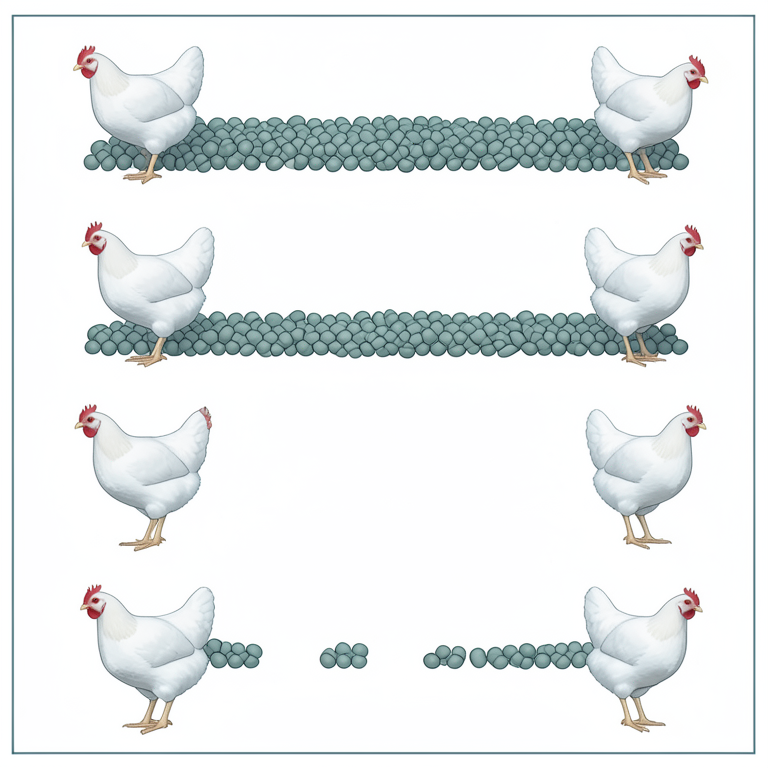
- Birds were divided into four treatments: a control group (ad libitum) and three groups receiving a skip-a-day feed restriction during either the 2nd, 3rd, or 4th week. View evidence ↗
- Carcass evaluations were performed on six birds per treatment per strain, randomly selected at 56 days of age after overnight starvation. View evidence ↗
- Meat quality was assessed by 12 trained individuals using a 9-point hedonic scale to evaluate color, flavor, tenderness, juiciness, texture, and overall acceptability. View evidence ↗
What they found
- There was no significant interaction between broiler strain and feed restriction regarding live weight or slaughter weight (p>0.05). View evidence ↗
What it means
- The authors suggest that Arbor Acre birds combined with second-week feed restriction may be recommended to farmers to increase meat production and profit. View evidence ↗
- The authors conclude that most carcass traits in broiler chickens are dependent on the interaction between the bird's strain and the feeding treatment. View evidence ↗
Visual summary
3 visualsIllustrations explain the paper; charts are replotted from the paper's own table values.
Feed Restriction Protocol
AI-generated conceptual illustration (broiler chickens). It explains the idea and does not show study data.
View source evidence ↗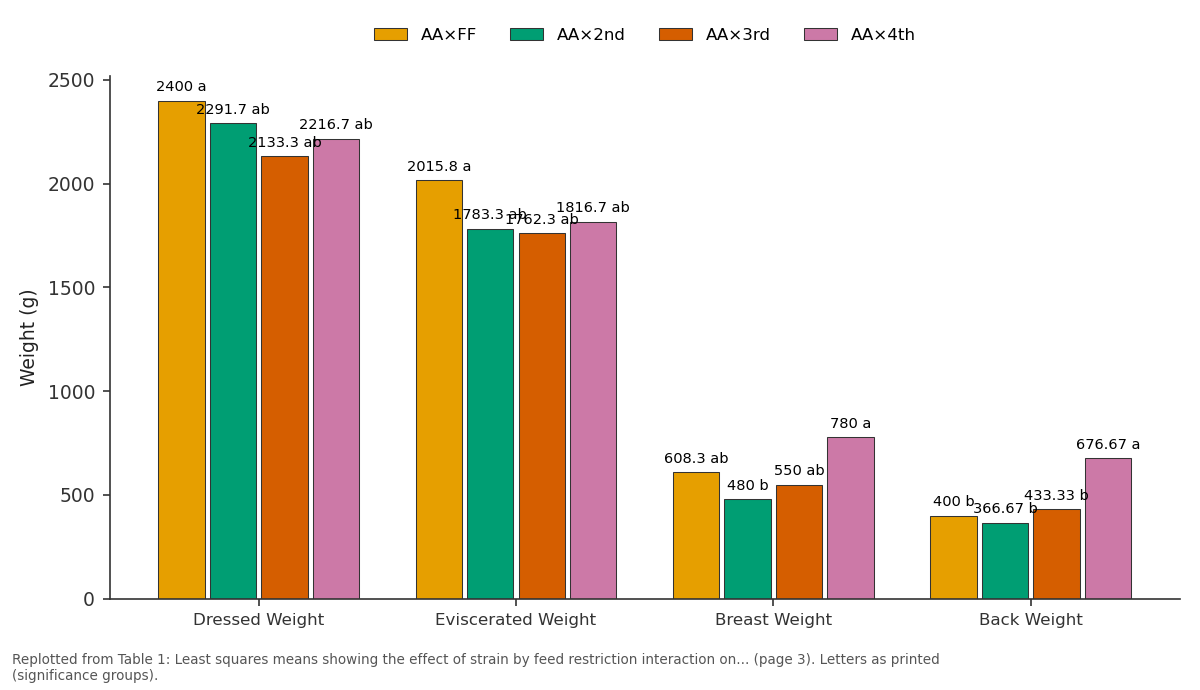
AA×FF and AA×2nd and more: Dressed Weight vs Eviscerated Weight vs Breast Weight vs Back Weight
Replotted from Table 1 (page 3) of the original paper. Every bar is the paper's own table value.
View source evidence ↗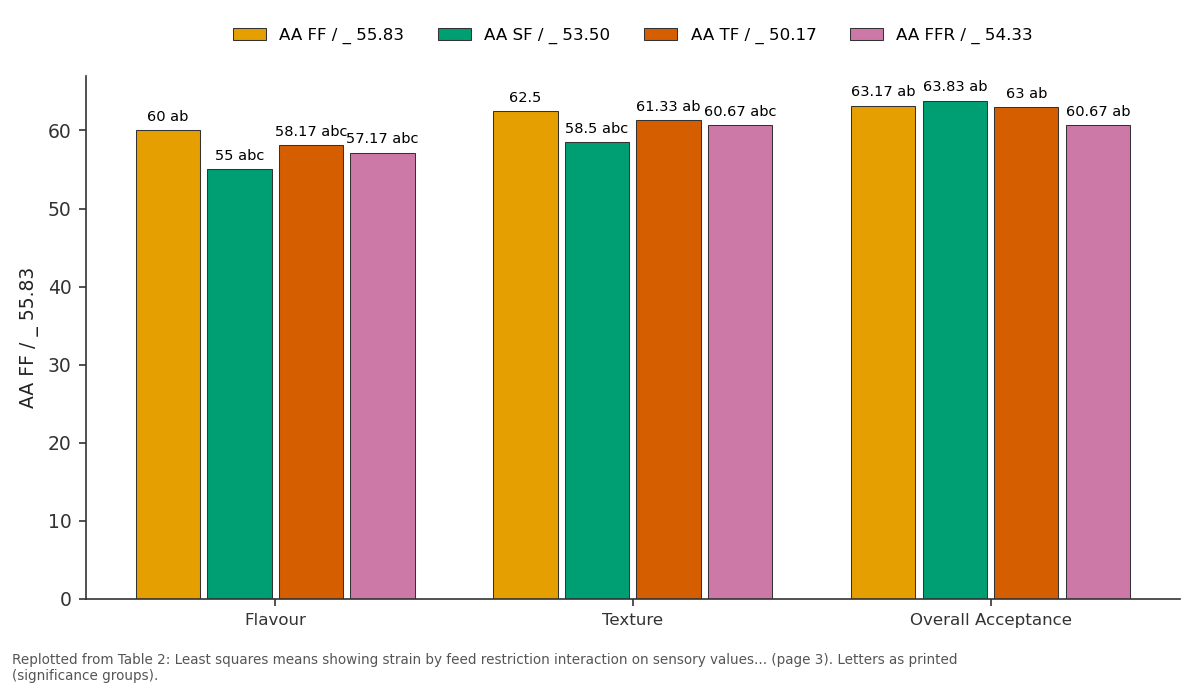
AA FF / _ 55.83 and AA SF / _ 53.50 and more: Flavour vs Texture vs Overall Acceptance
Replotted from Table 2 (page 3) of the original paper. Every bar is the paper's own table value.
View source evidence ↗Figures & tables
From the original paper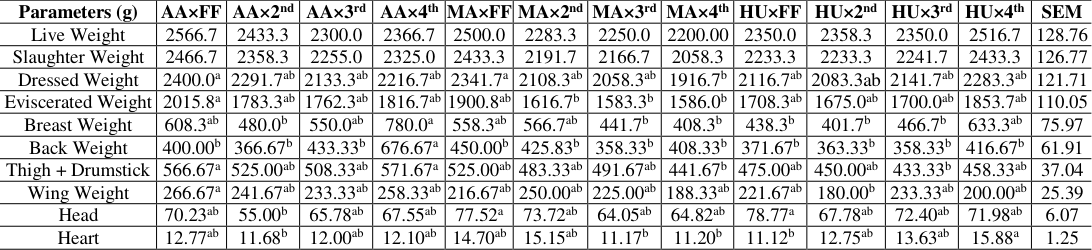 Table 1
 Table 2
Introduction
The reproductive and productive efficiency of farm animals depend on genetic constitution and environment as well as interaction between the two factors. Chicken meat is unique in that its price is comparatively low, easy to partition into smaller parts and no religious restriction against its consumption (Jaturasitha, 2004) [5] . Significant genotype x environment interaction effects on egg production among four strains of commercial layers had been reported in earlier study (Gwaza and Egahi, 2009) [2] . In addition, Olawumi (2007) [10] observed significant strain by season interaction effect on egg production, fertility and hatchability of breeder hens. The success of poultry production has been strongly related to the improvements in growth performance and carcass yield and composition. Current commercial broiler chickens strains according to Idahor et al. (2013) [4] are the result of successful selection programme for rapid growth and body conformation. This improvement in growth performance and carcass characteristics have resulted to physiological, immunological, biochemical and anatomical changes in broiler (Schmidt et al., 2009) [13] . In addition, Julian (2005) [7] reported that rapid growth rate of modern broiler chickens was associated with series of physiological disorders resulting to increase in the rate of mortality during grow-out. Earlier studies had used the concept of feed restriction in broilers to reduce the incidence of metabolic disorders and high mortality (Gonzales et al., 1998; Balog et al., 2000) [3,1] . Feed restriction improved feed efficiency, reduced feed cost and mortality (Zubair and Leeson, 1996) [15] . In previous studies, breed of chickens was reported to have significant effect on live weight (Jaturasitha et al., 2008) [6] , carcass weight (Olawumi and Fagbuaro, 2011) [11] , breast and leg muscle weight (Musa et al., 2006) [8] and back and drumstick weight (Ojedapo et al., 2008) [9] . While separate effects of breed and non-genetic factors on birds' productivity were given prominence in literature, little attention has been paid to the interaction between breed and nutritional factors. This refers to the ranking order of productivity of strains of chickens as influenced by the feeding regimen imposed on them. According to Olawumi et al. (2012) [12] , carcass traits were significantly affected by strain x sex interaction. This implies that the traits were breed and sex dependent in their expression. In contrast, Ojedapo et al. (2008) [9] reported that breed x sex interaction had no significant effect on carcass traits of broiler chickens. There is dearth of information in literature regarding interaction effects between strain and feed restriction on carcass traits and meat quality of broiler chickens. This study therefore, was undertaken to compare and rank the carcass characteristics and meat quality of three strains of commercial broilers as affected by skip-a-day feed restriction.
Materials and methods
The study was carried out at the poultry unit of the Teaching and Research Farm, Faculty of Agricultural Sciences, Ekiti State University, Ado-Ekiti, Nigeria. Ekiti State is situated entirely within the tropics. It is located between longitudes 40 • 51ꞌ and 50 • 451ꞌ East of the Greenwich meridian and latitudes 70 • 151ꞌ and 80 • 511ꞌ North of the Equator. The State enjoys a tropical climate with two distinct seasons. These are the rainy season (April -October) and the dry season (November -March). Temperature ranges between 21 0 C and 28 0 C with high humidity.
Management and feeding practices
A total number of 300 day-old broiler chicks comprising 100 chicks each of Arbor Acre, Hubbard and Marshall were purchased from reputable hatcheries. Prior to arrival of the birds, the pens were properly cleaned, washed with soap and fumigated thoroughly with 40% formaldehyde in water solution and allowed to rest for one week. The house was properly covered and pre-heated before the arrival of the birds so as to raise the temperature of the brooding environment to keep the chickens warm. The chicks were vaccinated against Newcastle and Infectious Bursa diseases at recommended doses, and at specified ages. During the adaptation period (1-7 days), all the chicks were fed ad libitum. They were thereafter allotted to four different treatments having three replicates each (8 chicks/replicate) as follows: Treatment 1 -Control-ad libitum Treatment 2 -Skip-a-day method across the three strains at 2 nd week and ad libitum thereafter. Treatment 3 -Skip-a-day method across the three strains at 3 rd week and ad libitum thereafter. Treatment 4 -Skip-a-day method across the three strains at 4 th week and ad libitum thereafter. The birds were fed starter mash (1-4 weeks) containing 22%CP and 3000Kcal ME Kg -1 , while between 4-7 weeks they were given finisher feed containing 20% CP and 3100Kcal ME Kg -1 .
Carcass evaluation
At 56 th day of age, two birds per replicate, that is, six birds per treatment on strain basis were randomly selected after starving them overnight for carcass evaluation. The birds were numbered and weighed individually to obtain live body weight and thereafter, slaughtered, bled, scalded and plucked. After feathering, the carcasses were eviscerated and dissected manually into various parts such as breast muscle, back muscle, drumstick, thigh muscle, wings, legs and giblets (heart, liver and gizzard). The different parts were weighed using sensitive scale and were expressed in grammes. Data collected at 56 th day of age included live body weight, slaughter weight, dressing weight, eviscerated weight, carcass weight, breast weight, back muscle weight, drumstick and thigh weights, neck and head weights, wing and intestinal weight, liver, lung, heart and gizzard.
Sensory evaluation:
Samples for sensory evaluations were taken from the breast muscle and cooked to an internal temperature of 72 0 C. Total of 12 trained individuals aged between 22 and 35 years males and females were employed to assess the coded meat samples. Equal bite size from each treatment was coded, replicated thrice and served for evaluation by the trainees on a 9-point hedonic scale for colour, favour, tenderness, juiciness, texture and overall acceptability.
Statistical analysis
The data collected were analyzed by the analysis of variance technique in completely randomized design, while the differences between means were separated by Duncan New Multiple Range Test as per SAS (2001) [14] . The appropriate statistical model used was: Yijk = µ + (GR) ij + ɛijk Yijk = observation on k th population, of i th strain by j th feed restriction µ = common mean (GR)ij = Fixed effect of strain x feed restriction interaction ɛijk = error term
Results and Discussion
Table 1 shows the effect of strain by feed restriction on live weight and carcass characteristics of broiler chickens. The result showed that there was no significant (p>0.05) strain by feed restriction interaction effect on live weight and slaughter weight of broiler chickens. The result contradicted the findings of Olawumi et al. (2012) [12] who reported that carcass traits were significantly affected by strain x sex interaction. For dressed weight, there was significant (p<0.01) strain by feed restriction interaction effect. This implies that the expression of this trait depended on strain by treatment interaction. Arbor Acre and Marshall birds on full feed (ad libitum) showed superior mean values, while Marshall birds on fourth week feed restriction interaction recorded the least mean value at 8 weeks. Also, there was significant (p<0.01) strain by feed restriction interaction effect on eviscerated weight of broiler chickens. Arbor Acre birds on full feed (ad libitum) showed superiority in terms of eviscerated weight, while Marshall birds on second, third and fourth week feed restriction recorded the lowest mean values. In the same vein, there was significant (p<0.01) strain by feed restriction interaction effect on breast weight. Arbor Acre birds on fourth week feed restriction had the highest mean value, while Arbor Acre on second week feed restriction, Marshall birds on fourth week feed restriction, Hubbard birds on full feed (ad libitum), Hubbard birds on second week feed restriction and Hubbard birds on third week feed restriction recorded the lowest mean values of breast weight at 8 weeks. In addition, there was significant (p<0.01) strain by feed restriction interaction effect on back weight. Arbor Acre birds on fourth week feed restriction had the highest value, while Arbor Acre birds on second week feed restriction, Marshall birds on third and fourth week feed restriction, Hubbard birds on full feed (ad libitum), second and third week feed restriction recorded the lowest mean values. In contrast, Ojedapo et al. (2008) [9] reported that breed x sex interaction had no significant effect on carcass traits of broiler chickens.
| Parameters (g) | AA×FF | AA×2nd | AA×3rd | AA×4th | MA×FF | MA×2nd | MA×3rd | MA×4th | HU×FF | HU×2nd | HU×3rd | HU×4th | SEM |
|---|---|---|---|---|---|---|---|---|---|---|---|---|---|
| Live Weight | 2566.7 | 2433.3 | 2300.0 | 2366.7 | 2500.0 | 2283.3 | 2250.0 | 2200.00 | 2350.0 | 2358.3 | 2350.0 | 2516.7 | 128.76 |
| Slaughter Weight | 2466.7 | 2358.3 | 2255.0 | 2325.0 | 2433.3 | 2191.7 | 2166.7 | 2058.3 | 2233.3 | 2233.3 | 2241.7 | 2433.3 | 126.77 |
| Dressed Weight | 2400.0a | 2291.7ab | 2133.3ab | 2216.7ab | 2341.7a | 2108.3ab | 2058.3ab | 1916.7b | 2116.7ab | 2083.3ab | 2141.7ab | 2283.3ab | 121.71 |
| Eviscerated Weight | 2015.8a | 1783.3ab | 1762.3ab | 1816.7ab | 1900.8ab | 1616.7b | 1583.3b | 1586.0b | 1708.3ab | 1675.0ab | 1700.0ab | 1853.7ab | 110.05 |
| Breast Weight | 608.3ab | 480.0b | 550.0ab | 780.0a | 558.3ab | 566.7ab | 441.7b | 408.3b | 438.3b | 401.7b | 466.7b | 633.3ab | 75.97 |
| Back Weight | 400.00b | 366.67b | 433.33b | 676.67a | 450.00b | 425.83b | 358.33b | 408.33b | 371.67b | 363.33b | 358.33b | 416.67b | 61.91 |
| Thigh + Drumstick | 566.67a | 525.00ab | 508.33ab | 571.67a | 525.00ab | 483.33ab | 491.67ab | 441.67b | 475.00ab | 450.00ab | 433.33b | 458.33ab | 37.04 |
| Wing Weight | 266.67a | 241.67ab | 233.33ab | 258.33ab | 216.67ab | 250.00ab | 225.00ab | 188.33ab | 221.67ab | 180.00b | 233.33ab | 200.00ab | 25.39 |
| Head | 70.23ab | 55.00b | 65.78ab | 67.55ab | 77.52a | 73.72ab | 64.05ab | 64.82ab | 78.77a | 67.78ab | 72.40ab | 71.98ab | 6.07 |
| Heart | 12.77ab | 11.68b | 12.00ab | 12.10ab | 14.70ab | 15.15ab | 11.17b | 11.20b | 11.12b | 12.75ab | 13.63ab | 15.88a | 1.25 |
Table text extracted from the original PDF; superscript letters are shown inline. The original table image is below.
View original table image
Furthermore, there was significant (p<0.01) strain by feed restriction interaction effect on back weight. Arbor Acre birds on fourth week feed restriction showed the highest mean value, while other interactions recorded similar (p>0.05) mean values. In addition, there was significant (p<0.01) strain by feed restriction interaction effect on thigh + drumstick. At 8 weeks, Arbor Acre birds on full feed (ad libitum) and fourth week feed restriction showed superior values, while Marshall birds on fourth week feed restriction and Hubbard birds on third week feed restriction recorded the least mean value. Also, there was significant (p<0.01) strain by feed restriction interaction effect on wing weight. Arbor Acre birds on full feed (ad libitum) had superior value, while Hubbard birds on second week feed restriction had the lowest value at age 8 weeks. In addition, there was significant (p<0.01) strain by feed restriction interaction effect on broiler chickens' head. Marshall birds on full feed (ad libitum) and Hubbard birds on full feed (ad libitum) recorded the superior mean values, while Arbor Acre birds on second week feed restriction recorded the least mean value. Regarding heart, there was significant (p<0.01) strain by feed restriction interaction effect. Hubbard birds on fourth week feed restriction showed the highest value, while Arbor Acre birds on second week feed restriction, Marshall birds on third and fourth week feed restriction and Hubbard birds on full feed (ad libitum) showed the lowest mean values. However, there was no significant (p>0.05) strain by feed restriction interaction effect on broiler chickens' liver. For proventiculus + gizzar, there was significant (p<0.01) strain by feed restriction interaction. Marshall birds on full feed (ad libitum) had the highest mean value, while Marshall birds on third week feed restriction showed the lowest mean value. In addition, there was significant (p<0.01) strain by feed restriction interaction effect on broiler chickens intestinal weight. Hubbard birds on second week feed restriction showed superior value, while Arbor Acre birds on full feed (ad libitum) had the least mean value. Also, there was significant (p<0.01) strain by feed restriction interaction effect on broiler chickens neck. Marshall birds on second week feed restriction recorded the highest value, while other interactions except Arbor Acre birds on third week feed restriction, Marshall birds on full feed (ad libitum), and Marshall birds on third week feed restriction showed the least mean values. Table 2 represents strain by feed restriction interaction effect on meat qualities at 8 weeks. The result revealed that there was no significant (p>0.05) strain by feed restriction interaction effect on aroma, colour, tenderness, juiciness and saltiness. This implies that the expression of the traits as affected by strain and treatment is mutually exclusive and not by joint action. However, there was significant (p<0.01) strain by feed restriction interaction effect on flavour. Marshall birds on third week feed restriction recorded highest mean value, while Marshall birds on fourth week feed restriction showed the lowest mean value.
In the same vein, there was significant (p<0.01) strain by feed restriction interaction effect on texture. Arbor Acre birds on full feed (ad libitum) showed superiority to other interactions, while Marshall birds on second week feed restriction showed the lowest mean value. Also, there was significant (p<0.01) strain by feed restriction interaction effect on the overall acceptability at 8 weeks. Marshall birds on second week feed restriction had the highest mean value, while Hubbard birds on fourth week feed restriction showed the least mean value.
The findings in this study showed that expression of meat texture and overall acceptability are strain and treatment dependent.
Conclusion
The findings of this study revealed significant strain by feed restriction interaction effect on most carcass traits of broiler chickens. This in effect indicates that the expression of the traits are strain and treatment dependent.
Acknowledgement
The authors expressed their deep appreciation to Management and Staff of Teaching and Research Farm, Ekiti State University, Ado-Ekiti, for their support and technical assistance in the course of the study.
References
14 in the original paper- Balog MJ, Anthony NB, Cooper MA, Kidd BD, Huff GR, Huff WE et al. Ascites syndrome and related pathologies in feed restricted broilers raised in a hypobaric chamer. Poul. Sci. 2000; 79:318-323.
- Gwaza DS, Egahi JO. Genotype x environment interaction on egg laying performance of four layer breeds In the Derived Southern region of Nigeria. 34 th Annual Conference of Animal Society for Animal Production, 15 th -18 th March, 2009 at University of Uyo, Akwa Ibom State, Nigeria.
- Gonzales E, Buyse J, Loddi MM, Takita TS, Buyi N, Decuypere E. Performance, incidence of metabolic disturbances and endocrine variables of food restricted male broilers. Br. Poul. Sci. 1998; 39:671-678.
- Idahor KO, Yakubu A, Egalu JO, Gwaza DS, Ahmadu GB, Tham AP. Growth performance, carcass characteristics and cost benefits of four broiler strains on restricted feeding regimes in North Central Nigeria. J. Anim. Sci. Advances, 2013; 3(9):449-452.
- Jaturasitha S. Meat Management. Mingmuang Press, Chiang Mai, Thailand, 2004.
- Jaturasitha S, Srikanchai T, Kreuzer M, Wicke M. Differences in carcass and meat characteristics between indigenous chicken and Northern Thailand (Black boned and Thai Native) and important extensive breeds (Bresse and Rhode Island Red). Poul. Sci., 2008; 87:160-169.
- Julian RJ. Production and growth related disorders and other metabolic diseases of poultry: A review. Vet. J., 2005; 169: 350-369.
- Musa HH, Chen GH, Cheng JH, Li BC, Mekki DM. Study on carcass characteristics of chicken breeds raised under the intensive condition. Int. J. Poul. Sci., 2008; 5(6):530-533.
- Ojedapo LO, Akinokun O, Adedeji TA, Olayeni TB, Ameen SA, Amao SR. Effect of strain and sex on carcass characteristics of three commercial broilers reared on deep litter system in the Derived Savannah area of Nigeria. World J. Agric. Sci., 2008; 4(4):487-491.
- Olawumi SO. Genotype x season interaction effects on reproductive performance of two layer breeders in Humid zone of Nigeria. Applied Trop. Agric., 2007; 12(1&2):78-82.
- Olawumi SO, Fagbuaro S. Productive performance of three commercial broiler genotypes reared in the Derived Savannah zone of Nigeria. Int. J. Agric. Res., 2011; 6(11):798-804.
- Olawumi SO, Fajemilehin SO, Fagbuaro SS. Genotype x Sex interaction effects on carcass traits of three strains of commercial broiler chickens. J. World's Poult. Res., 2012; 2(1):21-24.
- Schmidt CJ, Persia ME, Fejerstein E, Kingham B, Saylor WW. Comparison of a modern broiler line and a heritage line unselected since the 1950s. Poult. Sci., 2009; 88:2610-2619.
- Zubair AK, Lusson S. Compensatory growth in broiler chicken: a review. World's Poult. Sci., 1996; 52:189-201.