
Research article · 2018 · Full text
International Journal of Veterinary Sciences and Animal HusbandryPresent need of organized manufacturing and marketing of milk-cereal based dairy product of north India
Volume 3(4) · Pages 07–09
Research areasAgricultural Economics and PracticesLivestock Management and Performance Improvement
Abstract
Author-writtenIndia is the top most milk producing country in the world with an annual production of 155.5 million tonnes having per capita availability of 337 g/day (NDDB, 2017) and accounting for 18.5% of world’s production of milk. About 50-55 % of milk produced annually in India is converted into various Traditional Indian Dairy Products (TIDPs) (Bandyopadhyay and Khamrui, 2007, Patil, 2013). The market for TIDPs is the second highest after fluid milk both in value and volume having a market value of more than Rs. 100,000 crores with annual growth of 10-15 % (Patil, 2013). Unfortunately the technology for the production of most of the traditional Indian milk products is confined to local sweetmeat makers (halwais) and like many other traditional sweets. But the changing life-styles and increased purchasing power especially among urban population has necessitated the research efforts for organized manufacturing and marketing of traditional milk products with added convenience, enhanced shelf life and added nutritive value.
Summary
Source-checkedPlain-language reading of the full paper, prepared with AI and checked against the text. Each point links to the authors' own words.
Why it matters
- India is the world's leading milk producer, contributing 18.5% of global production with an annual output of 155.5 million tonnes. View evidence ↗
- Traditional Indian Dairy Products (TIDPs) use 50-55% of India's annual milk production and represent a market valued at over Rs. 100,000 crores, growing by 10-15% annually. View evidence ↗
- Urbanization and increased purchasing power have created a need for traditional milk products that offer more convenience, longer shelf life, and higher nutritional value. View evidence ↗
The question
- The author identifies a lack of scientific data regarding the average composition, sensory properties, and physico-chemical characteristics of popular milk-cereal sweets like pinni and doda burfi. View evidence ↗
What they did
- The paper proposes combining milk and cereal proteins to create a balanced food, as milk lacks certain sulphur-containing amino acids while cereals lack lysine, threonine, and tryptophan. View evidence ↗
- The study focuses on North Indian milk-cereal sweets, specifically Pinni, which is a dark brown, granular composite sweet popular in Punjab, Haryana, and Delhi. View evidence ↗
- The study also examines Doda Burfi, a sweet from Punjab, Haryana, and Western U.P. made from buffalo milk, sugar, and germinated wheat flour. View evidence ↗
What they found
- The production of pinni and doda burfi is currently limited to cottage-scale operations run by local sweetmeat makers (halwais). View evidence ↗
- Small-scale production often leads to poor hygienic conditions, resulting in the marketing of inferior quality products. View evidence ↗
- The absence of official food standards causes significant variability in the texture, microbiological counts, and proximate composition of these sweets. View evidence ↗
What it means
- The author concludes that establishing standard production protocols and ingredient formulations is necessary to enable large-scale industrial production and the creation of legal quality standards. View evidence ↗
- Industrializing these products would allow the dairy industry to diversify and expand into export markets, leveraging the global Indian diaspora. View evidence ↗
Visual summary
1 visualsIllustrations explain the paper; they do not show study data.
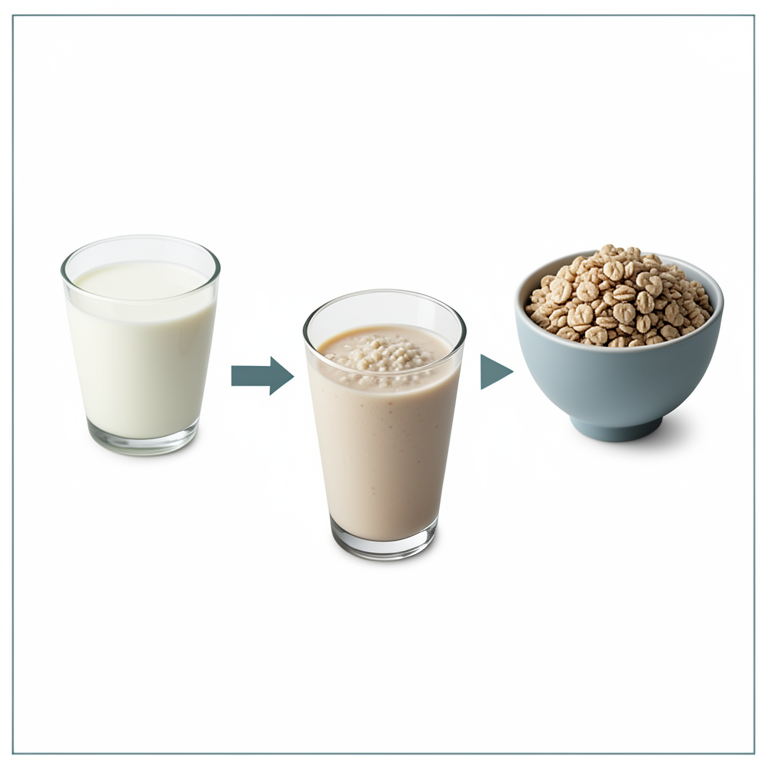
Nutritional Complementarity
AI-generated conceptual illustration (Glass of milk and a bowl of whole grain cereal). It explains the idea and does not show study data.
View source evidence ↗Figures & tables
From the original paper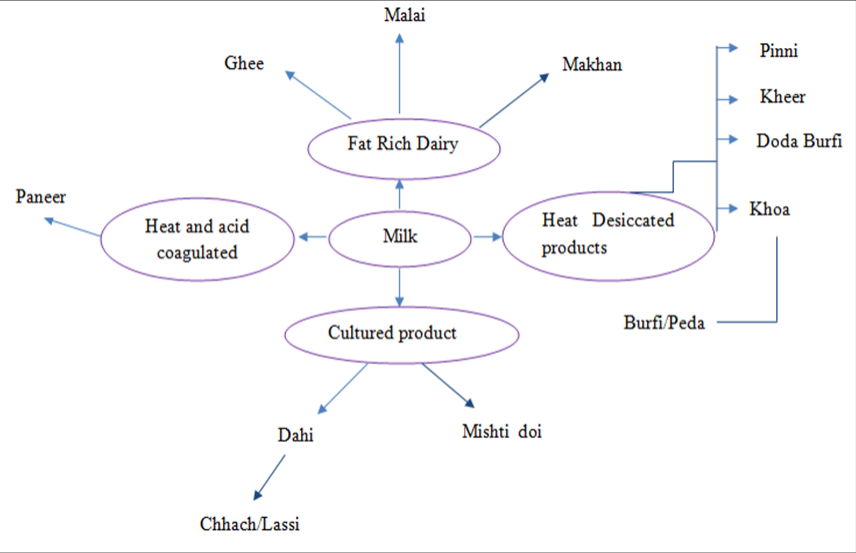 Figure 1
Introduction
Advancements of economy, education and technologies have altered every facets of today world including lifestyles and eating habits. The traditional custom of only men working and women taking care of the household is no longer practiced, rather along with household responsibilities participation of women in the workforce has increased drastically in the past two decades which has drastically reduced time available for household work. Rapid lifestyle transformation has brought about a remarkable increase in the demand for processed, packaged and ready-to-eat food products. Urban consumers are typically more affluent but busier, thus more willing to pay for convenience. Technological advancements, changing household structures, multicultural societies as well as changing social norms and values have resulted in shifting demand for all types of consumer goods and convenience food (Buckley et al., 2007) [3] . The ready-to use and instant foods are meeting urgent situations as well as saving time for preparation (Bhikhabhai, 2014) [2] . Nowadays, major challenge is to achieve optimal processing to meet specific requirements for improving human health, nutrition and food quality. Hence, convenience type foods are rapidly emerging into the current market to meet the demands of the modern society. India is top most milk producer in the world with an annual production of 155.5 million tonnes (NDDB, 2017) [8] . About 50-55 percent of milk produced annually in India is converted into Traditional Indian Dairy Products (Bandopadhyay and Khamrui, 2007) [1] Milk, despite being a great source of nutrients, is deficient in some micronutrients like iron, copper and certain vitamins viz., Supplementing milk with required micronutrients from suitable sources will mitigate this deficiency will mitigate this deficiency (NAAS, 2012) [7] . Milk proteins are also deficient in sulphur containing amino acids like methionine and cysteine (NAAS, 2012) [7] . Cereals on the other hand are generally deficient in lysine, threonine and tryptophan. Thus in order to develop a balanced food, cereal protein should be supplemented with milk protein. The nutritional significance of cereals lies in their richness in micronutrients like iron, phosphorous, zinc, vitamins and sulphur containing amino acids (Rai et al., 2011) [12] .
International Journal of Veterinary Sciences and Animal Husbandry Cereals are also rich source of dietary fibre, proteins, energy and minerals, serve as ideal supplements for development of composite dairy products like pinni, doda burfi, ghewar and kheer, etc Fig. 1 (Das et al., 2012) [5] .
Fig 1: Classification of Traditional Indian Dairy Products of North India
Pinni is an immensely popular traditional milk-cereal based sweet of Northern states of India mainly Punjab, Haryana and Delhi. It is milk based composite sweet having dark brown colour and is granular texture. The product is a rich source of nutrients derived from milk solids as well as goodness of wheat or gram flour, nuts, dry fruits etc. It is also a rich source of fat, protein, minerals and energy. Considering its high nutritive value, traditionally pinni is considered as an ideal food for young ones in their growing stage, pregnant and lactating women (Singh et al., 2018) [15] . India has the largest repertoire of milk based sweets and out of them doda burfi, simply called as "Doda" or "Dhoda", is immensely popular traditional milk-cereal based sweet of northern states of India like Punjab, Haryana, and Western U.P (Singh and Kumar 2006) [6] . The product is made from germinated wheat flour (angoori atta), buffalo milk, and sugar along with certain optional ingredients and characterized by dark brown colour, sticky granular texture having glossy surface covered with nuts with intact pleasant caramelized flavour (Chawla 2010) [4] . The attractive and salient feature of the product is the presence of most of the nutrients from cereals in pre-digested form, which also serves as an excellent source of dietary fibre absent in other dairy products. The product also has a longer shelf-life as compared to other milk based sweets. There is a great demand of pinni and doda-burfi in other regions of India due to its unique taste and health benefits. Despite the fact that it is a common and popular product, very limited scientific information is available about average composition of its variants and product characteristics including sensory and physico-chemical properties. Unfortunately the technology for the production of most of the traditional Indian milk products is confined to local sweetmeat makers (halwais) and like many other traditional sweets, the practice of pinni and doda burfi making has largely remained a cottage scale operation. Being prepared at small scale, the hygienic conditions are usually not maintained and thus inferior quality products are manufactured and marketed. At the same time due to lack of any prescribed standards laid down by any of the food standards authority, quality in terms of proximate composition, texture and microbiological counts vary a lot. Recently in order to tap the potential of traditional sweet markets, several dairies in private and cooperative sector have started their organized production. Today, a wide range of fresh as well as packaged ethnic milk products and convenience mixes are available in market. These products are also being exported to countries having large Indian ethnic population Also the changing economic scenario offers new opportunities to Indian dairy industry, particularly organized sector, for expanding their product profile. Many of the traditional milk products such as channa based sweets, mishit doi, Shrikhand, basundi etc. which were manufactured at small scale in specific geographical locations, have now been introduced in other parts of the Indian subcontinent. These dairy delicacies have now been relished by the consumer as they possess excellent flavour, mouth-feel and exhibit characteristic textural profile. In absence of technical knowhow, the large scale production of these region specific milk products in organized sector is a challenging task (Kumar et al., 2006) [6] . A standard production protocol and well-defined ingredient formulation and processing parameters would facilitate largescale production of pinni and doda burfi by organized dairy sector and also help to frame legal standards of the product Organized production of the product at industrial scale may provide product diversification and market expansion opportunities to the dairy industry. These products not only have established market in India but also great export potential because of strong presence of Indian diaspora in many parts of the world (Rao and Raju, 2003; Pal and Raju, 2007) [13,9] . Following are the ways by which organization can manufacture wholesome traditional dairy products at competitive prices (Patil, 2006) [6] .
References
15 in the original paper- Bandyopadhyay P, Khamrui K. Technological Advancement on Traditional Indian Desiccated and HeatAcid Coagulated Dairy Products. Bulletin-International Dairy Federation. 2007; 415:1-7.
- Bhikhabhai C. Development of dry mix for khoa jalebi preparation. Ph.D Thesis, ICAR-National Dairy Research Institute (Deemed University), Karnal, India, 2014.
- Buckley M, Cowan C, Mc Carthy M. The convenience food market in Great Britain: Convenience food lifestyle (CFL) segments. Appetite. 2007; 49(3):600-617.
- Chawla R. Development of Technology for Functional Doda Burfi, Ph.D Thesis, ICAR-National Dairy Research Institute, Deemed University, Karnal, 2010.
- Das A, Raychaudhuri U, Chakraborty R. Cereal based functional food of Indian subcontinent: a review. Journal of Food Science and Technology. 2012; 49(6):665-672.
- Kumar AJ, Singh RRB, Patel AA, Patil GR. Kinetics of colour and texture changes in Gulab jamun balls during deep-fat frying. LWT-Food Science and Technology. 2006; 39(7):827-833.
- NAAS. Integration of Millets in Fortified Foods. Policy Paper 54. National Academy of agricultural Sciences, New Delhi, India, 2012, 1-15.
- NDDB. National Dairy Development Board Statistics for the year 2015-16. Department of Animal Husbandry, Dairying and Fisheries, Ministry of Agriculture GoI, 2017. (http,//www.nddb.org/information/stats/milkprodindia) [Internet document] Accessed on 25 April, 2017.
- Pal D, Raju PN. Indian Traditional Dairy Products: An Overview, Theme Paper, In: International Conference on Traditional Dairy Foods, Dairy Technology Society of India & National Dairy Research Institute, Karnal, India, 2007.
- Patil GR. Current scenario, scope and challenges of traditional Indian dairy products. Compendium of National Training on Advances in Production, Functional, Rheological and Quality Aspects of Traditional Indian Dairy Products", NDRI, Karnal, October, 2013.
- Patil GR. Traditional Indian Dairy Products: Present Status, Scope and Challenges, In: Developments in Traditional Dairy Products, 21st Short Course, Centre of Advanced Studies in Dairy Technology, December, National Dairy Research Institute, Karnal, India, 2006.
- Rai KN, Gowda CLL, Reddy BVS, Sehgal S. Adaptation and potential uses of sorghum and pearl millet in alternative and health foods. Comprehensive Reviews in Food Science and Food Safety. 2011; 7(4):320-396.
- Rao KH, Raju PN. Prospects and challenges for Indian dairy industry to export dairy products, Indian Journal of Dairy and Biosciences. 2003; 14(2):72-78.
- Singh AK, Kumar A. Technology of selected region specific milk products. In: 21st Short course on Developments in traditional dairy products, Dec. 10-30, 2006, Karnal, 2006, 225-234.
- Singh RK, Khamrui, V Jaglan. Physicochemical and colour attributes of market samples of North Indian sweet Pinni. Journal of Pharmacognosy and Phytochemistry 2018; 7(3):3370-3374.