
Research article · 2019 · Full text
International Journal of Veterinary Sciences and Animal HusbandryGenetically modified fish: An overview
Volume 4(3) · Pages 17–18
Research areasAnimal Genetics and ReproductionCRISPR and Genetic EngineeringPluripotent Stem Cells Research
Abstract
Author-writtenGenetically modified fish are organism whose genetic material (DNA) has been altered using genetic engineering technique. The aim is to introduce a new trait to the fish which does not occur naturally in the species i.e. transgenes is. These are used in scientific research and are being developed as environmental pollutant sentinels and for use in aquaculture production. Now a days also use for commercial production, sales and consumption (1). This report provide an overview of the potential ecological and genetic effect of using genetically engineered fish in aquaculture. It reviews the recent development in gene transfer in fish and consider how genetic engineering could be used in future aquaculture.
Summary
Source-checkedPlain-language reading of the full paper, prepared with AI and checked against the text. Each point links to the authors' own words.
Why it matters
- Genetically modified (GM) fish are created using genetic engineering to introduce traits that do not naturally occur in the species. View evidence ↗
- GM fish serve multiple purposes, including scientific research, monitoring environmental pollutants, and commercial aquaculture for human consumption. View evidence ↗
- As of 1986, aquaculture production reached 12 million tonnes, representing 12% of the total tonnage from international fishing. View evidence ↗
The question
- The report aims to provide an overview of the genetic and ecological effects of GM fish in aquaculture and review gene transfer developments for future use. View evidence ↗
What they did
- Microinjection is the most common gene transfer method in fish; unlike mammals, DNA is typically injected into the egg cytoplasm because male pronuclei are generally not visible. View evidence ↗
- Retroviruses are used for potential mass gene transfer by inserting foreign genes into a viral genome to infect hosts. View evidence ↗
- Electroporation uses short electric pulses to make cell membranes permeable, allowing genes to enter the cell. View evidence ↗
What they found
- Since the first transgenic fish were produced in China in 1985, approximately 50 species have been modified, creating over 400 fish/trait combinations by 2013. View evidence ↗
- The US FDA approved AquaAdvantage salmon for commercial production in 2015. View evidence ↗
- GM Zebrafish are utilized as models to study heart tissue repair and regeneration to help find cures for cardiovascular diseases. View evidence ↗
- Transgenic rainbow trout with fluorescence in fast-twitch muscle fibers can serve as indicators for aquatic pollutants or developmental factors. View evidence ↗
- Grass carp modified with human lactoferrin show a survival rate double that of control fish when exposed to Grass carp haemorrhage virus and Aeromonas bacteria. View evidence ↗
- The use of Cecropia in channel catfish has increased their protection against several pathogenic bacteria by 2 to 4 times. View evidence ↗
What it means
- The authors conclude that GM fish are excellent models for studying molecular and organismal evolution and have significant potential across various biological disciplines. View evidence ↗
- GM fish are recommended for use as bioreactors for biomedical proteins, indicators of pollution, and tools for functional genomics and trait enhancement. View evidence ↗
Visual summary
1 visualsIllustrations explain the paper; they do not show study data.
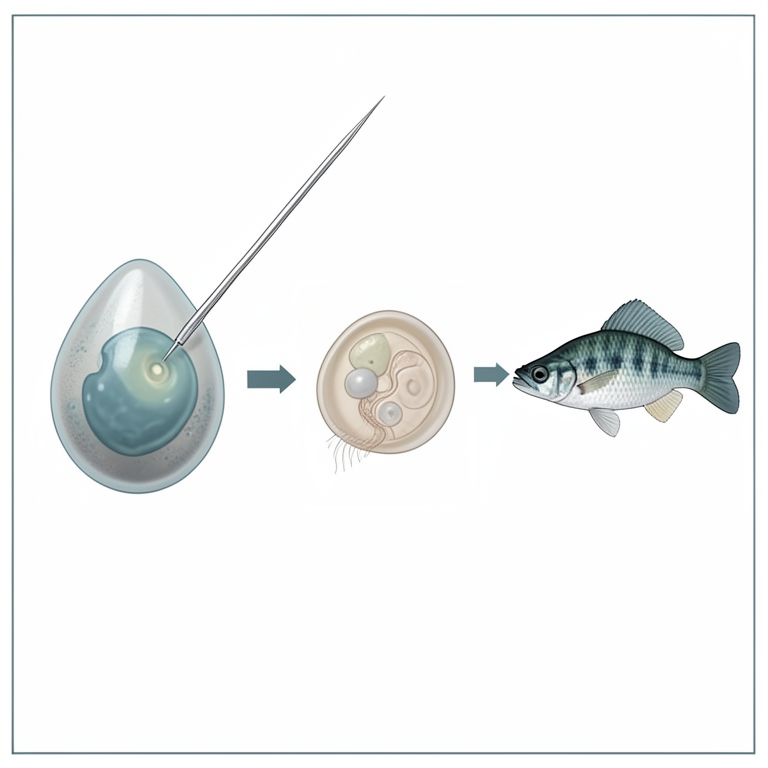
Study overview
AI-generated conceptual illustration (Zebrafish embryos and adult fish). It explains the idea and does not show study data.
View source evidence ↗Introduction
Introduction
GM Fish
GM Fish is one which has genetic modification entails manipulation of DNA. This process is k/as cisgene when a gene from one species is transferred to a different species that conventionally bred or transgenes is. In case of fish there are some techniques which used for transfer of gene.
History
The first transgenic fish were produced in china in 1985 [2] . As of 2013, approx. 50 species of fish have been subjected to genetic modification, resulted in more than 400 fish/trait combination. In 2015, the aqua advantage salmon was approved by the US Food and Drug administration (FDA) for commercial production [1] . In 1986, it was estimated that the production of fish by aquaculture reached 12 million tones, which was 12% of the tonnage generated by international fishing. (FAO 1989).
Technique for gene transfer
The methodology for gene transfer to fish has been reviewed by Chourrout (1987), Chen & Power (1990), Hew & Fletcher (1992), Power et al, (1992) & Jiang (1993). Microinjectionit is commonest method for introducing gene into the germ line of fishes. In mammals, the foreign DNA is microinjected in mae pronuclei of the fertilized egg. In fishes, the male pronuclear are not visible (except in Medaka) and the foreign DNA has to be microinjected into the egg cytoplasm (Powers et al 1992). The injection is carried out shortly after fertilization. One method with a potential for mass gene transfer is the use of retrovirus, which can transfer DNA to hosts by viral infection and mediate transgenes is if foreign gene have been inserted into the viral genome. Electroporation method involve the use of short electric pulse to permeabilize the cell membrane there by gaining entry of genes into the cell.
Importance
Most GM Fish are used in based research in genetics and development. Two species of fishzebra fish and Medaka fish, are most commonly modified because they have clear chorions (shells), develop rapidly, the 1-cell embryo is easy to see and microinject with transgenic DNA DNA and Zebra fish have the capability of regenerating their organ tissue [3] . GM Fish also used in drug discovery [4] . GM Zebra fish are being explored for benefit of unlocking human organ tissue disease and failure mysterius. Zebrafish are used to understand heart tissue repair and regeneration in efforts to study and discover cures for cardiovascular disease [5] . Transgenic rainbow trout (Oncorhynchus mykiss) have been developed by introducing gene florescence transgene to appear in fast twitch muscle fiber early in development which persist through life. It might be used as indicator or aquatic pollutant or other factor which influence development [6] . Grass carp (Ctenopharyngodon idella) have been modified with a transgene coding for human lactoferrin, which doubles their survival rate relative to control fish after exposure to Aeromonas bacteria and Grass carp haemorrhage virus. Cecropia has been used in channel Catfish to enhance their production against several pathogenic bacteria by 2-4 times [7] . GM Fish were originally created and patented for scientific research at the National university of Singapore, Texas Company, Yorktown technologies, obtained rights to market the fish as pets [8] .
Conclusion
GM Fish are being engineered to increase aquaculture production and also promoted as the first marketable transgenic animals for human consumption. GM fish have been used to elaborate the research fscility in aquatic. GM Fish serve as excellent models for studies of organism and molecular evolution and that they have a large potential as experimental models system for a number of biological disciplines including genetic engineering [8] . GM Fish are used in research as enhancing the traits of commercially available fish, as bioreactor for development of bio medically important proteins, as indicator of aquatic pollutants, use for developing new non-mammalian animal models and also for studies of functional genomics [10] .
References
10 in the original paper- Staff, FDA Has. Determined That the Aqu Advantage Salmon is as safe to Eat as Non-GE Salmon FDA Consumer Health Information / U.S. Food and Drug Administration, 2015. / Retrieved 20 November 2015
- Dunham RA, Winn RN. Chapter 11-Production of transgenic fish. In Pinkert, C.A. Transgenic Animal Technology: A Laboratory Handbook. Elsevier, 2014. ISBN 9780323137836.
- Hacket PB, Ekker SE, Essner JJ. Applications of transposable elements in fish for transgenesis and functional genomics. Fish Development and Genetics (Z. Gong and V. Korzh, eds.) World Scientific, Inc, Chapter. 2004; 16:532-580.
- Bowman TV, Zon LI. Swimming into the future of drug discovery: in vivo chemical screens in zebrafish". ACS Chem. Biol. 2010; 5(2):159-61.doi:10.1021/cb100029t. PMC 4712380. PMID 20166761.
- Major R, Poss K. Zebrafish Heart Regeneration as a Model for Cardiac Tissue Repair. Drug disco Today Dis Models. 4 (4):219-225. doi:10.1016/j.ddmod.2007.09.002. PMC 2597874. PMID 19081827.
- Gabillard JC, Rallière C, Sabin N, Rescan PY. The production of fluorescent transgenic trout to study in vitro myogenic cell differentiation. BMC Biotechnology. 2010; 10(1):39. doi:10.1186/1472-6750-1039. PMC 2887378. PMID 20478014.
- Forabosco F, Löhmus M, Rydhmer L, Sundström LF. Genetically modified farm animals and fish in agriculture: A review. Livestock Science. 2013; 153(1):19. doi:10.1016/j.livsci.2013.01.002.
- Maxham A. The Gene Revolution (PDF). George Mason University School of Law, 2015.
- Powers DA. Fish as model systems.-Science (Wash.). 1989; 246:352-358.
- Dunham RA, Winn RN. Chapter 11-Production of transgenic fish. In Pinkert, CA. Transgenic Animal Technology: A Laboratory Handbook. Elsevier, 2014. ISBN 9780323137836.