
Research article · 2018 · Full text
International Journal of Statistics and Applied MathematicsMHD flow on a moving infinite vertical porous plate in the presence of thermal radiation
Volume 3(4) · Pages 27–37
Research areasNanofluid Flow and Heat TransferFluid Dynamics and Turbulent FlowsHeat Transfer Mechanisms
Abstract
Author-writtenAn attempt has been made in this paper to study the MHD Flow on a Moving Infinite Vertical Porous Plate In The Presence Of Thermal Radiation. The effects of various parameters on the flow entities has been examined. It is noticed that as Pr increases, the velocity in general increases. Through, there is a marginal change in the value of t, not much of significant change in the velocity profiles is observed. Further, it is observed that as Grash off number increases, the flow rate decreases. Also, as the Magnetic field increases, the flow rate decreases. This in agreement with the real life situation that the Magnetic field suppress the fluid motion.
Summary
Source-checkedPlain-language reading of the full paper, prepared with AI and checked against the text. Each point links to the authors' own words.
Why it matters
- Radiative convective flow is critical in various industrial and environmental contexts, including solar power technology, space vehicles, and combustion or cooling chambers. View evidence ↗
- Radiative heat transfer is a significant factor in the design of high-precision equipment and is commonly found in aircraft engines, missiles, gas turbines, and nuclear power plants. View evidence ↗
The question
- The study aims to examine the influence of critical parameters on velocity and flow entities, as these had not been detailed by previous investigators. View evidence ↗
What they did
- The research models the flow of an incompressible, viscous, radiating fluid passing an infinite vertical plate that is impulsively started and has uniform heat flux. View evidence ↗
- The fluid is characterized as a non-scattering medium with grey, absorbing-emitting radiation properties. View evidence ↗
- The authors utilize the Rosseland approximation to define the radiative heat flux. View evidence ↗
What they found
- For Prandtl numbers (Pr) of 0.01, 0.03, 0.04, and 0.05, the relationship between plate width (Y) and velocity is consistently linear. View evidence ↗
- The study found that velocity generally increases as the Prandtl number (Pr) increases. View evidence ↗
- Changes in the value of time (t) resulted in only marginal changes to the velocity profile. View evidence ↗
- At fixed magnetic parameters of M=0.02 and M=0.04, an increase in the Grashoff number (Gr) leads to a decrease in the flow rate. View evidence ↗
- For Grashoff numbers of 0.02 and 0.04, increasing the magnetic field results in a decrease in the flow rate. View evidence ↗
What it means
- The authors conclude that the observed decrease in flow rate due to the magnetic field aligns with real-world scenarios where magnetic fields suppress fluid motion. View evidence ↗
Visual summary
1 visualsIllustrations explain the paper; they do not show study data.
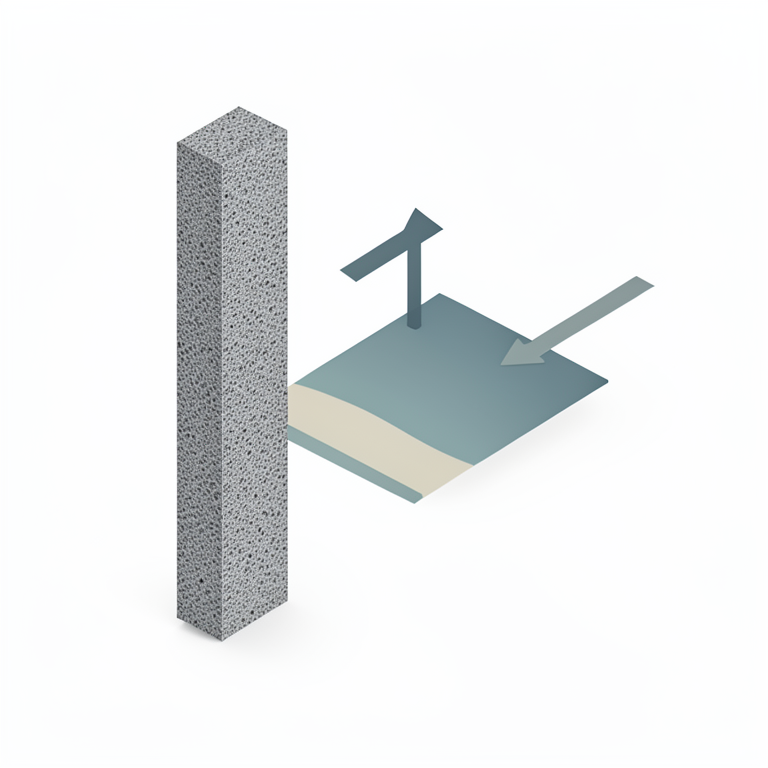
Problem Geometry
AI-generated conceptual illustration (a vertical porous plate in a fluid). It explains the idea and does not show study data.
View source evidence ↗Figures & tables
From the original paper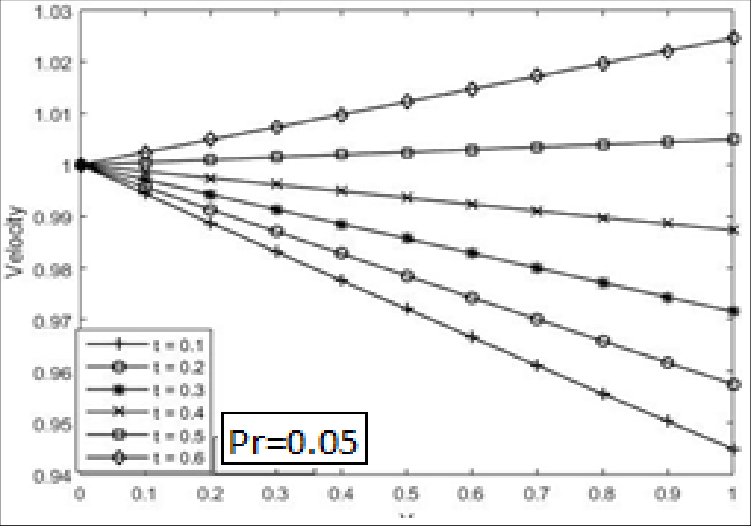 Figure 1
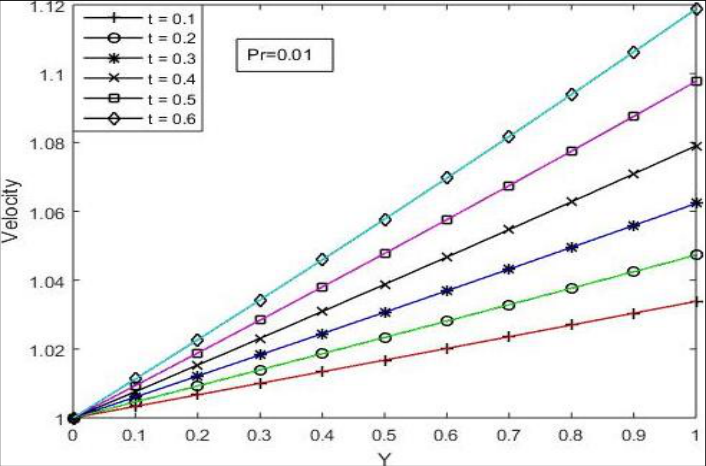 Figure 2
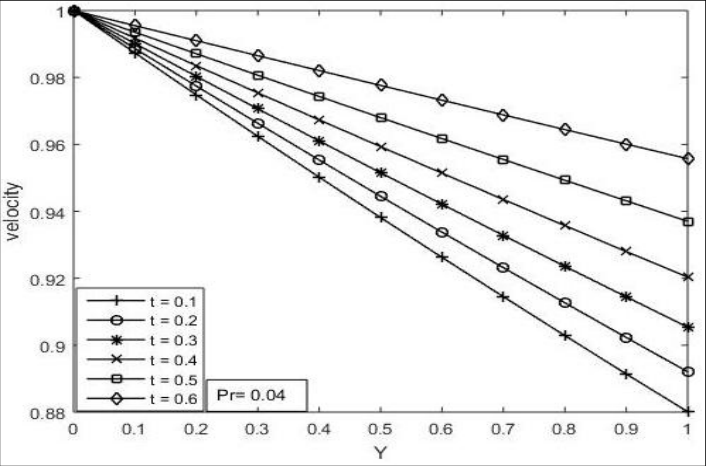 Figure 3
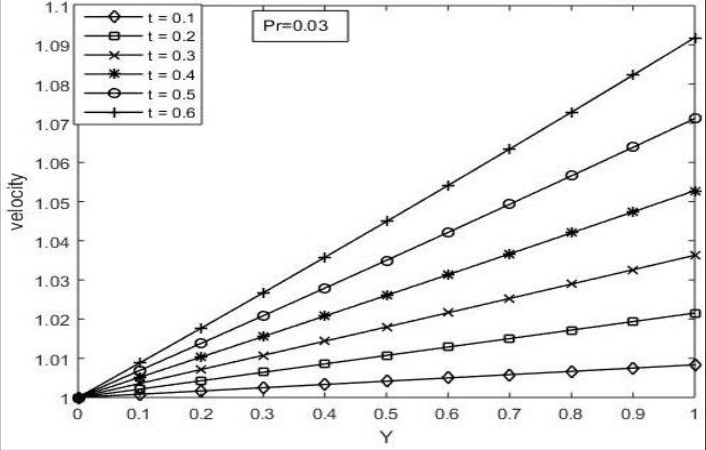 Figure 4
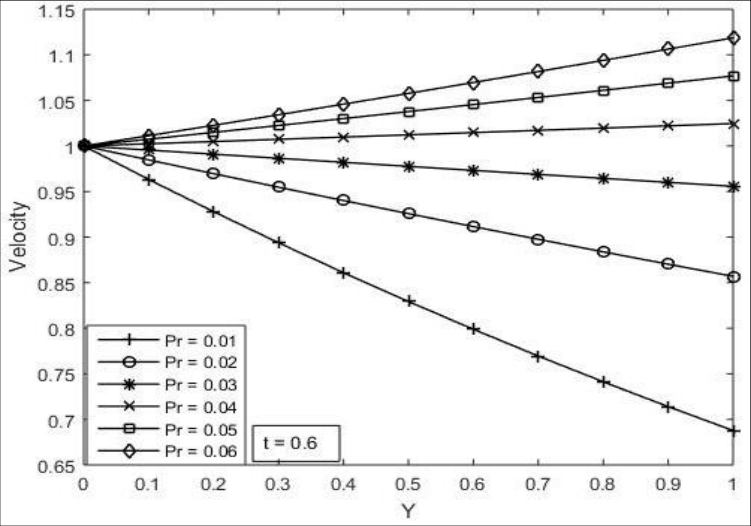 Figure 5
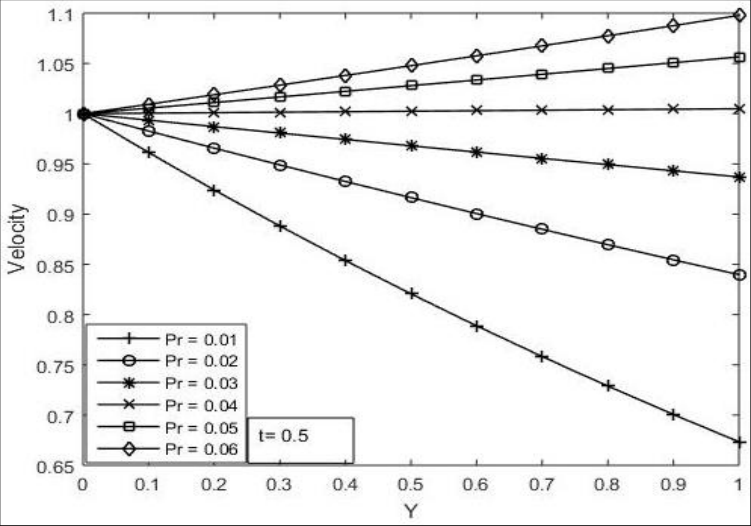 Figure 6
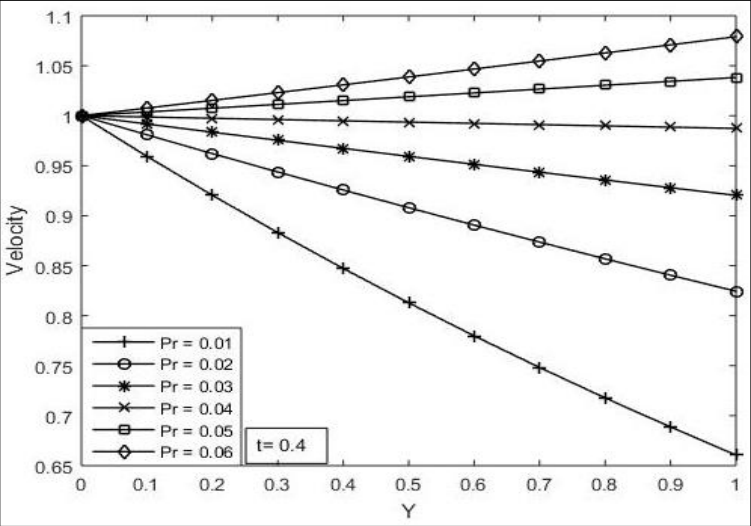 Figure 7
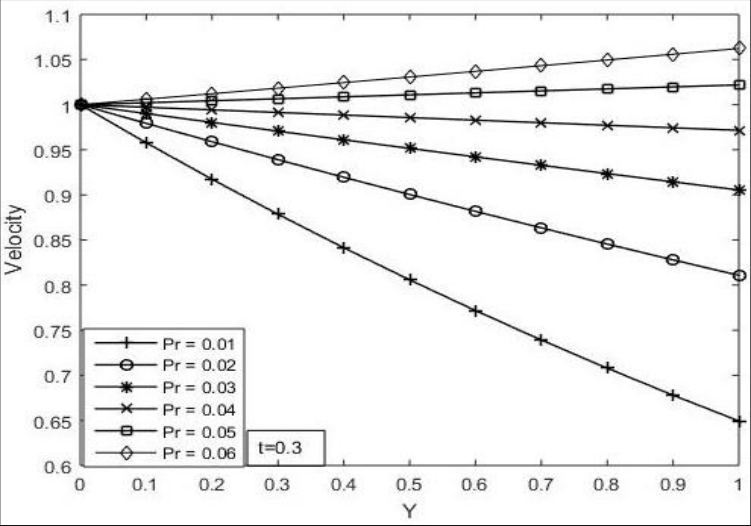 Figure 8
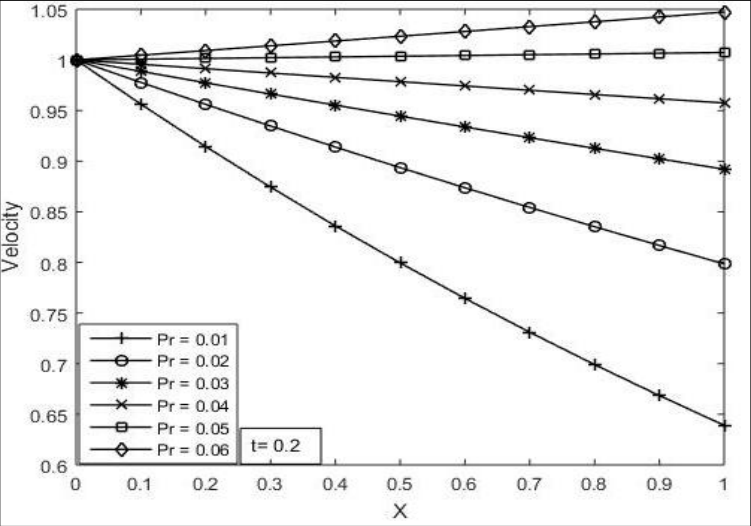 Figure 9
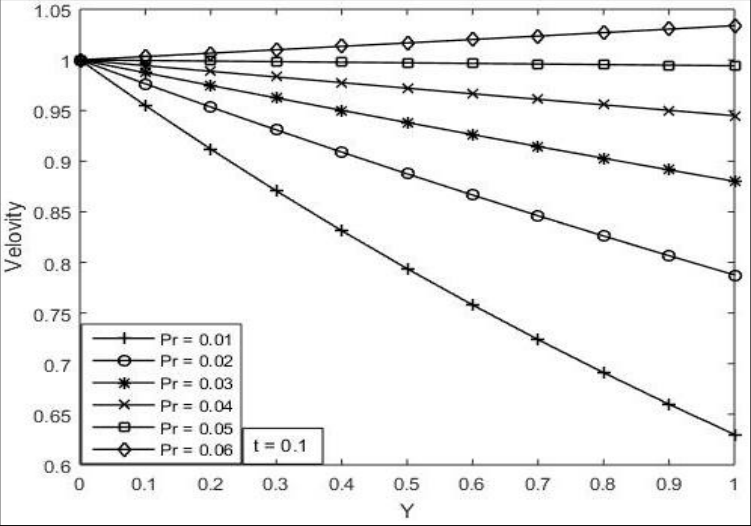 Figure 10
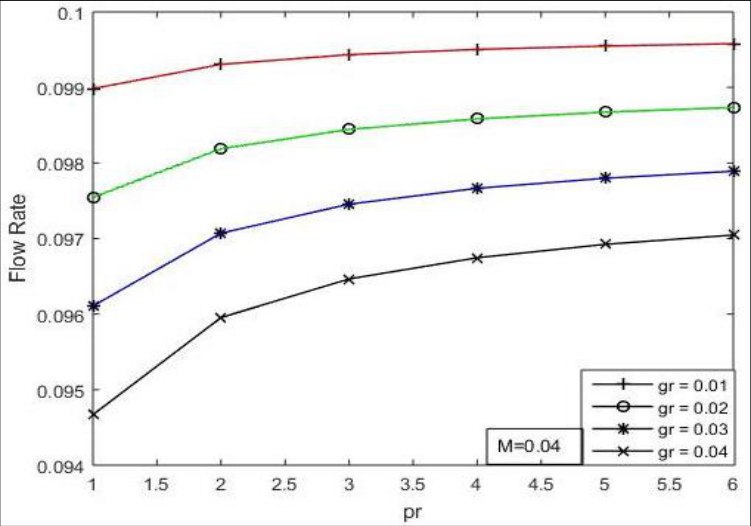 Figure 11
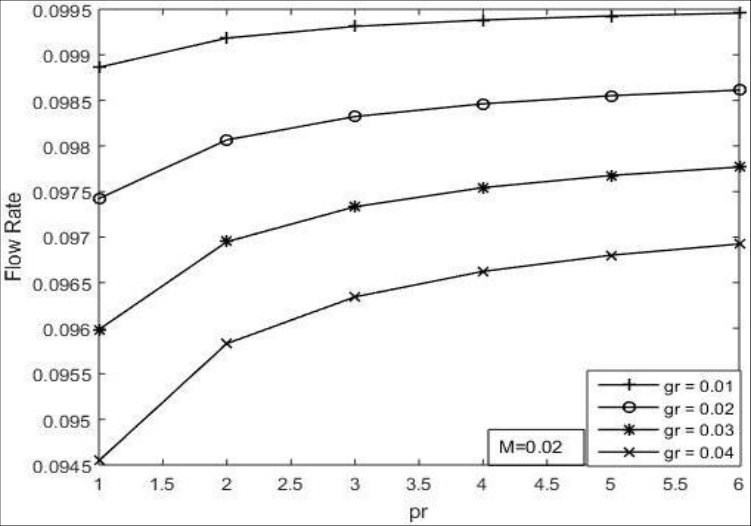 Figure 12
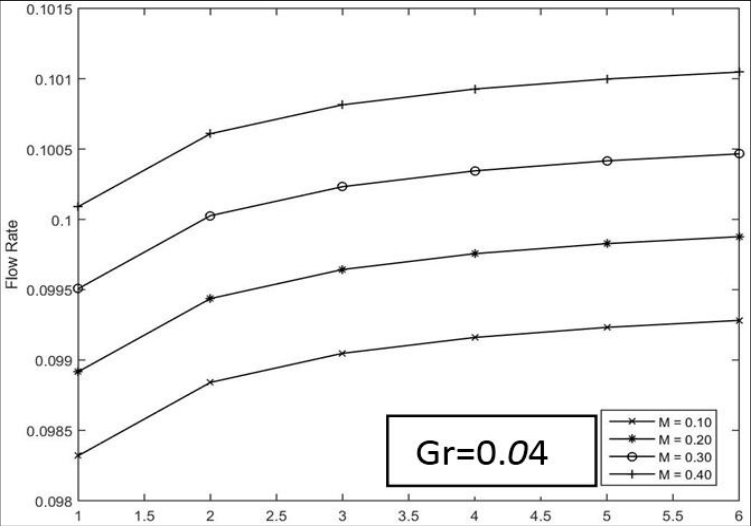 Figure 13
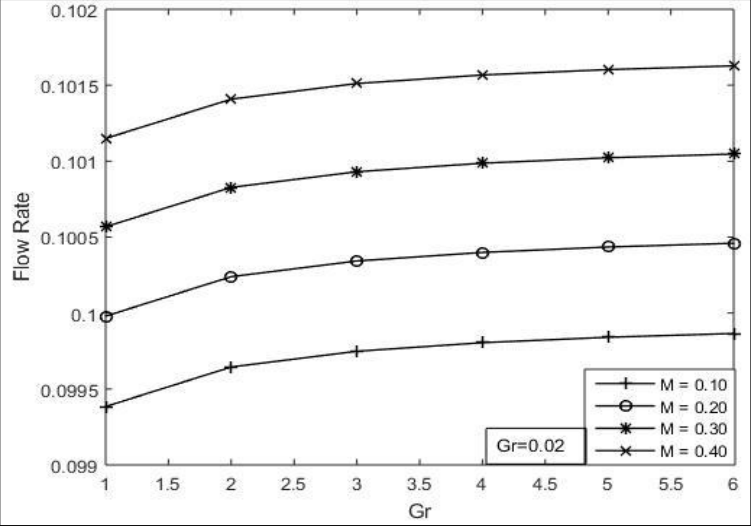 Figure 14
Introduction Nomenclature
In several industrial and environmental situations, the radiative convective flow occurs flow place a very important role. Several applications are noticed in combustion and cooling chambers. The applications are more seen astrophysical flows, solar power technology and space vehicles. In the design high precision equipment, the radiative heat transfer plays a very significant role. The radiative transfer is more found in nuclear power plants, gas turbines, missiles and in air craft engines. The problem of viscous incompressible fluid over an infinite horizontal plate which moves in its own plane once was studied by stokes [1] . Thereafter, the viscous force imparted by flowing fluid in a dense swarm of particles was studied by Brinkman [2] . Later on, Stewartson [3] obtained the analytical solution for viscous flow past and impulsively started semi-infinite horizontal plate. Thereafter, Berman [4] , studied the case of two dimensional study state flow of an incompressible fluid with parallel rigid porus walls where the flow is influenced by uniform section and injection. Next, the flow between two vertical plates where the plates are electrically non non-conducting with the assumption that the wall temperature influences linearly in the direction of the flow was studied by Macy [5] and Mori [6] . Hall [7] studied the same problem with the help of finite differences method of a mixed explicit implicit time for the stability of the solution. Change et al. [8] examined the effects of radioactive heat transfer of free convection in an enclosed with specialized applications. Thereafter, Mahajan et al. [9] examined the influence of viscous heat dissipating effect in natural convective flows. Subsequently, Soundalgekar and Thaker [10] . Investigated radiation effects of an optionally thin gray gas bounded by a stationary vertical plate. By applying Rossland's approximation, Hossain et al. [11] studied the radiation effects and mixed convection along a vertical plate with uniform free surface temperature by applying Rossland's approximation, Subsequently, the effects of thermal radiation and convective flow past a moving infinite vertical plate was analyzed, discussed and presented by Raptis and Perdikis [12] . The effects of thermal radiation and flow past semi-infinite vertical isothermal plate with uniform heat flux in the presence of applied magnetic field was examined by Antony Raj et al. [13] .
The Influence of velocity with reference to the critical parameters which appear in the equation of motion were neither commented nor examined in detail by any of the above investigators is a point of great concern academic interest. Therefore, an attempt has been made to study the effects of such parameters in this paper. Also the effect of critical parameter on the flow entities has been examined.
Mathematical Formulation
Flow of an incompressible viscous radiating fluid past an impulsively started infinite vertical plate with uniform heat flux is considered. The x-axis is taken along the plate in the vertical direction and the y-axis is taken normal to the plate. The Flow geometry is as shown below Schematic representation of the problem Initially, the plate and fluid are at the same temperature in a stationary condition. The plate is given an impulsive motion in the vertical direction against the gravitational field with constant velocity 0 u when 0 t . At the same time, the heat is supplied from the plate to the fluid at uniform rate. The fluid exhibits the properties of grey, absorbing-emitting radiation but a non-scattering medium. Then by usual Bossiness's approximation, the unsteady flow is governed by the following equations.
In view of Rossland approximation r q is given by:
While, the initial and boundary conditions are:
Under the assumption that, the temperature differences within the flow are sufficiently small such that 4 T may be expressed as a linear function of the temperature. This is accomplished by expanding 4 T in a Taylor series about T and neglecting higher order terms, thus
On introducing the following non-dimensional quantities , , , ,
By considering the magnetic intensity as M and the permeability of the boundary as K Eqs. ( 1) to (6), can be re defined as:
The initial and boundary conditions in non-dimensionless form are , 0 , 0
Methodology for solution
We assume that the solutions for Eqn (8) and Eqn (9) in form of:
Under the modified initial and boundary conditions:
Using Eqns (11), ( 12) and (13) in Eqns ( 8) and ( 9)
The expression for the skin friction is:
Results and Discussion
Figures 1, 2, 3 and 4 illustrates the effect of time on the velocity profiles for Pr=0.05, 0.01 0.04 and 0.03 respectively. In all these illustrations, it is observed that their relationship between Y (plate width) and velocity is always linear In some cases, their relationship is positive and while in some cases it is negative. 10 shows the nature of the velocity profiles for Prandtl numbers 0.01, 0.02,0.03,0.04 and 0.05 respectively for t = 0.6, 0.5, 0.4, 0.3, 0.2 and 0.1 respectively. In each of these figures, their relationship is found to be perfectly linear. The relationship is positive while sometimes is negative as Pr increase. Further, it is noticed that as Pr increases, the velocity in general increases. Through, there is a marginal change in the value of t, not much of significant change in the velocity profile is observed.
Figures and tables from the paper
References
14 in the original paper- Stokes GG. On the effects of Internal Friction of Fluids on the Motion of Pendulums, Camb. Phil. Trans. 1851; IX(2):8-106.
- Brinkman HC. A calculation of viscous force extended by flowing fluid in a dense swarm of particles. Appl. sci. Res. 1947; 1:27-34.
- Stewartson K. On the impulsive Motion of a Flat plate in a Viscous Fluid. Quarterly Jnl. of Mechanics and Applied Mathematics. 1951; IV(2):182-198.
- Berman AS. Laminer flow in a channel with porous walls. Jnl. Appl. Phys. 1953; 24:1232-1235.
- Mori Y. on combined free and forced convective laminar MHD flow and heat transfer in channels with transverse magnetic field, international developments in heat transfer, ASME. 1961; 124:1031-1037.
- Macey RI, Pressure flow patterns in a cylinder with reabsorbing walls, Bull Math. Bio phys. 1963, 25(1).
- Hall MG. The Boundary Layer over an impulsively Started Flat plate, Proc. Roy. Soc. A. 1969; 310(1502):401-414.
- Chang IC, Yang KT, Lloyd JR. Radiation Natural Convection Interactions in Two Dimensional Complex Enclosures, ASME. Jnl. Heat Transfer. 1983; 105(1):89-95.
- Mahajan RL, Gebhart BB. Viscous Dissipation Effects in Buoyancy-Induced Flows. Int. Jnl. of Heat Mass Transfer. 1989; 32(7):1380-1382.
- Soundalgekar VM, Thaker HS. Radiation effects on free convection flow past a semi-infinite vertical plate. modeling measurement and control. 1993; B51:31-40.
- Das UN, Deka RK, Soundalgekar VM. Effects of Mass Transfer on Flow Past an Impulsively Started Infinite Vertical Plate with Constant Heat Flux and Chemical Reaction, Forschang im Ingenieurwesen. 1994; 60(10):284-287.
- Hossain MA. Takhar, Radiation effect on mixed convection along a vertical plate with uniform surface temperature, Heat and Mass Transfer. 1996; 31:243-248.
- Raptis A, Perdikis C. Radiation and free convection flow past a moving plate, Int. J App. Mech. Engg. 1999; 4:817-821.
- Chandrakala P, Antony Raj S. Radiation effects on MHD flow past an implusively started vertical plate with uniform heat flux, Indian Journal of Mathematics. 2008; 50(3):519-532.