
Research article · 2018 · Full text
International Journal of Statistics and Applied MathematicsForecast of road traffic accidents in Jordan utilizing artificial neural network (ANN)
Volume 3(3) · Pages 242–245
Research areasTraffic Prediction and Management TechniquesIoT and GPS-based Vehicle Safety SystemsTraffic and Road Safety
Abstract
Author-writtenHighway-related mischances are viewed as one of the most significant issues in the advanced world as movement mischances make genuine risk human life around the world. Jordan, a creating nation, has a high and developing level of car crashes bringing about in excess of 13000 fatalities in the vicinity of 1989 and 2012 with a normal yearly cost of over $500 million. The expectation of future car crashes is in this manner of most extreme significance so as to value the size of the issue and accelerate the basic leadership towards its lightening. In this paper, a car crash forecast show was created utilizing the novel Artificial Neural Network (ANN) reproduction with the point of distinguishing its appropriateness for the expectation of auto collisions under Jordanian conditions. The outcomes showed that the evaluated auto collisions, in view of adequate information, are sufficiently close to genuine auto collisions and in this manner are dependable to foresee future car crashes in Jordan.
Summary
Source-checkedPlain-language reading of the full paper, prepared with AI and checked against the text. Each point links to the authors' own words.
Why it matters
- Road traffic accidents are considered a major global issue because they pose a significant risk to human life. View evidence ↗
- In Jordan, a developing nation, there were more than 13,000 fatalities from car crashes between 1989 and 2012, with an average annual cost exceeding $500 million. View evidence ↗
- Traditional statistical methods may be insufficient for forecasting accidents due to the complex relationships between various traffic factors. View evidence ↗
The question
- The study aimed to develop a car crash forecast model using an Artificial Neural Network (ANN) to determine if it is appropriate for predicting accidents in Jordan. View evidence ↗
What they did
- The dataset was split into three groups: 70% for training, 15% for validation, and 15% for testing. View evidence ↗
- The researchers used MATLAB for the training, validation, and testing of the ANN, and SPSS for the statistical analysis. View evidence ↗
What they found
- Among four tested models, Model 4 was the most effective, achieving the highest coefficient of determination (R² = 0.992). View evidence ↗
- The correlation coefficients (r) for Model 4 were 0.9950 for training, 0.99999 for testing, and 0.9994 for validation. View evidence ↗
- The predicted values showed small residuals, particularly for recent years, which the authors attribute to better data collection methods. View evidence ↗
What it means
- The authors conclude that the ANN model produces reliable results under Jordanian traffic conditions and can be used to predict future road accidents. View evidence ↗
Visual summary
2 visualsIllustrations explain the paper; charts are replotted from the paper's own table values.
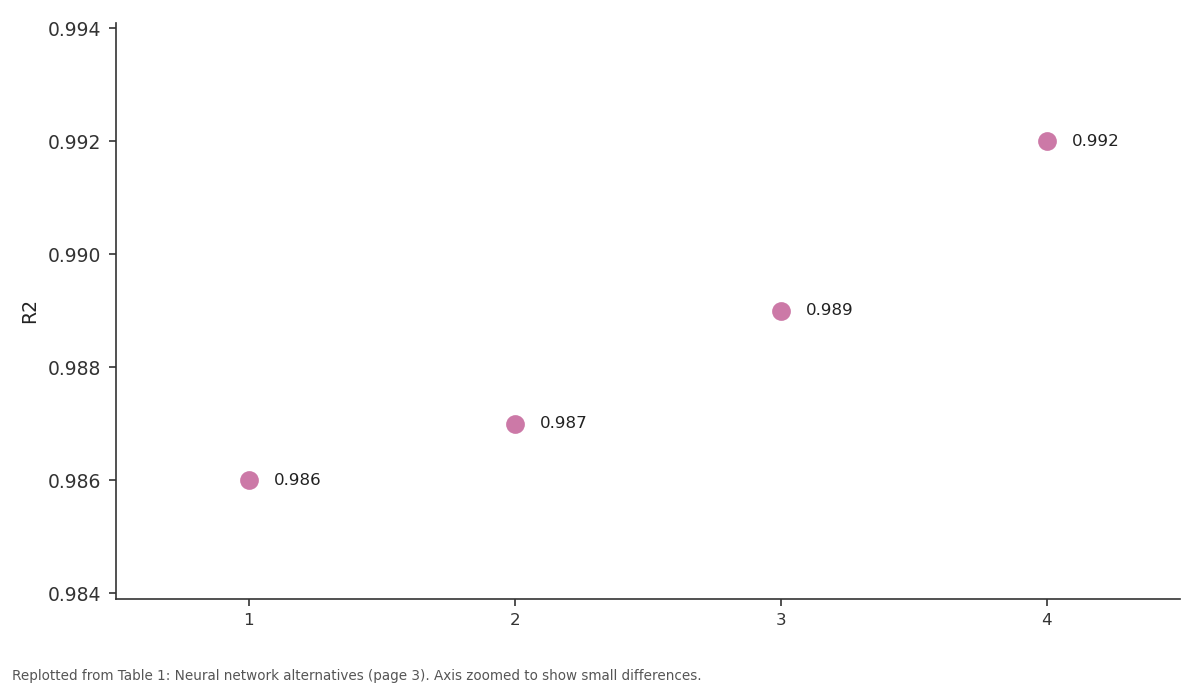
R2: 1 vs 2 vs 3 vs 4
Replotted from Table 1 (page 3) of the original paper. Every bar is the paper's own table value.
View source evidence ↗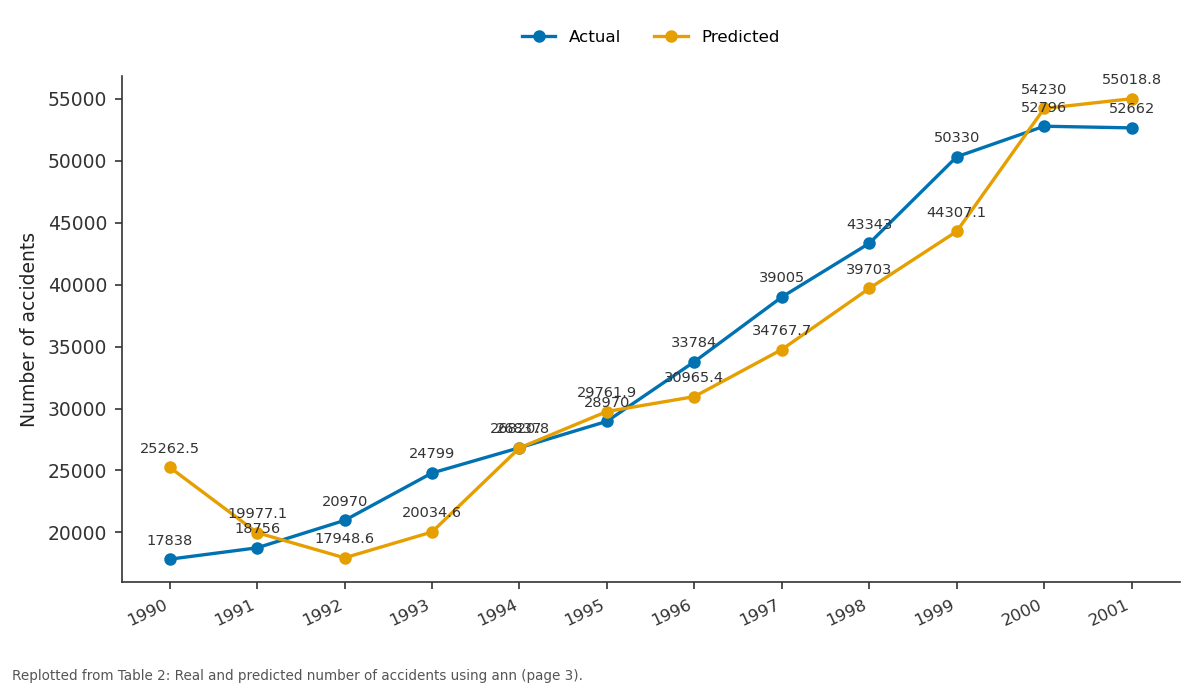
Actual and Predicted: 1990 vs 1991 vs 1992 vs 1993 vs 1994
Replotted from Table 2 (page 3) of the original paper. Every bar is the paper's own table value.
View source evidence ↗Figures & tables
From the original paper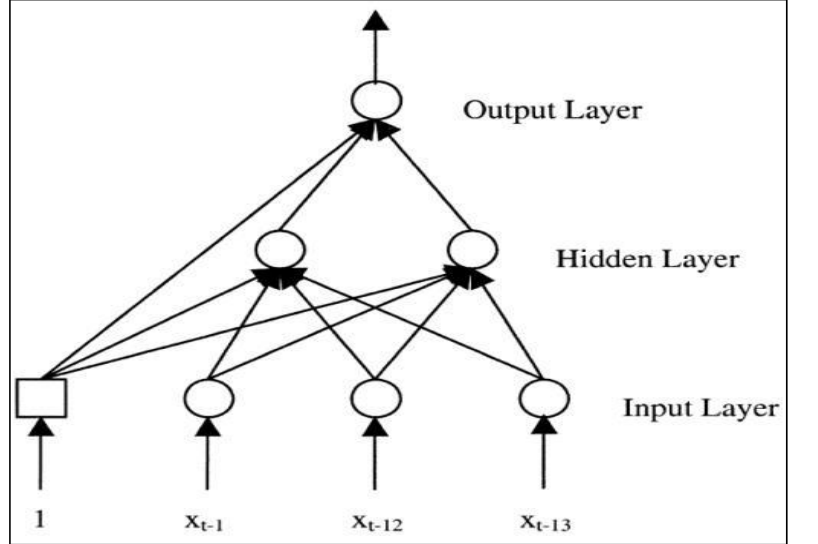 Figure 1
 Table 1
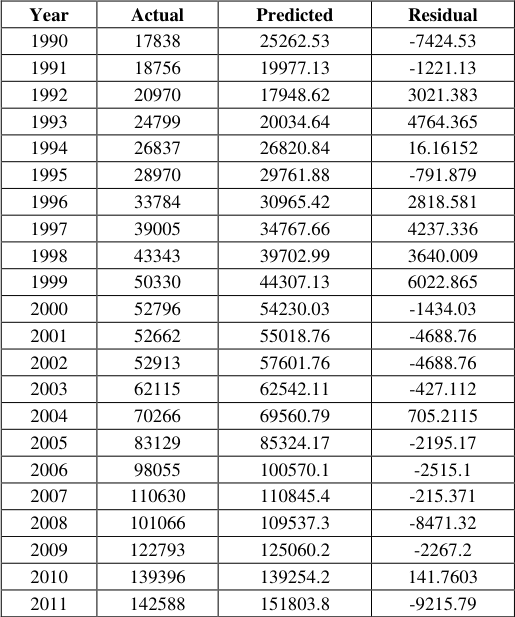 Table 2
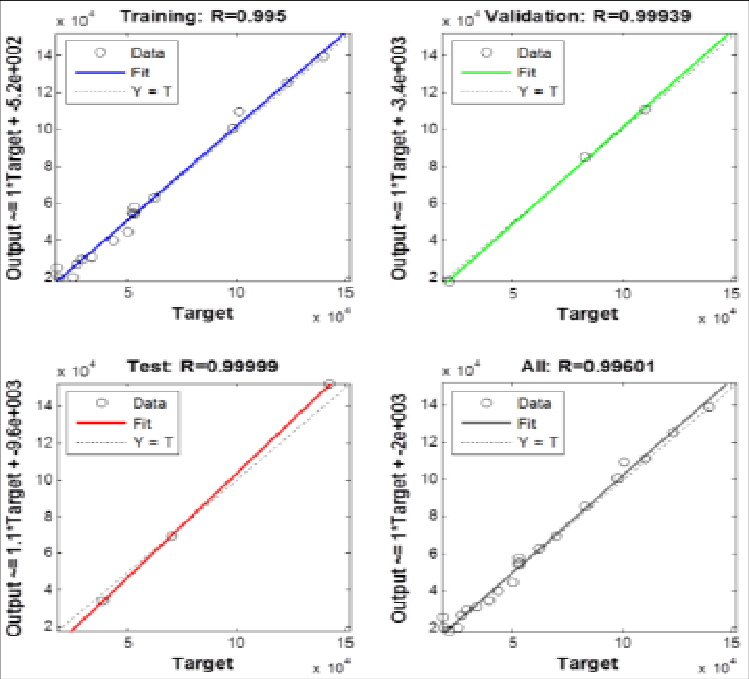 Figure 3
Introduction
Auto collisions make genuine risk human life around the world. As per the World Health Organization (WHO), in excess of 1.2 million individuals bite the dust every year in engine vehicle mishaps and in excess of 50 million are harmed around the world. Jordan, as one of the creating nations, has abnormal state of car crashes where there were in excess of 13000 fatalities between the years 1989-2012 requiring the need to decide the current and future greatness of the scourge with a specific end goal to take important activities to control this consistently developing issue. Broad research has been done into the forecast of car crashes in both created and creating nations utilizing different factual systems. In any case, the various factors and complex connections between the qualities of the different movement components require scientific systems other than customary. A current way to deal with a break down these connections is the simulated neural systems (ANN) which have been proposed and utilized effectively by numerous researchers as another option to the ordinary relapse approach in determining time arrangement relating to complex atmospheric and natural wonders. This paper exhibits and talks about the advancement of a forecast display for evaluating future car crash in Jordan utilizing the ANN approach.
Artificial neural networks and their applications
Artificial Neural Network is a sub-space of simulated knowledge framework which has been utilized as of late to comprehend wide assortment of structural building issues. A neural arrange is an information demonstrating device and a data preparing worldview that speaks to complex connections in a way like the human mind. ANNs are known to be widespread capacity approximators, what's more, are fit for abusing nonlinear connections between factors. Neural systems are a wide class of adaptable nonlinear relapse and separate models, information lessening models, and nonlinear dynamical frameworks. They comprise of a frequently a vast number of "neurons," i.e. straightforward director on the other hand nonlinear figuring components, interconnected in frequently complex ways and frequently sorted out into layers [1] . The key part of this perspective is the novel structure of the information planning system. It is made out of: Highly interconnected preparing components (neurons.
Every neuron has an esteem, weight, and bias (constant) where the neuron's net info is the estimation of the neuron duplicate by the weight in addition to the inclination. Layers made out of an info layer which contains the information to be ordered by the system (autonomous factors), at least one concealed layers which do the handling, and a yield layer which contains the coveted yield (subordinate variable). Each layer comprises neurons associated with each other neuron in the past layer by a connection that speaks to the weight. A case of an ANN with its different layers is appeared in "Fig. 1" [2] . Activation works: These are additionally called exchange capacities that characterize the mappings from contributions to concealed hubs and from shrouded hubs to output(s), respectively [3] . Artificial Neural Networks have been used effectively in comprehending designing issues identified by arrangement, expectation, and work guess. In the transportation zone, ANN has numerous applications and when connected to anticipate speed, for instance, McFadden et al. [4] discovered it to offer prescient power prevalent to those of relapse models. This is predominantly on the grounds that of their capacity to demonstrate non-linearity and adaptability with huge complex informational indexes. Further applications incorporate crafted by Shoukry [5] who utilized the ANNs in order of seriousness levels of mishaps and announced different uses of ANN in the transportation field particularly in the rush hour gridlock wellbeing territory. Chiou [6] utilized ANN to build up a specialist framework for the evaluation of two-auto collisions, Xiangzheng Xu [7] connected the ANNs system to assess movement wellbeing in China, and Wenhui [8] looked into the assessment of well-being in rush hour gridlock mischance scene in view of ANN. The information is isolated into three sets; preparing data. (About 70% of the aggregate information), approval information (around 15% of the add up to information), and testing information (about15% of the aggregate information). Preparing, approval, and testing of the system were performed utilizing MATLAB. The measurable investigation was performed utilizing the SPSS measurable programming, and the Chosen exchange capacities were Input concealed layer: Tan-sigmoid exchange work Output concealed layer: Linear exchange work
The preparation procedure incorporates the accompanying tasks: Setting beginning qualities for weights Evaluating the yield in view of beginning weights. Measuring the mistake (mean square blunder or any capacity to ascertain the mistake) Adjusting the weights utilizing the rate of learning (usually little esteem, for example, 0.01) The weights keep on being changed as every blunder is registered. In the event that the system is competent and the learning rate is set accurately, the blunder is in the long run headed to zero. In the approval stage, no change jumps out at the weights. Approval is important to gauge the execution of the system demonstrate where the anticipated qualities are contrasted and the real as given by the approval information. This procedure can be incorporated into preparing procedure to enhance the execution of the model Through the testing procedure, the anticipated qualities are contrasted and the information esteems utilizing testing information that was not utilized as a part of preparing or approval process. Once more, no alteration strikes the weights The engineering of the ANN was as appeared in "Fig. 2". [9] Figure 2. Design of the ANN
Results
The Neural Networks permit the advancement of diverse options by changing the number of hidden layers. Four elective models, with a various number of hidden layers, were considered and
Conclusion
Street auto collision in Jordan constitutes a genuine issue and forecast of its future extent utilizing dependable methodologies has turned into a need. Artificial Neural Networks (ANN) is a novel approach which turned out to be effective in taking care of building issues, what's more, analysts discovered it to offer profitable power better than those of conventional relapse models. A mishap expectation show was produced utilizing the ANN approach by dissecting the relationship amongst mishaps and parameters influencing them for which information was accessible. The model was approved and found to create great outcomes under Jordanian movement conditions, therefore, can be utilized with certainty to foresee future auto collisions on the national street.
Figures and tables from the paper
| Demonstrate No. | Number of hidden layers | ra (Preparing) | r (Testing) | r (Approval) | R2 |
|---|---|---|---|---|---|
| 1 | 1 | 0.9972 | 0.9998 | 0.9998 | 0.986 |
| 2 | 2 | 0.9995 | 0.9913 | 0.9984 | 0.987 |
| 3 | 3 | 0.9984 | 0.9814 | 0.9966 | 0.989 |
| 4 | 3b | 0.9950 | 0.99999 | 0.9994 | 0.992 |
Table text extracted from the original PDF; superscript letters are shown inline. The original table image is below.
View original table image
| Year | Actual | Predicted | Residual |
|---|---|---|---|
| 1990 | 17838 | 25262.53 | -7424.53 |
| 1991 | 18756 | 19977.13 | -1221.13 |
| 1992 | 20970 | 17948.62 | 3021.383 |
| 1993 | 24799 | 20034.64 | 4764.365 |
| 1994 | 26837 | 26820.84 | 16.16152 |
| 1995 | 28970 | 29761.88 | -791.879 |
| 1996 | 33784 | 30965.42 | 2818.581 |
| 1997 | 39005 | 34767.66 | 4237.336 |
| 1998 | 43343 | 39702.99 | 3640.009 |
| 1999 | 50330 | 44307.13 | 6022.865 |
| 2000 | 52796 | 54230.03 | -1434.03 |
| 2001 | 52662 | 55018.76 | -4688.76 |
| 2002 | 52913 | 57601.76 | -4688.76 |
| 2003 | 62115 | 62542.11 | -427.112 |
| 2004 | 70266 | 69560.79 | 705.2115 |
| 2005 | 83129 | 85324.17 | -2195.17 |
| 2006 | 98055 | 100570.1 | -2515.1 |
| 2007 | 110630 | 110845.4 | -215.371 |
| 2008 | 101066 | 109537.3 | -8471.32 |
| 2009 | 122793 | 125060.2 | -2267.2 |
| 2010 | 139396 | 139254.2 | 141.7603 |
| 2011 | 142588 | 151803.8 | -9215.79 |
Table text extracted from the original PDF; superscript letters are shown inline. The original table image is below.
View original table image
References
9 in the original paper- Sarle WS. Neural networks and statistical models, in Proc. Nineteenth Annual SAS Users Group International Conference, NC, USA, 1994.
- Balkin SD. Automatic neural network modeling for univariate time series, International Journal of Forecasting. 2000; 16(4):509-515.
- Neural Network Toolbox, User's Guide, Mark Hudson Beale, Martin T. Hagan, Howard B. Demuth, 2013.
- McFadden J, Yang WT, Durrans R. Application of ANN to predict speeds on two-lane rural highways, Transportation Research Record. 2000; 1751:9-17.
- Shoukry FN. Artificial neural network in the classification of severity levels in crashes with a guardrail, Masters of Science Thesis, West Virginia University, USA, 2005.
- Chiou YC. An artificial neural network-based expert system for the appraisal of two-car crash accidents, Department of Traffic and Transportation Engineering and Management, Feng Chia University, Taiwan, 2006.
- Xu X, Chen B, Gan F. Traffic safety evaluations based on grey systems theory and neural networks, in Proc. WRI World Congress on Computer Science and Information Engineering. 2009; 5:603-607.
- Wenhui Z. Safety evaluation of traffic accident scene based on artificial neural network, ICICTA, China, 2009; 1:408-410.
- Personal Communication with Mosa AL-Akhras, IT Department, University of Jordan, 2013.