
Research article · 2018 · Full text
International Journal of Statistics and Applied MathematicsA short survey on cosmology and their recent progress
Volume 3(2) · Pages 564–566
Research areasCosmology and Gravitation TheoriesRelativity and Gravitational TheorySpace Science and Extraterrestrial Life
Abstract
Author-writtenSome survey of modern cosmology and the lessons to be learned from the successes and blind alleys of the past are described. In this survey paper, we collected the developmental history of cosmology theory. Some important results from beginning up to now are incorporated in this paper.
Summary
Source-checkedPlain-language reading of the full paper, prepared with AI and checked against the text. Each point links to the authors' own words.
Why it matters
- String theory provides a useful conceptual framework for understanding the universe prior to the creation of particles. View evidence ↗
- Cosmic strings are viewed as stable topological defects resulting from phase transitions when temperatures dropped below a critical point in the early universe. View evidence ↗
- Density fluctuations caused by vacuum strings are proposed as an explanation for the formation of galaxies. View evidence ↗
The question
- The fundamental goal in cosmology is to develop models of the universe and validate them against current astronomical data. View evidence ↗
What they did
- The author conducted a survey to collect and describe the developmental history of cosmological theory. View evidence ↗
- The survey examines Bianchi type cosmological models because their homogeneous and isotropic nature allows for the study of the universe's isotropization over time. View evidence ↗
What they found
- Letelier successfully solved Einstein's field equations for string clouds exhibiting cylindrical, spherical, and plane symmetry. View evidence ↗
- In 1983, Letelier derived cosmological models for massive strings within Kantowski-Sachs and Bianchi type I space-times. View evidence ↗
- While cosmic fluid is typically treated as a perfect fluid, the author notes that bulk viscosity is expected to be significant during specific stages of universal expansion. View evidence ↗
- Research by Murphy suggests that the introduction of bulk viscosity may allow for the avoidance of the Big Bang singularity. View evidence ↗
- The existence of cosmic strings in the early universe is considered a byproduct of Grand Unified Theories (GUT). View evidence ↗
What it means
- The author concludes that determining the precise physical conditions during the earliest stages of the universe's formation remains a significant challenge. View evidence ↗
- The author acknowledges that the origin of the universe remains the greatest unsolved mystery in cosmology. View evidence ↗
Visual summary
1 visualsIllustrations explain the paper; they do not show study data.
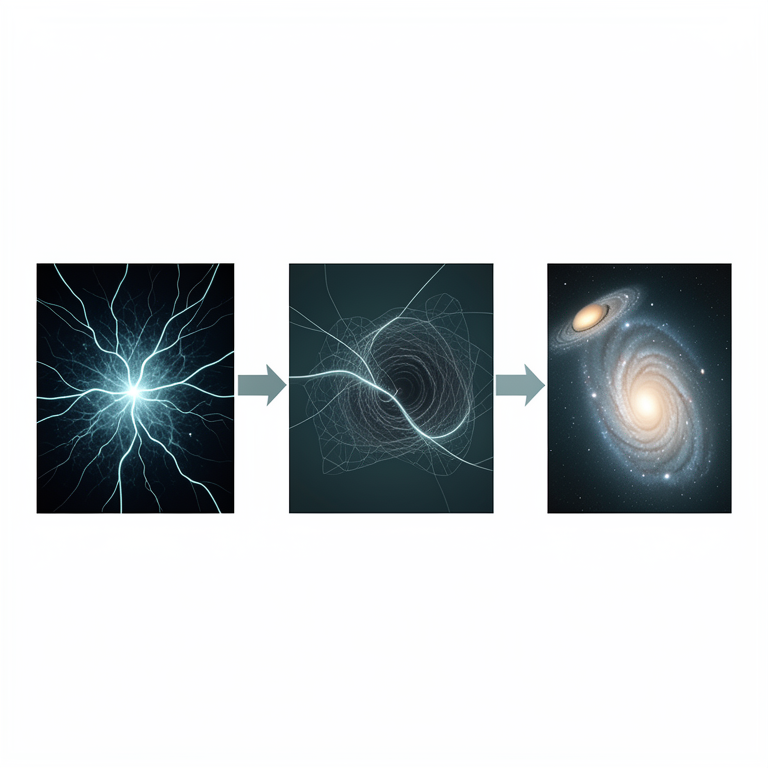
Cosmic String Formation and Galaxy Influence
AI-generated conceptual illustration (The early universe and evolving galaxies). It explains the idea and does not show study data.
View source evidence ↗Introduction
In recent years for the study of the early universe, Cosmic strings have drawn substantial attention among researchers for various aspects. The string theory is useful concept before the creation of the particle in the universe. The string are nothing but the important topological stable defects due to the phase transition that occurs as the temperature lower below some critical temperature at the very early stages of the universe. The present day configuration of the universe is not contradicted by the large scale network of strings in the early universe. Moreover, the galaxy formation can be explained by the density fluctuations of the vacuum strings. The general relativistic treatment of strings was obtained by Letelier and stachel. Leterlier has obtained the solution to Einstein's field equation for a cloud of strings with spherical plane and cylindrical symmetry. Then in 1983 he solved Einstein's field equation for a closed of massive strings and obtained cosmological model in Bianchi type I and Kantowski-sachs space times Baliet al Tikerkar and Patel and chakraborty and chakraborty 7 presented exact solution for the Bianchi III Cosmological models for string cloud. The string models have an important rule in cosmology, as strings are believed to have an important role during the early stage of the universe and can greate density fluctuations which lead to galaxy formation Bianchi type III string cosmological model with viscosity where the constant coefficient of bulk viscosity is considered. Recently Bali and Prathan have obtained formalism for studying the new inerrability of Bianchi type III massive strings cosmological models in general relativity. Wang has also discussed LRS Bianchi type I and Bianchi type III cosmological for a cloud string with bulk viscosity. Very recently, Rai and Pradhan have found the inerrability of cosmic string in Bianchi type III space time in presence of bulk viscous fluid by applying a new technique. Recently Tiwari and Sonia 14 investigated the non extinct of shear in Bianchi type III string cosmological models with bulk viscosity and time dependent ∧. present universe is both spatially homogeneous and isotropic. The basic problem is cosmology is to find the cosmological models of universe and to compare the resulting models with the present day universe using astronomical data. In most treatments of Cosmology, Cosmic fluid is considered as perfect fluid. However, bulk viscosity is expected to play an important role at certain stages of an expanding universe. In the last few years of study of cosmic strings has attracted considerable interest as they are believed to paly an important role during early stages of the universe. The idea was that particles like the photon and the neutron could be regarded as waves on a string. The presence of strings in the early universe is a byproduct of Grant unified theories (GUT). Bianchi type cosmological models are important in the sense that these models are homogeneous and an isotropic, from which the process of iso-tropization of the universe is studied through the passage of time. It is still a challenging problem before us to know the exact physical situation at very early stages of formation of our universe.
The string theory is useful concept before the creation of the particle in the universe. The string are nothing but the important topological stable defects due to the phase transition that occurs as the temperature lower below some critical temperature at the very early stages of the universe. The present day configurations of the universe are not contradicted by the large scale network of strings in the early universe. More over the galaxy formation can be explained by the density fluctuations the vacuum strings.
Theoretical Cosmology
Cosmology is the scientific study of large scale properties of the universe as a whole cosmology is study of the motion of crystalline objects. The origin of the universe is greatest cosmological mystery even today. The recent observations that ⋀ ~ 10 while the particle physics predication for ∧ is greater than this value by a factor of order 10 120 . It is still a challenging problem before us to know the exact physical situation at very early stages of the formation of our universe. The sting theory is a useful concept before the creation of the particle in the universe. The sting are noting but the important topological stable defects due to phase transition that occurs as the temperature lower below some critical temperature at the very early stages of the universe. Bianchi type models are important in the sense that there are homogenous and isotropic from which the process of isotropic is studied through the passage of time these models are tube known as suitable models of our universe, therefore study of Bianchi type models create much more interest. The string cosmological models with magnetic field in homogenous and anisotropic Bianchi type I, models have been studied by number of researchers in different aspects. Bali has obtained Bianchi type I, III, IX string cosmological models in modified theory of relativity. Yadav. Has studied some Bianchi type I viscous fluid string cosmological model with magnetic field. Tripathi and Dubey have studied LRS Bianchi type I cosmological models with variable deceleration parameter. Bianchi type I universe is also studied with various matters the content of biometric theory of relativity by Deo and Sing, Deo and Roughe In the last few years the study of cosmic strings has attracted considerable interest as they are believed to play an important role during early stayes of the universe. The idea was that particles like the photon and the neutron cloud be regarded as waves on a string. The presence of strings in the early universe is a byproduct of grant unified theories (GUT) The general relativistic treatment of cosmic strings has been originality given by Letelier. Cosmic strings plays an important role in structure formation in cosmology Bianchi type II models play an important role in current modern cosmology for simplification of the actual universe. Krori et al. and Chakraborty and Nandy have investigated Cosmological models for Bianchi type II, VIII and IX space times. Asseo and Sol emphasized the importance of Bianchi type II universe. Patel, Maharaj and Leach [11] have studied the integrability of cosmic string in the context of Bianchi type II, VIII, and IX space times. Bali Cosmology is the scientific study of large scale properties of the universe as a whole cosmology is study of the motion of crystalline objects The origin of the universe is greatest cosmological mystery even today. The recent observations that ⋀~10 Cm while the particle physics predication for ⋀ is the greater than this value by a factor of order 10 . The present universe is both spatially homogeneous and isotropic. The basic problem in cosmology is to find the cosmological models of universe and to compare the resulting models with the present day universe using astronomical data. However bulk viscosity is expected to play an important role at certain stages of an expanding universe. In the last few years the study of cosmic strings has attracted considerable interest as they are believed to play an, important role during early stages of the universe. The idea was that particles like the photon and the neutron could be regarded as waves on a string. The presence of strings of the early universe is a by product of Grant Unified theories (GUT) Roy and Banerjee have investigated some LRS Bianchi type II string cosmological models which represent geometrical and massive strings. Some cosmological solution of massive strings for Bianchi type I space time in presence and absence of magnetic field have investigated by Banerjee et. al. Bali et al. have a investigated Bianchi types I, V, IV string cosmological models in General relativity Wang has investigated and discussed some cosmological models and their physical implication in some Bianchi type space times. At the early stayes of the evolution of the universe, when radiation is in the form of photons as well as neutrino decoupled, the matter by haved like a viscous fluid. Bulk viscosity could arise in many circumstances and could lead to an effective mechanism of galaxy formation. Murphy constructed isotropic homogeneous spatially flat cosmological model with a fluid containing bulk viscosity alone because the shear viscosity can not exist due to assumption of isotropy. He observed that the 'Big-Bang singularity of finite past may be avoided by introduction of bulk viscosity. Bali
References
21 in the original paper- Kibble TWB. Some implications of a cosmological phase-transition, phys. Ref. 1980; 67:183-1999.
- Banerjee A, Dutta SB, Sanyal AK. Bianchi type III Cosmologicla model with viscous fluid Gen. Relativity and Graviation. 1986; 18:461-477.
- Singh T, Agrawal AK. Bianchi type II, VIII, IX in certain new theories of gravitation Astrophys. Space sc. 1997; 191:61-88.
- Zel's dovich, ya B, Kokzarev ya I, Okun LB. Cosmological consequences of a spontaneous breakdown of a discrete symmetry, Zn. Sov. Phys. JETP. 1975; 40:15.
- Kibble TWB. Topology of cosmic domains and strings, J. Phys. A: math Gen. 1976; 9:1387-1398.
- Vilenkin A. Cosmic strings phys. Rev D.24, 1981, 20822089.
- Letelier PS. strings cosmologeis, Phys. Rev. D28, 1983, 2414-2419.
- Stachel J. Thickening the string I the string perfect dust Phys. Rev. D21, 1980, 2171-2181.
- Bali R, Anjali. Bianchi type I magnetized string cosmological model in general relativity Astrophys. space Sci. 2006; 302:201-205.
- Bali R, Dave S. Bianchi type IX string cosmological model in generla relativity Pramana. J Phys. 2001; 56:53518.
- Bali R, Anjali. Bianchi type IX magnetized string cosmological model in general relativity Astrophys. space. Sci. 2003; 288, 399-405.
- Bali R, Singh DK. Bianchi type V bulk viscous fluid dust cosmological model in general relativity Astophys. spce. Sci. 2005; 300:387-394.
- Bali R, Pareek UK, Pradhan A. Bianchi type I massice string magnetized barotropic perfect fluid cosmological model in general relativity, chin phys. Lett. 2007; 24:2455-2458.
- Bali R, Upadhaya RD. LRS Bianchi type I string dust magnetized cosmological models Astrophys. spce Sci. 2003; 283:97-108.
- Yadav MK, Pradhan A, Rai A. Some magnetized bulk viscous string cosmological models in general relativity, Astrophys. Space sci. 2007; 317:423-429.
- Wang XX. Bianchi type I, string cosmological models with bulk viscosity and magnetic field Astrophys. Space Sci. 2004; 293:933-944.
- Wang XX. Kantowski-Sachs string cosmological models with bulk viscosity in general relativity Astrophys. Space Sci. 2005; 298:433-440.
- Wang XX. Bianchi type III string cosmological models with bulk viscosity and magnetic field chin, phys Lett. 2006; 23:1702-1704.
- Yadav MK, Pradhan A, Rai A. Some Bianchi type III string cosmological models with bulk viscosity, Int. J Theor phys. 2007; 46:2677-2687.
- Tyagi A, Sharma K. Bianchi type II Bulk viscous string cosmological models in general relativity, International Journal of theoritical Phys. 2010; 49(8):1712-1718.
- Pradhan A, Amirhashchi H, Mahanta KL. Five dimentional LRS Bianchi type I string cosmological model in saez and Ballesterv theory Astrophys. Space Sci. 2007; 312:321-424.