
Research article · 2018 · Full text
International Journal of Statistics and Applied MathematicsMathematical model for minimizing divorce through counseling
Volume 3(3) · Pages 218–225
Research areasMathematical and Theoretical Epidemiology and Ecology Models
Abstract
Author-writtenIn this paper, we propose a mathematical model to examine the impact of counseling in divorce cases. A divorce related hardship/illness forces the individuals to go for counseling. Counseling sections has always help decrease divorce cases and to increase the maximum number of marriages from divorce in our communities. Basic Reproduction Number, stability analysis and its numerical simulation for the proposed model was carried out which proves that counseling sections for the divorced is helpful for improving individuals’ health and consequently the community.
Summary
Source-checkedPlain-language reading of the full paper, prepared with AI and checked against the text. Each point links to the authors' own words.
Why it matters
- In Ghana, divorce is culturally discouraged, yet the actual rates of divorce remain very high. View evidence ↗
- Common causes for the dissolution of marriages include financial issues, infertility, infidelity, alcoholism, and physical or emotional abuse. View evidence ↗
- Divorce is stated to have significant negative impacts on both the children and the parents involved. View evidence ↗
The question
- The study aims to analyze how counseling can be used to decrease divorce rates using a mathematical model similar to the SEIR epidemic model. View evidence ↗
What they did
- The model divides the population into four compartments: divorced individuals (D), those suffering from divorce-related hardship (H), those receiving counseling (C), and those who return to marriage (M). View evidence ↗
- The researchers constructed a system of non-linear differential equations to simulate the process of minimizing divorce through counseling. View evidence ↗
- The basic reproduction number (R0) was calculated using the next generation matrix method to determine the threshold for divorce stability. View evidence ↗
- The study employed linearization and matrix analysis to evaluate the local and global stability of the divorce-free (E0) and endemic (E*) equilibrium points. View evidence ↗
What they found
- The calculated basic reproduction number (R0) is 0.34508, suggesting that counseling can prevent divorce from becoming an epidemic in society. View evidence ↗
- The model finds that the divorce-free equilibrium point is locally asymptotically stable when the basic reproduction number (R0) is less than 1. View evidence ↗
- The endemic equilibrium point (E*), where divorce is present, was also found to be locally asymptotically stable. View evidence ↗
- Numerical simulations indicate that as divorce decreases initially, divorce-related hardship increases, which in turn drives more individuals to seek counseling. View evidence ↗
- Simulations suggest that counseling is successful in moving individuals away from divorce, as the levels of hardship, counseling, and marriage compartments eventually trend toward zero over time. View evidence ↗
- The results indicate that counseling has a high impact on increasing the number of people who return to marriage. View evidence ↗
What it means
- The authors conclude that counseling plays a vital role in minimizing divorce within society. View evidence ↗
- The authors state that numerical simulations demonstrate that counseling can minimize the hardship and stress associated with divorce. View evidence ↗
Visual summary
2 visualsIllustrations explain the paper; charts are replotted from the paper's own table values.

Divorce Counseling Model Flow
AI-generated conceptual illustration (a married couple). It explains the idea and does not show study data.
View source evidence ↗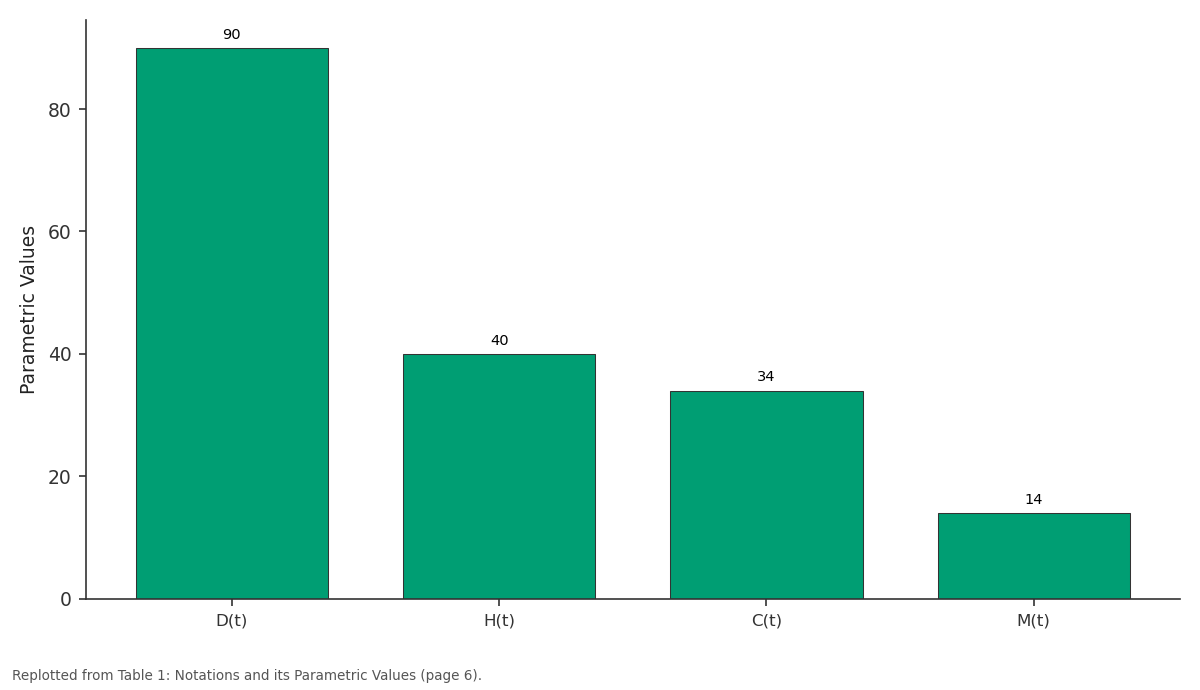
Parametric Values: D(t) vs H(t) vs C(t) vs M(t)
Replotted from Table 1 (page 6) of the original paper. Every bar is the paper's own table value.
View source evidence ↗Figures & tables
From the original paper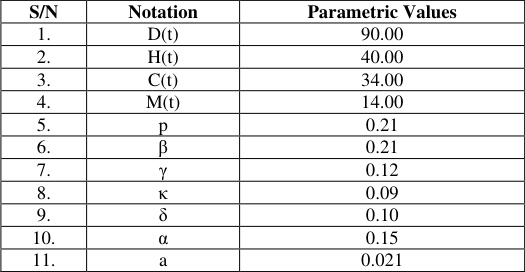 Table 1
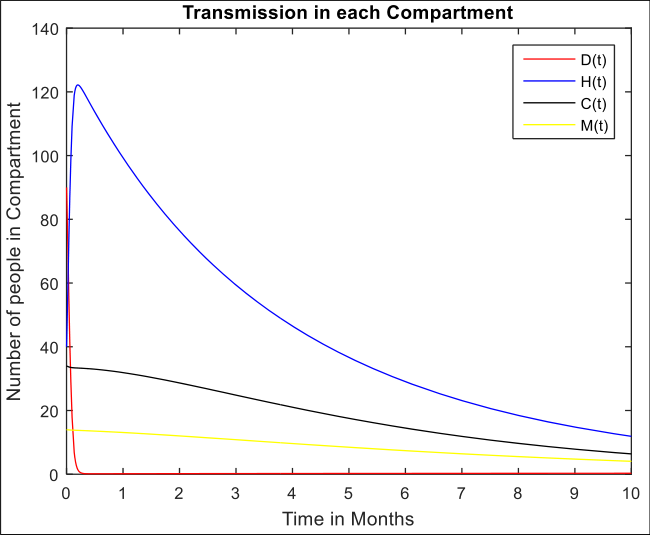 Figure 1
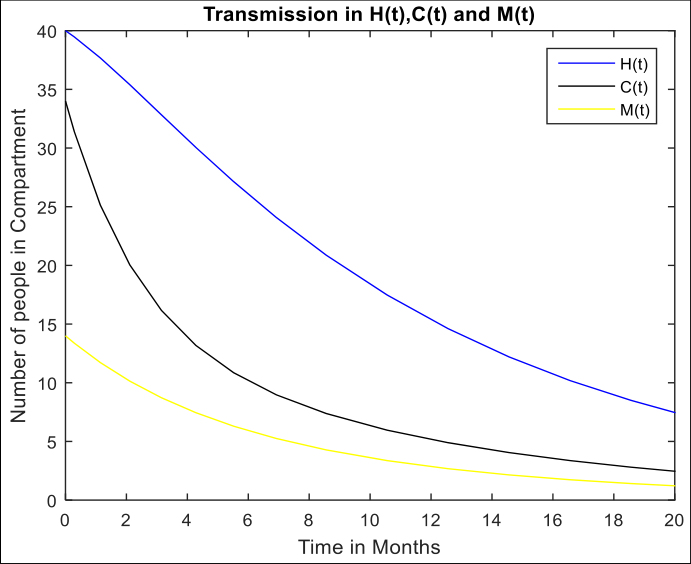 Figure 2
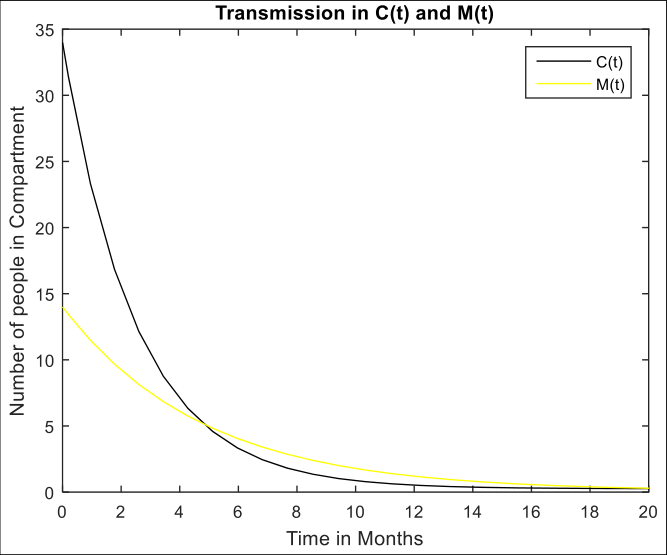 Figure 3
Introduction
Divorce according to the oxford dictionaries, is the legal dissolution of a marriage by a court or other competent body. Marriage, on the other hand is a socially or ritually recognized union between spouses that establishes rights and obligations between those spouses, as well as between them and any resulting biological or adopted children and affinity. Haviland et al. (2011) [1] In Ghana, divorce is frowned upon and seen as an element of culture diffusion; no ethnic group has been found to be in favor of divorce. Despite this, divorce cases in Ghana are very high. According to the Regional News of Thursday, 10 July 2014 on 'Ghana Web', six hundred and eighteen (618) customary marriages were dissolved as against a thousand five hundred and eleven marriages registered. The causes of these marriage dissolutions has been enumerated as infertility, financial problems, physical or emotional abuse, infidelity, and even alcoholism. The negative effects of divorce is enormous and a disadvantage to both parents and children. If parents consider all the negative effects of divorce, I believe the rate of divorce will reduce drastically. This paper is an improvement on 'Mathematical Model of Divorce Epidemic in Ghana' proposed by Gambrah and Adzadu (2018) [3] and "Divorce Transmission Model" by Gambrah, Abdul-Samad and Adzadu (2018) [6] . In this paper, we will analyze how counseling can decrease the rates of divorce similar to SEIR model. The mathematical model, notations along with its parametric values, basic reproduction number are formulated and discussed respectively in Section 2. Stability, where local and global stability are evaluated is in Section 3. Numerical analysis of the results is illustrated in Section 4. Section 5 is the Conclusion.
Mathematical Model
Here, we formulate a mathematical model for minimizing divorce through counseling using SEIR model. Below are the notations along with its description; D (t): Number of people who are divorced at some time t H (t): Number of people who are suffering from divorce related hardship/illness at some time t C (t): Number of people going for counseling at some time t M (t): Number of people who come back to marry at some time t P: New Recruitment Rate Β: Rate of people suffering due to divorce γ: Rate of people going for counseling due to divorce related hardship κ: Rate of people who get back to their hardship after counseling δ: Rate of people who get back to their divorce state after counseling α: Rate of people who get back to marriage after counseling a: Natural death rate Let N (t) denotes the sample size of the total population at some time t. Here, N (t) is divided into four compartments D (t), H (t), C (t) and M (t) which are described above. Thus, N
(t) = D (t) + H (t) + C (t) + M (t).
Below is the schematic diagram to minimize divorce through counseling.
People who are divorced (D) get into hardships like how to take care of the children, heartbreaks, emotional and physical distress and the like (H) at some stage of life which is defined by the rate β. Rate γ represents the individuals who go for counseling to get rid of this hardships. As, counseling does not ensure 100% remedial of this hardship, the rate k go back to the hardship stage. δ is the rate who again go back to the divorce stage after counseling and α is the rate who quits divorce after counseling. Here, new recruitment rate p and mortality rate a are assumed to be equal.
From the above, a set of non-linear differential equations for minimizing divorce through counseling has been constructed as;
In the system of equation ( 1), N (t) is constant so we assume that ( )
Also, as the M variable does not appear in any of the first three equations from the set of equations ( 1) we consider the following subsystem of equations;
Adding the above set of equations ( 2) we get
Now, we are interested in calculating the basic reproduction number which is to be calculated using next generation matrix method, Dikeman et al. (2010) [5] , Hethcote (2000) [8] , Heffernan et al. (2005) [7] and Van den Driessche et al. (2002) [9] . The next generation matrix method is defined as 1 FV where F and V are both Jacobian matrices of and v evaluated with respect to the people suffering from divorce related hardship (H) and the one joining counseling (C) at the point 0
denotes the rate of new divorce and () vX denotes the rate of transfer of divorce Which is given by ( ) 0 0
Now, the derivative of and v at divorce free equilibrium point E 0 gives matrices F and V of Order 33 defined as
Where v is non-singular matrix. Thus, the basic reproduction number R 0 which is the spectral radius of matrix
Stability Analysis
In this section, the local and global stability at E 0 and E * using the linearization method and matrix analysis are studied.
Local Stability
Theorem 3.1.1: (stability of E 0 ) If R 0 <1 then the divorce free equilibrium point E 0 of System (2) is locally asymptotically stable and if R 0 >1then it is unstable. Proof: At point E 0 , the Jacobian matrix of the system (2) is
The characteristic polynomial for the above matrix is
By Routh Hurwitz criteria, Allen (2006), if R 0 <1then it is locally asymptotically stable at E 0 and if R 0 >1then it is unstable.
Lemma 3.1.2: (stability of E * ) Let K be a real matrix of order 33 . If trace (K), det (K) and Det (K [1] ) <0 then all the eigen values of the matrix K have negative real parts.
Proof: On linearizing the set of equations ( 2
Now, the second additive compound matrix of * JE , which is given by
*
Hence, E * is locally asymptotically stable by above lemma.
Global Stability
Theorem 3. [2] , E 0 is globally asymptotically stable. Theorem 3.2.2: (stability of E * ) Consider a piecewise smooth vector field
Then, the system of differential equations
has no homoclinic loops, periodic solutions and oriented phase polygons inside
,, g g g g is a vector field such that
The alternate form of 12 , ff and 3 f are equivalent
So, the system (2) has no homoclinic loops, periodic solutions and oriented phase polygons in the interior of * Y .
Therefore * E is globally asymptotically stable in the interior of * Y .
Numerical Simulation
In this section, numerical results with their interpretation are described which will help us to know the impact of counseling for minimizing divorce. The table below will be used. Figure 1 shows that in the initial stage divorce decreases which means that, the hardship due to divorce is increasing simultaneously. This increase in hardship pushes the individual to go for counseling which is increasing in the first few months but this decreases and becomes stable after some months which implies that, it forces maximum number of people to marry, but as counseling decreases remarriage also decreases. Figure 2 shows that hardship caused due to divorce has made them adapt a way of moving from the divorce by going for counseling and this has proved to be successful because as time goes on all three goes to zero. Figure 3 shows that the impact of counseling is truly high to increase the number of people who go into marriage again.
Counseling has proven to played a vital role in minimizing divorce in our society
Conclusion
A mathematical model has been formulated as a system of nonlinear ordinary differential equations to study the impact of counseling on people who go for divorce. The systems were proven to be locally and globally asymptotically stable at both equilibrium points. A basic reproduction number has been calculated at a divorce free equilibrium point and is equal to 0.34508 which shows that with counseling, divorce will not be and epidemic in the society. Numerical Simulation was carried out to examine the results of the compartments which shows that hardship/stress due to divorce can earlier be minimize through counseling.
Figures and tables from the paper
| S/N | Notation | Parametric Values |
|---|---|---|
| 1. | D(t) | 90.00 |
| 2. | H(t) | 40.00 |
| 3. | C(t) | 34.00 |
| 4. | M(t) | 14.00 |
| 5. | p | 0.21 |
| 6. | β | 0.21 |
| 7. | γ | 0.12 |
| 8. | κ | 0.09 |
| 9. | δ | 0.10 |
| 10. | α | 0.15 |
| 11. | a | 0.021 |
Table text extracted from the original PDF; superscript letters are shown inline. The original table image is below.
View original table image
References
9 in the original paper- Haviland William A, Prins Harald EL, McBride Bunny, Walrath Dana. Cultural Anthropology: The Human Challenge (13th Ed.). Cengage Learning, 2011. ISBN 978-0-495-81178-7 https://en.oxforddictionaries.com/definition/divorce
- La Salle JP. The Stability of Dynamical Systems, Society for Industrial and Applied Mathematics, Philadelphia, Pa, 1976. https://doi.org/10.1137/1.9781611970432
- Gambrah PP, Adzadu Y. Mathematical model of divorce epidemic in Ghana International Journal of Statistics and Applied Mathematics. 2018; 3(2):395-401.
- Allen Linda JS. An Introduction to Mathematical Biology Pearson, Addison-Wesley, 2006. ISBN13 9780130352163
- Dikeman O, Heesterback JAP, Roberts MG. The construction of next generation matrices for compartmental epidemic models, Journal of the Royal Society Interface. 2010; 7(47):873-885.
- Gambrah PP, Abdul-Samad A, Adzadu Y. Divorce Transmission Model International Journal of Statistics and Applied Mathematics. 2018; 3(3):102-106. www.ghanaweb.com/GhanaHomePage/regional/Over-4-000-couples-divorce-316281
- Heffernan L, Smith R, Wahl L. Perspectives on the basic reproductive ratio, Journal of the Royal Society Interface. 2005; 2:281-293.
- Hethcote HW. The mathematics of infectious diseases, Society for Industrial and Applied Mathematics review. 2000; 42(4):599-653.
- Van den Driessche P, Watmough J. Reproduction numbers and sub-threshold endemic equilibria for compartmental models of disease transmission, Mathematical Biosciences. 2002; 180:29-48.