
Research article · 2018 · Full text
International Journal of Statistics and Applied MathematicsEffect of time dependent background temperature on slow waves in viscous coronal plasma
Volume 3(2) · Pages 178–184
Research areasSolar and Space Plasma DynamicsIonosphere and magnetosphere dynamicsTropical and Extratropical Cyclones Research
Abstract
Author-writtenWe study the effect of varying background temperature on small amplitude oscillations interpreted in terms of slow magneto hydrodynamic waves in solar coronal structures like prominences and coronal loops. We consider two damping mechanisms radiation and viscosity to study the behavior of slow MHD waves. We solve the MHD equations numerically to examine the effects of radiation and viscosity on velocity amplitude. It is found that amplitude of perturbed velocity decreases in case of increasing background temperature, whereas the perturbed velocity amplitude increases in case of decaying background temperature.
Summary
Source-checkedPlain-language reading of the full paper, prepared with AI and checked against the text. Each point links to the authors' own words.
Why it matters
- The solar atmosphere is a dynamic environment consisting of many magnetic structures that support various magnetohydrodynamic (MHD) waves. View evidence ↗
- Slow MHD waves in the solar corona are observed to undergo rapid damping, making the identification of the dominant damping mechanism a key area of research. View evidence ↗
- The primary theoretical and numerical damping mechanisms studied for these waves are viscosity, radiation, and thermal conduction. View evidence ↗
The question
- The study aims to investigate how slow MHD waves behave in an unbounded solar plasma where the background temperature changes over time, specifically considering radiation and viscosity as the damping mechanisms. View evidence ↗
What they did
- The researchers used numerical solutions of MHD equations to analyze the impact of radiation and viscosity on the amplitude of velocity. View evidence ↗
- The model incorporates compressive viscosity parallel to the magnetic field, defined as ν = 10−17 T 5/2 kg m−1 s−1. View evidence ↗
What they found
- Adding viscosity to the radiation damping mechanism further reduces the velocity amplitude, which enhances the overall damping of the waves. View evidence ↗
- The decrease in velocity amplitude is more significant when the characteristic time is lower. View evidence ↗
- The period of the slow wave decreases as the characteristic time increases, though the addition of viscosity does not change this period. View evidence ↗
- The amplitude of the perturbed velocity decreases when the background temperature increases and increases when the background temperature decays. View evidence ↗
- In cases of decreasing background temperature, the perturbed velocity amplitude increases more quickly for smaller characteristic times, and the wave period increases. View evidence ↗
What it means
- The authors conclude that increasing background temperature leads to a decrease in both the period and velocity amplitude of slow waves, an effect that is more pronounced at smaller characteristic times. View evidence ↗
- Conversely, the authors state that when the background temperature decreases over time, both the wave period and the perturbed velocity amplitude increase. View evidence ↗
Visual summary
1 visualsIllustrations explain the paper; they do not show study data.
Temperature Effect on Wave Amplitude
AI-generated conceptual illustration (viscous coronal plasma). It explains the idea and does not show study data.
View source evidence ↗Figures & tables
From the original paper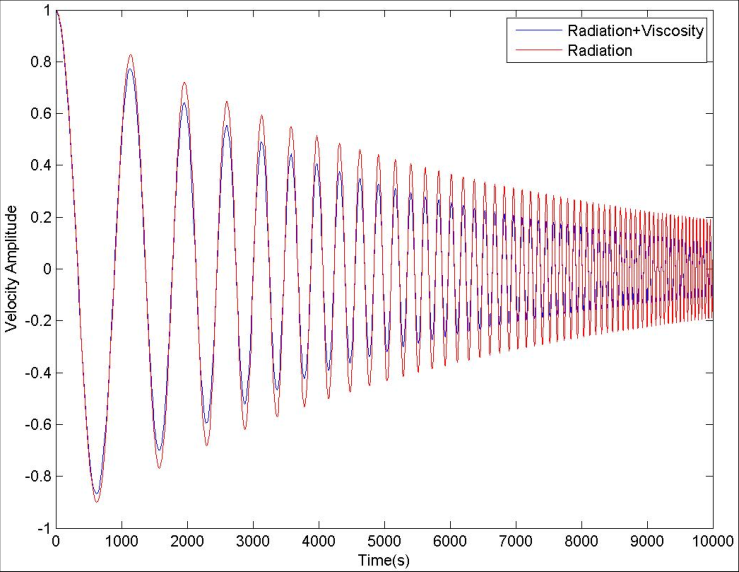 Figure 1
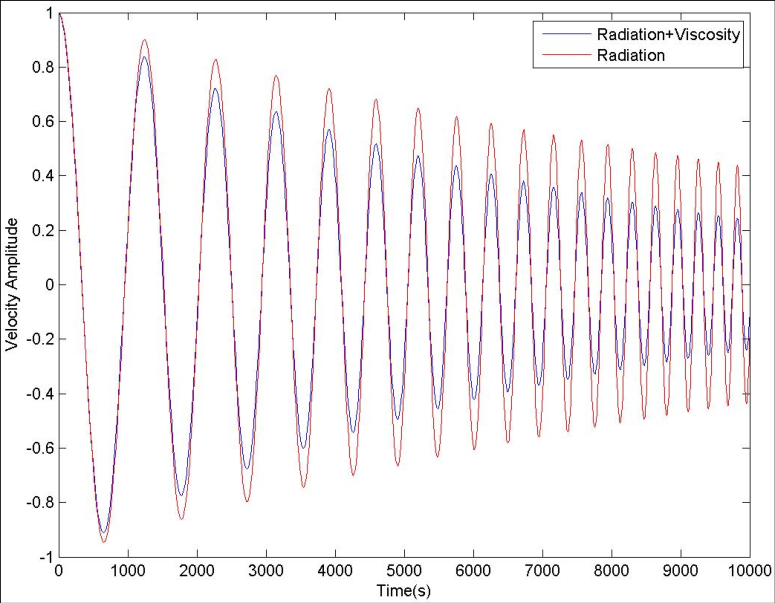 Figure 2
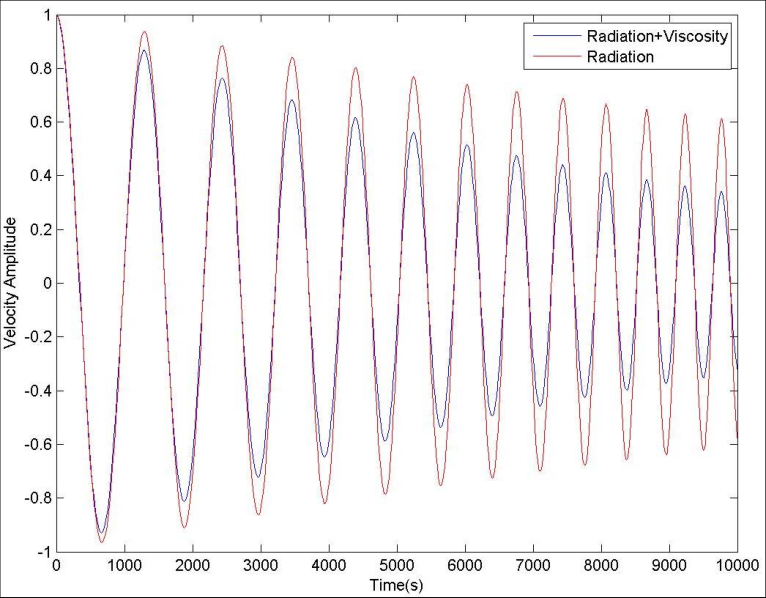 Figure 3
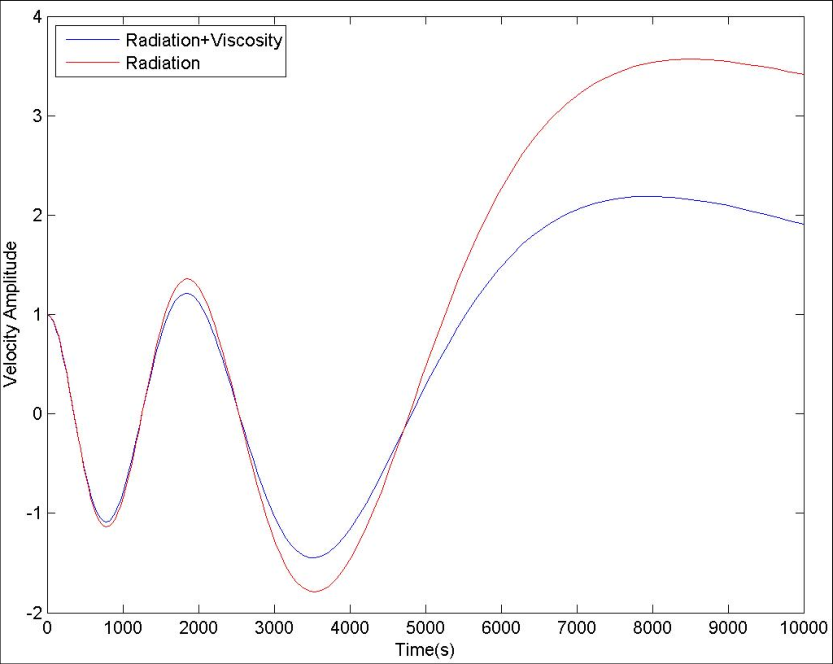 Figure 4
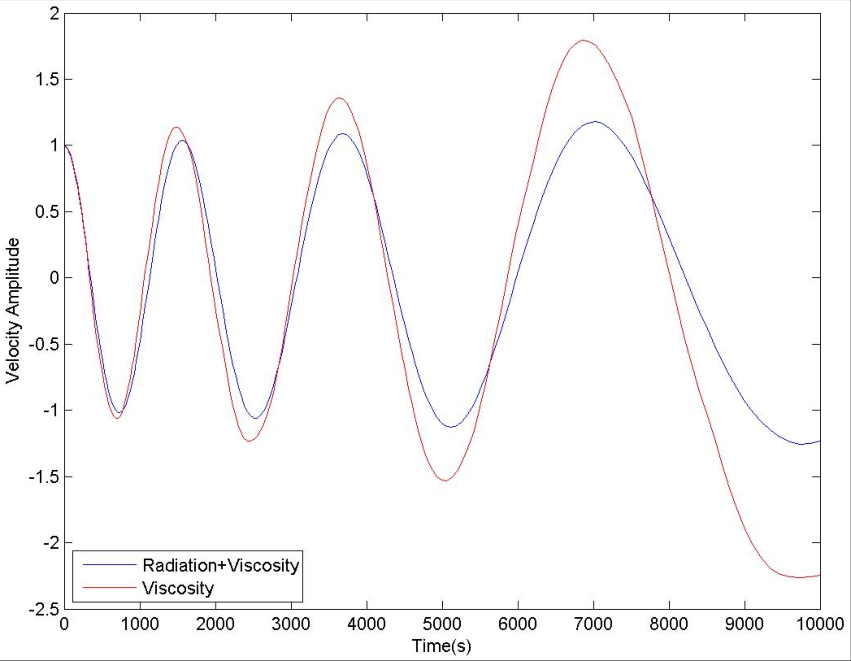 Figure 5
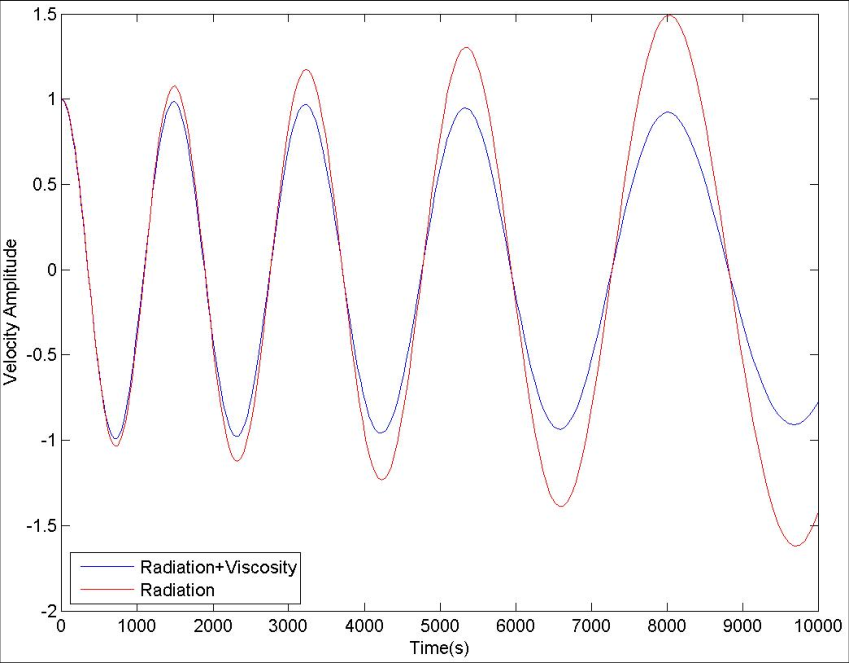 Figure 6
Introduction
Solar observations made by SUMER on board SoHO (Wang et al., 2002 [1] , 2003a [2] ) have shown that solar atmosphere is composed of numerous magnetic structures and is dynamic in nature. These structures support a wide range of magnetohydrodynamic waves. Small amplitude oscillations observed in solar coronal loops can be interpreted in terms of linear magnetohydyrodynamic waves (De Moortel et. al 2002) [3] . The propagating intensity disturbances that were interprated as slow manetoacoustic waves have been detected in polar plumes firstly by Ofman et al. (1997) [4] using UVCS on board SoHO. The slow (propagating and standing) MHD waves have been seen to suffer a rapid damping (De Moortel 2009 [5] , Wang et al. 2003a [2] , 2003b [6] ). The fast damping of slow MHD waves has become a subject of remarkable attention to find out dominant damping mechanism. Thermal conduction, radiation and viscosity are the most studied damping mechanisms theoretically as well as numerically. The damping of slow MHD waves in a homogeneous medium has been discussed by De Moortel and Hood (2003) [7] by taking into account thermal conduction and compressive viscosity as the damping mechanisms. Numerical simulation performed by Ofman and Wang (2002) [8] shows that thermal conduction is dominant damping mechanism for standing slow waves. In the absence the coronal heating, the plasma starts to cool by thermal conduction and radiation (Klimchuk., 2012) [9] . The effect of time dependent background temperature on standing slow MHD waves in hot coronal loop has been studied by Al-Ghafri and Erdelyi (2013) [10] . Recently, Ballester et al. (2016) [11] has studied the effect of a time dependent background temperature on prominence oscillations taking into account thermal conduction and radiative losses as damping mechanisms. The present study investigates the behavior of slow MHD waves in an unbounded solar plasma in which temperature varies with time. We consider viscosity and radiation as damping mechanisms for slow MHD waves. The paper is structured as follows: In section 2, the basic equations governing the plasma motion in the atmosphere of the Sun are described. In section 3, numerical results are obtained. We draw our conclusions in section 4.
The model and governing equations
The basic MHD equations that describe the background plasma motion are .( ) 0 t
and T denote the velocity, magnetic field, density, gas pressure and temperature respectively; R is gas constant, is mean molecular weight, is the ratio of specific heats and 0 is the magnetic permeability of free space. The symbol F represents the viscous force due to compressive viscosity taken to act along z-axis so that 4
(Ofman et al. 1994 [12] , Sigalotti et al. 2007 [13] Ofman and Wang 2002 [8] ), where ν = 10 -17 T 5/2 kg m -1 s -1 is the compressive viscosity that is, viscosity parallel to magnetic field (Hollweg 1985 [14] , Hood et al. 1989 [15] ).
encompassing radiation and heating terms and H r L respectively. The magnetic field is considered to be uniform and horizontal,
. Therefore the background state can be described as follows:
Following Ballester et al. (2016) [11] , we assume that radiation term is proportional to plasma temperature, 0 r L aT t and heating term is constant. Imposing 0i
T as the initial temperature, we obtain from equation ( 8)
is the characteristic time that governs the rate at which plasma temperature is changing.
Considering small perturbations from the equilibrium, the field quantities can be written as
where the subscripts "0" and "1" refer to equilibrium and perturbed quantities respectively. Taking into consideration the motion and propagation in the XZ plane, the linearised MHD equations are
As we aim to study slow waves, we will consider the perturbed velocity component 1z v , parallel wave number z k and 0 ( ) T t
only. Hence all perturbations can be expressed as
where 1 ( ) f t is time dependent amplitude of the perturbation. The linearised equations ( 10) to ( 15) become
(20) The above equations ( 17) -( 20) govern the slow waves propagating along the magnetic field.
Results
We solve equations ( 17)-(20) numerically by using the following set of parameters: We plot amplitude of perturbed velocity vs. time to study the combined effects of radiation and viscosity on the propagation on slow MHD waves in figures 1 to 6. In each figure combined effect of viscosity and radiation is compared with the effect of radiation alone.
Conclusions
In this paper, we have studied the propagation and damping of slow MHD waves propagating in solar coronal plasma with varying background temperature with time. Radiation and viscosity have been taken into account as damping mechanisms. The period of slow wave and velocity amplitude decrease with the increase in background temperature with time. The decrease in period and perturbed velocity amplitude is more prominent for smaller values of characteristic time . On the other hand, when background temperature decreases with time, both period and perturbed velocity amplitude increase with time. The period and perturbed velocity amplitude increase with the decrease in characteristic time .
Figures and tables from the paper
References
13 in the original paper- Wang TJ, Solanki SK, Curdt W, Innes DE, Dammasch IE. Doppler shift oscillations of hot Solar coronal plasma seen by SUMER: A signature of loop oscillations?, Astrophys. J. 2002; 574:L101-L104.
- De Moortel I, Ireland J, Hood AW, Walsh RW. The detection of 3 & 5 min period oscillations in coronal loops, Astron. Astrophys. 2002; 387:L13-L16.
- Ofman L, Romoli M, Poletto G, Noci G, Kohl JL. Ultraviolet coronagraph spectrometer observations of density fluctuations in the solar wind, Astrophys. J. 1997; 491:L111-L114.
- De Moortel I. Longitudinal waves in coronal loops, Space Sci. Rev. 2009; 149:65-81.
- De Moortel I, Hood AW. The damping of slow MHD waves in solar coronal magnetic fields, Astron. Astrophys. 2003; 408:755-765.
- Ofman L, Wang TJ. Hot coronal loop oscillations observed by SUMER: Slow magnetosonic wave damping by thermal conduction, Astrophys. J. 2002; 580:L85-L88.
- Klimchuk JA. The role of type II spicules in the upper solar atmosphere. J Geophys. Res. 2012; 117:A12102.
- Al-Ghafri KS, Erdélyi R. Effect of variable background on an oscillating hot coronal loop, Solar Phys. 2013; 283:413-428.
- Ballester JL, Carbonell M, Soler R, Terradas J. Prominence oscillations: Effect of a time-dependent background temperature, Astron. Astrophys. 2016; 591:A109.
- Ofman L, Davila JM, Steinolfson RS. Coronal heating by the resonant absorption of Alfven waves: The effect of viscous stress tensor, Astrophys. J. 1994; 421:360-371.
- Sigalotti L, Di G, Mendoza-Briceño CA, Luna-Cardozo M. Dissipation of standing slow magnetoacoustic waves in hot coronal loops, Solar Phys. 2007; 246:187-212.
- Hollweg JV. Viscosity in a magnetized plasma -Physical interpretation. J Geophys. Res. 1985; 90:7620-7622.
- Hood AW, van der Linden R, Goossens M. A formulation of non-ideal localized (or ballooning) modes in the solar corona, Solar Phys. 1989; 120:261-283.