
Research article · 2018 · Full text
International Journal of Statistics and Applied MathematicsA tri-neuron network model and bifurcation phenomenon with respect to synaptic weight and time delay
Volume 3(1) · Pages 335–339
Research areasNeural Networks and ApplicationsNeural Networks Stability and SynchronizationNeural dynamics and brain function
Abstract
Author-writtenWe consider a tri-neuron network model and calculate the condition of steady state stability of the equilibrium points analytically. We have also focused on investigating the conditions for single Hopf-Bifurcation with respect to synaptic weight and also the conditions for resonant co-dimension two bifurcations with respect to time delay.
Summary
Source-checkedPlain-language reading of the full paper, prepared with AI and checked against the text. Each point links to the authors' own words.
Why it matters
- Artificial neural networks (ANNs) are designed as information processing systems that mimic characteristics of biological neural networks. View evidence ↗
- To increase the realism of ANN models, it is necessary to include the processing time of individual neurons. View evidence ↗
- While delays can make networks more versatile, uncontrolled delays can degrade performance by making equilibrium unstable and preventing information retrieval. View evidence ↗
The question
- The study aims to analytically determine the conditions for the steady state stability of equilibrium points in a tri-neuron network model. View evidence ↗
- The researchers investigate the conditions for single Hopf-Bifurcation related to synaptic weight and resonant co-dimension two bifurcations related to time delay. View evidence ↗
What they did
- The authors use a system of delay differential equations to model a three-unit network, focusing on internal decay rate, self-connection strength, inter-neuron connection strength, and delay. View evidence ↗
- The model parameters include the activation state of three neurons, a positive decay rate (k), self-synaptic weight (β), inter-neuron synaptic weight (a), and axon transmission delay (τ). View evidence ↗
- The stability analysis is performed by linearizing the system around the trivial steady state (0, 0, 0). View evidence ↗
What they found
- The trivial equilibrium (0, 0, 0) is locally asymptotically stable for all delays (τ ≥ 0) if the decay rate k is greater than the sum of the absolute self-synaptic weight and twice the absolute inter-neuron synaptic weight (|β| + 2|a|). View evidence ↗
- The trivial equilibrium (0, 0, 0) is unstable for all delays (τ ≥ 0) if k is greater than (β + 2a). View evidence ↗
- The system undergoes a Hopf-bifurcation regarding synaptic weight at a critical value a₀, defined by specific surface equations involving decay rate, self-synaptic weight, and delay. View evidence ↗
- For a ring network model, if the self-synaptic weight β is greater than negative decay rate (-k), a single Hopf-bifurcation occurs with respect to the delay parameter near the origin. View evidence ↗
- A resonant co-dimension two Hopf-bifurcation occurs with respect to the delay parameter when the decay rate K falls between the minimum and maximum of {|β + a|, |β - a|}. View evidence ↗
What it means
- The authors conclude that they have successfully established criteria for stability and instability in a tri-neuron network with discrete time delay, regardless of the delay value. View evidence ↗
- The study explicitly identifies the parameter space where resonant double Hopf-Bifurcation occurs when time delay is the bifurcating parameter. View evidence ↗
Visual summary
1 visualsIllustrations explain the paper; they do not show study data.
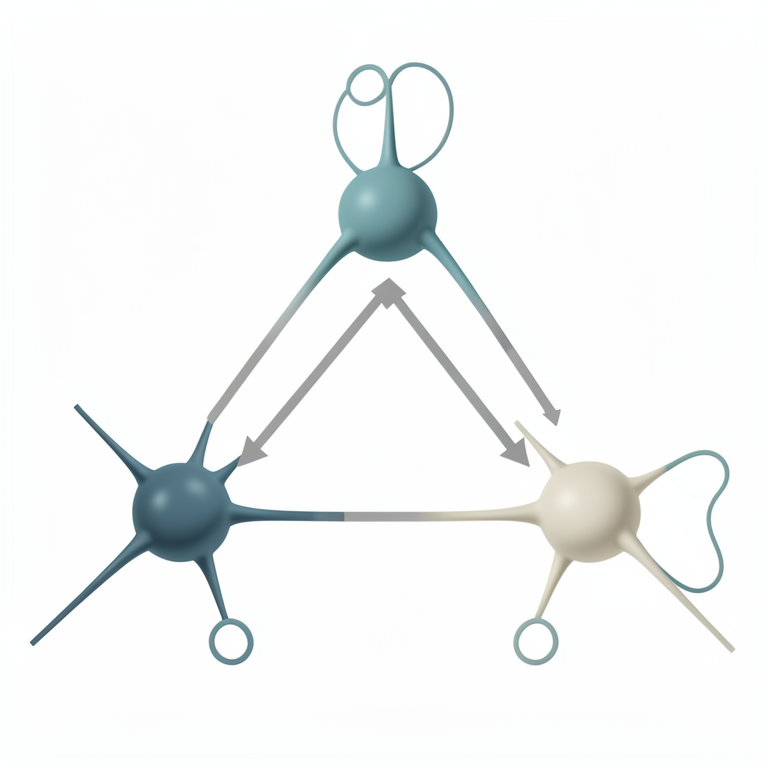
Tri-Neuron Network Structure
AI-generated conceptual illustration (three biological neurons in a network). It explains the idea and does not show study data.
View source evidence ↗Introduction
It is well known that the human brain is made up of large number of cells called neurons and their interaction. An artificial neural network is an information processing system that has certain characteristic in common with biological neural network. The neural network model occupies a unique and fascinating position in the development of human memory, which was proposed in 1980 by Hopfield, constructing a simplified model with electronic circuit implementation to store certain memories or patterns in a manner rather similar to our brain. Recently E. Bas et al. [2] consider the two most commonly used types of artificial neural networks are the multilayer feed-forward and multiplicative neuron model ANNs. In this paper they to evaluate the performance the proposed method to the well known real world time series datasets and also a simulation study is performed. The algorithm has superior performance both when it is applied to real world time series datasets and the simulation study when compared with other ANNs reported in the literature. Another of its advantages is that, for datasets with outliers, the results are very close to the results obtained from the original datasets. They also demonstrate that the algorithm is unaffected by outliers and has a robust structure. F. Mesiti et al. [3] shown that the intracellular calcium dynamics of atrocities is a critical process with significant impact on the regulation of the neural activity. In a tripartite synapse the atrocity of the cell actively interacts with the neural response of adjacent presynaptic neurons providing a feedback which is believed to regulate several brain processes. They investigated the special link between neuron and glia-cells from the mathematical and electronic point of view, providing an alternative representation of the glia-neuron system. Main gliotransmitters are glutamate ATP, D-serine and adenosine S. Paixao et al. [4] which have direct impact on adjacent neurons equipped with compatible receptors located on the cell membrane. Glutamate is one of the most important abundant neurotransmitter in the brain and neurons have several types of glutamate sensitive receptors such as AMPAR and NMDAR and mGluR metabotropic glutamate receptors. In [5] the authors described the communication between neurons in terms of input or output blocks with the purpose of nano machine neuron communications. A more theoretical analysis of multiple inputs single out put synaptic communications has been described in [6] , where as a block description of the neuronal process accounting for the stochastic release of neurotransmitters has been proposed in [7] with an extension to the tripartite synapse proposed in [8] . Successful attempts in using intercellular calcium signaling to establish a communication channel for neuronal applications have been reported by Nakano et al. in [9] . To our knowledge no other existing investigations in the engineering of neuronal communication systems have consider the active presence of the atrocyte.
Other authors [1,12] have found that crushed brick aggregate concrete has a relatively lower strength at early age than normal aggregate concrete. They attributed this characteristic to the higher water absorption of crushed brick aggregate compared to gravel, which was used as the control aggregate. The compressive strength is lower for crushed brick concrete; the higher the rate of substitution normal aggregate with brick, the lower the compressive strength. The use of bricks as concrete aggregate caused a 40% reduction in compressive strength [13,14] . Concrete produced with these aggregates did not perform as well as concrete produced with natural aggregates in terms of strength. Strength properties of specimens with crushed brick aggregate are lower compared to the same properties for the reference mixtures with natural aggregate. Results of experimental investigations in [15] revealed lower compressive strength of concrete with recycled brick aggregate. These results are expected due to the lower grain hardness of a crushed brick/tile aggregate compared to a river aggregate Moreover, our approach can provide further tools for design and implementation of biomimetic devices mimicking the behavior of neurons and atrocyte at micro and nano scale as well as for the implementation of innovative biomedical tools for the stimulation of neurons at nanoscale, as envisioned in [10,11] . In modeling ANN it is necessary to incorporate the processing time of each neuron to make the model more realistic. In the past two decades the analysis of stability of steady states for different classes of neural networks with or without time delays such as additive neural networks, cellular neural networks, bi-directional neural networks has been extensively investigated. In some artificial neural network information is store as stable equilibrium points of the system. Retrieval occurs when the system is initialized within the basin of attraction of one of the equilibrium and the network is allowed to stabilize in its steady state. Delay may render such works more versatile. Nevertheless uncontrolled delays may degrade network performance by rending the equilibrium unstable and makes the retrieval of the corresponding information impossible. Thus delay is an important parameter in neural system.
Mathematical formulation of the model
Here we consider a three unit network model by the following system of delay differential equations in a parameter space consisting of internal decay rate, self connection strength, connection strength of one neuron to other and delay; is the activation state of neuron i(i=1, 2, 3) at time t, k>0 is the decay rate of neurons, 0 is self synaptic weight, a is the weight of synaptic connections from one neuron to another, 0 corresponds to the transmission delay along the axon.
Schematic representation of three neurons model:
The fundamental questions we would like to answer in order to understand the behavior of a model with time delays are the following: i. What equilibrium solutions occur in the system? ii. Are these stable or unstable? iii. Whether periodic solutions occur in the system? iv. How do the answers to these questions change as parameter s like synaptic weight, delay parameter is varied? v. Whether the theoretical results can be validated by numerical example?
Steady state and stability analysis
Obviously (0, 0, 0) is the trivial steady state of the system (2). Linear zing (2) about (0, 0, 0) it gives
and ∆ . We get the following theorem,
| then trivial equilibrium (0, 0, 0) of ( 3) is locally asymptotically stable for all 0. (ii) If 2 then trivial equilibrium (0, 0, 0)of ( 3) is unstable for all 0. Now we are interested to analyze the bifurcation phenomenon considering synaptic weight a between two neurons as bifurcating parameter. As the parameters are varied the stability may be lost if a real root of the characteristic equation ( 4) passes through the origin or by a pair of complex conjugate roots passing through imaginary axis. The former occurs if 0 in equation (4) implying or 2 , which can lead to the static bifurcation of the equilibrium points change as the bifurcation parameter very. The later deals with the Hopf-bifurcation such that the dynamical behavior of the system changes from a static stable to a periodic motion or vice-versa. Let us assume or 2 . In this section we are interested in Hopf-bifurcation of trivial solution considering the synaptic strength an as bifurcating parameter. Let at a= characteristic equation ( 4) has a simple pair of purely imaginary root , that is ∆ )=0. This yields the following equations: 2 =0 and 2 =0. Substituting the values of and obtaining above in ∆ ` and ∆ ` it can be shown that at a= , is a simple root of the characteristic equation. Now differentiating both side of the characteristic equation with respect to a and substituting = for it is obtained as Re( ) 0.Therefore we have the following theorem:
Theorem 2
For given k, , if at all the rots of the characteristic (4) have negative real parts except the pair of purely imaginary ones then the system (3) undergoes Hopf-bifurcation with respect to synaptic weight at where lies on the surface: 2 =0 and 2 =0, . It is possible to show that the presence of points (bifurcating parameter) at which the characteristic equation has two pairs of purely imaginary roots , . As such points are commonly occurring where curves of Hopf-bifurcation cross, these points are referred to as points of resonant double Hopf-bifurcation. If : = : then a possible double Hopf-bifurcation point appears with frequencies in the ratio : . If , ∈ and then such a point is called : resonant double Hopfbifurcation point. To study the resonant double Hopf-bifurcation let us consider a special three neurons ring network with discrete delay describe by the following system of equations: Obviously (0, 0, 0) is the trivial steady state of the above equation. Linear zing above equation about (0, 0, 0) it gives ……………….. (
The corresponding characteristic equation is ( 0, ⟹ 0 where (λ)= (λ)= (λ)= . Therefore either 0 or 0. Now we consider the following two cases:
Conclusion
In this paper we have analyzed a neural network model composed of three identical neurons with discrete time delay. We first obtained in the result (1) the criteria under which no change in stability and instability occur for all the values of delay. We have also focused on investigating the conditions for single Hopf-Bifurcation with respect to synaptic weight and also the conditions for resonant co-dimension two bifurcations with respect to time delay. In the result (2) condition for single Hopf-Bifurcation with respect to synaptic weight (a). Again we have studied the periodic and stability of such Hopf-Bifurcating periodic solution when the value of the synaptic weight passes a critical values . Lastly the parameter space is explicitly found, where the resonant double Hopf-Bifurcation with time delay as bifurcating parameter occurs.
References
15 in the original paper- Milicevic I. Fire resistance of concrete with crushed bricks and roof tiles PhD Thesis, Faculty of Civil Engineering Osijek, University J.J. Strossmayer Osijek, 2014.
- Bas E, Vedide R, Uslu E. Egrioglu. Robust learning algorithm for multiplicative neuron model artificial neural networks. Expert Systems With Applications. 2016; 56:80-88.
- Mesiti F, Veletic M. Astrocyte-neuron communication as cascade of equivalent circuits. Nano communication networks 2015; 6:183-197.
- Paixao S, Klein R. Neuron-astrocyte communication and synaptic plasticity, Curr.opin.Neurobiol. 2010; 20(4):466-473.
- Galluccio L, Palazzo S, Santagati GE. Modeling signal propagation in nanomachine to neuron communications. Nano commun. Netw. 2011; 2(4):213-222.
- Malak D, Kocaoglu M. Communication theoretic analysis of the synaptic channel for cortical neurons. Nano Commun.Netw. 2013; 4(3):131-141.
- Veletić M, Floor PA, Balasingham I. From nano-scale neural excitability to long term synaptic modification, in: Nanoscale Computing and Communication, NANOCOM' 14, ACM, New York, NY, USA, ISBN: 978-1-4503-2979-8, 2007; 22:1-22:9.
- Veletić M, Mesiti F, Floor PA, Balasingham I. Communication theory aspects of synaptic transmission, in: IEEE ICC 2015 - Nanoscale, Molecular and Quantum Networking, in press, 2015.
- Nakano T, Suda T, Koujin T, Haraguchi T, Hiraoka Y. Molecular communication through gap junction channels: System design, experiments and modeling, in: Bio-Inspired Models of Network, Information and Computing Systems, Bionetics 2007, second ed., IEEE, 2007, 139-146.
- Mesiti F, Balasingham I. Nanomachine-to-neuron communication interfaces for neuronal stimulation at nanoscale, IEEE J. Sel. Areas Commun. (ISSN: 0733-8716) 2013; 31(12):695-704.
- Mesiti F, Balasingham I. Correlated neuronal activity in networks of neurons stimulated with nanomachines, in: Proceedings of ACM The First Annual International Conference on Nanoscale Computing and Communication, ACM, 2014, 1-5.
- Khalaf FM, DeVenny AS. Recycling of demolished masonry rubble as coarse aggregate in concrete: review, J. Mater. Civ. Eng. 2004; 16:331-340.
- Rühl M, Atkinson G. The influence of recycled aggregate concrete on stressstrain relation of concrete, Darmstadt Concr. 26 1999; (14):36-52.
- Khatib JM. Properties of concrete incorporating fine recycled aggregate, Cem. Concr. Res. 2005; 35:763-769.
- Poon CS, Chan D. The use of recycled aggregate in concrete in Hong Kong, Resour. Conserv. Recycl. 2007; 50(3):293-305.