
Research article · 2018 · Full text
International Journal of Statistics and Applied MathematicsAnalytical study on financial investor on investment decision making
Volume 3(3) · Pages 01–05
Research areasIslamic Finance and Banking StudiesStock Market Forecasting MethodsFinTech, Crowdfunding, Digital Finance
Abstract
Author-writtenThe changing situation of financial markets, financial products and services innovations through financial building, developments in data and correspondence innovation, multifaceted highlights engaged with the heap of financial products, the speed with which financial markets and new financial instruments have risen and/or number of establishments go into the financial market with the more perplexing products, changes in the annuity course of action, increment in the future and the part of innovation progresses in advertising and conveying the financial products and/or services in the financial services industry, don't just give more decisions to purchasers, yet in addition difficulties to understand the advantages and expenses related with the innovations, and all the more particularly, the hazard return grid innate to every advancement and henceforth, leave numerous people not well outfitted to adapt up to the complex decisions that they have to make, for astute sparing and speculation choices. Instruction may assume an imperative part in outfitting the people with principal learning and abilities required to assess and pick the best choices as far as financial products and/or services and suppliers as well and to distinguish those that best suit iv their necessities and conditions. This might be particularly valid for the populace which has been traditionally underserved by the financial framework.
Summary
Source-checkedPlain-language reading of the full paper, prepared with AI and checked against the text. Each point links to the authors' own words.
Why it matters
- Low levels of financial literacy prevent individuals from making wise decisions regarding their financial options. View evidence ↗
- Increased longevity and a reduced government safety net mean individuals must be more responsible for planning their own retirement and insurance. View evidence ↗
The question
- The study aims to investigate the level of financial literacy among investors in the state of Gujarat. View evidence ↗
What they did
- The researcher employed exploratory and descriptive research design techniques. View evidence ↗
- A non-probability convenience sampling technique was used to select participants. View evidence ↗
- The study sample consisted of 100 financial investors located in Gujarat. View evidence ↗
- Financial literacy was measured using a 50-question test, consisting of 20 basic and 30 advanced questions. View evidence ↗
What they found
- A majority of the investors demonstrated a low level of financial literacy, indicating a lack of understanding of investment fundamentals. View evidence ↗
- The study found that females had a lower level of financial literacy compared to males. View evidence ↗
- Investors at the age extremes, those aged 18 to 35 and those 56 and older, showed lower levels of financial literacy. View evidence ↗
- Respondents in lower income brackets were found to have lower levels of financial literacy. View evidence ↗
- Higher financial literacy was associated with higher monthly income, more years of investment experience, and a higher frequency of seeking information before investing. View evidence ↗
- For most investors, the primary goals for investing are tax savings and meeting unexpected financial needs. View evidence ↗
What it means
- The author concludes that education is essential for providing people with the skills needed to evaluate and choose the best financial products and services. View evidence ↗
Figures & tables
From the original paper Figure 1
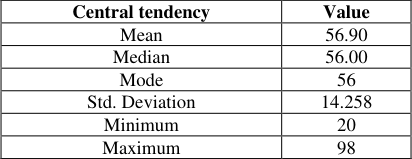 Table 1
Introduction
The development and development of the Indian economy and the extension of financial markets through progression, privatization and globalization have given a route to a plenty of financial products either as a speculation elective or a credit one. However, then again, financial illiteracy or low level of financial literacy keeps the people from settling on a judicious decision with respect to his/her financial choices. Therefore, the people are not ready to pick the most reasonable venture elective which can beat the rate of expansion winning in the economy and give them a net constructive return.
Requirement for contemplate
Financial literacy has turned out to be progressively vital over the previous decades. There is a developing conviction that the individual would need to wind up more confident later on. Expanded competition and more unpredictable products in the financial services industry leave numerous individuals badly furnished to adapt to the advanced decisions they may need to make. Contrasted with the past ages, there is currently a wide assortment of ways people create and arrange their wage. The adjustments in work life over the world are implied that the pay stream of people has turned out to be more conflicting. The changing universe of work has made a conflicting salary over a long stretch. There are times of high wage took after by low level of wage or no wage by any stretch of the imagination. In the meantime, individuals are living longer and they have to make a more noteworthy arrangement for retirement, social insurance and protections to cover flighty inevitabilities, where government/state is not any more ready to give the kind of security net that was accessible before. Given this, people must have essential aptitudes to settle on appropriate financial choices to empower them to be more responsible for their own conditions and have a safe financial future.
Literacy
Literacy has traditionally been depicted as the capacity to peruse and compose. It is an idea asserted and characterized by a scope of various hypothetical fields. The primary globally concurred meaning of literacy was given in 1958 by The United Nations Educational, Scientific and Cultural Organization (UNESCO). This definition has advanced in 2003, when UNESCO proposed an operational definition that endeavored to include the few distinct measurements of literacy. It had characterized literacy as a-ability to distinguish, understand, translate, make, convey, process and utilize printed and composed materials related with shifting settings. Literacy includes a continuum of learning in empowering people to accomplish their objectives, to build up their insight and potential and to take part completely in their group and more extensive society.
Importance of financial literacy
The importance of financial literacy is acknowledged when it is placed in the point of view of the accompanying developments in the financial space: 1. Financial products and services development: 2. Changing situation of the residential financial markets: 3. Multifaceted highlights of financial products: 4. Increase out of a person's obligation: 5. Increase in the future, changes in annuity assention and exchange of hazard: 6. Technological changes and market innovations:
Outcomes of financial illiteracy
As talked about above, to adapt up to the financial products and services innovations, changing situation of the local financial markets, multifaceted highlights of financial products, increment in a person's obligation, increment in the future, changes in annuity assention and exchange of hazard and mechanical changes and market innovations, each individual should be financially proficient. Said that-financial literacy should be installed in our lifestyle. Everybody who gains a wage is a potential saver; each saver is a potential speculator; each financial specialist should be financially proficient.
Indian Financial Systems
Financial frameworks are of essential centrality of capital development. It needs no emphasis that sufficient capital arrangement is vital to a fast monetary development and development. The fundamental capacity of capital markets the gathering of reserve funds and their dispersion for modern venture, in this way fortifying the capital development and, to that degree, quickening the procedure of financial development. The procedure this capital arrangement includes three unmistakable, in spite of the fact that between related exercises. 1. Savings: The capacity by which cases to assets are put aside and wind up accessible for the other reason. 2. Finance: The action by which cases to assets are either collected from those discharged by residential funds, got from abroad, or extraordinarily made as a rule as bank stores or notes and then set in the hands of financial specialists. 3. Investments: The movement by which assets are really dedicated to creation.
The volume of capital arrangement relies on the force and effectiveness with which these exercises are gone ahead. The viable assembly of funds, the proficiency of the financial organization and the channelization of these reserve funds into the most alluring and profitable types of speculation are all between associated and have an incredible bearing on the commitment of capital arrangement to the monetary development. Their pertinence to the funds speculation process is gotten from what is called exchange process.
Importance of financial literacy
The importance of financial literacy is acknowledged when it is placed in the point of view of the accompanying developments in the financial space:
1. Financial products and services advancement: 2. Changing situation of the household financial markets: 3. Multifaceted highlights of financial products: 4. Increase out of a person's obligation: 5. Increase in the future, changes in pension agreement and exchange of hazard: 6. Technological changes and market innovations:
Consequences of financial illiteracy
As talked about above, to adapt up to the financial products and services innovations, changing situation of the household financial markets, multifaceted highlights of financial products, increase in a person's duty, increase in the future, changes in pension agreement and exchange of hazard and technological changes and market innovations, each individual should be financially educated. Said that-financial literacy should be installed in our lifestyle. Everybody who acquires a pay is a potential saver; each saver is a potential speculator; each speculator should be financially proficient.
Indian Financial Systems
Financial systems are of vital centrality of capital arrangement. It needs no emphasis that sufficient capital arrangement is key to a rapid monetary development and development. The fundamental capacity of capital markets the gathering of savings and their appropriation for mechanical speculation, thereby animating the capital arrangement and, to that degree, quickening the procedure of financial development. The procedure this capital development includes three unmistakable, despite the fact that between related exercises. 1. Savings: The capacity by which cases to assets are put aside and end up accessible for the other purpose. 4. To study the contrast between inclinations for the chose enlightening factors and their impact on speculation choice under study. 5. To study the connection between financial literacy level of speculators and their month to month use to month to month salary proportion of speculators.
Research Methodology
Research methodology is an approach to methodicallly tackle research issue. An arrangement of models, strategies and techniques used to discover the aftereffect of a research issue is known as Research Methodology.
Research Design
Research design is a course of action of information accumulation and examination of information in a way that intends to consolidate importance to the research purpose. It is a blue print for the accumulation, estimation and investigation of information. For this study Exploratory and Descriptive research design techniques have been utilized, wherein researcher has investigated the financial literacy level of speculators and then portrayed the effect of financial literacy level on venture choice of financial specialists. Both the kinds of wellspring of information essential and optional were utilized. The information gathering technique is examined in detail in the accompanying areas.
Sampling Design
Sampling design is a clear arrangement for acquiring a sample from a given populace. Sampling design implies a strategy, chose before the review is attempted, of choosing the items out of the universe. It alludes to the technique or the methodology a researcher receives in choosing a sample and the sample size.
Sampling Technique
Sampling techniques are extensively isolated into two gatherings as likelihood sampling techniques and nonlikelihood sampling techniques. For the present study, nonlikelihood helpful sampling technique is picked. In helpful sampling technique, the researcher picks the sampling units according to his/her accommodation.
Sample
For this study sample is an Individual.
Sample Size
Add up to sample size of 100 financial specialists in the territory of Gujarat is considered for the study. Amid information gathering, legitimate care was taken to gather the information such that it covers the whole territory of Gujarat.
The legitimization for sample size assurance is given underneath. Following recipe can be utilized to decide sample size
Where, N = Sample Size Z = Z value from the standard normal distribution for the certainty level wanted by the researcher. For this study, the researcher has accepted 95 percent certainty level. Then from the standard distribution tables, the Z value is 1.96. p = Frequency of event of something communicated as extent (0.50).
Information gathering
For this study both essential and optional information sources are utilized
Optional Data
To get knowledge into the research region and to build up the theoretical system and hypotheses, the data was gathered from different books, magazines, diaries, daily papers, sites, research ventures, reports distributed by Government and private research firms at national and universal level.
Addresses and addresses of officials of different legislative experts and arrangement producers around the globe were additionally utilized as optional information sources.
Essential Data
A point by point Performance Test and Questionnaire were arranged and directed on speculators in the State of Gujarat.
With the assistance of these, individual (up close and personal) meetings of the respondents were performed, due to the benefits of this technique over other strategies. By individual talking, the researcher gets some other data relating to the respondent. Once in a while, if the respondent has any question/question, it can be followed by the researcher or questioner.
Research Instrument
The study was produced to research the financial literacy level of speculators and its effect on venture choice. To serve this target, the research instrument was isolated into four segments. The subtle elements of which are talked about in the following area.
Analysis of Financial Literacy
The top to bottom clarification for methodology used to quantify the financial literacy level of respondents for display study is given in paper. Following this, to quantify the financial literacy of respondents, speculator/respondent's aggregate score was ascertained as the level of right answers, by endeavoring the aggregate 50 questions. Out of these, fundamental financial literacy comprised of 20 addresses and progressed financial literacy comprised of 30 questions. The middle level of right answers of the sample was considered to outline financial literacy level and/or to characterize the subgroups. The respondents with scores above middle are considered as respondents with higher financial literacy and thus delegated higher financially educated and respondents with measure up to and/or beneath middle are considered as respondents with generally bring down level of financial literacy and consequently named bring down financially proficient.
Conclusion
In view of information analysis a few conclusions are introduced as under.
All the respondents have stopped their savings in different speculation choices, however greater part of the respondents (speculators) have bring down level of financial literacy. This demonstrates every one of the financial specialists don't understand the fundamentals of investments and its count. From the analysis of financial literacy questions, it is additionally discovered that the lion's share speculators are less financially proficient on some of subjects of essential financial literacy and progressed financial literacy and even some of them don't understand the imperative ideas by any stretch of the imagination. With respect to statistic and financial profile of respondents and financial literacy, it was discovered that females have bring down level of financial literacy, as 317 contrasted with guys. It was likewise discovered that financial specialists based on two extremes of age i.e. 18 to 35 years and 56 years and above have a lower level financial literacy. Based on month to month wage gathering of respondents, it is discovered that the respondents falling under lower wage bunches have a lower level of financial literacy. It is likewise inferred that for respondents with higher month to month wage, higher number of years of speculation encounter, and the individuals who look around most extreme number of times/influence greatest number of request while contributing, to have nearly more elevated amount of financial literacy than others. With respect to venture objective, for dominant part of speculators (respondents), the primary venture objective is sparing of pay assessment and meeting sudden financial needs.
Recommendations
Increase in the future, changes in pension agreement and exchange of hazard, increase in a person's obligation, financial item and services Innovation, globalization, privatization and deregulation of financial services industry, multifaceted highlights of financial products, technological changes and market innovations have looked for the consideration of instructors, group gatherings, organizations, government offices, organizations, non-government organizations, approach creators and administrative specialists.
Figures and tables from the paper
| Central tendency | Value |
|---|---|
| Mean | 56.90 |
| Median | 56.00 |
| Mode | 56 |
| Std. Deviation | 14.258 |
| Minimum | 20 |
| Maximum | 98 |
Table text extracted from the original PDF; superscript letters are shown inline. The original table image is below.
View original table image
References
13 in the original paper- Della Vigna S. Psychology and Economics: Evidence from the field. Journal of Economic Literature. 2009; 47(2):315-372.
- Glaser M, Noth M, Weber M. Behavioural finance. In D. J. Koehler & N. Harvey (Eds.), Blackwell Handbook of Judgment & Decision Making, Oxford: Blackwell, 2004, 527-546.
- Singh M. Forward', Eleventh Five Year Plan 2007-2012, Inclusive Growth, 1, planning commission, government of India, New Delhi, India: Oxford University Press, 2008, iii.
- Planning Commission. Tenth Five Year Plan 2002-2007, Sectoral Policies and Programmes, New Delhi, India. 3 Ibid, 15. 2003, 2.
- Oleson M. Exploring the relationship between money attitudes and Maslow's hierarchy of needs. International Journal of Consumer Studies, 2004, 28, 83-92.
- Hira TH, Fanslow AM, Titus PM. Changes in financial status influencing level of satisfaction in households' Lifestyles. Family and Economic. 1989; 10:107-121.
- Ahuvalia MS. Speech at launching of the book-How India Earns, Spends and Saves‖, launched by Deputy Chairman, Planning Commission, Government of India, Montek Singh Ahluwalia, February 6, New Delhi, 2006.
- Beal DJ, Delpachitra SB. Financial literacy among Australian university students, Economic Papers. 2003; 22(1):65-78.
- UNESCO Educational Sector. The Plurality of Literacy and its implications for policies and programs: Position Paper. [Monograph on the Internet]. France: United Nations Educational Scientific and Cultural Organization. Retrieved January 30, 2010 from, 2004. http://unesdoc.unesco.org/images/0013/001362/136246e. pdf. 10
- The National Literacy Act of, Public law 102-73, 105 Stat. 333, 1991.
- Goody Jack. The logic of writing and the organization of society. New York: Cambridge University Press. 0521327458. Location: Dallas SIL Library 303.4 G658, 1986.
- Burnet M. ABC of Literacy, Paris: United Nations, 1965.
- Carolyne LJM, Richard MSW. Conceptualizing financial literacy. Business School Research, 7, Loughborough University, 2000, 1-40.