
Research article · 2018 · Full text
International Journal of Statistics and Applied MathematicsModeling and analysis of a resource population due to increase in industrialization
Volume 3(2) · Pages 557–563
Research areasSustainability and Ecological Systems AnalysisInnovation Diffusion and ForecastingEconomic and Technological Systems Analysis
Abstract
Author-writtenIn this paper, a non-linear mathematical model is proposed and analyzed to study the effect of rapid increase in industrialization produced by the human species affecting its own living resources and depleting the environment. It is shown that if the rate of industrialization increases, the density of the biological species settles down to a lower equilibrium than its original carrying capacity and its magnitude decreases as the equilibrium level of concentration of it increases. It may be noted that for very large increase in this field of development, the survival of the biological species is threatened.
Summary
Source-checkedPlain-language reading of the full paper, prepared with AI and checked against the text. Each point links to the authors' own words.
Why it matters
- Resource-dependent populations can be negatively impacted when industrialization depletes the resources they rely on. View evidence ↗
- The impact of human activities and resource usage patterns on resource composition has been a subject of study by various researchers. View evidence ↗
- Biological species are typically affected by toxicants through pathways such as food chains or direct uptake from the environment. View evidence ↗
The question
- The study aims to propose and analyze a model for the survival of a resource-dependent population when its resource biomass is depleted by industrialization driven by a population precursor. View evidence ↗
What they did
- The model assumes that the density of the biological species and the resource biomass follow a generalized logistic equation with variable carrying capacity and intrinsic growth rate. View evidence ↗
- A key assumption of the model is that industrialization reduces the carrying capacity of the resource density within the habitat. View evidence ↗
- The model assumes the rate of industrial increase is proportional to the density of the population that produces it. View evidence ↗
What they found
- Increasing rates of industrialization cause the biological species density to settle at an equilibrium level lower than its original carrying capacity. View evidence ↗
- The magnitude of the species density decreases as the equilibrium concentration level of industrialization increases. View evidence ↗
- The equilibrium level of the resource biomass is reduced as industrialization increases. View evidence ↗
- Very large increases in industrial development threaten the survival of the biological species. View evidence ↗
What it means
- The authors conclude that large-scale industrialization introduces toxicants and waste into the environment, creating a possibility of species extinction over the long term. View evidence ↗
Visual summary
1 visualsIllustrations explain the paper; they do not show study data.
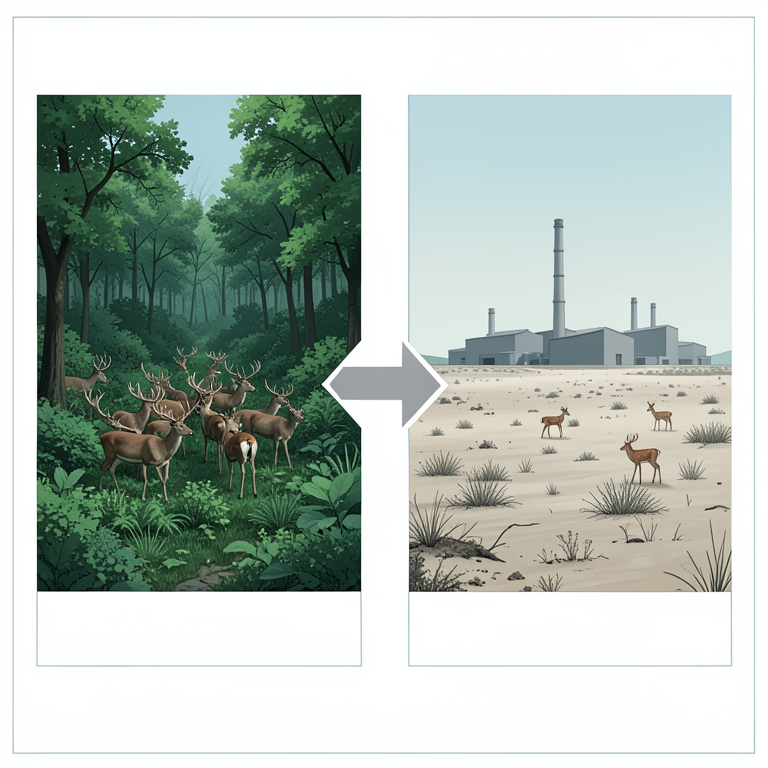
Industrialization vs. Population and Resource Equilibrium
AI-generated conceptual illustration (a forest ecosystem with deer and vegetation). It explains the idea and does not show study data.
View source evidence ↗Introduction
There exists a situation where resource dependent population is affected when its resource is depleted by industrialization. This type of industrialization may be augmented by human actions (precursors). The effects of human activities and patterns of resource use on the structure and composition of resource have been studiedby many investigators, Bormann and Likens (1979), Padoch and Vayda (1983) [11] , Hammond (1990), Brown (1992), Garcia -Montiel and Scatena (1994) [4] , Woodwell (1970) [18] , McLaughlin (1985) [10] , Hari et al. (1986), Woodman and Cowling (1987) [19] , Schulze (1989) [13] . Shukla et al. proposed and analyzed a mathematical model to study the effect of industrialization / population on resource depletion showing that the resource may be doomed to extinction if the rate of industrialization / population increase without control. The effect of changing habitats on survival of species has also been investigated, Shukla et al. (1996) [14] . Shukla and Dubey (1996) [14] have also studied the detrimental effects of industrialization and population on forestry resources. two toxicants on a biological species by using the same assumptions (see also Shukla and Dubey (1997)) [15] . Shukla et al. (2001) have further studied effect of a toxicant on the existence and survival of two competing species in a polluted environment. In this paper a model has been proposed and analyzed for the survival of a resource dependent population (such as human beings) whose resource biomass is depleted by industrialization, the density of which is augmented by a precursor of the population. Shukla et al. (2004) have also the model on survival of resource dependent species when resource is depleted by precursor augmented industrialization. Generally the biological species is affected by toxicants through different pathways including uptake of toxicants from the environment or through food chains. In the case of less toxic substances, when the biological species is exposed to them for longer durations, these are uptaken by the species, the toxicant in the uptake phase interacts with tissues of body organ through various physiological processes, which in turn makes the species diseased. Such situations arise when the dusts of various substances enter into the human lung, Holma (1985), Folinsbee (1989). In the modeling process, the following assumptions are made: (1) The density of biological species and resource biomass is assumed to be governed by a generalized logistic equation with variable intrinsic growth rate and carrying capacity.
(2) The industrialization decreases the carrying capacity of the resource density in the habitat.
Mathematical Model
We consider a biological population growing logistically in its habitat, which is affected by the growth of industrialization, by the human population. It is assumed that the rate of increase of the industrial factor is proportional to the density of the population producing it. Keeping in view the considerations and assumptions as mentioned above the problem is assumed to be governed by the following differential equations.
is the density of biological species with growth rate r and carrying capacity
is the density of resource biomass density with growth rate s and carrying capacity L , t I is the density of industrialization produced by the population.
1
is the growth rate of N and 2
is the depletion rate of B , the constant is the growth rate coefficient of industrialization formed by population and is the natural depletion rate coefficient of industrialization. The coefficient
s is the depletion rate coefficient of the biomass by industrialization and 2 s is the coefficient causing biomass depletion due to crowding of industrial activity. In our model (1) the coefficient r and s represent the intrinsic growth rate constants of the consumer species and the resource species respectively. The constants K and L denote the carrying capacities of population and the resource respectively. Also, it can be seen that if industrialization is caused only by the population species then also the model is meaningful.
Equilibrium analysis
The given model (1) has two non-negative equilibria in
Stability analysis (i) Local stability
By calculating Jacobian matrix it can be checked that 0 E is a saddle point with unstable manifold locally in N direction and stable manifold locally in
E is a saddle point with unstable manifold locally in B direction and stable manifold locally in
The stability behavior of * E is not obvious from the corresponding Jacobian matrix, therefore, by using Liapunov's method, in the following theorem we have found sufficient conditions for * E to be locally asymptotically stable.
To study the local stability of * E , we consider the following positive definite function,
On substituting the values of n , b and i and we get.
Choosing the values of the as
For to be V negative definite the following conditions must be satisfied,
Where, Proof: From the model we have,
Theorem : In addition to the above assumptions that growth rate r and s and the carrying capacity are assumed to be constant. Let the functions s and L satisfy in A . Then if the following conditions hold
Substituting from the above equations and doing manipulations,
Choosing the values of the as
For W to be negative definite the following conditions must be satisfied, Which is same as done in above theorem.
Conclusion
In this paper, a nonlinear mathematical model has been proposed and analyzed to study the effect of growing industrialization by the human population and its impact on resource species. Although it affects both the species directly and indirectly yet in this paper on effect on resource biomass is being considered. The existence of nontrivial equilibrium has been proved and its stability behavior has analyzed. It is noted that the population settles down to a equilibrium level, which is lower than its carrying capacity. Also the equilibrium level of resource biomass reduces as the industrialization increases. The results discussed here are more general than Shukla et al. (2005). It is noted that for large increase in industrialization, the toxicant and other wastage are induced in the environment, the possibility of extinction of the species does exist in the long run.
References
16 in the original paper- JK DeLuna, TG Hallam. Effect of toxicants on population: a qualitative approach IV. Resource-consumer-toxicant models. Ecol, Modelling. 1987; 35:249-273.
- HI Freedman, JB Shukla. Models for the effect of toxicant in single species and predator-prey systems. J Math. Biol. 1991; 30:15-30.
- HI Freedman, JWH. So, Global stability and persistence of simple food chains Math. Biosciences. 1985; 76:69-86.
- DC Garcia-Montiel, FN Scatena. The effect of human activity on the structure and composition of a tropical forest in Puerto Rico. Forest Ecol. Management. 1994; 63:57-78.
- TG Hallam, CE Clark. Nonautonomous logistic equation as models of population in a deteriorating environment. J. Theor. Biol. 1982; 93:303-311.
- TG Hallam, JT De Luna. Effects of toxicants on population: A qualitative approach III. Environmental and food chain pathways, J Theor. Biol. 1982; 109:411-429.
- J LaSalle, S Lefschetz. Stability by Liapunov's Direct Method with Applications, Academic Press, New York, London, 1961.
- SB McLaughlin. Effects of air pollution on forests, J of Air Pollut. Control Assoc. 1985; 35:512-534.
- C Padoch, AP Vayada. Pattern of resource use and human settlement in tropical forest. In: Golley F.B. (ed), Tropical Rain Forest Ecosystems, Elsevier, New York, 1983, 301-313.
- SA Patin. Pollution and the biological resource of the ocean, Butterworth Scientific, London, 1982.
- ED Schulze. Air pollution and forest decline in a Spruce (Picaabies) forest, Science. 1989; 224:776-783.
- A Shukla, JB Shukla, B Dubey. Effect of Environmentally degraded soil on crop yeild: the role of conservation. Ecological Modelling. 1996; 86:235-240.
- JB Shukla, HI Freedman, VN Pal, OP Misra, M Agarwal, A Shukla. Degradation and subsequent regeneration of a forestry resource: A mathematical model. Ecol. Model. 1989; 44:219-229.
- PDN Srinivasu. Control of environmental pollution to conserve a population, Non Linear Analysis, RWA. 2002; 3:397-411.
- GM Woodwell. Effects of pollution on the structure and physiology of ecosystems, Science. 1970; 168:429-431.
- JN Woodman, EB Cowling. Airborne chemicals and forest health, Environ. Sci. Technol. 1987; 21:120-126.
Cited by 1
From OpenAlex, OpenCitations and reference lists read by Scinovex
- Exploring the concepts of decent work through the lens of SDG 8: addressing challenges and inadequacies ↗
Bianca Ifeoma Chigbu, Fhulu Nekhwevha · Frontiers in Sociology · 2023
Promoting decent work and sustainable economic growth within the framework of Sustainable Development Goal 8 (SDG 8) entails addressing gender inequality, the consequences of market economies, and the role of the informal sector while also considering environmental sustainability. Research on SDG 8 remains limited, often adopting an appraisal perspective, and the concept of decent work within this goal remains relatively…
❝ 65PDF